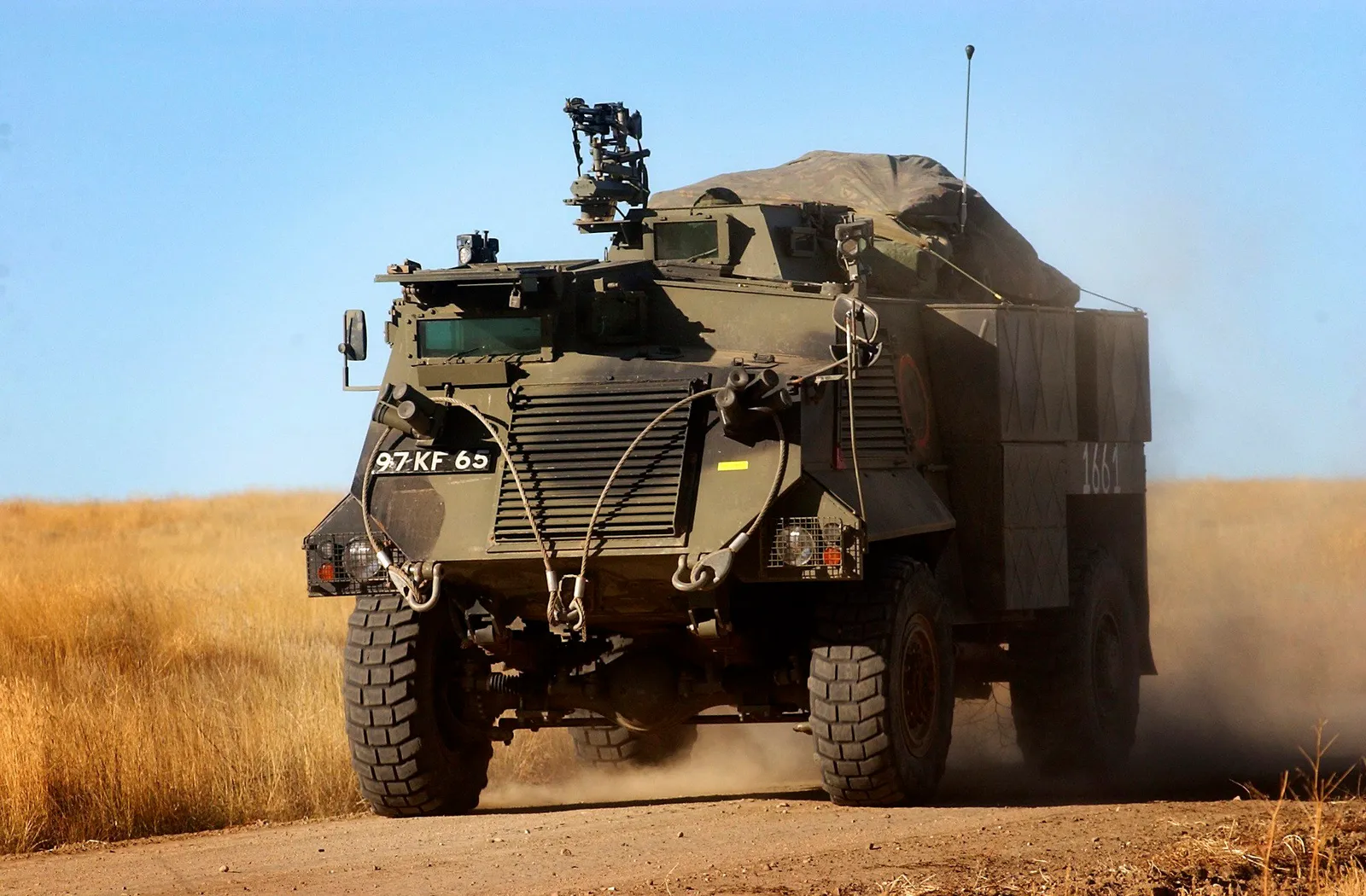
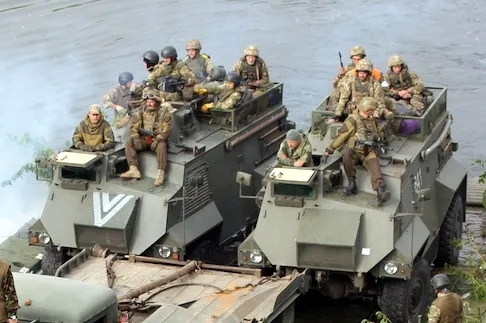
SIPRI records a 2014 UK-to-Ukraine order for 75 second-hand AT-105 Saxon APCs, all delivered in 2015; Ukrainian and defense reporting documents conversion and service as protected-mobility, command-staff, armed, and medical-evacuation vehicles with Ukrainian units in the war.
Role detailsSaxon
- AT105 Saxon
- AT-105 Saxon
- AT 105 Saxon
- GKN AT105
- GKN AT-105
- Saxon APC
Saxon is a British 4x4 armored personnel carrier developed by GKN Sankey/GKN Defence on a Bedford truck base as a low-cost protected-mobility vehicle. Ukraine brought 75 second-hand AT-105 Saxons into service in 2015 through a licensed commercial export, then adapted them during the 2014 Russia-Ukraine War as troop carriers, command vehicles, armed conversions, and medical-evacuation vehicles.
Role in Conflicts
Design And Ukrainian Adaptation
Saxon was built for protected movement rather than close combat. Its welded-steel body, V-shaped chassis protection, road speed, and simple truck-derived running gear made it attractive as an interim Ukrainian mobility vehicle, while UK reporting and parliamentary material framed the 2015 deliveries as unarmed commercial exports rather than close-combat aid.
Modified Bedford 4x4 truck chassis with welded-steel armored body and automotive components kept inside the armored compartment where practical.
Protected troop movement against small arms and shell splinters, not a front-line infantry fighting vehicle.
Reported Ukrainian conversions included communications equipment, DShKM and PK machine-gun mounts, MEDEVAC layouts, and command-staff vehicles.
Sources: Airborne Assault Museum AT105 Saxon; Forecast International Saxon Report; UK Arms Export Controls Saxon Ukraine; The Independent Saxon Ukraine Delivery; Defence24 Saxon Vehicles In Ukraine; Armourers Bench Saxon APCs In Ukraine.
Profile / Specs
Profile
- Origin
- United Kingdom
- Built by
- GKN Sankey
- Type
- 4x4 armored personnel carrier
- Service note
- British service from the 1980s; Ukrainian service documented from 2015 during the 2014 Russia-Ukraine War
- Designer
- GKN Sankey
- Designed
- 1975-1976
- Produced
- 1980s-1990s
- Number built
- 577 entered British Army service; Forecast International reported 1,054 Saxon vehicles manufactured by January 1, 2003, including export and later production.
Specifications
- Crew and capacity
- Driver and commander plus 8 to 10 troops depending on internal layout
- Combat weight
- About 11,660 kg combat loaded; museum listing gives 10.6 tonnes
- Dimensions
- 5.17 m long, 2.49 m wide, about 2.63 m high
- Engine
- Cummins 6BT 5.91-litre turbo-diesel in upgraded vehicles; earlier vehicles used a Bedford 500 diesel
- Transmission
- Allison AT-545 automatic gearbox with four forward ratios and one reverse, plus a two-speed transfer case
- Speed
- 96 km/h maximum road speed
- Range
- 480-510 km, depending on source and configuration
- Fuel capacity
- 153 litres
- Fording
- About 1.12 m in Forecast International's 2003 technical data
- Armament
- Typically a pintle-mounted 7.62 mm GPMG; Ukrainian conversions included DShKM and PK-pattern machine guns
- Protection
- Welded steel hull with small-arms and shell-splinter protection and a V-shaped chassis/floor approach for mine-blast deflection
Variants
Public sources describe the Saxon family around the Mark 1 and Mark 2 APC configurations, internal-security and patrol versions, recovery and incident-control conversions, command and ambulance layouts, and Ukrainian wartime adaptations.
| Variant | Configuration | Designation notes |
|---|---|---|
| Saxon Mark 1 | Original APC configuration | Forecast International identifies Mark 1 as the original Saxon configuration before the Bosnia-era turret retrofit. Sources: Forecast International Saxon Report |
| Saxon Mark 2 | FV432-turret retrofit | Forecast International describes a 1994 retrofit that added FV432 7.62 mm GPMG turrets to reduce commander exposure, with the modified vehicles referred to as Mark 2. Sources: Forecast International Saxon Report |
| Basic APC | 2+8 to 2+10 protected troop carrier | The baseline Saxon carried a driver, commander, and eight to ten troops depending on internal layout, with welded-steel protection and a typical 7.62 mm GPMG mount. Sources: Forecast International Saxon Report, Think Defence Saxon History, Airborne Assault Museum AT105 Saxon |
| Command vehicle | Command-staff conversion | Think Defence lists command as a Saxon variant, and Defence24 reported that 35 Ukrainian vehicles from the second 2015 batch were to be customized as command-staff vehicles. Sources: Think Defence Saxon History, Defence24 Saxon Vehicles In Ukraine |
| Ambulance / MEDEVAC | Medical evacuation conversion | Think Defence lists ambulance as a Saxon variant, while Defence24 reported that 20 vehicles from Ukraine's second 2015 batch were to be tailored for medical evacuation. Sources: Forecast International Saxon Report, Think Defence Saxon History, Defence24 Saxon Vehicles In Ukraine |
| Recovery vehicle | Vehicle recovery conversion | Forecast International describes a recovery version with a five-tonne winch and associated recovery equipment. Sources: Forecast International Saxon Report |
| Incident control vehicle | Internal-security and control conversion | Forecast International lists an incident-control version with low-light surveillance, mesh window protection, smoke launchers, and a front dozer blade. Sources: Forecast International Saxon Report |
| Ukrainian armed conversion | DShKM and PK machine-gun fit | Ukrainian wartime conversions added communications and weapons; reporting describes a 12.7 mm DShKM heavy machine gun with two 7.62 mm PK-pattern machine guns on some vehicles. Sources: Think Defence Saxon History, Defence24 Saxon Vehicles In Ukraine, Armourers Bench Saxon APCs In Ukraine |
Timeline
Saxon Key Events
AT105 private-venture development begins
Think Defence traces the AT105 Saxon back to GKN Sankey private-venture work that followed the AT100 and AT104 vehicle projects.
Sources: Think Defence Saxon History
British order gives the vehicle the Saxon name
Think Defence says the AT105 was renamed Saxon when the British Ministry of Defence placed an initial order in 1983, while Hansard recorded production orders for the first Saxon wheeled APCs from GKN Sankey.
Sources: Think Defence Saxon History, Hansard 1983 Army Debate
Cummins-engine upgrade introduced
Think Defence describes a 1990 upgrade program that replaced the original Bedford 500 diesel with a Cummins 6BT 5.91-litre turbo-diesel engine.
Sources: Think Defence Saxon History
Mark 2 turret retrofit follows Bosnia operations
Forecast International says Saxons were retrofitted in 1994 with FV432 7.62 mm GPMG turrets after British Army operations in Bosnia-Herzegovina, creating the Mark 2 configuration.
Sources: Forecast International Saxon Report
UK export licences approved for Ukraine
UK parliamentary material records two export licences for 75 Saxon APCs to Ukraine, with the sale treated as a licensed commercial export rather than a UK government gift.
Sources: UK Arms Export Controls Saxon Ukraine, The Independent Saxon Ukraine Delivery
Ukraine prepares Saxons for service
UNIAN reported that Ukrainian officials expected the purchased Saxons to undergo conversion and testing before entering service with military units.
Sources: UNIAN Saxon Delivery Report
Second Ukrainian batch arrives
Defence24 and Think Defence report that the second 55-vehicle batch reached Ukraine in June 2015, with command-staff and medical-evacuation conversions planned.
Sources: Defence24 Saxon Vehicles In Ukraine, Think Defence Saxon History
Saxons documented during the full-scale invasion
The Armourers Bench documented Ukrainian Saxon sightings, captures, and losses during Russia's full-scale invasion, with many sightings involving ambulance vehicles.
Sources: Armourers Bench Saxon APCs In Ukraine
Media
Saxon Videos
Saxon Images
Related Weapon Systems