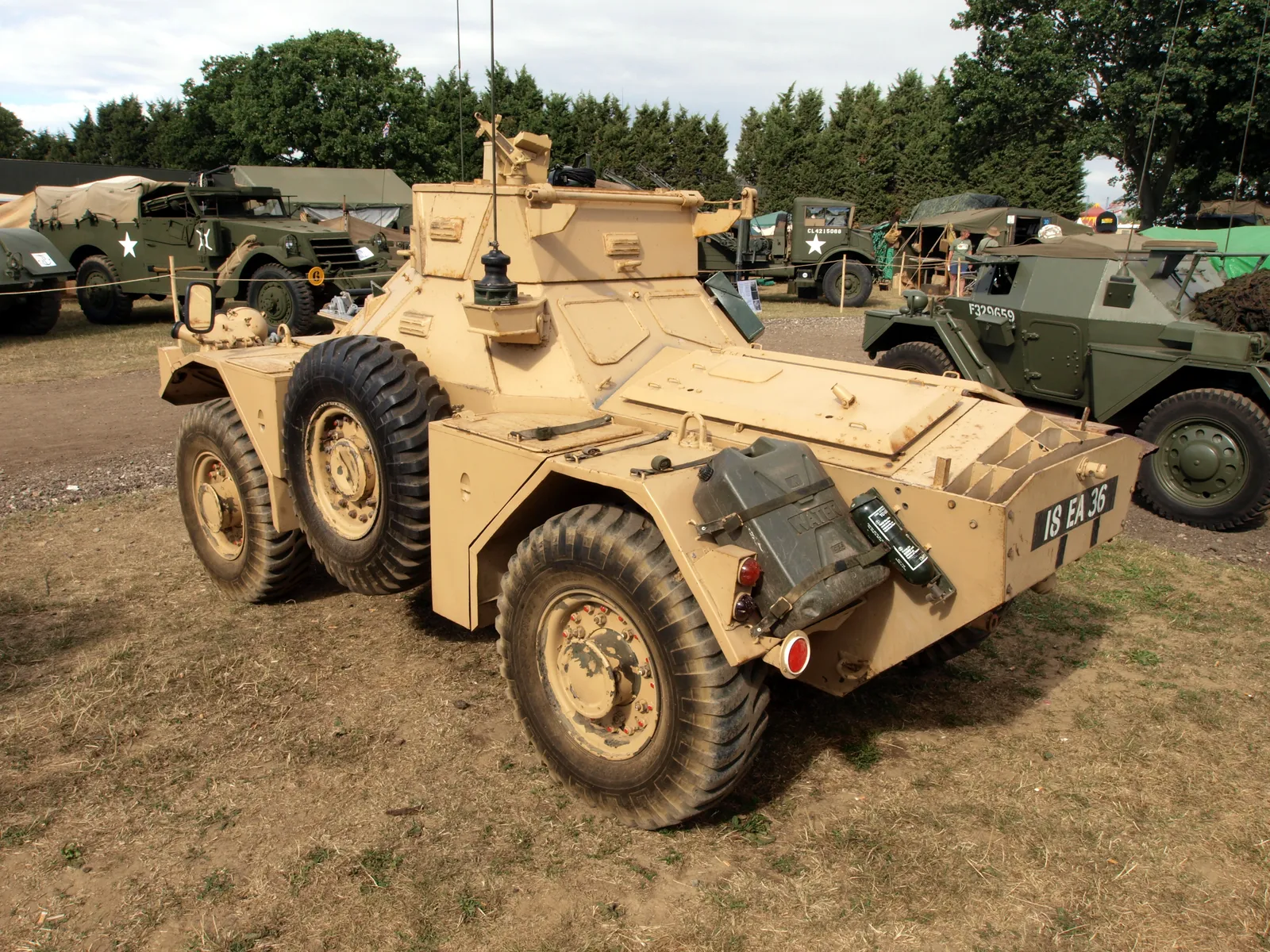
Ukrainian forces were documented with Ferret Mk 1 scout cars from 2022, and 2025 footage from the Nadiia operation showed a modified Ferret used by the 1st Assault Battalion of the 3rd Separate Assault Brigade with protective grilles and electronic-warfare equipment.
Role detailsDaimler Ferret armoured car
- Ferret Scout Car
- Ferret Armoured Car
- Ferret Armored Car
- Daimler Ferret Scout Car
- Daimler Ferret
- FV701 Ferret
- FV701C
- Car Scout 4x4 Ferret
- Ferret Mk 1
- Ferret Mk 2
- Ferret Mk 2/6
- Ferret Mk 5
- Ferret Swingfire
The Daimler Ferret is a compact British 4x4 armored reconnaissance car built for liaison, scouting, patrol, and internal-security work. Daimler produced the type from the 1950s into the early 1970s, and its small hull, machine-gun armament, smoke dischargers, and high road speed made it a durable export vehicle after British service. Sri Lanka Army history places Ferret scout cars in its reconnaissance fleet before civil-war armor deployments, while Ukrainian Mk 1 vehicles have appeared as improvised light reconnaissance and force-protection platforms, including a modified example with anti-drone grilles and electronic-warfare equipment during the 2025 Nadiia operation.
Role in Conflicts
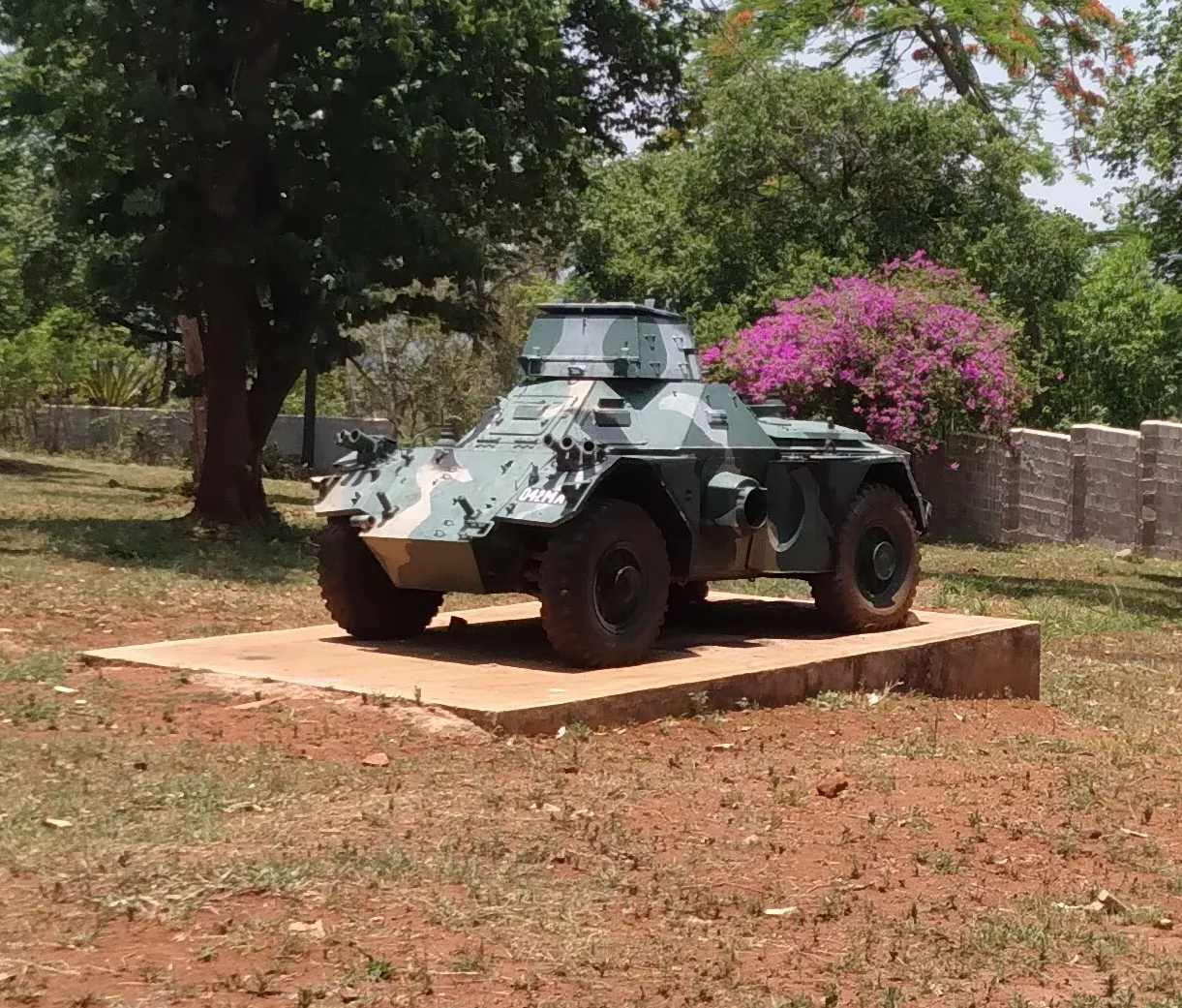
Sri Lanka Army history records Ferret scout cars in the 1st Reconnaissance Regiment inventory and places the regiment's armor deployments in northern and eastern Sri Lanka during the civil war, including counter-LTTE deployments from 1990 before older British armored vehicles were phased out.
Profile / Specs
Profile
- Origin
- United Kingdom
- Built by
- Daimler Company
- Type
- 4x4 armored reconnaissance car
- Service note
- Cold War design documented in Sri Lankan service and Ukrainian service during later conflicts
- Designer
- Daimler Company
- Designed
- Late 1940s
- Produced
- 1952-1972
- Number built
- More than 4,400 vehicles
Specifications
- Crew
- Typically 2 in common scout/reconnaissance marks
- Armament
- 7.62 mm L4A4 Bren, 7.62 mm GPMG, or .30 Browning M1919 by mark; six smoke grenade dischargers
- Dimensions
- 3.835 m length; 1.905 m width; 1.879 m turret-roof height for Mk 1/2
- Weight
- About 3.7 tonnes unladen for liaison versions; about 4.4 tonnes laden for reconnaissance versions
- Engine
- Rolls-Royce B60 inline-six petrol engine, 4.256 L, 129 bhp gross at 3,750 rpm
- Mobility
- Up to 93 km/h road speed and about 306 km road range for Mk 1/2 versions
- Protection
- 8-16 mm welded steel armor, with applique armor on selected later variants
Compact Scout Design
The Ferret was a reconnaissance car rather than an infantry carrier or tank substitute. Its value came from a small 4x4 hull, two-person crew in common marks, high road speed, run-flat tyres, smoke dischargers, and light machine-gun armament that suited liaison, patrol, route security, and observation tasks.
Driver forward, fighting compartment in the center, and engine/transmission at the rear.
Welded steel armor in the small-arms and fragmentation class, with later up-armored marks adding thicker plates or applique armor.
The handbook describes a three-barrel smoke grenade discharger on each front mudguard, electrically fired from inside the vehicle.
A 2025 example was reported with anti-drone grilles and electronic-warfare equipment, showing improvised adaptation of a Cold War scout car to a drone-saturated battlefield.
Sources: Scout Car Ferret User Handbook 1969; Think Defence Ferret Armoured Car; TWZ Ferret In Ukraine; Defense Express Nadiia Ferret.
Variants
Ferret marks used FV designations for open-top liaison cars, turreted reconnaissance vehicles, up-armored rebuilds, flotation-screen variants, and missile-armed anti-tank versions.
| Variant | Configuration | Designation notes |
|---|---|---|
| Ferret Mk 1 / Mk 1/1 | Open-top liaison/scout car | The handbook lists Mk 1 as the original liaison vehicle with .30 Browning armament and Mk 1/1 as the thicker side-and-rear-hull-plate production form. Ferret-owner reference material maps them to FV701(C) and FV701(J). Ukrainian examples reported in 2022 and 2025 were identified as Mk 1 vehicles. Sources: Defense Express Ferrets In Ukraine, Defense Express Nadiia Ferret, Scout Car Ferret User Handbook 1969, Daimler Ferret Marks |
| Ferret Mk 1/2 | Fixed-roof light reconnaissance car | The handbook describes the Mk 1/2 as a Mk 1/1 fitted with a fixed turret and hinged roof door for the light reconnaissance role, armed with a Bren LMG; the Ferret marks reference maps this version to FV704. Sources: Scout Car Ferret User Handbook 1969, Daimler Ferret Marks |
| Ferret Mk 2 / Mk 2/3 | Turreted reconnaissance car | The handbook lists Mk 2 as the original two-door-turret reconnaissance vehicle and Mk 2/3 as the thicker-plate production version. The Ferret marks reference maps Mk 2 to FV701(E) and Mk 2/3 to FV701(H). Sources: Scout Car Ferret User Handbook 1969, Daimler Ferret Marks, TWZ Ferret In Ukraine |
| Ferret Mk 2/6 | Vigilant anti-tank missile carrier | The handbook describes the Mk 2/6 as a Mk 2/3 converted as a Vigilant missile launcher with .30 Browning armament. The Ferret marks reference identifies the FV703 designation and side-mounted Vigilant launcher boxes. Sources: Scout Car Ferret User Handbook 1969, Daimler Ferret Marks |
| Ferret Mk 4 | Big-wheeled reconnaissance rebuild | The handbook lists Mk 4 as a two-door-turret reconnaissance vehicle, or Mk 2/3 rebuilt to a new specification. The Ferret marks reference maps it to FV711 and notes stronger suspension, larger wheels, disc brakes, and flotation-screen equipment. Sources: Scout Car Ferret User Handbook 1969, Daimler Ferret Marks |
| Ferret Mk 5 | Swingfire anti-tank variant | The handbook lists Mk 5 as a Mk 3-hull vehicle with a missile-launching turret and 7.62 mm GPMG. Airborne Assault Museum identifies the Mk 5 Ferret as the Swingfire wire-guided anti-tank missile version, and the Ferret marks reference maps it to FV712. Sources: Scout Car Ferret User Handbook 1969, Airborne Assault Ferret, Daimler Ferret Marks |
Timeline
Daimler Ferret armoured car Key Events
War Office scout-car requirement
The Tank Museum's Ferret guide announcement traces the design story to a 1947 War Office policy statement for a new armored scout car after the Daimler Dingo era.
Sources: Tank Museum Ferret Guide
Daimler receives development contract
Think Defence describes Daimler receiving an October 1948 development contract under the FV701 Fighting Vehicle designation for a compact 4x4 scout car.
Sources: Think Defence Ferret Armoured Car
First FV701(C) prototype completed
Think Defence places completion of the initial FV701(C) prototype in June 1950 before acceptance into service and production.
Sources: Think Defence Ferret Armoured Car
Production and British service period begins
Museum and specialist sources place Ferret production and service entry in the early 1950s, with Daimler building the reconnaissance car for British and export users.
Sources: Airborne Assault Ferret, Tank Museum December YouTube, Tank Museum Ferret Guide
Production era closes
The Tank Museum describes the Ferret as built by Daimler between 1952 and 1972, while other sources place the main production close around 1971.
Sources: Tank Museum December YouTube, TWZ Ferret In Ukraine
Ferret appears in Ukraine
TWZ reported that at least one British-made Daimler Ferret scout car was in Ukraine, apparently supplied through a privately funded initiative, with more reportedly present or en route.
Sources: TWZ Ferret In Ukraine
Modified Mk 1 seen in Nadiia operation
Defense Express reported that a Ferret Mk 1 was seen with the 1st Assault Battalion of Ukraine's 3rd Separate Assault Brigade during the liberation of Nadiia in Luhansk region.
Sources: Defense Express Nadiia Ferret
Media
Daimler Ferret armoured car Videos
Daimler Ferret armoured car Images
Related Weapon Systems