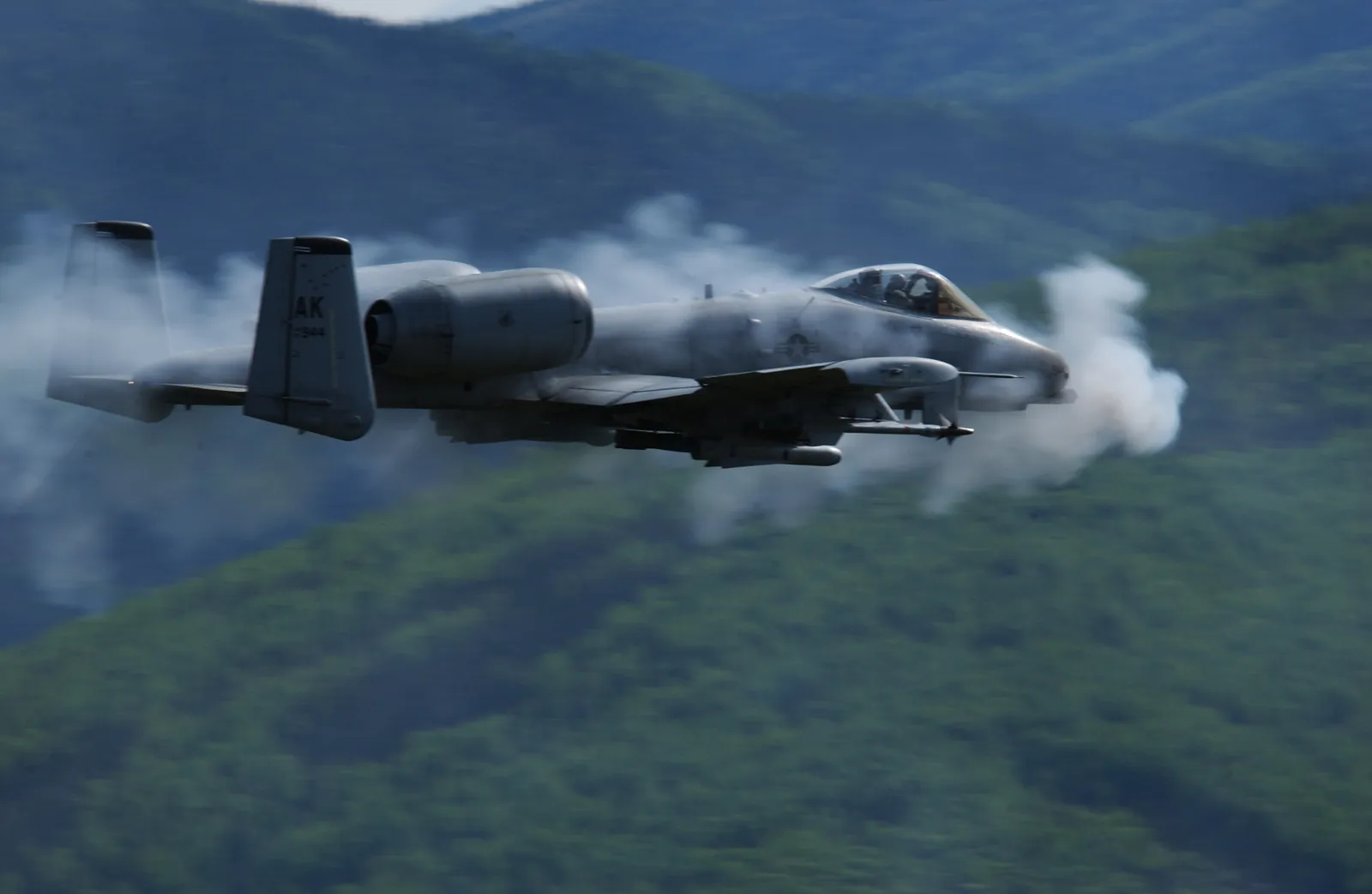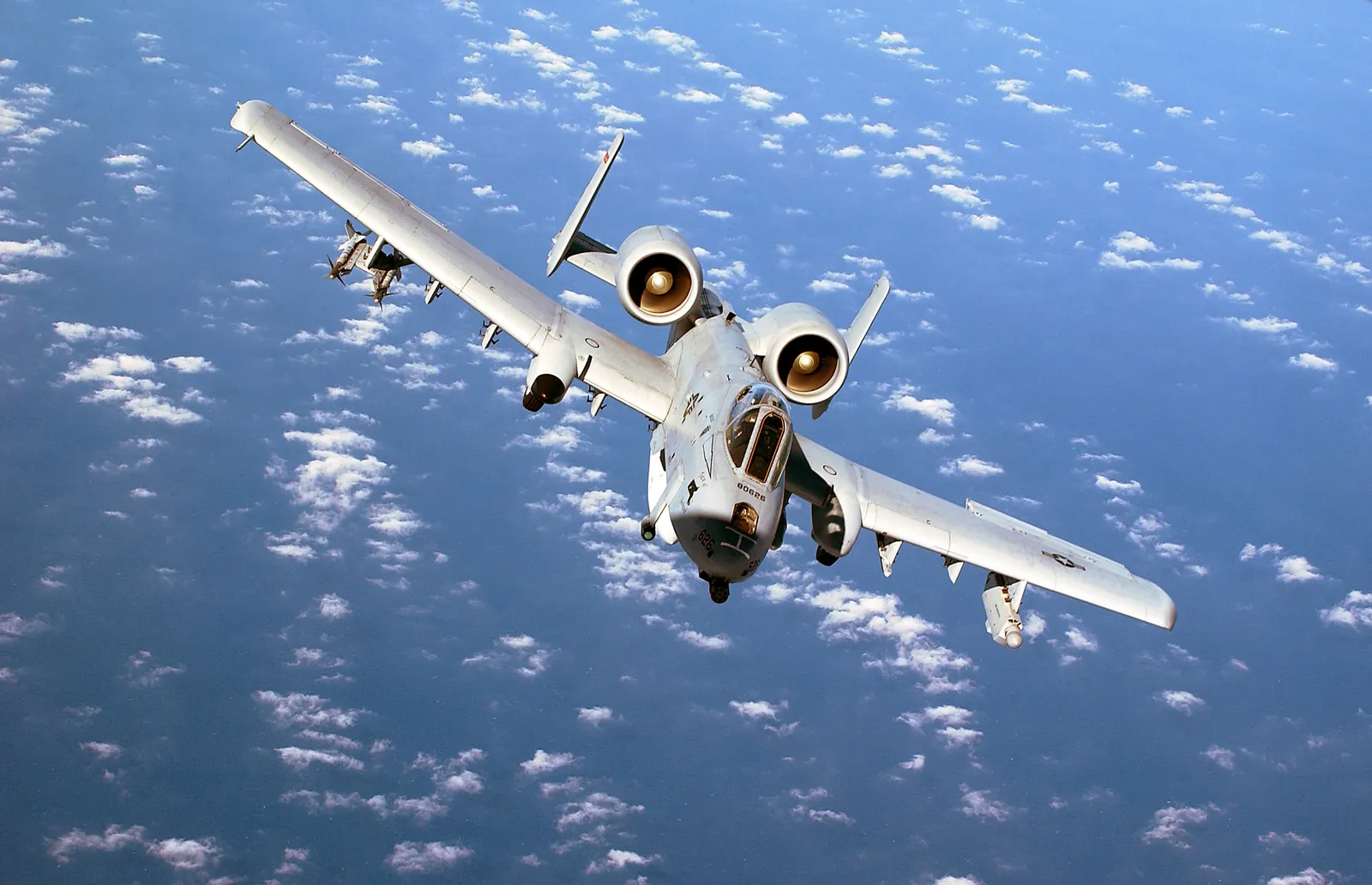
- Side
- Coalition forces

U.S. Air Force fact-sheet data credits A-10s in Operation Desert Storm with 8,100 sorties and 90 percent of the AGM-65 Maverick missiles launched in the campaign.
Role detailsThe A-10 Thunderbolt II is a U.S. single-seat, twin-engine attack aircraft built around close air support, austere operations, survivability, and the 30 mm GAU-8/A cannon. Official U.S. military sources document A-10 use from the 1990 Gulf War through Iraq, Afghanistan, Libya, Operation Inherent Resolve, and later U.S. Central Command missions, while the A-10C modernization added digital cockpit, targeting, datalink, and precision-weapon capability to the original low-altitude support platform.
U.S. Air Force fact-sheet data credits A-10s in Operation Desert Storm with 8,100 sorties and 90 percent of the AGM-65 Maverick missiles launched in the campaign.
Role detailsAir Force historical reporting identifies A-10s among the major aircraft used in the 1999 NATO air war over Serbia and Kosovo, including support for combat search-and-rescue coverage.
U.S. Air Force reporting documents A-10 close-air-support missions during Operation Iraqi Freedom, including an April 7, 2003 mission over Baghdad that supported ground troops before the aircraft was hit by enemy fire.
Role detailsJoint Task Force Odyssey Dawn reporting says a U.S. Air Force A-10 engaged Libyan Coast Guard vessels after they fired on merchant vessels in Misrata on March 28, 2011.
A DVIDS caption documents an A-10 Thunderbolt II taking off for a U.S. Central Command mission during Operation Epic Fury on March 17, 2026.
U.S. Air Force A-10s flew Operation Inherent Resolve combat missions against ISIS from Incirlik in 2017, providing close-air and contact support with bombs, missiles, and the GAU-8/A cannon.
Role detailsA-10s returned to Kandahar Airfield in 2018 to support Operation Freedom's Sentinel with close-air-support and precision-strike capacity for U.S. and Afghan operations against Taliban revenue targets.
Role detailsThe A-10 was designed for low-altitude support near friendly troops rather than high-speed strike. Its layout combines long loiter, short-field operation, pilot protection, manual backup controls, and the GAU-8/A cannon into a platform built to stay near the battle area.
Wide combat radius, short takeoff and landing capability, and interchangeable parts support operation from bases with limited facilities near battle areas.
Titanium armor protects the pilot and parts of the flight-control system, while self-sealing fuel cells and manual backup controls improve chances of returning after damage.
The GAU-8/A 30 mm Gatling gun was developed for the A-X aircraft and became central to production A-10 armament.
The aircraft emphasizes maneuverability at low speeds and altitude so pilots can find, verify, and support ground-force targets.
A-10 family designations cover the original single-seat attack aircraft, forward-air-control use, the A-10C Precision Engagement modernization, and one two-seat night/adverse-weather prototype.
| Variant | Configuration | Designation notes |
|---|---|---|
| YA-10A | A-X close-air-support prototype | Two prototypes were built for the A-X program before Fairchild Republic's design was selected for production. Sources: Republic Night/Adverse Weather A-10 (YA-10B), A-1 Legacy and the A-X Program |
| A-10A | Original single-seat production attack aircraft | The National Museum source lists 707 production A-10A aircraft after the prototype and pre-production batches. |
| OA-10A | Airborne forward air control designation/use | The U.S. Air Force fact sheet lists airborne forward air control among A-10 primary functions. Sources: A-10C Thunderbolt II Fact Sheet |
| A-10C | Precision Engagement modernization | A/OA-10 aircraft modified with the Precision Engagement kit were designated A-10C and gained digital cockpit, targeting-pod, datalink, and precision-weapon upgrades. Sources: A-10 upgrade effort transforms Warthog capabilities, A-10s get digital makeover |
| YA-10B | Two-seat night/adverse-weather prototype | One pre-production A-10A was converted, tested in 1979, and later redesignated YA-10B; the program was canceled. |
Air Force reporting and fact sheets document the A-10 carrying and employing multiple air-to-surface and self-defense munitions, including Mavericks, Laser JDAMs, guided rockets, and Sidewinders.
| Carried item | Item type | Carriage evidence |
|---|---|---|
 | Laser-guided 2.75-inch rocket munition family | The Air Force article says the A-10 fired the fixed-wing APKWS II rocket, showing the aircraft can carry and employ the 2.75-inch guided rocket family. |
 | Air-to-surface guided missile | The AGM-65 Maverick fact sheet identifies the A-10 as one of the aircraft that carries Mavericks. Sources: AGM-65 Maverick Fact Sheet |
 | Laser-guided precision bomb | Air Force Materiel Command reporting says an A-10C made the first ever drop of a GBU-54 Laser Joint Direct Attack Munition from an A-10. |
 | Short-range air-to-air missile | The Air Force A-10C fact sheet lists AIM-9 Sidewinder missiles among the A-10C armament, and the 127th Wing fact sheet also lists Sidewinders in the A-10 loadout. Sources: A-10C Thunderbolt II Fact Sheet, Air Force A-10 Thunderbolt II |
The National Museum of the U.S. Air Force traces the A-X program to Air Force lessons from A-1 Skyraider search-and-rescue and close-air-support operations in Southeast Asia.
Sources: A-1 Legacy and the A-X Program
Fairchild Republic's YA-10A was selected over other A-X proposals as the production basis for the A-10.
Sources: A-1 Legacy and the A-X Program
The U.S. Air Force fact sheet says the first production A-10A was delivered to Davis-Monthan Air Force Base in October 1975.
Sources: A-10C Thunderbolt II Fact Sheet
The converted two-seat A-10 N/AW, later redesignated YA-10B, began flight testing at Edwards Air Force Base.
Sources: Republic Night/Adverse Weather A-10 (YA-10B)
The A-10C Precision Engagement upgrade added JDAM/WCMD compatibility, targeting pods, datalink, multifunction displays, and hands-on-throttle-and-stick controls.
Sources: A-10 upgrade effort transforms Warthog capabilities, A-10s get digital makeover
Hill Air Force Base reported completion of the Enhanced Wing Assembly program after 173 A-10s received replacement wings.
Sources: 173 to 173: A-10 Enhanced Wing Assembly replacement program comes to an end
The A-10C upgrade kept the basic attack-aircraft role but replaced much of the pilot workflow around weapons, targeting, and battlefield information.
| Configuration | Focus | Documented change |
|---|---|---|
| A-10A / OA-10A | Original attack and forward-air-control use | Single-seat close-air-support aircraft built around the GAU-8/A, heavy stores carriage, and survivable low-altitude operation. |
| A-10C | Precision Engagement | Digital displays, stores management, targeting pods, datalink, JDAM/WCMD employment, and improved hands-on controls. |
| Re-winged A-10C | Service-life sustainment | Enhanced Wing Assembly work replaced wings on 173 aircraft, with follow-on Boeing wing assembly contracts supporting continued service. |