Electronic Warfare

AN/TPQ-37 Firefinder radar

Also known as
  • AN/TPQ-37
  • TPQ-37
  • Q-37
  • AN/TPQ-37 Firefinder
  • AN/TPQ-37(V)
  • Firefinder artillery locating radar
  • Firefinder weapon locating radar

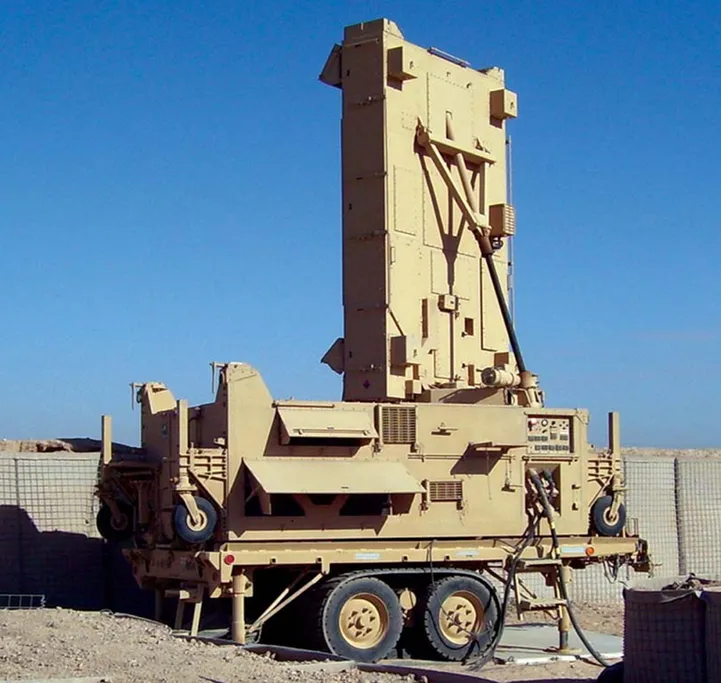
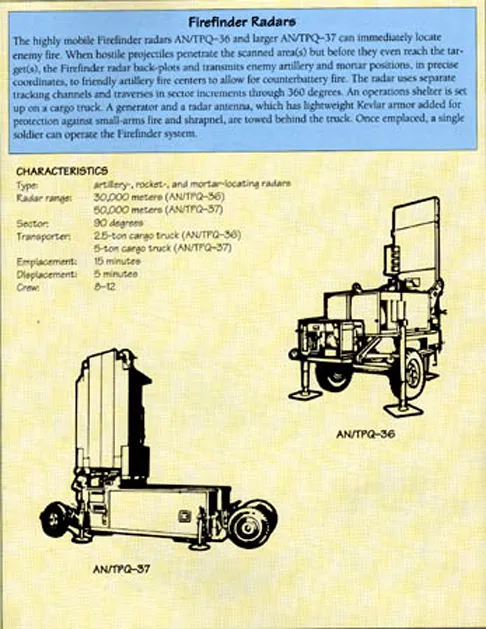
The AN/TPQ-37 Firefinder is a U.S. long-range weapon-locating radar built to detect artillery and rocket launches, compute firing points, and pass coordinates for counter-battery fire. Developed from the Army's Firefinder program and produced by Hughes Aircraft before later Raytheon/ThalesRaytheonSystems sustainment and upgrade work, the Q-37 complemented the shorter-range AN/TPQ-36, shaped Coalition counterbattery tactics in Desert Storm, and later appeared in Ukraine's partner-supplied artillery reconnaissance network.

Role in Conflicts

Ukraine Artillery Reconnaissance Network

Ukrainian artillery command reporting in 2025 described AN/TPQ-37 as one of several partner-supplied radars used in Ukraine's artillery reconnaissance network. In that context it appears beside the AN/TPQ-36, AN/TPQ-50, and Swedish ARTHUR systems rather than as a standalone fire unit.

Network role

Detect enemy artillery fire and feed coordinates for counterfire by Ukrainian artillery units.

Source boundary

Public Ukrainian-command reporting identifies operational use but does not give quantities, delivery batches, or assigned units for AN/TPQ-37.

Profile / Specs

Profile

Origin
United States
Type
Long-range counter-battery radar
Service note
U.S. Army development began in the 1970s; operational service and upgrades continued through later allied and foreign military use.
Designer
Hughes Aircraft Company
Designed
Army materiel-need approval and development contracting began in June 1972; competitive AN/TPQ-37 prototypes were tested in 1975.
Unit cost
Deagel lists a $25 million unitary cost; historical costs vary by configuration, support package, and upgrade state.
Produced
Low-rate contract award in 1976; full-scale production contract in 1981; U.S. Army production complete in 1986, with later upgrades and sustainment.

Specifications

Primary function
Mobile long-range phased-array artillery locating and counter-battery radar
Tracked threats
Artillery and rocket launchers; broader Firefinder-family sources also describe mortar tracking
Maximum detection range
Up to 50 km in open-source references, depending on target type and conditions
Howitzer location range
Deagel lists up to 30 km for howitzer locations
Rocket launcher location range
Deagel lists up to 50 km for rocket-launcher locations
Tracked targets
Up to 10 artillery, mortar, and rocket launcher sites reported in seconds in Deagel's reference
Scan sector
90-degree electronically steered radar curtain; special 60-degree extended-range sector for long-range surface-to-surface missile search in Deagel's reference
Power generation
MEP-115A 60 kW, 400 Hz generator set in FAS and GlobalSecurity descriptions
Crew
Twelve personnel for operations and maintenance in GlobalSecurity's system description
Mobility
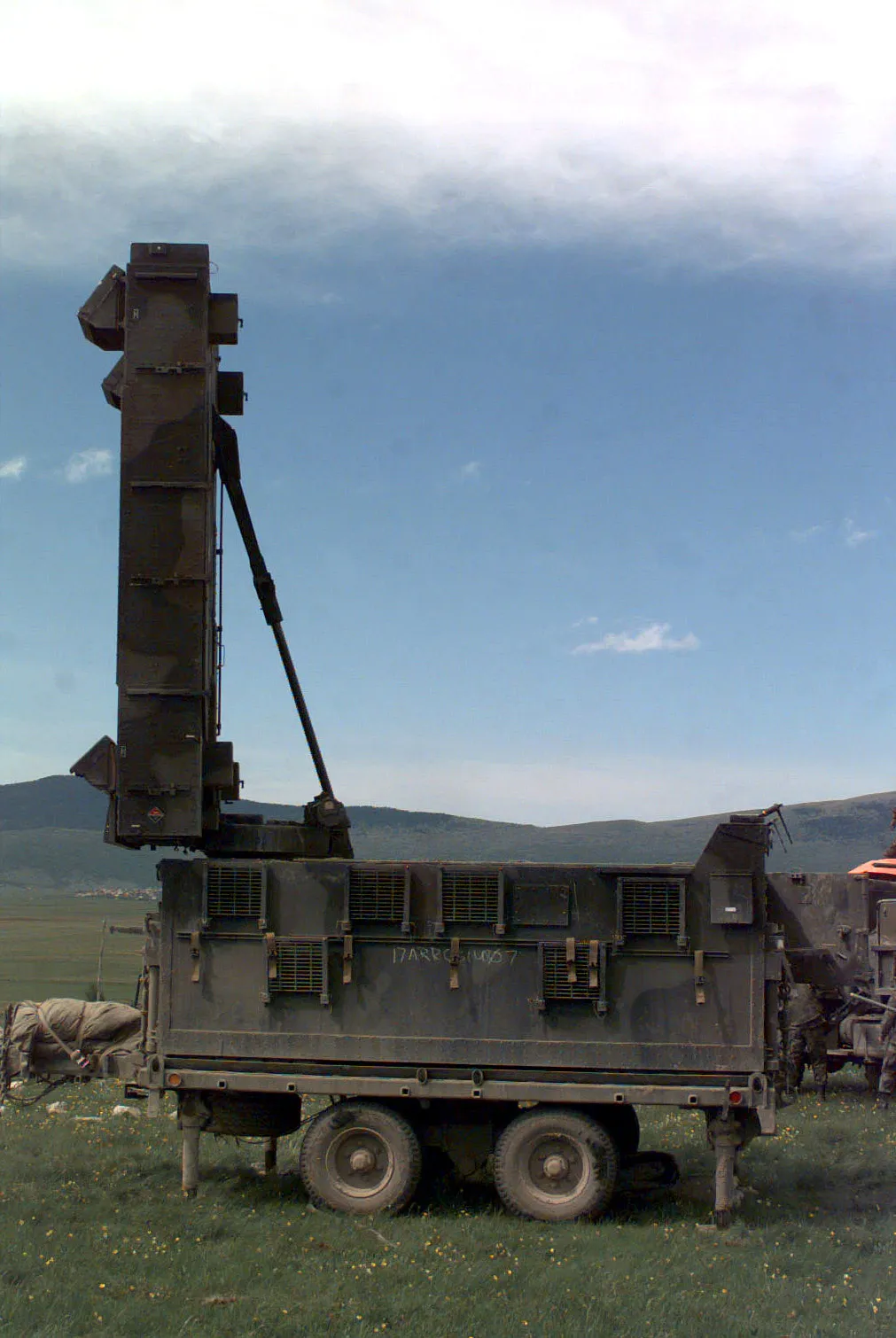
Antenna-transceiver group on an M1048 trailer with truck-mounted operations shelter and generator support; V8 added C-130 roll-on/roll-off mobility improvements
Firefinder Family Context

The Q-37 is the larger long-range member of the Firefinder weapon-locating radar family. It worked alongside the shorter-range AN/TPQ-36 Firefinder radar, while the later AN/TPQ-53 multimission radar became the Army's modern counterfire replacement path for aging Q-36 and Q-37 systems.

Primary target set

Enemy artillery and rocket launch points, with mortar detection in broader Firefinder-family references.

Scan geometry

Stationary electronically steered antenna scanning a 90-degree sector.

Combat lesson

Desert Storm validated long-range counterfire utility but drove later mobility and transportability upgrades.

Replacement path

Army history describes Q-53 fielding as the program-of-record replacement for legacy Q-36 and Q-37 Firefinder radars.

Variants

The AN/TPQ-37(V) designations identify configuration and upgrade states within the same long-range Firefinder radar family.

VariantConfigurationDesignation notes
AN/TPQ-37(V)6Desert Storm-era long-range configuration

FAS and GlobalSecurity describe the V6 as the long-range configuration used extensively during Operation Desert Storm, but note that it was difficult to move by air in anything smaller than a C-5.

Sources: FAS AN/TPQ-37 Firefinder, GlobalSecurity AN/TPQ-37

AN/TPQ-37(V)8Enhanced Firefinder Block I mobility upgrade

The V8 package added C-130 roll-on/roll-off mobility improvements, a medium tracked suspension system, HMMWV-mounted shelter changes, self-survey capability, memory updates, and cooling-system improvements.

Sources: FAS AN/TPQ-37 Firefinder, GlobalSecurity AN/TPQ-37

AN/TPQ-47Proposed successor derivative

Deagel describes the TPQ-47 as an advanced derivative intended to replace AN/TPQ-37 radars with longer range, reduced crew burden, and improved mobility.

Sources: Deagel AN/TPQ-37

Timeline

AN/TPQ-37 Firefinder radar Key Events

  1. Army Firefinder development lane opens

    FAS records June 1972 Army approval of the materiel need and development contracting path for the AN/TPQ-37 artillery locating radar.

    Sources: FAS AN/TPQ-37 Firefinder

  2. Competitive prototypes tested

    InfoAge's Firefinder history says Hughes and Sperry prototype AN/TPQ-37 radars were field-tested in 1975 before Hughes was selected for production.

    Sources: InfoAge Firefinder History

  3. Full-scale production contract

    FAS lists May 1981 as the full-scale production contract award date after low-rate contracting in 1976.

    Sources: FAS AN/TPQ-37 Firefinder

  4. Initial operational capability complete

    FAS records February 1983 initial operational capability completion in Europe for AN/TPQ-37.

    Sources: FAS AN/TPQ-37 Firefinder

  5. Desert Storm counterfire use

    InfoAge's Firefinder history states that 21 TPQ-37 radars deployed to the Middle East in support of VII and XVIII Corps during Desert Storm.

    Sources: InfoAge Firefinder History

  6. V8 fielding completed

    FAS says the V8 upgrade's fielding was completed by the third quarter of 1997 after adding mobility, self-survey, memory, and cooling improvements.

    Sources: FAS AN/TPQ-37 Firefinder

  7. Firefinder sustainment upgrade announced

    ThalesRaytheonSystems announced Firefinder upgrades for AN/TPQ-36 and AN/TPQ-37 radars, including a modular air-cooled transmitter package for TPQ-37.

    Sources: Raytheon Firefinder Upgrade Release

Media
Related Weapon Systems
AN/TPQ-53 multimission radar, Mobile multimission counterfire and air-surveillance radar, Electronic WarfareElectronic WarfareAN/TPQ-53 multimission radarMobile multimission counterfire and air-surveillance radarThe AN/TPQ-53, commonly called Q-53, is a Lockheed Martin mobile active electronically scanned array radar that began as the Army's counterfire replacement for AN/TPQ-36 and AN/TPQ-37 Firefinder radars. Its baseline mission is to detect, classify, track, and locate mortar, artillery, and rocket launches in 90-degree or 360-degree modes, while software and open-architecture upgrades have extended the same family into counter-UAS, air-surveillance, and wider multimission radar roles.
ARTHUR, Weapon locating / artillery locating radar, Electronic WarfareElectronic WarfareARTHURWeapon locating / artillery locating radarARTHUR is Saab's mobile weapon locating radar family for counter-battery work: it detects artillery, mortar, and rocket projectiles in flight, calculates firing and impact points, and feeds counter-fire or warning networks. UK defence sources documented MAMBA, the British ARTHUR designation, supporting operations in Iraq and Afghanistan, while Ukrainian artillery-reconnaissance troops were later documented operating British MAMBA/ARTHUR in 2022.
Naval Tactical Data System, Shipboard combat information and weapon-direction data system, Naval SystemsNaval SystemsNaval Tactical Data SystemShipboard combat information and weapon-direction data systemThe Naval Tactical Data System was a U.S. Navy real-time shipboard command-and-control system developed in the 1950s to automate tactical data processing for missile-era fleet air defense. Built around militarized UNIVAC unit computers, Hughes display equipment, and Collins digital communications links, NTDS fused radar, sonar, communications, and ship-to-ship data into a shared tactical picture for combat information centers and weapon-direction support. Direct conflict-use accounts place NTDS-equipped ships in Vietnam War PIRAZ air-defense control and in Gulf War coalition airspace coordination.
1RL239/1RL239M ARK-1/ARK-1M Rys counter-battery radar, Tracked artillery-locating counter-battery radar, Electronic WarfareElectronic Warfare1RL239/1RL239M ARK-1/ARK-1M Rys counter-battery radarTracked artillery-locating counter-battery radarThe 1RL239/1RL239M ARK-1/ARK-1M Rys is a Soviet tracked artillery-locating radar family on the MT-LBu chassis, built to detect mortar, artillery, rocket-artillery, and tactical-missile firing positions for counter-battery work. The baseline ARK-1 entered Soviet service as the 1RL239, while the ARK-1M modernization added independent power and updated command equipment before late-Soviet production ended.

Sources