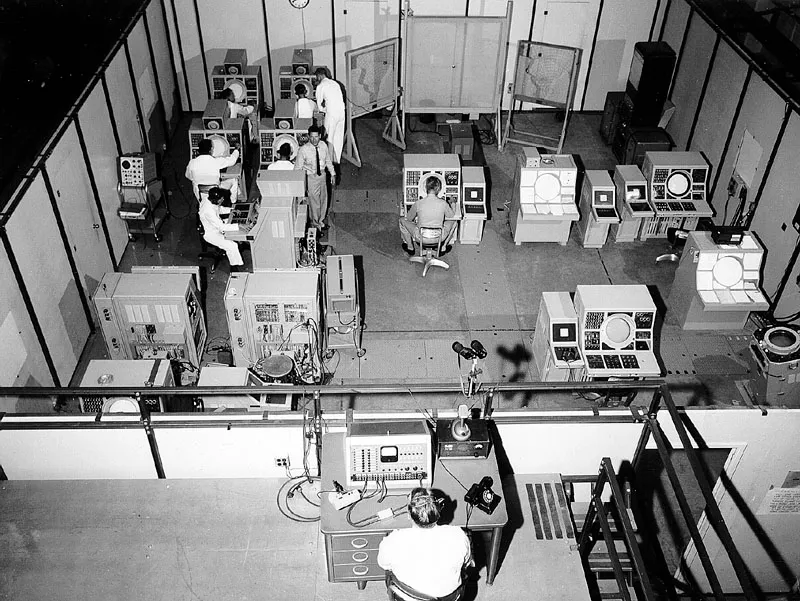
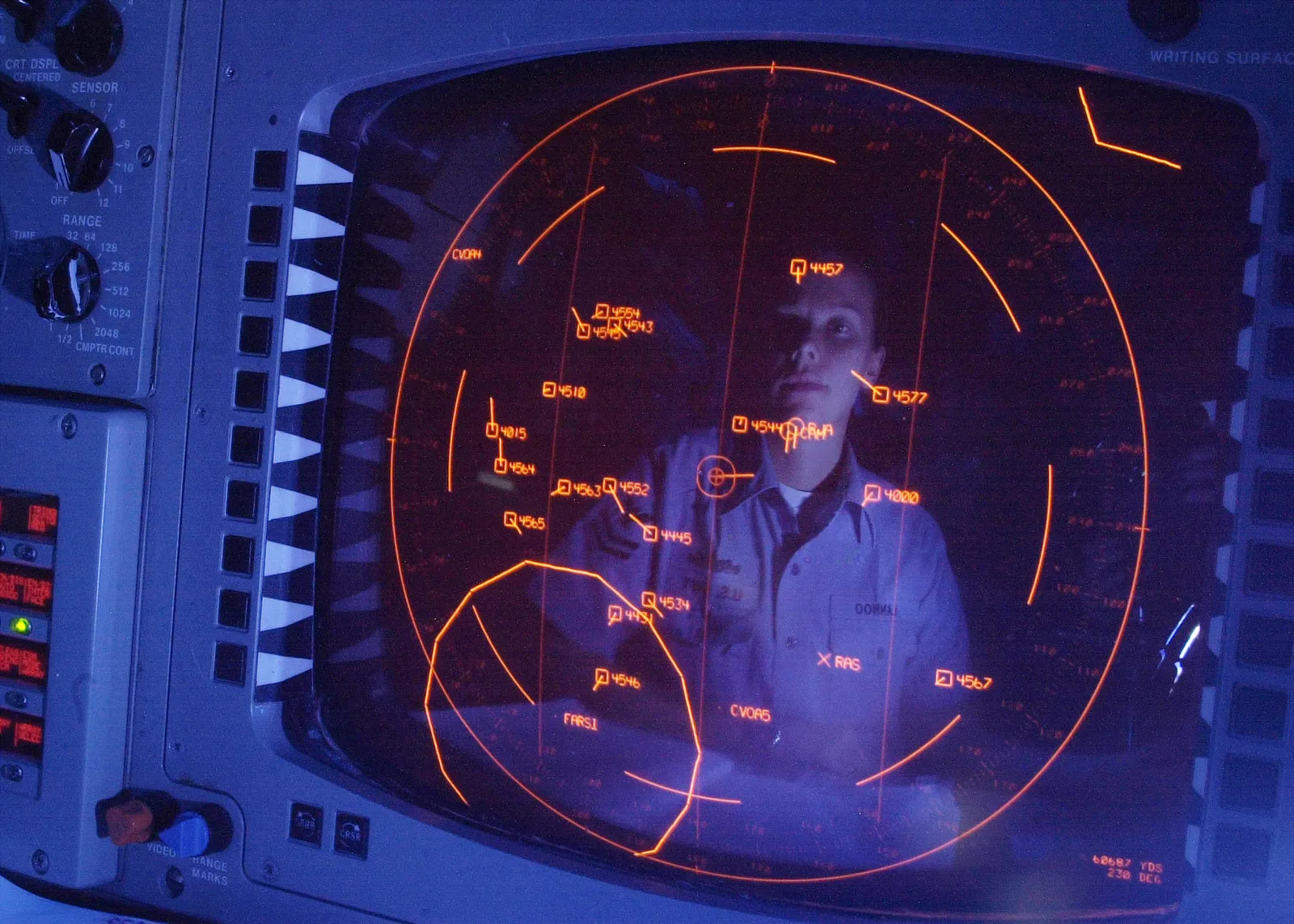
NTDS-equipped U.S. Navy ships carried the PIRAZ air-defense control mission in the Gulf of Tonkin, with NTDS supporting aircraft tracking, interceptor direction, rescue vectoring, and shipboard missile engagements.
Naval Tactical Data System
- NTDS
- AN/USQ-20
- AN/USQ-20(V)
- CP-642
- CP-642A
- CP-642B
- CP-642/USQ-20(V)
- UNIVAC CP-642
- UNIVAC 1206
- UNIVAC 1212
The Naval Tactical Data System was a U.S. Navy real-time shipboard command-and-control system developed in the 1950s to automate tactical data processing for missile-era fleet air defense. Built around militarized UNIVAC unit computers, Hughes display equipment, and Collins digital communications links, NTDS fused radar, sonar, communications, and ship-to-ship data into a shared tactical picture for combat information centers and weapon-direction support. Direct conflict-use accounts place NTDS-equipped ships in Vietnam War PIRAZ air-defense control and in Gulf War coalition airspace coordination.
Role in Conflicts
A U.S. Navy air-warfare commander described Link 11/NTDS coordinating roughly 120 ships and hundreds of allied aircraft during Desert Shield and Desert Storm, including air-picture management, tanker orbit control, Tomahawk track monitoring, and deconfliction.
Profile / Specs
Profile
- Origin
- United States
- Built by
- Univac
- Type
- Shipboard combat information and weapon-direction data system
- Service note
- Cold War
- Designer
- U.S. Navy Bureau of Ships and Navy Electronics Laboratory program; UNIVAC unit-computer design with Seymour Cray credited for the initial 1957 NTDS computer design
- Designed
- 1955 technical requirements; 1956 development authorization; 1957 initial computer design; early-1960s service entry
Specifications
- System role
- Real-time shipboard tactical-data processing, display, communications integration, and weapon-direction support
- Core computer family
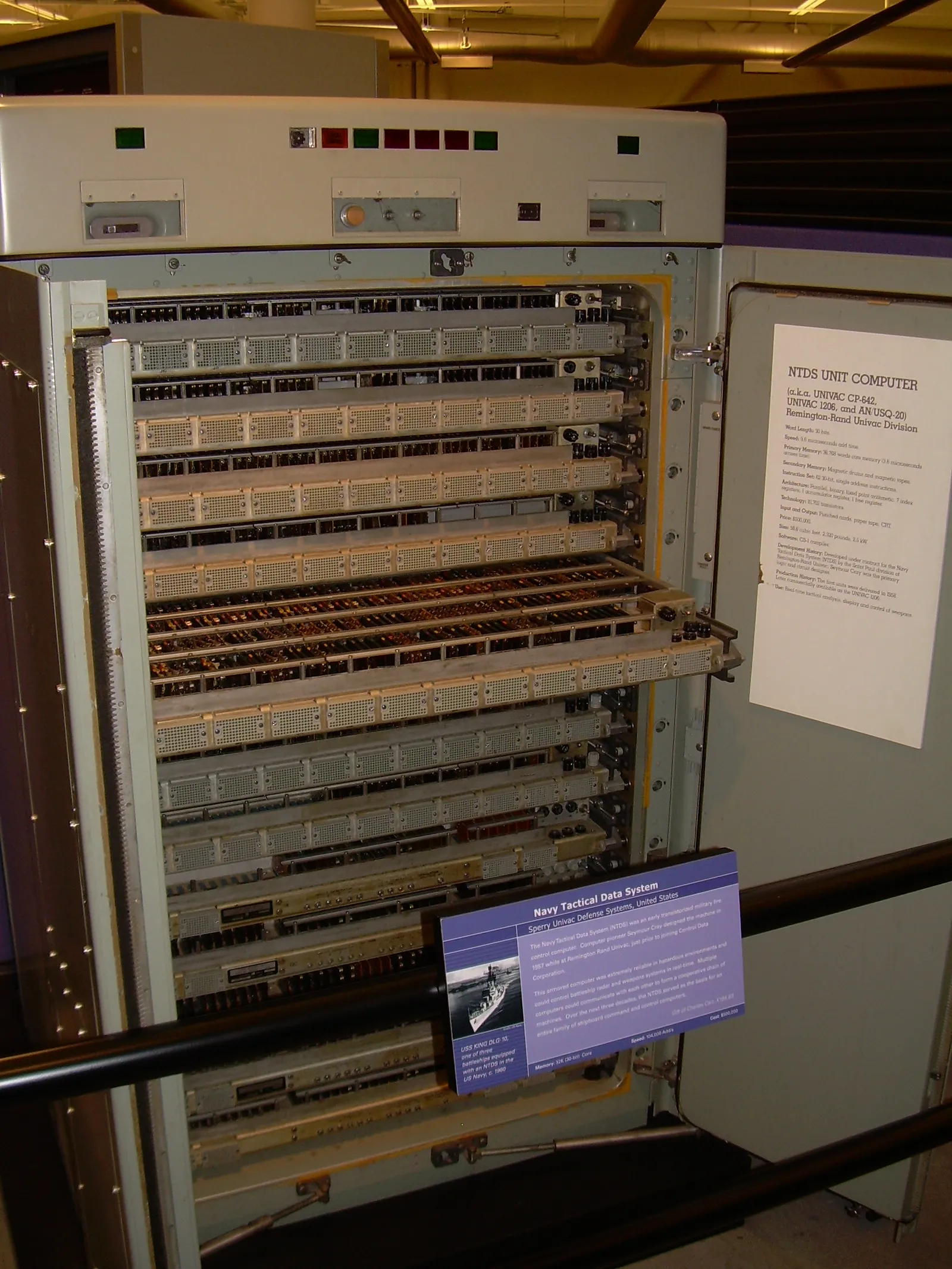
- CP-642/AN/USQ-20 NTDS unit computer family; CP-642B documented as compatible with the AN/USQ-20 data set
- Primary contractors
- Remington Rand Univac/Sperry Univac for computers and system design, Hughes Aircraft for displays, Collins Radio for digital communications links
- Word length
- 30-bit word architecture
- Instruction format
- Single-address stored-program instructions; CP-642B instructions usually executed in 8-12 microseconds
- Main memory
- CP-642B: 32,672 words of 30-bit ferrite-core memory with a 4 microsecond cycle
- Control memory
- CP-642B: 64 addressable control-memory locations with 2/3 microsecond read/restore cycle
- Input/output
- CP-642B: 16 input and 16 output channels, each using 30 parallel data lines plus control lines
- Cabinet
- CP-642B: 37 in deep, 38 in wide, 72 in high; CHM CP-642/USQ-20(V) artifact listed as 64 x 37 x 36 in
- Cooling and installation
- CP-642B standard water-cooled heat exchanger, optional air plenum; designed for shipboard or trailer installation
- Power
- CP-642B maximum 3.0 kW input to motor-alternator
Architecture And Designations
NTDS was more than a single computer. The shipboard system combined UNIVAC unit computers, Hughes display consoles, Collins communications links, sensor inputs, and interfaces to weapons-direction equipment. Public sources use CP-642, AN/USQ-20, CP-642/USQ-20(V), and UNIVAC 1206 around the NTDS unit-computer family; later Navy criteria describe the CP-642B as compatible with the AN/USQ-20 data set rather than simply as a renamed original computer.
| Designation | Meaning in sources | Notes |
|---|---|---|
| NTDS | Naval Tactical Data System | Full shipboard tactical data, display, communications, and weapon-direction system. |
| AN/USQ-20 | Army-Navy designation tied to the NTDS computer/data set | Appears with CP-642 and CP-642/USQ-20(V) in museum and Navy sources. |
| CP-642 | UNIVAC NTDS unit computer family | Production refinements include CP-642A; CP-642B is separately described in Navy criteria. |
| UNIVAC 1206 | UNIVAC designation associated with CP-642/AN-USQ-20 | Useful alias, but should be presented as a designation rather than the whole NTDS system. |
Sources: Naval Tactical Data System (NTDS) CP-642/USQ-20(V) | Computer History Museum; Naval Shore Electronics Criteria: Digital Computer Systems; Case Study of the Development of the Naval Tactical Data System.
Timeline
Naval Tactical Data System Key Events
Technical requirements written
A National Academy of Sciences case study traces NTDS development back to 1955 technical-requirements work for a digital fleet data system.
Sources: Case Study of the Development of the Naval Tactical Data System
Development authorized
The same case study identifies the Bureau of Ships as the developing agency, with Navy Electronics Laboratory and CNO support, after NTDS moved into formal development.
Sources: Case Study of the Development of the Naval Tactical Data System
Initial NTDS computer design
Computer History Museum credits Seymour Cray with the initial NTDS computer design after the Navy sought a fast, flexible shipboard computer system.
Sources: Naval Tactical Data System (NTDS) CP-642/USQ-20(V) | Computer History Museum
AN/USQ-17 reaches the test site
The NTDS testing history describes Univac delivering the AN/USQ-17 prototype to the Navy Electronics Laboratory test site in March 1958 before the later CP-642 production lineage.
Sources: Testing the Naval Tactical Data System - Chapter 5
Service-test ships begin operational evaluation
USS Oriskany, USS King, and USS Mahan carried NTDS service-test installations during the 1961 operational evaluation period.
Sources: Testing the Naval Tactical Data System - Chapter 5
CP-642/USQ-20(V) introduced
Computer History Museum lists the CP-642/USQ-20(V) NTDS object as introduced in 1962 and identifies Sperry Univac as manufacturer.
Sources: Naval Tactical Data System (NTDS) CP-642/USQ-20(V) | Computer History Museum
Approved for full service use
The NTDS service-test history says the Chief of Naval Operations approved NTDS for full service use in March 1963 and designated the equipment as standard Navy equipment.
Sources: Testing the Naval Tactical Data System - Chapter 5
First-production CP-642 refinements documented
The first-production history describes CP-642A changes to move maintenance and control panels to the top of the unit computer and says 360 CP-642-series computers were built.
Sources: Moving the Firing Key to NTDS - Chapter 6
NTDS reaches Vietnam PIRAZ operations
The combat history says USS Chicago's newly installed NTDS mastered the PIRAZ mission in June 1966, after which NTDS-equipped ships were assigned to the task.
Sources: The Naval Tactical Data System in Combat - Chapter 7
Aegis lineage uses NTDS functions
The NTDS legacy history says the Aegis contract specified command-and-decision, radar control, weapons-control, and data-link subsystems using standard NTDS computers and operator consoles.
Sources: Legacy of NTDS - Chapter 9
Desert Shield and Desert Storm coalition use
A U.S. Navy first-hand account describes Link 11/NTDS supporting Arabian Gulf Battle Force coordination across coalition ships and aircraft during Desert Shield and Desert Storm.
Sources: NTDS in Desert Shield/Storm 1990-1991
Combat-System Lineage
NTDS became part of the design inheritance for later U.S. Navy combat systems rather than a standalone modern architecture. The Aegis contract carried forward NTDS command-and-decision, radar-control, weapons-control, data-link, computer, and display concepts while building a new missile-defense combat system around SPY-1 and standard Navy tactical computers.
Aegis Combat System became the cataloged combat-system line where the Navy describes command-and-decision as the core of a centralized automated weapon system.
Sources: Legacy of NTDS - Chapter 9; AEGIS Weapon System Fact File.
The source-backed connection is lineage and subsystem inheritance, not a carriage or compatibility relationship; NTDS is therefore not listed under weaponPairings.
Media
Naval Tactical Data System Videos
Naval Tactical Data System Images
Related Weapon Systems