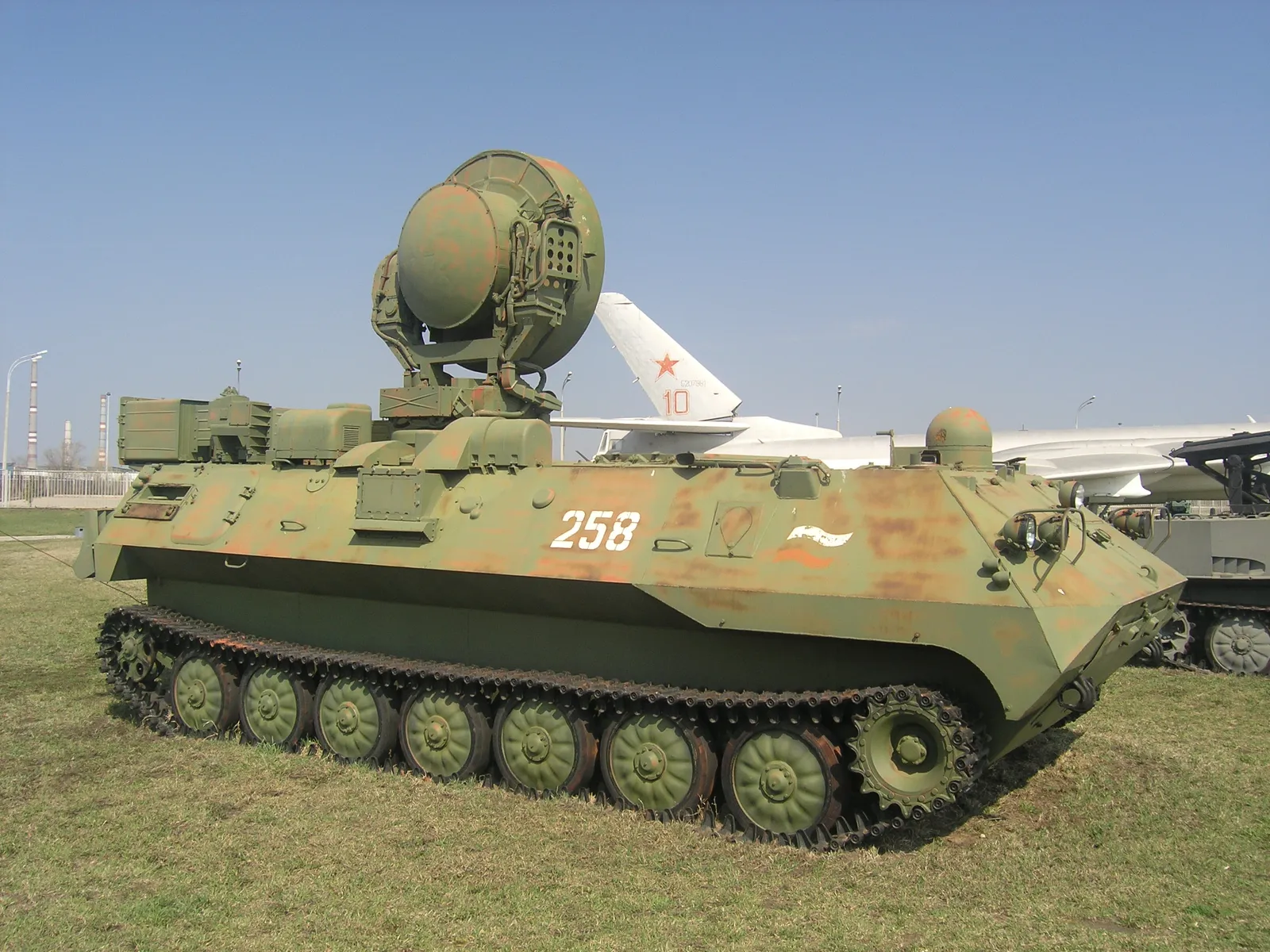
Russian General Staff history of the Soviet-Afghan War describes ARK-1 artillery radar reconnaissance systems in Afghanistan, where mountain conditions limited their effectiveness in finding enemy artillery but the radars were used to adjust Soviet artillery fire, especially at night.
1RL239/1RL239M ARK-1/ARK-1M Rys counter-battery radar
- 1RL239
- 1RL239M
- 1RL239-1M
- 1RL239 ARK-1
- 1RL239M ARK-1M
- 1RL239/1RL239M ARK-1/ARK-1M Rys
- ARK-1 Rys
- ARK-1M Rys
- ARK-1M Lynx
- 1РЛ239
- 1РЛ239М
- 1РЛ239-1М
- АРК-1
- АРК-1М
- Рысь
- Rys
- Lynx
- Small Fred
The 1RL239/1RL239M ARK-1/ARK-1M Rys is a Soviet tracked artillery-locating radar family on the MT-LBu chassis, built to detect mortar, artillery, rocket-artillery, and tactical-missile firing positions for counter-battery work. The baseline ARK-1 entered Soviet service as the 1RL239, while the ARK-1M modernization added independent power and updated command equipment before late-Soviet production ended.
Role in Conflicts
Ukrainian artillery units reportedly entered combat operations in 2014 with inherited ARK-1 / 1RL239 radars, while Russian and Russian-backed forces are also documented with the family. Foreign Policy reported a 1RL239 "Lynx" with Russian-backed forces near Donetsk in November 2014; ANNA News identified a Russian Eastern Military District ARK-1M crew during the full-scale invasion; Militarnyi, WarSpotting, and Oryx document a Russian 1RL239(-1M) / ARK-1(M) loss near Zavodivka in Kherson Oblast.
Role detailsCounter-Battery Role
The ARK-1 family is an artillery reconnaissance radar rather than a direct-fire weapon. Its job is to observe projectile trajectories, calculate likely firing or launch coordinates, and pass those coordinates into artillery fire-control channels.
Mortar bombs, artillery shells, rocket-artillery projectiles, and tactical-missile launches.
Four-person crew on an MT-LBu tracked chassis with amphibious mobility inherited from the vehicle family.
ARK-1M added independent power-generation and command-transceiver improvements over the original ARK-1.
Russian General Staff history treats Soviet-Afghan War radar use as terrain-limited for finding enemy artillery, while still useful for adjusting Soviet artillery fire at night.
NTV and ANNA reporting describe a Russian ARK-1M crew relying on frequent moves after radar emissions and counterfire made the vehicle a visible target.
Profile / Specs
Profile
- Origin
- Soviet Union
- Type
- Tracked artillery-locating counter-battery radar
- Service note
- Late Cold War Soviet service with Russia-Ukraine War battlefield appearances
- Designer
- OKB of the Arsenal Plant, Tula (now NPO Strela)
- Designed
- Development began after the 1969-06-17 Soviet Council of Ministers decision; state trials ran from 1976 to May 1977
- Produced
- ARK-1 / 1RL239 production ran at Tula Arsenal and IEMZ/Kupol in the 1980s; IEMZ/Kupol produced ARK-1M / 1RL239M from 1985 to 1991
- Number built
- IEMZ/Kupol reported more than 200 ARK-1 and ARK-1M units delivered
Specifications
- Radar role
- Three-coordinate artillery-locating radar for counter-battery reconnaissance and artillery fire adjustment
- Radar band
- K band for 1RL239 per RadarTutorial; ARK-1M also appears in U.S. WEG-derived references as an H-band / 5 cm-class artillery locating radar
- Peak transmitter power
- 200 kW
- Instrumented range
- 20 km
- Chassis
- MT-LBu tracked armored chassis
- Typical echelon
- Division reconnaissance battery
- Crew
- 4
- Combat weight
- 16,095 kg for ARK-1 baseline; 15.7 t listed for ARK-1M in U.S. WEG
- Road speed
- 60 km/h
- Amphibious speed
- 6 km/h for ARK-1 baseline; 4.5 km/h listed for ARK-1M in U.S. WEG
- Fuel range
- 500 km
- Armor
- 14-17 mm
- Deployment time
- 4 minutes for ARK-1 baseline; 5 minutes emplacement/displacement listed for ARK-1M in U.S. WEG
- Firing-position detection ranges
- ARK-1 baseline: mortars up to 12 km; guns up to 9 km; rocket artillery up to 16 km. U.S. WEG ARK-1M: mortars 13 km; gun/howitzer 8 km; MLRS 25 km; tactical missile 30 km
- Fire-adjustment ranges
- Mortars up to 14 km; gun/howitzer artillery up to 11 km; rocket artillery up to 20 km
Variants
The designation split is between the original ARK-1 / 1RL239 and the modernized ARK-1M / 1RL239M.
| Variant | Configuration | Designation notes |
|---|---|---|
| ARK-1 / 1RL239 | Baseline artillery reconnaissance radar | Accepted into Soviet service in 1977 as the ARK-1 artillery radar complex with GRAU index 1RL239. Sources: ArmForc ARK-1 1RL239 Rys |
| ARK-1M / 1RL239M | Modernized radar complex | The modernization added a D-21A1 power station and 1A30 command transceiver equipment, with service acceptance in 1983 and production from 1985 to 1991. Sources: ArmForc ARK-1 1RL239 Rys |
Tracked Chassis
The radar mission equipment is mounted on the larger MT-LBu member of the MT-LB tracked vehicle family.
| Compatible item | Item type | Compatibility evidence |
|---|---|---|
![]() | Tracked armored chassis family | The ARK-1 record identifies MT-LBu as the selected chassis, while the catalog's MT-LB page covers the MT-LB and MT-LBu family used for specialist radar, artillery, command, and support bodies. Sources: ArmForc ARK-1 1RL239 Rys, MVRsimulation 1RL239 model |
Timeline
1RL239/1RL239M ARK-1/ARK-1M Rys counter-battery radar Key Events
Rys development requirement issued
A Soviet Council of Ministers decision initiated the Rys artillery radar project, with OKB Arsenal in Tula assigned as lead developer.
Sources: ArmForc ARK-1 1RL239 Rys
ARK-1 accepted into Soviet service
After state trials in 1976-1977, the system was accepted as the ARK-1 artillery radar complex and assigned the 1RL239 index.
Sources: ArmForc ARK-1 1RL239 Rys
ARK-1M modernization accepted
The modernized ARK-1M / 1RL239M completed state trials and entered service with revised power and data-exchange equipment.
Sources: ArmForc ARK-1 1RL239 Rys
1RL239 photographed in eastern Ukraine
Foreign Policy reported a 1RL239 "Lynx" radar traveling with a 1RL232 near Donetsk, while Interpreter and InformNapalm coverage framed the sighting as part of Russian-supplied equipment for Russian-backed forces.
Sources: Foreign Policy 1RL239 eastern Ukraine sighting, Interpreter Kremlin Dirty War Ukraine, InformNapalm Leopard and Lynx Ukraine
NTV field report shows Russian radar crew activity
NTV reported Russian Eastern Military District artillery-reconnaissance radar activity on the Ukraine front, describing trajectory-based firing-position calculations, repeated movement to avoid counterfire, and a radar station that had continued operating after multiple shelling incidents; ANNA News later identified the radar in that report as ARK-1M.
Sources: NTV Eastern Military District artillery reconnaissance report, ANNA News ARK-1M combat use report
Russian ARK-1M use reported by ANNA News
ANNA News identified an ARK-1M counter-battery radar on an MT-LBu chassis in use by an Eastern Military District artillery-reconnaissance unit during Russia's full-scale invasion of Ukraine.
Sources: ANNA News ARK-1M combat use report
Kherson ARK-1 strike reported
Militarnyi reported that Ukrainian forces hit a Russian ARK-1 Rys counter-battery radar near Zavodivka in Kherson Oblast, attributing the strike to an M982 Excalibur precision artillery round.
Sources: Militarnyi ARK-1 Rys Kherson radar report
Destroyed Russian example documented in Kherson Oblast
WarSpotting listed a destroyed Russian 1RL239(-1M) ARK-1(M) Rys near Zavodivka in Kakhovka raion during the full-scale Russia-Ukraine War; Oryx also lists one destroyed Russian 1RL239 Ark-1(M) counter-battery radar.
Sources: WarSpotting 1RL239 ARK-1M Zavodivka loss, Oryx Russian equipment losses
Related Weapon Systems