Support Equipment

1V15 command and forward observer vehicle

Also known as
  • 1V15
  • 1V15M
  • 1V15(M)
  • 1V15-1
  • 1V15-3
  • 1V15-4
  • 1V15M-1
  • 1V15M-3
  • 1V15-1BM
  • 1В15
  • 1В15М
  • ACRV M1974/2b
  • 1V12 Mashina-S battalion command vehicle
  • Mashina-S battalion commander vehicle
  • Faltset battalion command vehicle
  • MT-LBu 1V15

The 1V15 is the battalion commander's mobile command-observation vehicle in the Soviet 1V12 Mashina-S artillery fire-control family. Built on the MT-LBu tracked chassis, it combines observation, rangefinding, navigation, communications, and fire-control equipment so an artillery battalion commander can reconnoiter targets, coordinate with supported maneuver units, and direct battalion fire from a protected forward post. Russian and Ukrainian 1V15-family vehicles are documented in the 2014 Russia-Ukraine War through visually confirmed loss and capture records.

Role in Conflicts

Oryx lists Russian 1V15M fire-control and observation vehicles as visually documented destroyed losses and Ukrainian 1V15 battery command and forward observer vehicles as captured losses during the full-scale invasion. WarSpotting separately identifies a destroyed Russian 1V15(M) artillery command vehicle for the 1V12(M) Mashina-S/Faltset fire-control system at Vestativka, Svatove raion, on 17 March 2023.

Role details
Profile / Specs

Profile

Origin
Soviet Union
Type
Artillery battalion command and forward observer vehicle
Service note
Cold War artillery command vehicle in post-Soviet service
Designer
Soviet artillery fire-control system design lineage; NPO Signal is associated with the wider 1V12/1V17 artillery command-automation family
Designed
Early 1970s; the 1V12 family entered the same early-1970s artillery command-automation generation as its 1V13, 1V14, 1V15, and 1V16 component vehicles
Produced
1970s onward for 1V12-family service vehicles; later 1V15M, 1V15-3, and 1V15-1BM modernization lines are described separately in open sources
Developed from
1V12 Mashina-S automated fire-control system for self-propelled artillery

Specifications

System role
Battalion commander's mobile command-observation post for the 1V12 Mashina-S self-propelled-artillery fire-control system
Base chassis
MT-LBu tracked amphibious armored chassis
Crew
6 in Armforc and Russian-language technical descriptions
Armament
One 7.62 mm PKMB machine gun with 1,250 rounds and an RPG-7 with five grenades in Armforc equipment list
Observation and rangefinding
DAK-2M laser rangefinder on baseline 1V15, 1D15 on 1V15M, VOP-7A panoramic sight, 1PN44/NNDV observation equipment, DS-1 stereoscopic rangefinder, DSP-30 engineer rangefinder, and PAB-2AM artillery aiming circle listed across open references
Navigation and orientation
1T121-1 navigation apparatus and 1G25-1 gyrocompass on baseline vehicles; Armforc lists 1T128 and 1G40 on 1V15M
Communications
R-123/R-123M, R-107M, R-111, R-130MT radios, T-219M secure-communications equipment, R-012M selective-call equipment, P-193M field switchboard, TA-57 field telephones, and cable reels in Armforc equipment list
Fire-control equipment
PUO-9M fire-control instrument, PRK-75 correction calculator, artillery correction tables, 1A30/1A30M command transceiver, and 1V520 ballistic computer on 1V15M in Armforc equipment list
Optical reconnaissance range
Up to 10,000 m by day and up to 2,500 m by night in Armforc technical table
Laser illumination range
Up to 7,000 m in Armforc and Rosoboronexport technical data
Radio range
R-123: 20-25 km; R-111: 220-250 km; R-130MT: 130 km in Armforc technical table
Fire-data timing
No more than 35 seconds to prepare settings for an unplanned target in Armforc technical table; Rosoboronexport lists 40 seconds for a three-battery Mashina-M fire task
Battalion Command Role

The 1V15 sits forward as the artillery battalion commander's mobile command-observation post. Open technical references describe it as a 1V12 Mashina-S vehicle for target reconnaissance, coordinate work, fire correction, communications, and fire-control coordination with battery command posts, firing positions, supported motor-rifle or tank units, reconnaissance assets, and a dismounted observation post.

Observation fit

Armforc lists a DAK-2M or 1D15 laser rangefinder depending on variant, VOP-7A panoramic sight, 1PN44/NNDV observation equipment, DS-1 stereoscopic rangefinder, PAB-2AM artillery aiming circle, and day/night periscopes.

Fire-control work

The vehicle determines its own and target coordinates, supports registration and fire correction, prepares firing settings, manages battalion fire, and can provide laser illumination for guided artillery ammunition where the equipment fit permits.

Communications

Armforc lists R-123/R-123M, R-107M, R-111, and R-130MT radios, T-219M secure-communications equipment, field telephones, cable reels, a P-193M field switchboard, and an intercom system for six subscribers.

Crew and protection

The six-person crew operates from a lightly armored, amphibious MT-LBu chassis; the carried armament is a 7.62 mm PKMB machine gun and an RPG-7 for self-defense rather than a primary fire-support weapon.

Variants

The 1V15 designation covers the battalion commander's command-observation vehicle in the 1V12 family. Open sources distinguish baseline 1V15 vehicles from later 1V15M, 1V15-3, and Belarusian 1V15-1BM modernization designations, while wartime loss trackers often group examples as 1V15M or 1V15(M).

VariantConfigurationDesignation notes
1V15Baseline battalion commander vehicle

Armforc describes the 1V15 as the battalion commander's mobile command-observation post in the 1V12 Mashina-S complex, intended for artillery reconnaissance and battalion fire control in close coordination with supported maneuver units.

Sources: Armforc 1V15 Mashina-S, FAS MT-LBu ACRV M1974

1V15MModernized Mashina-S/Faltset vehicle

Armforc identifies 1V15M equipment substitutions such as a 1D15 laser rangefinder, 1T128 navigation apparatus, 1G40 gyrocompass, 1A30M command transceiver, and 1V520 ballistic computer in place of earlier baseline equipment.

Sources: Armforc 1V15 Mashina-S

1V15-3Mashina-M command-observation vehicle

Rosoboronexport lists the 1V15-3 together with the 1V14-3 as the unified command-observation vehicle for the Mashina-M automated artillery fire-control complex.

Sources: Rosoboronexport Mashina-M

1V15-1BMBelarusian upgraded divisional commander vehicle

Belspetsvneshtechnika lists one 1V15-1BM divisional commander command-and-control vehicle in the 1V12-1BM modernized artillery fire-control complex.

Sources: BSVT 1V12-1BM

Artillery Fire-Control Family

The 1V15 is a component vehicle in the broader tracked Mashina-S/Faltset artillery command and fire-control family rather than a standalone artillery weapon.

Compatible itemItem typeCompatibility evidence
1V12(M) Mashina-S/Faltset fire control system, Tracked artillery command and fire-control system, Support Equipment1V12(M) Mashina-S/Faltset fire control systemTracked artillery fire-control system

Armforc and FAS place 1V15 as the battalion commander or battalion command-observation vehicle within the 1V12/1V12(M) Mashina-S/Faltset family, alongside 1V13, 1V14, and 1V16 vehicles.

Sources: Armforc 1V15 Mashina-S, FAS MT-LBu ACRV M1974

Base Tracked Vehicle Family

The vehicle's catalog role is artillery command and observation, but its mobility and protection come from the MT-LBu tracked armored chassis family.

Compatible itemItem typeCompatibility evidence
MT-LB, Amphibious tracked armored personnel carrier and artillery tractor, Armored VehiclesMT-LBTracked armored chassis family

Armforc, BSVT, and FAS identify the 1V15 or its modernized 1V12-family command vehicles as MT-LBu/MTLB-U-based artillery command vehicles.

Sources: Armforc 1V15 Mashina-S, BSVT 1V12-1BM, FAS MT-LBu ACRV M1974

Timeline

1V15 command and forward observer vehicle Key Events

  1. ACRV M1974 family observed

    FAS notes that the MT-LBu-based ACRV M1974 artillery command and reconnaissance vehicle family was first observed in 1974 and introduced alongside Soviet self-propelled howitzers.

    Sources: FAS MT-LBu ACRV M1974

  2. 1V15 photographed at a museum collection

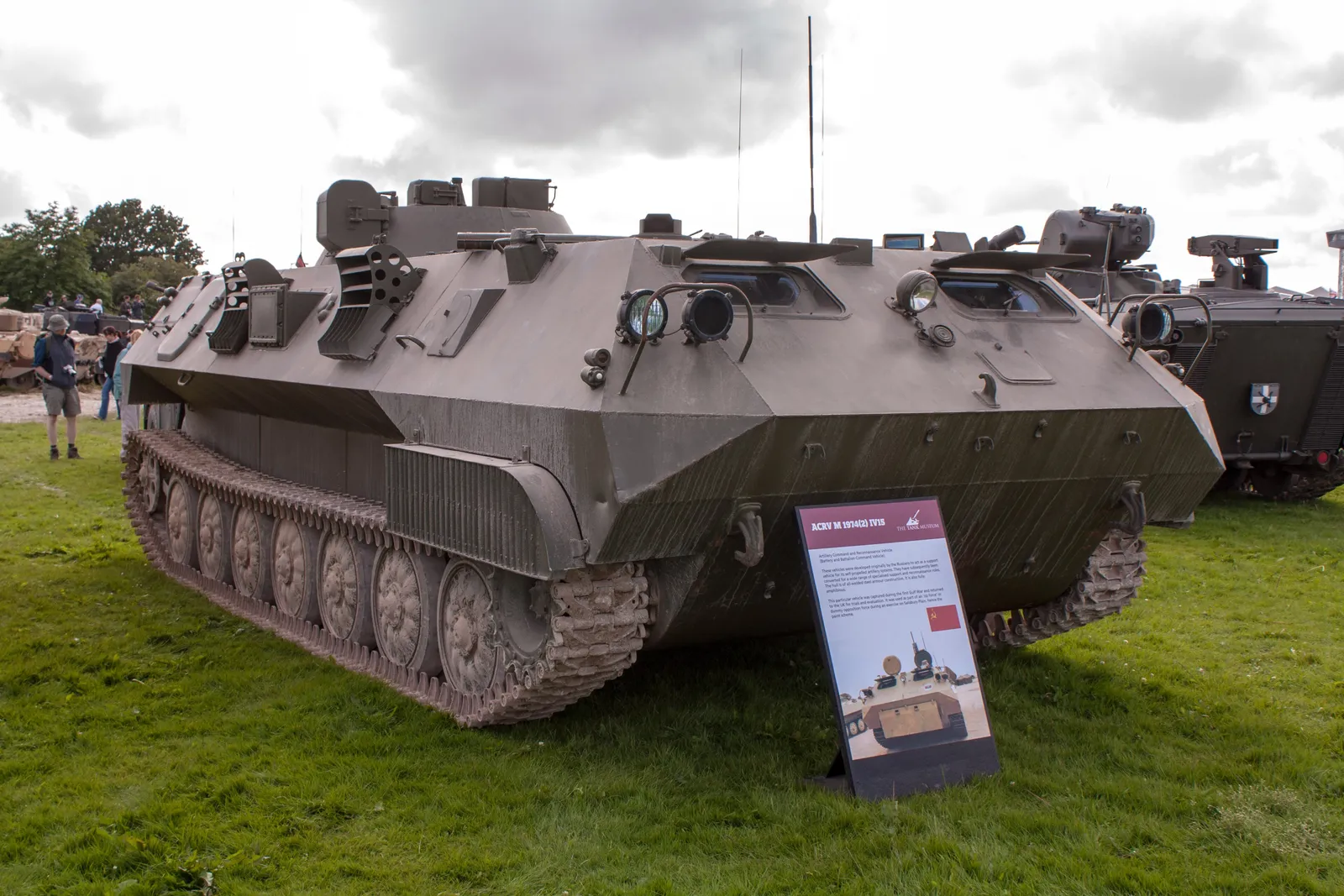
    The Wikimedia Commons primary image shows an ACRV M1974(2) IV15 vehicle photographed in July 2012 at the Military Vehicle Technology Foundation collection.

    Sources: Wikimedia Commons 1V15 image

  3. 1V15-family losses enter Ukraine-war trackers

    Oryx records Russian 1V15M fire-control and observation vehicle losses and Ukrainian 1V15 command/forward-observer vehicle capture losses in the full-scale phase of the 2014 Russia-Ukraine War.

    Sources: Oryx Russian equipment losses, Oryx Ukrainian equipment losses

  4. Russian 1V15(M) destroyed near Svatove

    WarSpotting entry #14908 identifies a Russian 1V15(M) artillery command vehicle for the 1V12(M) Mashina-S/Faltset system destroyed at Vestativka, Svatove raion.

    Sources: WarSpotting 1V15M Vestativka

  5. Mashina-M export listing remains active

    Rosoboronexport's Mashina-M listing describes a current automated artillery fire-control complex using unified 1V15-3/1V14-3 command-observation vehicles and 1V16-8/1V13-3 command-staff vehicles.

    Sources: Rosoboronexport Mashina-M

Related Weapon Systems
1V1003 command-observation vehicle, Artillery command-observation vehicle, Support EquipmentSupport Equipment1V1003 command-observation vehicleArtillery command-observation vehicleThe 1V1003 is the BTR-80-based command-observation vehicle in Russia's 1V198 Kanonada automated artillery fire-control system, used to help detect targets and automate fire missions for artillery batteries. Rostec says the 1V198 package was developed and produced by VNII Signal and includes 1V1003 vehicles with 1V1004 command-staff vehicles; open-source loss tracking and Ukrainian reporting documented at least one Russian 1V1003 captured during the 2022 phase of the Russia-Ukraine War.
1V119 Reostat, Airborne artillery reconnaissance and fire-control vehicle, Support EquipmentSupport Equipment1V119 ReostatAirborne artillery reconnaissance and fire-control vehicleThe 1V119 Reostat is a Soviet airborne, amphibious tracked artillery reconnaissance and fire-control vehicle based on the BTR-D chassis. Developed in the late 1970s for Soviet airborne artillery units, it combined observation, navigation, communications, and ballistic fire-control equipment to support self-propelled artillery formations, especially 2S9 Nona batteries. OSCE monitoring and Ukrainian reporting document Ukrainian 1V119s in the Donbas phase of the 2014 Russia-Ukraine War, while visual-loss records and defense reporting document Russian examples destroyed or captured after the 2022 full-scale invasion.
1V14 battery command and forward observer vehicle, Artillery battery command and forward observer vehicle, Support EquipmentSupport Equipment1V14 battery command and forward observer vehicleArtillery battery command and forward observer vehicleThe 1V14 is the battery commander's mobile observation and fire-control vehicle in the Soviet 1V12 Mashina-S artillery command system. Built on the MT-LBu tracked chassis, it carries observation, navigation, rangefinding, communications, and fire-control equipment so a battery commander can reconnoiter targets, correct artillery fire, and coordinate with supported maneuver units from a protected forward position. Russian and Ukrainian 1V14 vehicles are documented in the 2014 Russia-Ukraine War through visually confirmed loss and capture records.
1L271 Aistyonok, Portable mortar locating reconnaissance radar, Electronic WarfareElectronic Warfare1L271 AistyonokPortable mortar locating reconnaissance radarThe 1L271 Aistyonok is a Russian portable mortar-locating and artillery-reconnaissance radar built for battalion-to-brigade fire support. Rosoboronexport describes the export system as a modular radar for detecting 81-120 mm mortar positions, tracking shell bursts for artillery correction, and observing moving ground targets out to 20 km; specialist radar references describe a 135 kg J-band set, while open-source conflict reporting documents Russian-linked use in Syria and Ukraine plus Armenian/Artsakh wartime fielding problems in the 2020 Nagorno-Karabakh conflict.
1V110 BM-21 Grad battery command vehicle, Artillery battery command and fire-control vehicle, Support EquipmentSupport Equipment1V110 BM-21 Grad battery command vehicleArtillery battery command and fire-control vehicleThe 1V110 Bereza is the senior battery officer's command vehicle in the Soviet 1V17 Mashina-B artillery fire-control complex, used with towed and rocket-artillery units including BM-21 Grad batteries. Built on a GAZ-66 truck chassis, it carries navigation, communications, meteorological, and fire-control equipment for battery-level coordination; Oryx has documented Russian 1V110 BM-21 Grad battery command vehicles among losses in the 2014 Russia-Ukraine War.
1V12(M) Mashina-S/Faltset fire control system, Tracked artillery command and fire-control system, Support EquipmentSupport Equipment1V12(M) Mashina-S/Faltset fire control systemTracked artillery command and fire-control systemThe 1V12 Mashina-S is a Soviet tracked artillery command and fire-control set for self-propelled artillery battalions, later modernized as the 1V12M Faltset family. Built around MT-LBu-based command vehicles, the set includes 1V13(M) battery fire-control centers alongside battalion and battery command vehicles, linking reconnaissance, topographic preparation, meteorological inputs, and firing-data calculation for systems such as 2S1, 2S3, 2S4, 2S5, 2S7, and 2S19. Loss trackers and Ukrainian reporting document Russian 1V12-family vehicles destroyed, abandoned, and captured during the 2014 Russia-Ukraine War.

Sources