

Oryx lists Russian and Ukrainian 1V14 battery command and forward observer vehicles among visually documented losses in the full-scale invasion. WarSpotting records a Russian 1V14(M) destroyed at Katiuzhanka on 13 March 2022. Defense Express and Telegraf reported Ukrainian captures of Russian 1V14/1B14 vehicles after the Kharkiv and Kherson counteroffensives, with Telegraf citing StratCom ZSU for the Kherson capture.
Role detailsSupport Equipment
1V14 battery command and forward observer vehicle
Also known as
- 1V14
- 1V14(M)
- 1V14-1
- 1V14-3
- 1V14-4
- 1V14M
- 1V14M-1
- 1V14M-3
- 1В14
- 1В14М
- ACRV M1974/2a
- 1V12 Mashina-S battery command vehicle
- Mashina-S battery commander vehicle
- Faltset battery command vehicle
- MT-LBu 1V14
The 1V14 is the battery commander's mobile observation and fire-control vehicle in the Soviet 1V12 Mashina-S artillery command system. Built on the MT-LBu tracked chassis, it carries observation, navigation, rangefinding, communications, and fire-control equipment so a battery commander can reconnoiter targets, correct artillery fire, and coordinate with supported maneuver units from a protected forward position. Russian and Ukrainian 1V14 vehicles are documented in the 2014 Russia-Ukraine War through visually confirmed loss and capture records.
Role in Conflicts
Profile / Specs
Profile
- Origin
- Soviet Union
- Built by
- Motovilikha Plants
- Built in
- Soviet UnionRussia
- Type
- Artillery battery command and forward observer vehicle
- Service note
- Cold War artillery fire-control vehicle in post-Soviet service
- Designer
- Soviet artillery fire-control system design lineage; NPO Signal is associated with the wider 1V12/1V17 artillery command-automation family
- Designed
- Early 1970s; Ukrainian defense reporting states production began in 1972
- Produced
- 1970s onward for 1V12-family service vehicles; later 1V14M and 1V14-KMU modernization lines are separately described in open sources
- Developed from
- 1V12 Mashina-S automated fire-control system for self-propelled artillery
Specifications
- System role
- Battery commander's mobile command-observation post for the 1V12 Mashina-S self-propelled-artillery fire-control system
- Base chassis
- MT-LBu tracked amphibious armored chassis
- Crew
- 6 in Armforc and Russian-language technical descriptions; some English MT-LBu variant summaries list 5
- Armament
- One 7.62 mm PKMB machine gun with 1,250 rounds listed by Armforc; RPG-7 with five grenades carried in the vehicle equipment list
- Observation and rangefinding
- VOP-7A panoramic sight, 1PN44/NNDV observation equipment, DAK-2M or 1D15 laser rangefinder depending on variant, DS-1 stereoscopic rangefinder, DSP-30 engineer rangefinder, and PAB-2AM artillery aiming circle listed across open references
- Navigation and orientation
- 1T121-1 navigation apparatus and 1G25-1 gyrocompass on baseline vehicles; Armforc lists 1T128 and 1G40 on 1V14M
- Communications
- Three R-123/R-123M radios, R-107M portable radio, 1T803M or R-124 intercom, TA-57 field telephones, P-193M switchboard, and cable reels in Armforc equipment list
- Fire-control equipment
- PUO-9M fire-control instrument, PRK-75 correction calculator, artillery correction tables, and 1V520 ballistic computer on 1V14M in Armforc equipment list
- Optical reconnaissance range
- Up to 10,000 m by day and up to 2,500 m by night in Armforc technical table
- Laser illumination range
- Up to 7,000 m in Armforc technical table
- Radio range
- 20-25 km in Armforc technical table
- Fire-data timing
- No more than 35 seconds to prepare settings for an unplanned target in Armforc technical table
Battery Command Role
The 1V14 sits forward of the guns as the battery commander's mobile command-observation post. Open technical references describe it as a 1V12 Mashina-S vehicle for reconnaissance, target coordinate work, fire correction, communication with battery and battalion posts, and coordination with supported motor-rifle or tank units.
Observation fit
Armforc lists optical and night-observation devices, DAK-2M or 1D15 laser rangefinding depending on variant, a panoramic sight, stereoscopic and engineer rangefinders, and artillery surveying tools.
Fire-control work
The vehicle determines target coordinates, prepares firing data, helps register targets, corrects fire during fire-for-effect missions, and can support laser illumination for guided munitions where the equipment fit permits.
Communications
The vehicle carries multiple radio sets, field telephones, cable reels, an intercom system, and switching equipment for contact with battery firing positions, battalion command-observation and fire-control posts, supported units, and a dismounted observation post.
Crew and protection
Armforc lists a six-person crew in a lightly armored, amphibious MT-LBu chassis with a 7.62 mm PKMB machine gun and RPG-7 stowage for self-defense rather than offensive firepower.
Variants
The 1V14 name covers the original 1V12 battery commander vehicle and later variants tied to upgraded Mashina-S/Faltset fire-control complexes. Open loss records often group wartime examples as 1V14 or 1V14(M), while Russian-language references distinguish 1V14-1, 1V14-3, 1V14-4, 1V14M, 1V14M-1, and 1V14M-3.
| Variant | Configuration | Designation notes |
|---|---|---|
| 1V14 | Original battery commander vehicle | Baseline 1V12 Mashina-S battery command and observation vehicle on the MT-LBu chassis, with reconnaissance, fire-control, communication, and navigation equipment for battery-level artillery control. Sources: Armforc 1V14 Mashina-S, Russian Wikipedia 1V14 |
| 1V14M | Modernized Mashina-S/Faltset vehicle | Armforc distinguishes the 1V14M fit with updated navigation and observation equipment, including 1T128 navigation apparatus, a 1G40 gyrocompass, a 1D15 laser rangefinder, and a 1V520 ballistic computer. Sources: Armforc 1V14 Mashina-S |
| 1V14-1 / 1V14-3 / 1V14-4 | Upgrade-series designations | Russian and Ukrainian reference pages list these as battery commander vehicles for successive 1V12-1, 1V12-3, and 1V12-4 fire-control system variants; detailed public differences are thin compared with the baseline and 1V14M descriptions. |
Artillery Fire-Control Family
The 1V14 is a component vehicle inside the tracked 1V12 Mashina-S artillery fire-control family, not a standalone firing weapon.
| Compatible item | Item type | Compatibility evidence |
|---|---|---|
 | Tracked artillery fire-control system | Armforc identifies the 1V14 as the battery commander's command-observation vehicle in the 1V12 Mashina-S fire-control complex, and its 1V12 system page lists three 1V14 battery commander vehicles in the set. Sources: Armforc 1V14 Mashina-S, Armforc 1V12 Mashina-S |
 | Battalion command-observation vehicle | The same 1V12 family composition places the 1V15 battalion commander vehicle above the 1V14 battery commander vehicles in the artillery command-observation layer. Sources: Armforc 1V12 Mashina-S, FAS MT-LBu ACRV M1974 |
 | Battalion fire-direction vehicle | Armforc and FAS describe the 1V16 as the battalion-level fire-direction or chief-of-staff vehicle in the same MT-LBu-based ACRV/1V12 command family as the 1V14. Sources: Armforc 1V12 Mashina-S, FAS MT-LBu ACRV M1974 |
 | Tracked armored chassis | ODIN, Armforc, and MT-LBu reference material identify the 1V14 as an MT-LBu-based artillery command and reconnaissance or observation vehicle. Sources: ODIN 1V14 WEG, Armforc 1V14 Mashina-S, FAS MT-LBu ACRV M1974 |
Timeline
1V14 battery command and forward observer vehicle Key Events
Production-era baseline
Defense Express states that production of the 1V14 began in 1972, placing the vehicle in the early-1970s Soviet artillery command-automation generation.
Sources: Defense Express captured 1B14
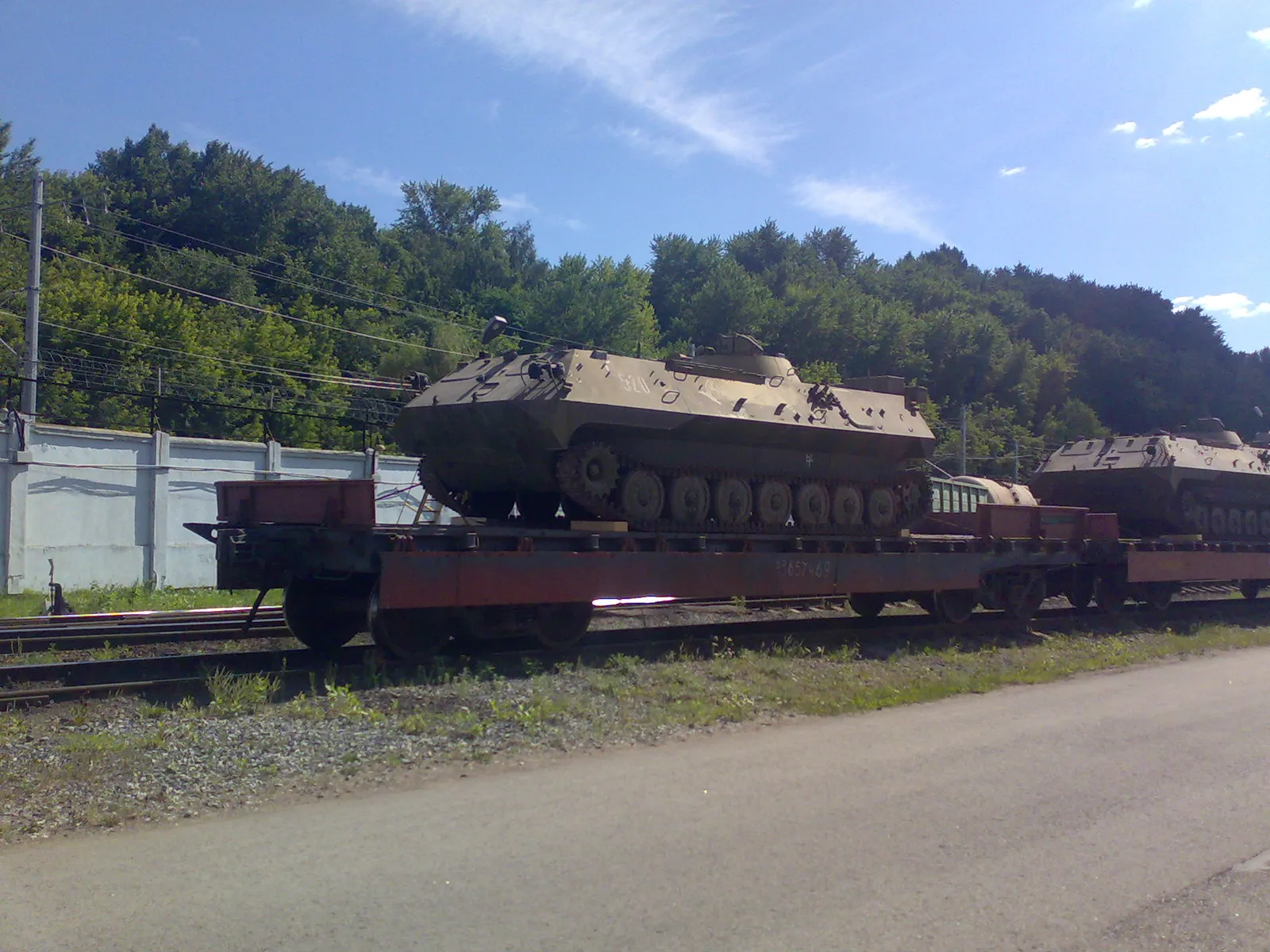
1V14-3 photographed in transit
The Wikimedia Commons primary image shows a 1V14-3 command post vehicle on a railway platform, supporting the visible external configuration used for the catalog image.
Sources: Wikimedia Commons 1V14-3 image
Russian 1V14(M) destroyed at Katiuzhanka
WarSpotting records a Russian 1V14(M) artillery command vehicle for the 1V12(M) Mashina-S/Faltset system destroyed at Katiuzhanka, Vyshhorod raion.
Sources: WarSpotting 1V14M Katiuzhanka
Captured Russian 1V14 reported after Kharkiv counteroffensive
Defense Express reported a captured Russian 1V14/1B14 battery command and forward observer vehicle from the 1V12 Mashina-S complex after Russia's retreat in Kharkiv Oblast.
Sources: Defense Express captured 1B14
Captured 1V14 reported after Kherson liberation
Telegraf, citing Ukrainian Strategic Communications reporting, described Ukrainian forces capturing a Russian 1V14 battery command vehicle in Kherson Oblast during the counteroffensive and liberation of Kherson.
Sources: Telegraf Kherson 1V14 capture
Related Weapon Systems


Sources
MT-LBu WikipediaPublisher: Wikipedia | Note: Starting reference for MT-LBu chassis background, 1V14 naming, ACRV M1974/2a designation, source leads, and the distinction from 1V13, 1V15, and 1V16 vehicles. | Accessed: 2026-07-04Russian Wikipedia 1V14Publisher: Wikipedia | Note: Baseline Russian-language starting reference for the 1V14 role, 1V12 Mashina-S relationship, crew positions, equipment categories, variant list, and bibliography leads. | Accessed: 2026-07-04Ukrainian Wikipedia 1V14Publisher: Wikipedia | Note: Baseline Ukrainian-language reference used for cross-checking the 1V14 name, variant list, MT-LBu chassis context, and public image linkage. | Accessed: 2026-07-04Armforc 1V14 Mashina-SPublisher: Armforc.su | Note: Detailed Russian-language technical reference supporting 1V14 role in the 1V12 Mashina-S complex, battery command-observation tasks, equipment fit, crew, MT-LBu chassis, armament, communication systems, and technical table values. | Accessed: 2026-07-04Armforc 1V12 Mashina-SPublisher: Armforc.su | Note: Detailed Russian-language technical reference supporting the 1V12 Mashina-S fire-control system composition, including one 1V15, one 1V16, three 1V14, and three 1V13 vehicles, MT-LBu chassis context, supported self-propelled artillery families, and system-level command, reconnaissance, communications, and firing-data tasks. | Accessed: 2026-07-04ODIN 1V14 WEGPublisher: U.S. Army Training and Doctrine Command / ODIN Worldwide Equipment Guide | Note: Supports the 1V14 identity as a Russian artillery command and reconnaissance vehicle, armored battery command-and-control role, and selected navigation, laser rangefinder, and sight equipment. | Accessed: 2026-07-04FAS MT-LBu ACRV M1974Publisher: Federation of American Scientists | Note: Supports MT-LBu/ACRV M1974 family background, recognition context, and artillery command and reconnaissance vehicle chassis relationship. | Accessed: 2026-07-04Wikimedia Commons 1V14-3 imagePublisher: Wikimedia Commons | Note: Supports primary image provenance and licensing for the 1V14-3 command post vehicle photograph, published as the uploader's own work under CC BY-SA 3.0. | Accessed: 2026-07-04Oryx Russian equipment lossesPublisher: Oryx | Note: Supports 2014 Russia-Ukraine War direct conflict-use context by listing Russian 1V14 battery command and forward observer vehicles among visually documented destroyed, abandoned, damaged-and-captured, and captured losses. | Accessed: 2026-07-04Oryx Ukrainian equipment lossesPublisher: Oryx | Note: Supports 2014 Russia-Ukraine War direct conflict-use context by listing Ukrainian 1V14 battery command and forward observer vehicles among visually documented destroyed and captured losses. | Accessed: 2026-07-04WarSpotting 1V14M KatiuzhankaPublisher: WarSpotting | Note: Supports 2014 Russia-Ukraine War direct conflict-use by identifying a Russian 1V14(M) artillery command vehicle for the 1V12(M) Mashina-S/Faltset fire-control system destroyed at Katiuzhanka on 13 March 2022. | Accessed: 2026-07-04Defense Express captured 1B14Publisher: Defense Express | Note: Supports 2014 Russia-Ukraine War direct conflict-use and capture context by reporting a Russian vehicle identified in the article as a 1B14 battery command and forward observer vehicle from the 1B12 Mashina-S complex abandoned during the Kharkiv Oblast retreat; also supports 1972 production-start context. | Accessed: 2026-07-04Telegraf Kherson 1V14 capturePublisher: Telegraf | Note: Supports 2014 Russia-Ukraine War direct conflict-use and capture context by reporting Ukrainian capture of a Russian 1V14 battery command vehicle in Kherson Oblast during the counteroffensive and liberation of Kherson. | Accessed: 2026-07-04