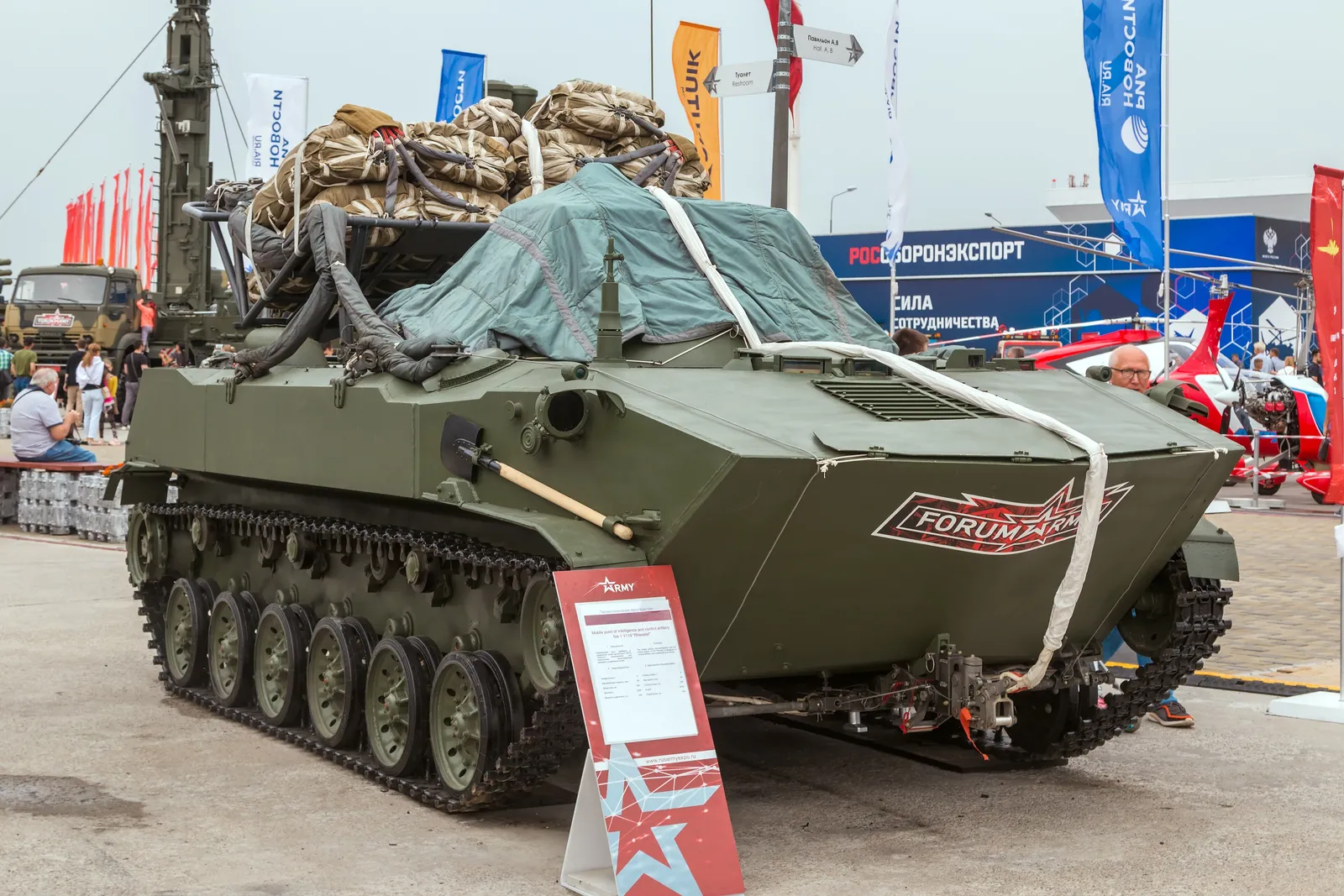


Ukrainian forces operated 1V119 Reostat artillery command vehicles during the Donbas phase: OSCE observed a BTR-D 1V119 Reostat in a government-controlled area near Novoselivka Druha on 2017-12-04, and reporting on the Shakhtyorsk fighting documents 25th Airborne Brigade 1V119s, including a burned vehicle. Russian forces also fielded 1V119s during the full-scale phase; visual-loss trackers and defense reporting document Russian VDV examples destroyed or captured at Mykolaiv, Orane, and in Kherson Oblast. Captures support transfer to Ukrainian possession, but do not by themselves prove Ukrainian operational reuse of captured Russian vehicles.
Role detailsSupport Equipment
1V119 Reostat
Also known as
- 1V119 Rheostat
- 1В119 Реостат
- Reostat
- Rheostat
- 1V119 Spektr
- 1В119
- 1В119 «Реостат»
The 1V119 Reostat is a Soviet airborne, amphibious tracked artillery reconnaissance and fire-control vehicle based on the BTR-D chassis. Developed in the late 1970s for Soviet airborne artillery units, it combined observation, navigation, communications, and ballistic fire-control equipment to support self-propelled artillery formations, especially 2S9 Nona batteries. OSCE monitoring and Ukrainian reporting document Ukrainian 1V119s in the Donbas phase of the 2014 Russia-Ukraine War, while visual-loss records and defense reporting document Russian examples destroyed or captured after the 2022 full-scale invasion.
Role in Conflicts
Profile / Specs
Profile
- Origin
- Soviet Union
- Built by
- Perm Machine-Building Plant
- Type
- Airborne artillery reconnaissance and fire-control vehicle
- Service note
- Late Cold War Soviet airborne artillery fire-control system; accepted for service in 1982
- Designer
- NII Signal
- Designed
- Late 1970s
- Produced
- From 1982
- Number built
- About 60 reported in the area west of the Urals in 1991
- Developed from
- BTR-D airborne armored personnel carrier
Specifications
- Crew
- 4-5
- Chassis
- BTR-D-derived tracked amphibious airborne chassis, object 926
- Combat weight
- 8,000 kg
- Role equipment
- PSNR-5M/1RL133-1 radar, DAK-2M rangefinder, NNP-21 night observation device, PAB-2AM aiming circle, 1V520 ballistic computer, and PUO-9M fire-control instrument
- Communications
- Two R-123M radios, R-107M radio, R-124 intercom, TA-57 field telephones, and telephone cable equipment reported
- Engine
- 5D-20 V-6 liquid-cooled diesel, about 240 hp
- Mobility
- Tracked amphibious chassis; about 60 km/h road speed, 10 km/h swimming speed, and up to 500 km fuel range reported
- Armor
- 6-26 mm aluminum armor; protection described against 7.62 mm small-arms fire and fragments
- Supported weapon
- Designed to control fire for 2S9 Nona self-propelled mortar batteries in airborne forces
Fire-Control Equipment
The Reostat replaces a normal troop-carrier or gun turret role with a compact artillery-control equipment set on the BTR-D airborne vehicle family. Source descriptions identify reconnaissance sensors, rangefinders, fire-control calculators, radio equipment, and survey/navigation instruments used to support airborne artillery batteries.
Observation and targeting
PSNR-5M/1RL133-1 ground-surveillance radar, DAK-2M rangefinder, NNP-21 night observation device, periscopic sights, and aiming-circle equipment are listed in Russian technical summaries.
Fire-control function
The vehicle carries calculation and fire-control devices such as the 1V520 electronic ballistic computer and PUO-9M fire-control instrument, tying target data to battery fire missions.
Battery readiness
Defense Express cites the Reostat's role in preparing 2S9 Nona batteries to open fire after movement, which is why battlefield reports treat captured vehicles as more than simple armored carriers.
Communications
Documented radio and telephone equipment includes R-123M, R-107M, R-124 intercom, TA-57 field telephones, and cable equipment for a dismounted observation point.
Variants
Russian-language references usually treat 1V119 Reostat as the BTR-D-based artillery reconnaissance and fire-control vehicle, while U.S. Army-derived references split the airborne fire-control set into 1V118 Reostat command-observation and 1V119 Spektr fire-direction roles.
| Variant | Configuration | Designation notes |
|---|---|---|
| 1V118 Reostat | Command-observation vehicle in the airborne artillery fire-control set | The U.S. Army Foreign Military Studies Office reference describes 1V118 as the command-observation post vehicle paired with the 1V119 fire-direction center vehicle; no separate catalog record exists. Sources: Russian Way of War |
| 1V119-1 Reostat-1 | Modernized equipment fit | The FMS reference describes 1V118-1/1V119-1 as a modernized version of the Reostat/Spektr artillery fire-control system; detailed public specification differences remain limited. Sources: Russian Way of War |
Supported Artillery Systems
The Reostat's operational value comes from its role as a control and observation vehicle for airborne artillery rather than from an onboard main gun.
| Compatible item | Item type | Compatibility evidence |
|---|---|---|
 | 120 mm self-propelled mortar | Defense Express and Army Recognition identify the 1V119 as a fire-control vehicle for 2S9 Nona batteries in airborne units. Sources: Defense Express Kherson 1V119, Army Recognition 1V119 Capture |
Designation Notes
Source naming is not fully uniform. Russian-language references usually call the 1V119 vehicle Reostat, while a U.S. Army Foreign Military Studies Office reference describes a paired 1V118 Reostat command-observation post and 1V119 Spektr fire-direction center vehicle. This record keeps the common 1V119 Reostat name while listing Spektr and Reostat transliterations as aliases.
Timeline
1V119 Reostat Key Events
Late-1970s development begins
Russian artillery reference material describes the Reostat project as a late-1970s effort for airborne artillery reconnaissance and fire control, with NII Signal responsible for the project and the BTR-D selected as the chassis.
Sources: Armforc 1V119 Reostat
Accepted for service
Armforc reports that the 1V119 Reostat was accepted for service in 1982 and that serial production was organized at the Perm Machine-Building Plant in the same year.
Sources: Armforc 1V119 Reostat
CFE-era inventory noted
Russian Wikipedia cites 60 1V119 vehicles in the zone west of the Urals as of 1991, later passing to successor states after the Soviet collapse.
Sources: Russian Wikipedia 1V119
Shakhtyorsk fighting documents Ukrainian Reostats
Censor.NET's 25th Airborne Brigade account describes Reostat vehicles accompanying Ukrainian airborne artillery around Shakhtyorsk, while Rubryka summarizes photo- and video-supported Ukrainian losses including one burned 1V119 Reostat.
Sources: Censor.NET Shakhtyorsk 25th Brigade Account, Rubryka Shakhtyorsk 25th Brigade Losses
OSCE observes Reostat in government-controlled Donetsk Oblast
The OSCE Special Monitoring Mission reported an artillery command vehicle identified as a BTR-D 1V119 Reostat near government-controlled Novoselivka Druha.
Sources: OSCE SMM Daily Report 2017-12-05
Captured near Mykolaiv
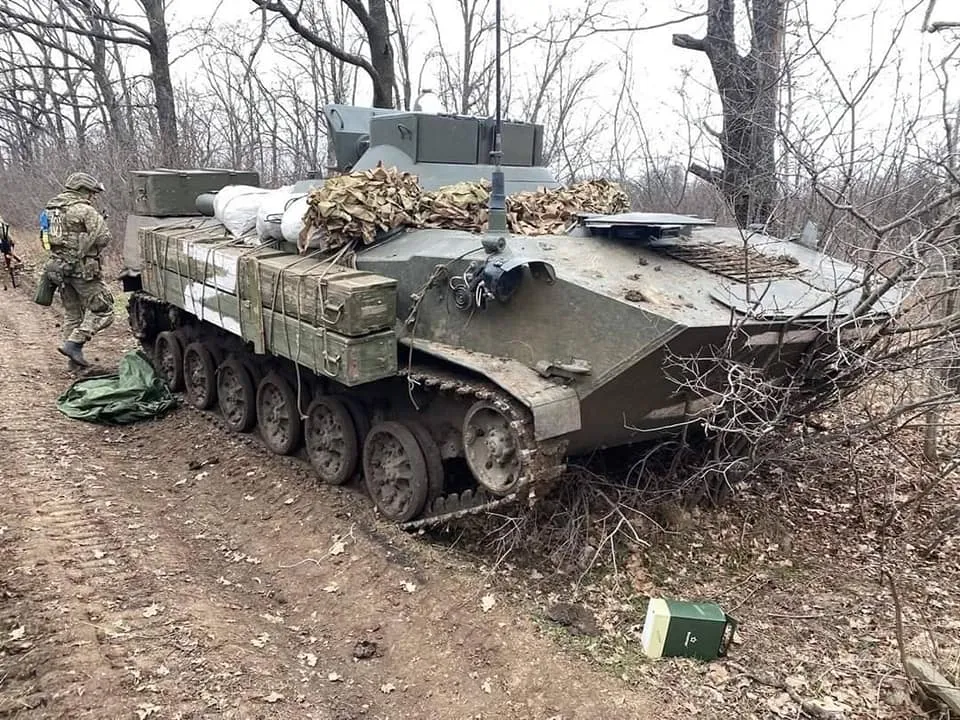
WarSpotting records a visually confirmed 1V119 Reostat captured from Russian VDV forces and transferred to Ukrainian possession near Mykolaiv.
Sources: WarSpotting 1V119 Mykolaiv
Destroyed near Orane
WarSpotting records a visually confirmed Russian VDV 1V119 Reostat marked destroyed near Orane during the full-scale invasion.
Sources: WarSpotting 1V119 Orane
Kherson trophy reported
Defense Express reported that Ukrainian forces captured a Russian 1V119 Rheostat fire-control vehicle as Russian forces left the west bank of Kherson Oblast.
Sources: Defense Express Kherson 1V119
Media
1V119 Reostat Images
Related Weapon Systems


Sources
Armforc 1V119 ReostatPublisher: Armforc.su | Note: Supports design background, BTR-D chassis selection, NII Signal project role, 1982 service acceptance, Perm Machine-Building Plant serial production, equipment fit, crew, armor, and mobility/specification details. | Accessed: 2026-07-02Russian Way of WarPublisher: Army University Press / Foreign Military Studies Office | Note: Supports the 1V118 Reostat / 1V119 Spektr naming split, command-observation versus fire-direction roles, 1V118-1/1V119-1 modernization, and Zavet-D replacement context. | Accessed: 2026-07-02Russian Wikipedia 1V119Publisher: Wikipedia | Note: Starting reference for aliases, 1V119-1 variant naming, operator inventory lead, and source leads for the Reostat designation. | Accessed: 2026-07-02Army Recognition 1V119 CapturePublisher: Army Recognition | Note: Supports 2014 Russia-Ukraine War direct conflict-use context by reporting Ukrainian capture of a Russian 1V119 in Kherson Oblast; also supports role, sensor, fire-control, engine, speed, and 2S9 relationship details. | Accessed: 2026-07-02Defense Express Kherson 1V119Publisher: Defense Express | Note: Supports 2014 Russia-Ukraine War direct conflict-use context by reporting Ukrainian capture of a Russian 1V119 Rheostat in Kherson Oblast and describing its 2S9 Nona battery fire-control role. | Accessed: 2026-07-02WarSpotting 1V119 MykolaivPublisher: WarSpotting | Note: Supports 2014 Russia-Ukraine War direct conflict-use context through a visually confirmed March 2022 1V119 Reostat capture record near Mykolaiv, marked Russia VDV to Ukraine. | Accessed: 2026-07-02WarSpotting 1V119 OranePublisher: WarSpotting | Note: Supports 2014 Russia-Ukraine War direct conflict-use context through a visually confirmed destroyed Russian VDV 1V119 Reostat near Orane during the full-scale invasion. | Accessed: 2026-07-02Oryx Russian Equipment Losses 1V119Publisher: Oryx | Note: Supports 2014 Russia-Ukraine War direct conflict-use context through visually confirmed Russian 1V119 artillery fire direction vehicle losses, including destroyed and captured examples. | Accessed: 2026-07-02OSCE SMM Daily Report 2017-12-05Publisher: Organization for Security and Co-operation in Europe | Note: Supports 2014 Russia-Ukraine War direct conflict-use context by reporting an artillery command vehicle identified as BTR-D 1V119 Reostat in a government-controlled area near Novoselivka Druha on 2017-12-04. | Accessed: 2026-07-02Censor.NET Shakhtyorsk 25th Brigade AccountPublisher: Censor.NET | Note: Supports 2014 Russia-Ukraine War direct conflict-use context through a 25th Airborne Brigade account that describes Reostat vehicles with Ukrainian airborne artillery around Shakhtyorsk and identifies a 1V119 Reostat from the brigade's first battalion group. | Accessed: 2026-07-02Rubryka Shakhtyorsk 25th Brigade LossesPublisher: Rubryka | Note: Supports 2014 Russia-Ukraine War direct conflict-use context by summarizing photo- and video-supported Ukrainian 25th Brigade equipment losses at Shakhtyorsk, including one burned 1V119 Reostat. | Accessed: 2026-07-02GlobalSecurity BTR-DPublisher: GlobalSecurity.org | Note: Supports BTR-D airborne vehicle family context, including the 1V118 Reostat/1V119 Spektr artillery command and observation variant and the 2S9 Nona family connection. | Accessed: 2026-07-02Wikimedia Commons 1V119 Reostat Army-2022Publisher: Wikimedia Commons | Note: Supports image provenance and reuse: Commons identifies the 2022 Army forum photo as Mike1979 Russia's own work under CC BY-SA 4.0. | Accessed: 2026-07-02Wikimedia Commons 1V119 Reostat UkrainePublisher: Wikimedia Commons | Note: Supports gallery image provenance and reuse: Commons identifies an abandoned Russian 1V119 in Ukraine, sourced to Ukraine's General Staff and licensed CC BY 4.0. | Accessed: 2026-07-02