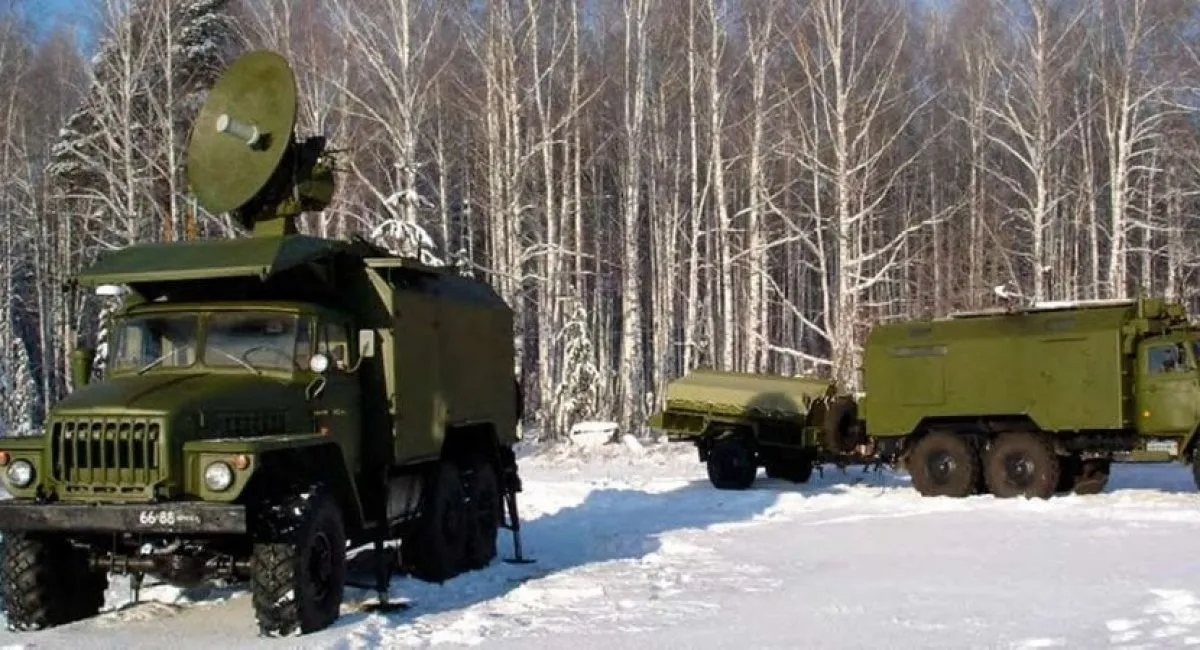


Russian 1B44-1 / RPMK-1 Ulybka equipment is documented through visually confirmed loss records and Ukrainian operational reporting of an August 2024 strike in the OSUV Tavria area, while Ukrainian use is supported by visual-loss records and reporting of a Lancet strike on a Ukrainian 1B44-1 weather radar.
Role detailsSupport Equipment
1B44-1 RPMK-1 Ulybka radiosonde weather radar
Also known as
- 1B44-1
- 1Б44-1
- RPMK-1 Ulybka
- РПМК-1 Улыбка
- Ulybka
- Smile
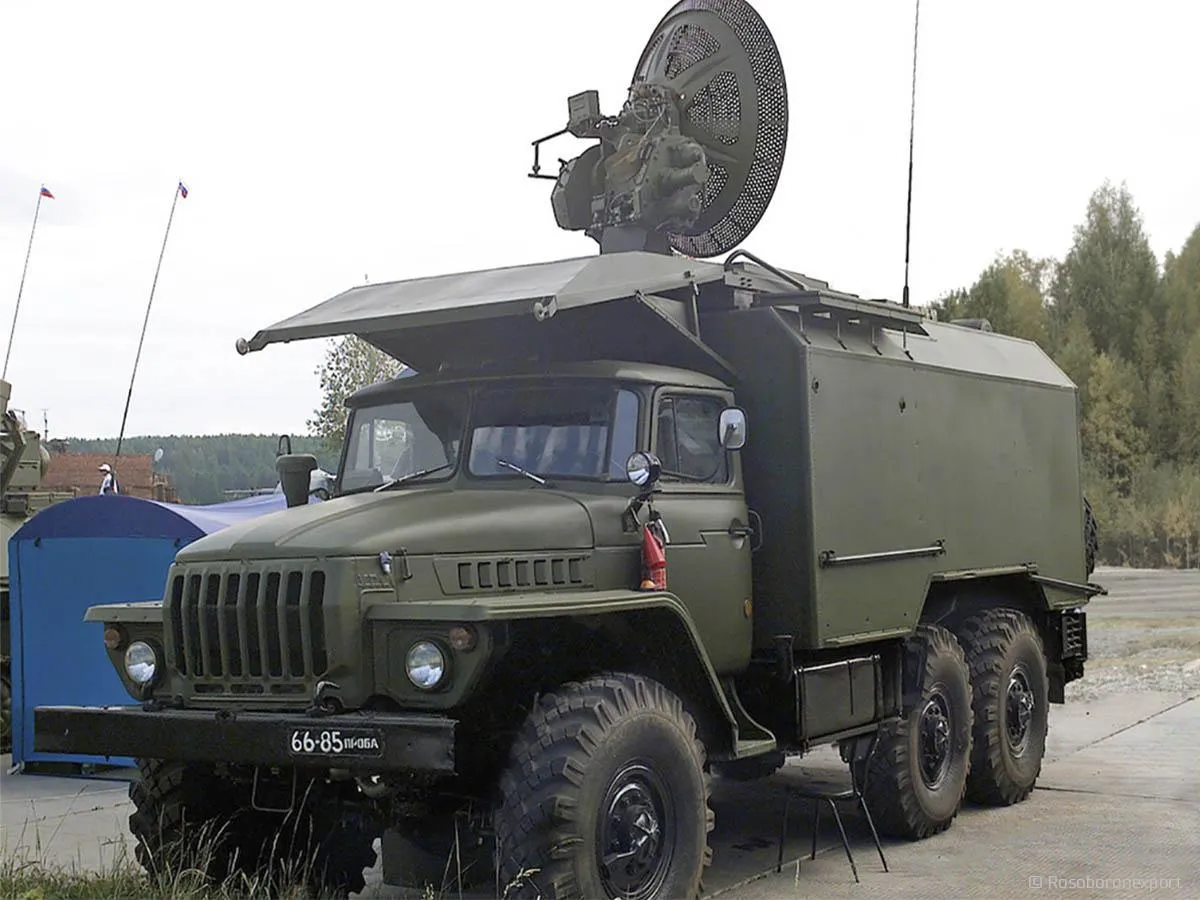
The 1B44-1 is the radar and operator vehicle of the RPMK-1 Ulybka mobile radiosonde meteorological complex, an automated support system that tracks free-flight radiosondes and distributes upper-air data for artillery, rocket, missile, aviation, and contamination-area calculations. Rosoboronexport lists the 1B44 set as a three-part complex with 40 km altitude and 200 km range limits, while visual-loss tracking and Ukrainian reporting document both Russian and Ukrainian Ulybka equipment destroyed during the 2014 Russia-Ukraine War.
Role in Conflicts
Profile / Specs
Profile
- Origin
- Russia
- Built by
- OKB Peleng
- Type
- Mobile radiosonde weather radar complex
- Service note
- In Russian service from 1990 and documented in the 2014 Russia-Ukraine War
- Designer
- OKB Peleng
- Produced
- In service from 1990
- Developed into
- Ulybka-M mobile aerological complex development work, documented as a later modernization path rather than a confirmed fielded replacement in this record
Specifications
- Primary function
- Radiosonde meteorological measurement for military fire, missile, aviation, and contamination-area calculations
- Measured data
- Wind direction and speed, relative humidity, temperature, and pressure
- Radar operation
- Active radar tracking or passive direction-finding of radiosonde signals
- Radar frequency
- 1,770-1,795 MHz L-band range listed by Radartutorial
- Pulse repetition frequency
- 457 Hz listed by Radartutorial
- Pulse width
- 0.5 or 1.1 microseconds listed by Radartutorial
- Instrumented radar range
- 300 km listed by Radartutorial; official export sounding range is 200 km
- Antenna beamwidth
- 6 degrees listed by Radartutorial
- Baseline antenna tracking
- Narrow-beam radiosonde antenna driven in azimuth and elevation to receive coordinate and telemetry data
- 1B44-1 vehicle
- Ural-4320 / Ural-432036-based radar and operator vehicle
- Set components
- 1B44-1 radar vehicle, 1B44-2 power vehicle with 8 kVA generator, and 1B44-3 gas-cylinder trailer
- Sounding height
- 30 km in METEO mode and 40 km in KN mode
- Maximum sounding range
- 200 km
- Deployment time
- 10 minutes
- Sounding duration
- 45 minutes to 14 km with extrapolated METEO-11 data to 30 km, or 90 minutes to 30 km
- Output products
- METEO-11, METEO-44, SLOY, SHTORM, METEOZVUK, KN-04, surface-layer, icing, and wind-shear data products
- Low-emission operation
- Radio-direction mode can work without transmitting on the air
- Transported sounding stock
- 44 soundings with the carried light-gas stock and No. 150P balloon envelopes
- Mean time between failures
- 500 hours
- Crew
- 5
- Operating conditions
- -50°C to +50°C ambient temperature, 98% relative humidity at +25°C, ground wind up to 25 m/s, and elevation up to 3000 m
- Service entry
- 1990 in Russian service
System Role
The 1B44-1 vehicle is the radar and operator element of the RPMK-1 Ulybka set rather than a stand-alone strike weapon. Its battlefield value is meteorological: it tracks radiosonde balloons and processes atmospheric data used to correct artillery, rockets, missiles, aviation support, and contamination-area calculations.
Radar vehicle
1B44-1 carries the main radio-technical equipment, follows radiosondes in flight, processes atmospheric parameters, and transmits sounding results.
Support vehicle
1B44-2 provides the 8 kVA diesel-electric generator, ground-observation instruments, radiosonde stores, batteries, and balloon envelopes.
Balloon support
1B44-3 is the single-axle trailer for light-gas cylinders, balloon-filling equipment, release gear, spares, and operating documentation.
Measurement envelope
Official export data lists 30 km METEO and 40 km KN sounding heights, maximum sounding range of 200 km, and ten-minute deployment.
Output products
Rosoboronexport lists METEO-11, METEO-44, SLOY, SHTORM, METEOZVUK, KN-04, surface-layer, icing, and wind-shear outputs.
Low-emission mode
The official export page describes radio-direction operation without emitting on the air, a useful survivability distinction for a support radar complex.
Supported users
Russian and Ukrainian references describe the output as serving ground and air-defense artillery, MLRS and tactical missile systems, CBRN units, airborne forces, and aviation workflows.
Variants
The 1B44 GRAU index covers the RPMK-1 Ulybka complex, while the numbered sub-items identify the radar vehicle, power vehicle, and gas-cylinder trailer.
| Variant | Configuration | Designation notes |
|---|---|---|
| 1B44-1 | Radar and operator vehicle | GRAU-index references identify 1B44-1 as the apparatus vehicle on a Ural-432036 chassis for the RPMK-1 complex. Sources: GRAU Index Tables |
| 1B44-2 | Power-supply vehicle | Listed as the RPMK-1 power vehicle; Defense Express describes the set as using a Ural-4320 support vehicle with an 8 kVA generator. |
| 1B44-3 | Gas-cylinder trailer | Listed as the RPMK-1 trailer for carrying light-gas cylinders used with the radiosonde balloons. Sources: GRAU Index Tables |
| 1B77 Ulybka-M | Later one-vehicle mobile weather-radar successor | Radartutorial describes 1B77 Ulybka-M as the successor to RPMK-1 Ulybka, moving the main complex onto a KamAZ truck and adding a trailer only for balloon-support equipment. Sources: Radartutorial 1B77 Ulybka-M Page |
Documented Missile-System Link
Most sources describe RPMK-1's meteorological role by user category. One technical-history source gives a concrete example by linking RPMK-1 Ulybka to Tochka-U accuracy support.
| Compatible item | Item type | Compatibility evidence |
|---|---|---|
 | Tactical ballistic missile system | A Bauman MSTU excerpt on Soviet and Russian missile systems says Tochka-U can be coupled with the mobile RPMK-1 Ulybka meteorological complex to improve accuracy by supplying wind, temperature, and humidity data. Sources: Bauman Missile Systems Excerpt |
Timeline
1B44-1 RPMK-1 Ulybka radiosonde weather radar Key Events
RPMK-1 Ulybka enters Russian service
Defense Express, citing open-source system references, describes RPMK-1 Ulybka as delivered to Russian forces in 1990 and replacing MRK-1 Shkval.
Sources: Defense Express Ulybka Strike
Eastern Military District artillery receives RPMK-1 sets
A Russian report attributed to the Eastern Military District press service said RPMK-1 Ulybka complexes were being delivered to artillery formations under the state defense order, replacing Shkval meteorological complexes.
Sources: Sdelanounas EMD Ulybka Deliveries
OKB Peleng supplies RPMK-1-related export items
OKB Peleng disclosure material says its 2014 military-technical cooperation work included serial U-2 items for UPP Vector to complete RPMK-1 meteorological complexes.
Sources: OKB Peleng 2014 Annual Report
UPP Vector files mobile aerological complex patent
A Russian patent assigned to AO UPP Vector treated RPMK-1 Ulybka as the predecessor design and described a compact one-vehicle radionavigation aerological complex intended to reduce deployment work and crew size.
Sources: RU2634486C2 Mobile Aerological Complex Patent
Ukrainian reporting describes an RPMK-1 Ulybka strike
Focus reported that OSUV Tavria spokesperson Dmytro Lykhovii singled out an RPMK-1 Ulybka among Russian equipment destroyed in the Tavria operational area for 19 August 2024.
Sources: Focus Tavria Ulybka Report
Media
1B44-1 RPMK-1 Ulybka radiosonde weather radar Images
Related Weapon Systems


Sources
Rosoboronexport RPMK-1 Product PagePublisher: Rosoboronexport | Note: Supports official RPMK-1 designation, 1B44-1/2/3 component roles, radiosonde mission, sounding height and range, crew, deployment time, sounding duration, output products, carried sounding stock, low-emission radio-direction operation, reliability, operating conditions, and export-category context. | Accessed: 2026-07-02Defense Express Ulybka StrikePublisher: Defense Express | Note: Supports RPMK-1 role, measured data, three-element set composition, service-entry context, illustrative image provenance, and 2014 Russia-Ukraine War reporting of an OSUV Tavria strike on Russian Ulybka equipment. | Accessed: 2026-07-02Sdelanounas EMD Ulybka DeliveriesPublisher: Sdelanounas | Note: Supports reported Eastern Military District deliveries, Shkval replacement context, three-element set composition, and military user groups for RPMK-1 meteorological data. | Accessed: 2026-07-02Missilery RPMK-1 MLRS DictionaryPublisher: Missilery.info | Note: Supports RPMK-1 meteorological support context for MLRS use, ground meteorological measurements, radiosonde sounding, intermediate meteorological bulletins, and surface-layer data products. | Accessed: 2026-07-02Oryx Russian Equipment LossesPublisher: Oryx | Note: Supports 2014 Russia-Ukraine War direct conflict-use evidence by listing a Russian 1B44-1 for RPMK-1 Ulybka radiosonde weather radar as visually confirmed destroyed. | Accessed: 2026-07-02Oryx Ukrainian Equipment LossesPublisher: Oryx | Note: Supports 2014 Russia-Ukraine War direct conflict-use evidence by listing a Ukrainian 1B44-1 (RPMK-1) radiosonde weather radar as visually confirmed destroyed. | Accessed: 2026-07-02TWZ Ukrainian 1B44-1 Lancet ReportPublisher: The War Zone | Note: Supports 2014 Russia-Ukraine War direct conflict-use evidence by reporting a Lancet strike on a Ukrainian 1B44-1 (RPMK-1) weather radar used to collect data for artillery, missiles, and military aviation. | Accessed: 2026-07-02Focus Tavria Ulybka ReportPublisher: Focus.ua | Note: Supports 2014 Russia-Ukraine War direct conflict-use evidence for Russian RPMK-1 Ulybka equipment through Ukrainian OSUV Tavria reporting for 19 August 2024. | Accessed: 2026-07-02GRAU Index TablesPublisher: Internet Archive | Note: Supports the 1B44 / RPMK-1 Ulybka designation and the 1B44-1, 1B44-2, and 1B44-3 component descriptions. | Accessed: 2026-07-02Bauman Missile Systems ExcerptPublisher: Ruzhany / Bauman MSTU | Note: Supports RPMK-1 / 1B44 designation, OKB Peleng development attribution, UPP Vector production attribution as secondary context, Tochka-U coupling, meteorological parameters, range, altitude, deployment time, and two-truck-plus-trailer set layout. | Accessed: 2026-07-02Radartutorial RPMK-1 PagePublisher: Radartutorial.eu | Note: Supports radar-specific RPMK-1 technical details, component composition, mission context, and 1990 service-entry context. | Accessed: 2026-07-02Radartutorial 1B77 Ulybka-M PagePublisher: Radartutorial.eu | Note: Supports 1B77 Ulybka-M successor context for RPMK-1, one-vehicle KamAZ layout, trailer role, and continued balloon-observation capability. | Accessed: 2026-07-02RU2634486C2 Mobile Aerological Complex PatentPublisher: Google Patents / Russian patent publication | Note: Supports RPMK-1 Ulybka predecessor layout, Ural-43203 vehicle context, mechanically tracked radiosonde antenna method, and later single-vehicle radionavigation modernization context by AO UPP Vector. | Accessed: 2026-07-02OKB Peleng 2014 Annual ReportPublisher: Interfax / PRIME disclosure archive | Note: Supports OKB Peleng manufacturer context and its 2014 supply of serial items for RPMK-1 meteorological complexes. | Accessed: 2026-07-02