Munitions

AQM-37A target missile

Also known as
  • AQM-37
  • AQM-37A
  • AQM-37C
  • AQM-37D
  • AQM-37 Jayhawk
  • KD2B-1
  • XKD2B-1
  • Q-12
  • Beech Model 1019
  • Jayhawk
  • Typhon

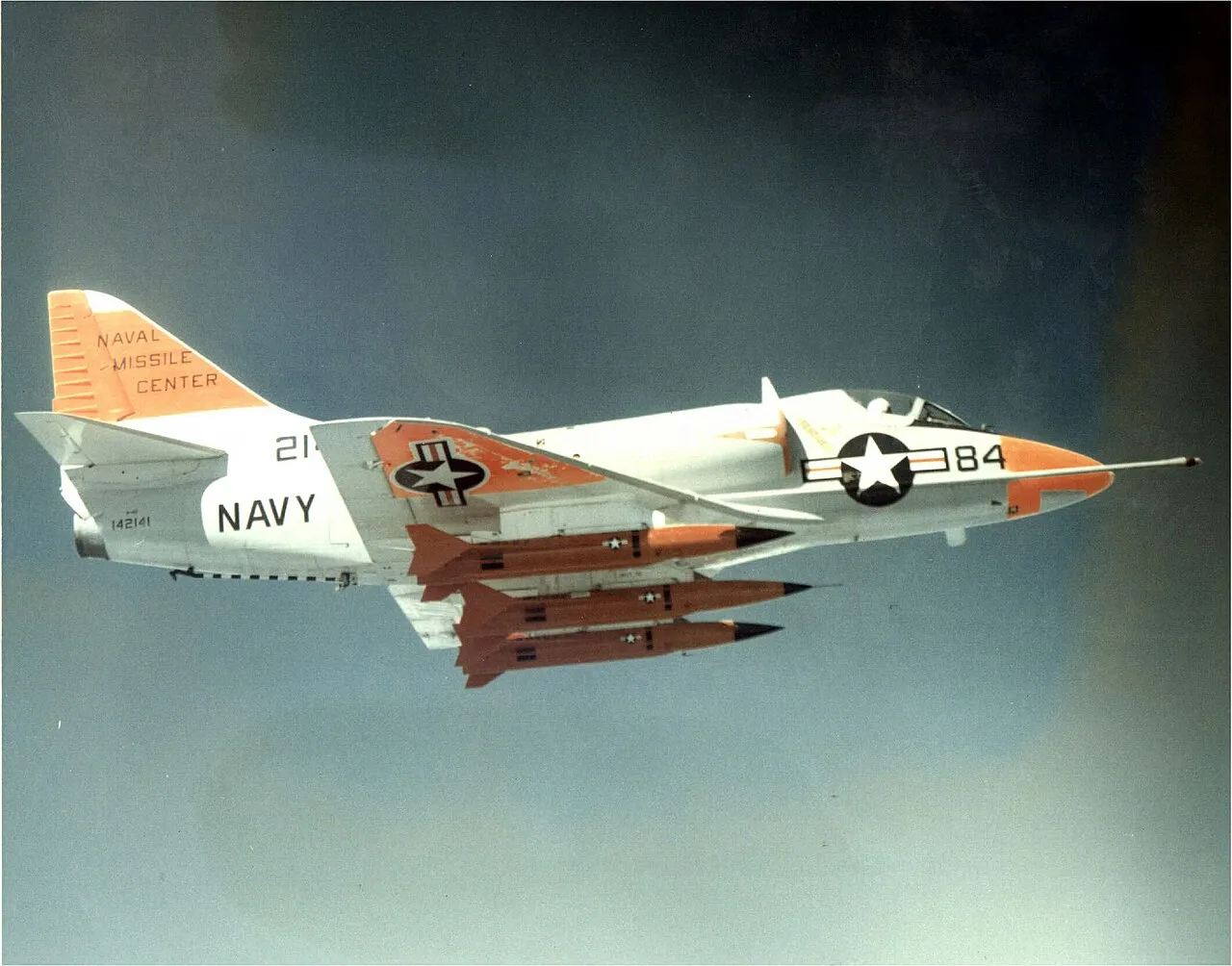
The AQM-37A was a U.S. expendable supersonic target missile developed by Beech Aircraft and later supplied by Maxson Electronics for missile-test and fleet-training work. Air-launched by aircraft such as the A-4, A-6, F-4, and later F-16, it used liquid-rocket propulsion, programmed profiles, radar augmentation, and destruct equipment to represent high-speed aircraft, anti-ship missile, and ballistic-threat targets.

Profile / Specs

Profile

Origin
United States
Type
Air-launched supersonic target missile
Service note
Cold War and post-Cold War target missile family
Designer
Beech Aircraft
Designed
1959 competition; first flight in May 1961
Produced
Operational with the U.S. Navy from 1963
Number built
More than 5,000 AQM-37 targets delivered across the program

Specifications

Launch platform
Air-launched from fighter-sized aircraft including A-4, A-6, and F-4 aircraft
Guidance/control
AQM-37A followed a pre-programmed flight path; later AQM-37C/D targets added command-control and reliability upgrades
Propulsion
North American/Rocketdyne LR64-NA-4 pre-packaged liquid-fuel rocket engine
Speed
Up to Mach 3 at high altitude; Cradle of Aviation exhibit lists 1,700 mph for its AQM-37A
Altitude envelope
About 1,000 ft to 80,000 ft for AQM-37A profiles, with later program use simulating ballistic profiles up to 300,000 ft
Endurance
About five minutes powered endurance after launch
Weight
565 lb on the Cradle of Aviation AQM-37A exhibit
Target features
Pre-programmed flight path, radar-image projection, high-intensity flares, radar reflectors, and automatic destruct equipment are documented across museum and reference sources
Variants

AQM-37 designations cover the original AQM-37A/KD2B target and later Navy, Army, and reliability-upgrade configurations.

VariantConfigurationDesignation notes
XKD2B-1Prototype target designation

The pre-1963 Navy designation belonged to the Beech-developed prototype target before the joint designation system produced AQM-37A.

Sources: Raytheon AQM-37 | Directory of U.S. Military Rockets and Missiles

AQM-37AOriginal production target

The AQM-37A/Model 1019 was the original non-recoverable, pre-programmed target used from aircraft such as the A-4, A-6, and F-4.

Sources: Raytheon AQM-37 | Directory of U.S. Military Rockets and Missiles, Maxson AQM-37A Target Missile | Cradle of Aviation Museum

Model 1100/1101Recoverable Army evaluation versions

Designation-Systems describes these 1976/1977 Army versions as AQM-37A modifications with a two-stage parachute recovery system.

Sources: Raytheon AQM-37 | Directory of U.S. Military Rockets and Missiles

Model 1102Non-recoverable Army version

The later Army order covered more than 400 non-recoverable Model 1102 targets with a solid-state autopilot and improved wings.

Sources: Raytheon AQM-37 | Directory of U.S. Military Rockets and Missiles

AQM-37CImproved Navy target

The AQM-37C incorporated Challenger-program features, radio command control, digital autopilot, radar augmentation, and later ballistic-threat profiles.

Sources: Raytheon AQM-37 | Directory of U.S. Military Rockets and Missiles

AQM-37DReliability upgrade

Raytheon developed the AQM-37D from 1996 with upgraded electrical systems and avionics; the last Navy AQM-37D was expended in September 2022.

Sources: Raytheon AQM-37 | Directory of U.S. Military Rockets and Missiles

Carrier Aircraft

AQM-37 targets were expendable air-launched missiles, so their operational value depended on aircraft able to carry them to the required release conditions.

LauncherLauncher typeLaunch evidence
A-4 Skyhawk, Carrier-based light attack aircraft, Aircraft & UAVsA-4 SkyhawkLight attack aircraft

Designation-Systems identifies the A-4 as one of the fighter-sized aircraft used to launch the AQM-37A; the current gallery image also shows A-4B aircraft carrying AQM-37 targets.

Sources: Raytheon AQM-37 | Directory of U.S. Military Rockets and Missiles, A-4B Skyhawk with AQM-37 target drones in flight 1965 | Wikimedia Commons

A-6E Intruder, Carrier-based attack aircraft, Aircraft & UAVsA-6E IntruderCarrier attack aircraft

Designation-Systems lists the A-6 among fighter-sized aircraft used to launch the AQM-37A, and museum sources describe A-6 Intruders as common launch platforms.

Sources: Raytheon AQM-37 | Directory of U.S. Military Rockets and Missiles, AQM-37A Jayhawk | Yanks Air Museum

F-4 Phantom II, Twin-engine, two-seat supersonic fighter-bomber, Aircraft & UAVsF-4 Phantom IICarrier and tactical fighter

The F-4 was a documented AQM-37A launch aircraft, with a Navy compatibility report evaluating AQM-37A and LAU-24/A carriage on an F-4B centerline station.

Sources: Raytheon AQM-37 | Directory of U.S. Military Rockets and Missiles, AQM-37A target compatibility with F-4B aircraft | DTIC

F-16 Fighting Falcon, Multirole fighter aircraft, Aircraft & UAVsF-16 Fighting FalconTest and training support fighter

NAVAIR reported Air Force 412th Test Wing AQM-37 launches from F-16s for Navy Exercise Gray Flag and final-program test support.

Sources: End of an Era: Navy conducts final AQM-37 target launch | NAVAIR

Timeline

AQM-37A target missile Key Events

  1. High-speed target competition

    The Navy and Air Force requirement that led to the AQM-37 selected Beech Aircraft's Model 1019 target concept.

    Sources: Raytheon AQM-37 | Directory of U.S. Military Rockets and Missiles

  2. First flight

    The Beech-developed target first flew in May 1961 before entering Navy service as the AQM-37A.

    Sources: Raytheon AQM-37 | Directory of U.S. Military Rockets and Missiles, Beechcraft AQM-37A Jayhawk | Naval Air Museum Barbers Point

  3. AQM-37A designation

    The KD2B-1 was redesignated AQM-37A under the joint designation system shortly before U.S. Navy service entry.

    Sources: Raytheon AQM-37 | Directory of U.S. Military Rockets and Missiles

  4. Army recoverable versions

    The U.S. Army ordered recoverable Model 1100 and Model 1101 AQM-37A modifications during the 1976/1977 period.

    Sources: Raytheon AQM-37 | Directory of U.S. Military Rockets and Missiles

  5. AQM-37C deliveries

    The AQM-37C followed Navy Challenger-program modifications and added command-control, digital-autopilot, and improved radar-augmentation features.

    Sources: Raytheon AQM-37 | Directory of U.S. Military Rockets and Missiles

  6. AQM-37D first flight

    Raytheon's AQM-37D reliability upgrade first flew after development work that began in 1996.

    Sources: Raytheon AQM-37 | Directory of U.S. Military Rockets and Missiles

  7. Final Navy launches

    The Navy launched its last two AQM-37 targets at White Sands Missile Range in support of Army Integrated Fires Mission Command work.

    Sources: End of an Era: Navy conducts final AQM-37 target launch | NAVAIR

Media
Related Weapon Systems
Kh-22, Air-launched supersonic anti-ship cruise missile, MunitionsMunitionsKh-22Air-launched supersonic anti-ship cruise missileThe Kh-22, NATO reporting name AS-4 Kitchen, is a large Soviet air-launched cruise missile designed by Raduga for attacks on carrier groups, radar-contrast surface targets, and major fixed targets. Its liquid-propellant rocket motor, supersonic flight profile, and roughly one-ton conventional or nuclear warhead made it a heavy standoff weapon for Tu-22, Tu-22M, and modified Tu-95K-22 bomber variants. Russia has repurposed Kh-22-family missiles for land attack in the 2014 Russia-Ukraine War, where the missile's naval-targeting heritage, large warhead, and high terminal speed have produced severe urban-strike risks and a difficult air-defense problem.
AN/ALE-50 towed decoy, Towed decoy countermeasure, Electronic WarfareElectronic WarfareAN/ALE-50 towed decoyTowed decoy countermeasureThe AN/ALE-50 is a Raytheon airborne towed decoy countermeasure developed from Naval Research Laboratory work to draw radar-guided missiles away from combat aircraft. It entered production in December 1996, pairs a launcher/controller installation with expendable decoy canisters, and is documented on F-16, F/A-18E/F Super Hornet, and B-1B aircraft as a compact radio-frequency self-protection system used from Kosovo and Iraq to later U.S. air operations.
Kh-32, Supersonic air-launched anti-ship and land-attack cruise missile, ArtilleryArtilleryKh-32Supersonic air-launched anti-ship and land-attack cruise missileThe Kh-32 is a Russian supersonic air-launched cruise missile derived from the Kh-22 family for long-range attacks on ships and fixed ground targets. Built by the Raduga design bureau within Russia's Tactical Missiles Corporation network, it is carried by Tu-22M3-series bombers and combines a high-altitude flight profile, inertial navigation, and terminal radar homing. Russia has used the Kh-22/Kh-32 family against Ukraine, where its speed, steep terminal profile, and anti-ship design heritage make interception difficult and raise accuracy risks when fired at urban land targets.
AN/TPQ-37 Firefinder radar, Long-range counter-battery radar, Electronic WarfareElectronic WarfareAN/TPQ-37 Firefinder radarLong-range counter-battery radarThe AN/TPQ-37 Firefinder is a U.S. long-range weapon-locating radar built to detect artillery and rocket launches, compute firing points, and pass coordinates for counter-battery fire. Developed from the Army's Firefinder program and produced by Hughes Aircraft before later Raytheon/ThalesRaytheonSystems sustainment and upgrade work, the Q-37 complemented the shorter-range AN/TPQ-36, shaped Coalition counterbattery tactics in Desert Storm, and later appeared in Ukraine's partner-supplied artillery reconnaissance network.

Sources