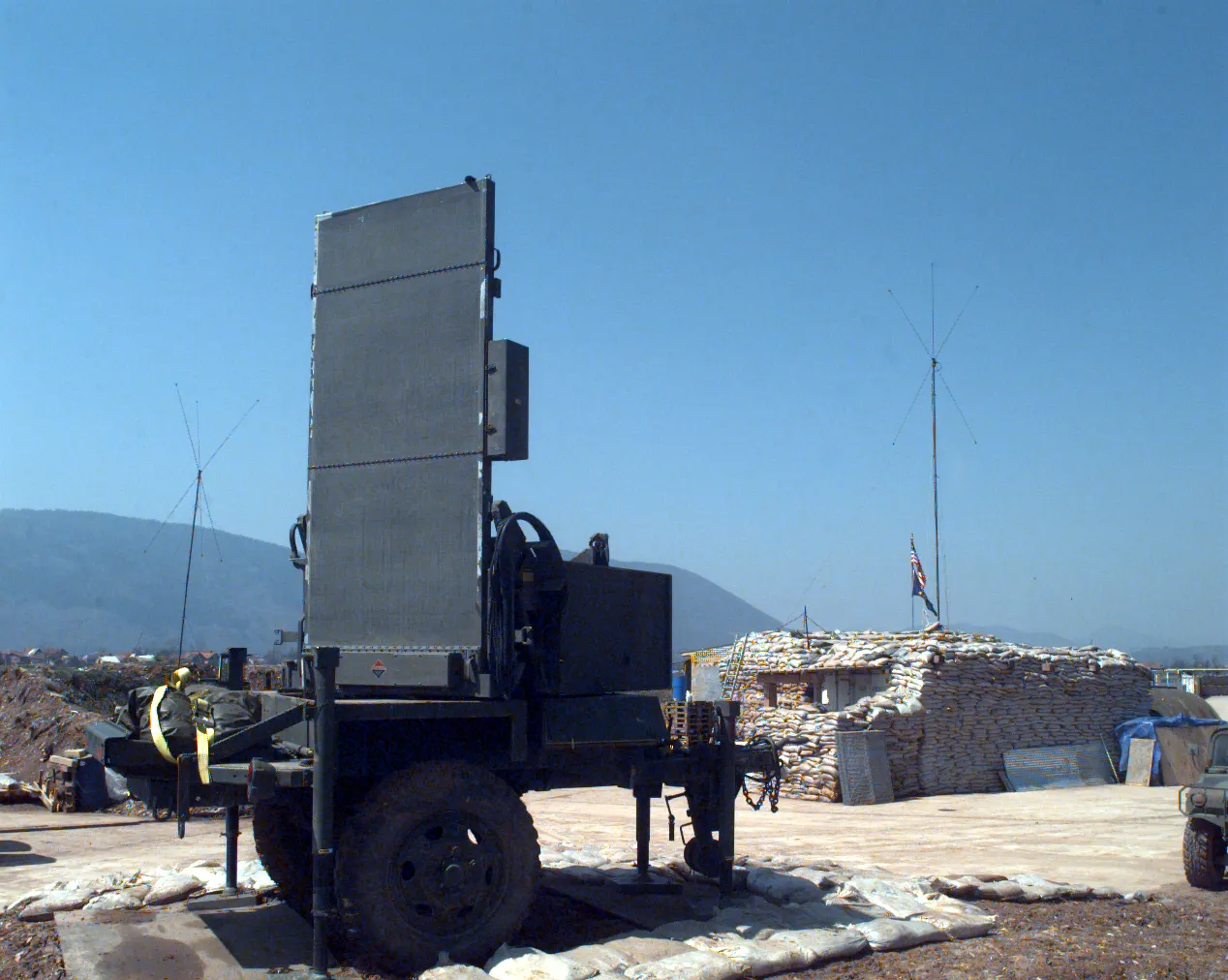
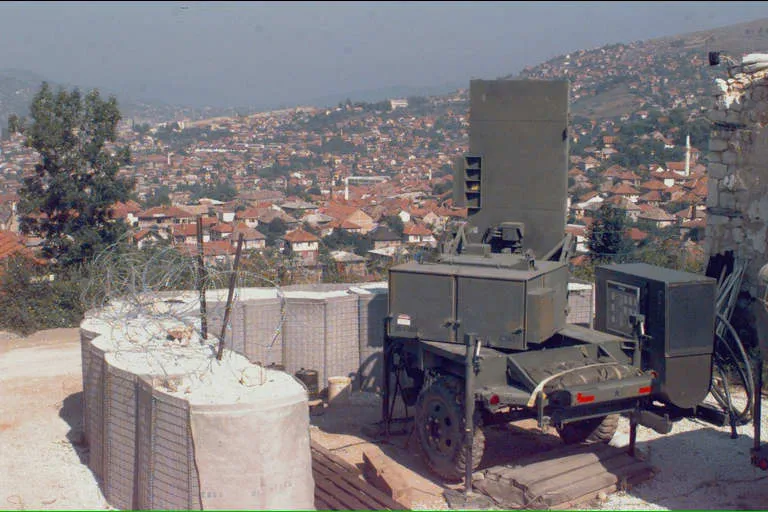
The United States delivered two AN/TPQ-36 radars to Ukraine in November 2015, and Defense Logistics Agency reporting later specified four more counterfire radars tied to 2016 fielding support. In 2022, DoD listed 10 AN/TPQ-36 radars on April 13, three more on May 6, and three more on May 19; Netherlands and Janes reporting also support a five-radar Dutch AN/TPQ-36 transfer, while Ukrainian ArmyInform articles documented battlefield counter-battery use in 2023 and 2025.
Role detailsAN/TPQ-36 Firefinder radar
- AN/TPQ-36
- Q-36
- TPQ-36
- Firefinder
- AN/TPQ-36 Firefinder
- AN/TPQ-36 Firefinder Weapon Locating System
- AN/TPQ-36(V)7
- AN/TPQ-36(V)8
- AN/TPQ-36 counter-artillery radar
The AN/TPQ-36 Firefinder is a U.S. mobile weapon-locating radar built to detect, track, and backplot mortar, artillery, and rocket fire for counter-battery response. Hughes developed the original system, Raytheon and Northrop Grumman supported later Firefinder upgrade paths, and Ukrainian, U.S., and coalition use kept the Q-36 relevant well after newer counterfire radars entered service.
Role in Conflicts
U.S. Army reporting from Iraq described C-RAM using AN/TPQ-36 Firefinder radar in 2006, while a 2008 brigade publication at FOB Hammer identified AN/TPQ-36 and AN/TPQ-37 radars providing warning, launch-point data, and response support against indirect fire.
Role detailsAt Forward Operating Base Kunduz in 2010, U.S. artillery soldiers operated a Q-36 Firefinder radar around the clock to watch for incoming mortars, rockets, and missiles and pass digital tracks to the tactical operations center for possible counterfire.
Profile / Specs
Profile
- Origin
- United States
- Type
- Mobile weapon-locating counterfire radar
- Service note
- Cold War-era U.S. Firefinder radar family, with later sustainment, upgrades, and foreign military transfers continuing into the 2010s and 2020s.
- Designer
- Hughes Aircraft Company
- Designed
- 1970s development; U.S. fielding in the early 1980s
- Unit cost
- About $1.55 million in historical U.S. reference data
- Produced
- Late 1970s onward, with later upgrades and sustainment
- Number built
- 130 original AN/TPQ-36(V) systems reported for the U.S. Army and Marine Corps; Northrop Grumman described 113 AN/TPQ-36(V)8 systems for 1997-2005 delivery
- Developed into
- Enhanced AN/TPQ-36 / EQ-36 development, later designated AN/TPQ-53, became the U.S. Army replacement path for AN/TPQ-36 and AN/TPQ-37 Firefinder radars.
Specifications
- Role
- Counterfire target-acquisition and weapon-locating radar
- Detected threats
- Mortars, artillery, and rocket launchers
- Maximum range
- 24 km in open-source and U.S. Army FMS reference data
- Artillery detection range
- About 14.5-18 km in open-source references
- Rocket detection range
- Up to 24 km
- Simultaneous locations
- Up to 10 weapons reported in seconds
- Scan sector
- 90-degree electronically steered sector
- System elements
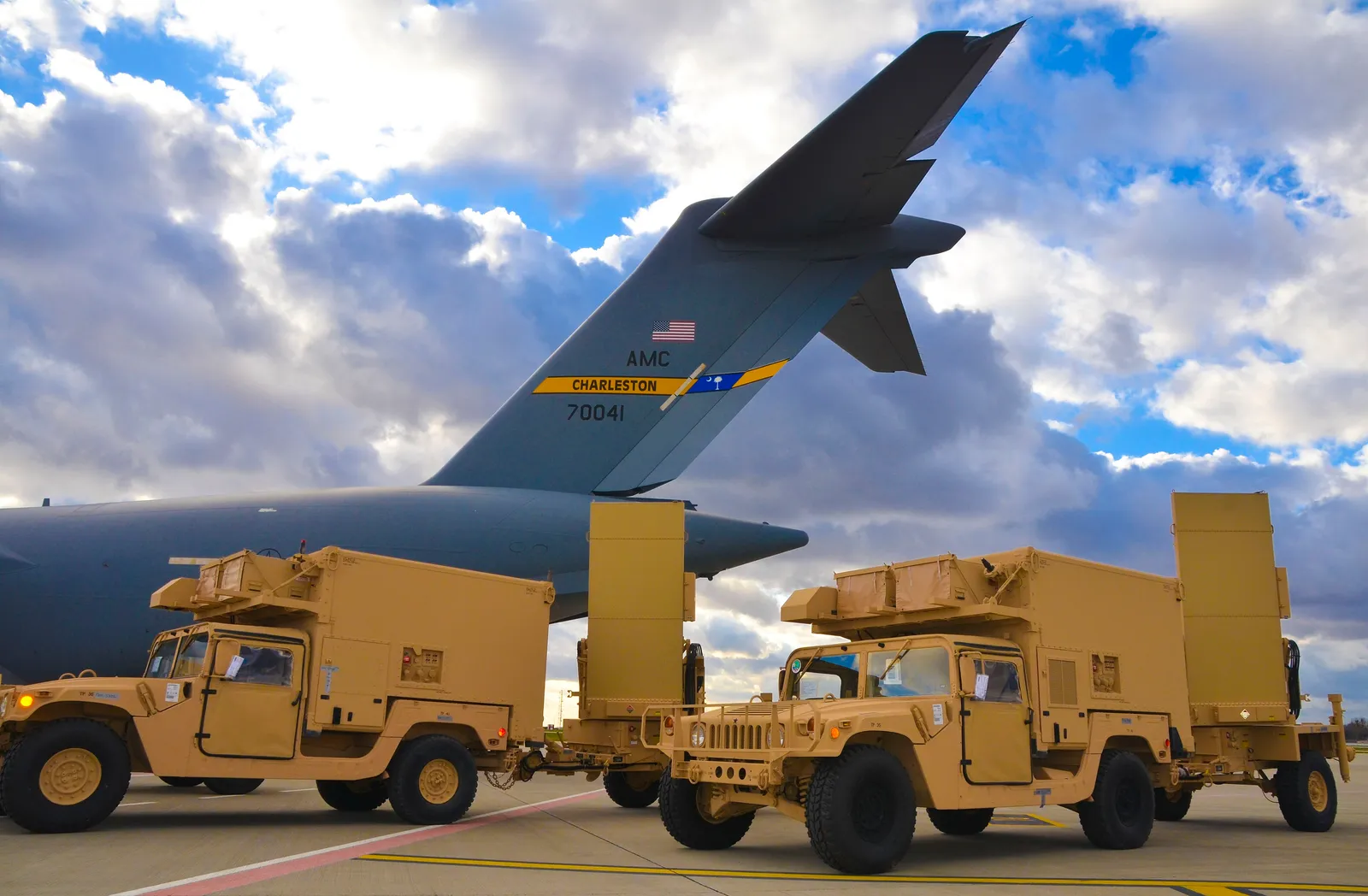
- Antenna-transceiver group, operation-control shelter, generator power group, and trailer-mounted auxiliary generator
- Mobility
- Trailer-mounted radar with HMMWV or tactical-vehicle support; V8 supports HMMWV and C-130 rapid deployment
- Remote operation
- V8 control display terminal supports operation up to 100 m from the radar
- V8 detection improvement
- Northrop Grumman described detection-range improvement of up to 50% against certain threats
- Successor path
- Enhanced AN/TPQ-36 / EQ-36 quick-reaction systems were designated AN/TPQ-53 in 2011
- Crew
- Six to nine personnel depending on configuration and reference
Firefinder Family Context
The Q-36 was the shorter-range Firefinder weapon-locating radar, while the AN/TPQ-37 Firefinder radar served as the larger long-range companion. The later AN/TPQ-53 multimission radar, originally tied to the Enhanced AN/TPQ-36 / EQ-36 program, became the U.S. Army replacement path for legacy Q-36 and Q-37 Firefinder radars.
Counter-Battery Role
The Q-36 is a sensor, not a launcher. Its battlefield value comes from locating hostile indirect-fire weapons quickly enough for artillery, command posts, or fire-direction systems to respond.
Mortars, artillery, and rocket launchers.
Selected 90-degree azimuth sectors over wider coverage by sector movement.
Computes hostile launch coordinates and can also support friendly-fire registration and adjustment.
Variants
Firefinder designations identify successive mobility and electronics configurations rather than separate battlefield roles.
| Variant | Configuration | Designation notes |
|---|---|---|
| AN/TPQ-36(V)5 | Earlier truck-based configuration | FAS describes later HMMWV versions as a downsizing from 5-ton-truck configurations. Sources: FAS AN/TPQ-36 Firefinder |
| AN/TPQ-36(V)7 | HMMWV-based Firefinder | The V7 configuration moved the operations group and antenna-transceiver group onto M1097 HMMWV and trailer combinations and added self-survey capability through MAPS. Sources: FAS AN/TPQ-36 Firefinder |
| AN/TPQ-36(V)8 | Electronics-upgraded Firefinder | The V8 upgrade retained existing antenna hardware while adding a new lightweight shelter, modern radar processor, low-noise amplifier, HMMWV mobility, and 100 m remote operation. Sources: FAS AN/TPQ-36 Firefinder, Northrop Grumman AN/TPQ-36(V)8 Datasheet |
Timeline
AN/TPQ-36 Firefinder radar Key Events
U.S. introduction date listed
FAS lists January 1985 as the AN/TPQ-36 introduction date, matching the system's early-1980s U.S. Army and Marine Corps fielding window.
Sources: FAS AN/TPQ-36 Firefinder
V7 HMMWV fielding completed
The HMMWV-based V7 fielding was completed in the third quarter of 1995 after shrinking the system from larger truck configurations.
Sources: FAS AN/TPQ-36 Firefinder
Firefinder electronics upgrade announced
ThalesRaytheonSystems announced Firefinder upgrades intended to extend service life, improve reliability, and share electronics commonality with improved Sentinel radar hardware.
Sources: Raytheon Firefinder Upgrade Release
Q-36 reported at FOB Kunduz
U.S. Army reporting described a five-person artillery radar team operating a Q-36 Firefinder at Forward Operating Base Kunduz in Afghanistan.
Sources: Army FOB Kunduz Q-36
First Q-36 radars delivered to Ukraine
The United States delivered two AN/TPQ-36 radar systems to Ukraine at Lviv after a Ukrainian request for counter-battery capability.
Sources: Army Q-36 Delivery to Ukraine
Additional Q-36 systems delivered
The U.S. Army Security Assistance Command delivered additional AN/TPQ-36 Firefinder radar systems to Ukrainian armed forces and paired the delivery with training support.
Sources: Army USASAC Ukraine Q-36 Delivery
Firefinder radars reported in eastern Ukraine
RFE/RL reported that Ukraine's Defense Ministry was using U.S.-supplied Firefinder radars to monitor cease-fire violations by Russia-backed separatists in eastern Ukraine.
Sources: RFE/RL Ukraine Firefinder Radars
Ten radars committed after full-scale invasion
DoD listed 10 AN/TPQ-36 counter-artillery radars in an April 13 drawdown package for Ukraine.
Sources: DoD Ukraine April 2022 Assistance
Three more U.S. radars committed
DoD listed three AN/TPQ-36 counter-artillery radars in a May 6, 2022 drawdown package for Ukraine.
Sources: DoD Ukraine May 6 2022 Assistance
Three additional radars committed
A May 2022 security-assistance release added three more AN/TPQ-36 counter-artillery radars for Ukraine.
Sources: DoD Ukraine May 2022 Assistance
Ukrainian battlefield use reported in Kherson Oblast
ArmyInform reported that a Ukrainian naval artillery brigade unit in Kherson Oblast was using AN/TPQ-36 around the clock to locate Russian artillery, rocket, and mortar fire.
Sources: ArmyInform Kherson AN/TPQ-36 Use
Azov artillery reconnaissance use documented
ArmyInform described Azov artillery reconnaissance using AN/TPQ-36 alongside acoustic sensors, UAVs, and artillery to find and attack Russian guns.
Sources: ArmyInform Azov AN/TPQ-36 Use
Media
AN/TPQ-36 Firefinder radar Videos
AN/TPQ-36 Firefinder radar Images
Related Weapon Systems