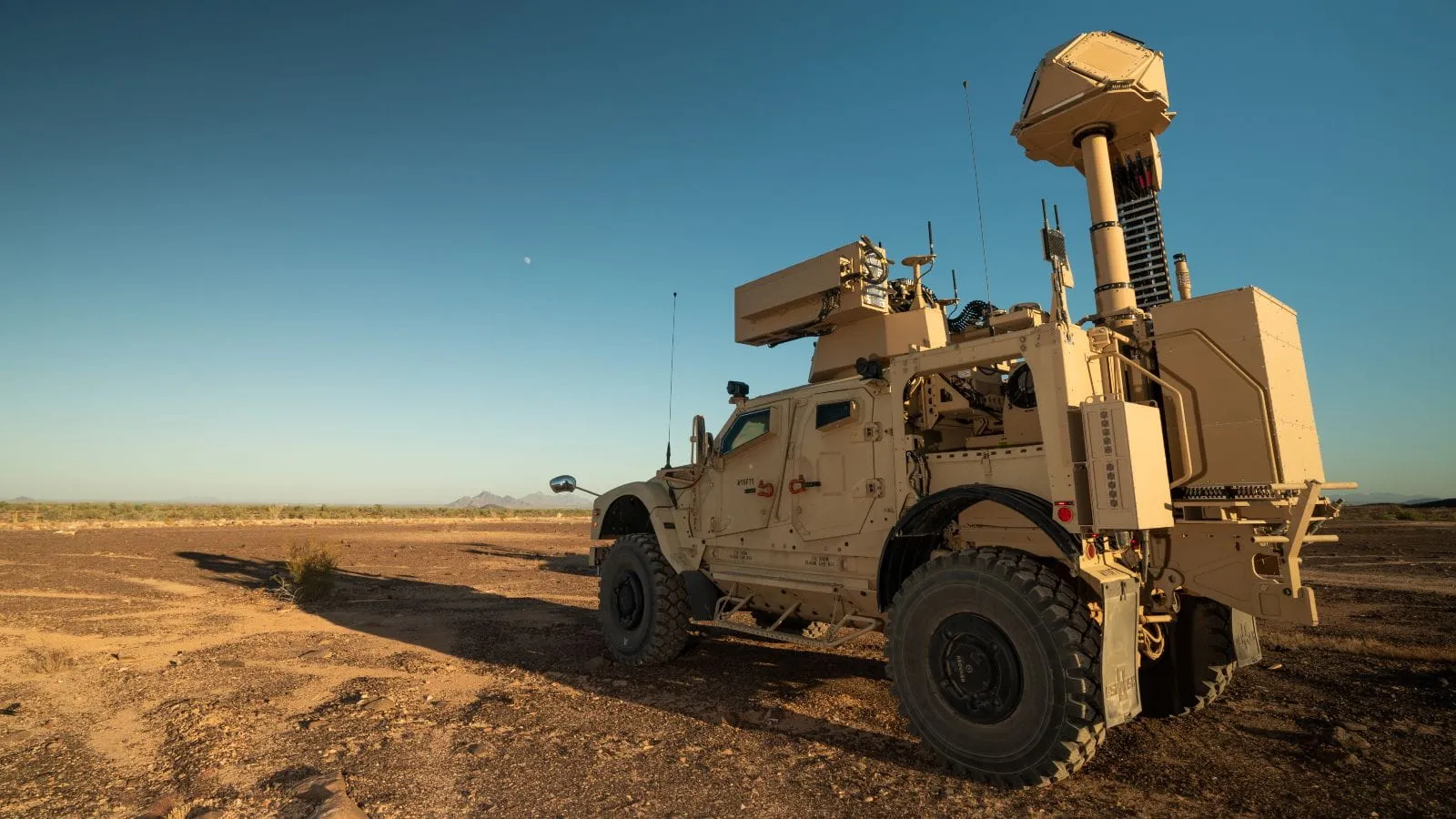

RTX says Raytheon and the U.S. Army made KuRFS as a sense-and-warn radar to detect and track rocket, artillery, and mortar attacks in the 2003 Iraq War.
Role detailsSupport Equipment
KuRFS radar
Also known as
- KuRFS
- Ku-band Radio Frequency Sensor
- Ku-band RF Sensor
- KuRFS precision targeting radar
KuRFS is RTX's Ku-band Radio Frequency Sensor, a 360-degree AESA radar first developed with the U.S. Army for rocket, artillery, and mortar warning in Iraq and Afghanistan and later adapted into the Army's LIDS counter-UAS architecture with Coyote effectors.
Role in Conflicts


RTX says the KuRFS sense-and-warn mission also covered the 2001 War in Afghanistan, where the radar was built to track rocket, artillery, and mortar attacks against U.S. forces.
Role detailsProfile / Specs
Profile
- Origin
- United States
- Built by
- Raytheon
- Type
- Counter-UAS and counter-RAM radar
- Service note
- 2010s-present
Specifications
- Radar type
- 360-degree Ku-band AESA radar
- Threats tracked
- Drones, rockets, artillery, and mortars
- Deployment
- Fixed location or vehicle-mounted; set up in about 30 minutes
- Deployment options
- Fixed relocatable KuRFS and mobile Ku720 radar family
- Role
- Detects, identifies, tracks, discriminates, and cues defensive weapons
- Documented integrations
- Coyote, land-based Phalanx, .50-caliber guns, 30 mm cannons, and high-energy laser defenses
Variants
RTX describes KuRFS as the fixed, relocatable radar in the LIDS family and Ku720 as the scaled mobile sensing radar.
| Variant | Configuration | Designation notes |
|---|---|---|
| Ku720 | Mobile sensing radar | RTX describes Ku720 as the mobile version of the KuRFS radar family and as the LIDS mobile sensing radar. Sources: Meet the US Army's LIDS: A sure shot against drones |
Coyote Effectors
RTX describes KuRFS and Coyote as the detect-and-defeat components of the Army's LIDS counter-UAS solution.
| Compatible item | Item type | Compatibility evidence |
|---|---|---|
 | Counter-UAS effector | RTX says KuRFS and Coyote team up to defeat unmanned aircraft system threats in LIDS, with KuRFS providing detection and Coyote providing defeat. Sources: Meet the US Army's LIDS: A sure shot against drones |
LIDS Sensor Platforms
RTX describes KuRFS as part of the Army's LIDS stack, which can be configured as either fixed or mobile, relocatable platforms.
| Compatible item | Item type | Compatibility evidence |
|---|---|---|
 | Fixed-site counter-UAS system | RTX says LIDS can be deployed as a fixed, relocatable platform and uses KuRFS as the 360-degree threat-detection sensor in that architecture. Sources: Meet the US Army's LIDS: A sure shot against drones |
 | Mobile counter-UAS system | RTX says LIDS can also be deployed as a mobile, relocatable platform, with Ku720 providing the mobile radar option in the KuRFS family. Sources: Meet the US Army's LIDS: A sure shot against drones |
C-RAM And Weapon Cueing
RTX describes KuRFS as a radar that began in the counter-rocket, artillery, and mortar warning mission and can cue several defensive weapon layers.
| Compatible item | Item type | Compatibility evidence |
|---|---|---|
 | Land-based close-in weapon system | RTX says KuRFS works with land-based Phalanx, and the cataloged C-RAM page covers that land-based Phalanx role. |
Radar Mission Context
KuRFS matters because it links warning, tracking, and defeat cueing in one radar layer.
| Mission role | Documented context |
|---|---|
| Counter-RAM warning | Raytheon and the U.S. Army built KuRFS to detect rocket, artillery, and mortar attacks in Afghanistan and Iraq. |
| Counter-UAS detection | RTX describes a 360-degree Ku-band AESA radar that tracks drones as well as rockets, artillery, and mortars. |
| Defeat cueing | RTX ties KuRFS to Coyote, land-based Phalanx, .50-caliber guns, 30 mm cannons, and high-energy laser defenses. |
Timeline
KuRFS radar Key Events
Sense-and-warn radar mission
RTX says Raytheon made KuRFS with the U.S. Army as a sense-and-warn radar for rocket, artillery, and mortar attacks in Afghanistan and Iraq.
Sources: Meet the US Army's LIDS: A sure shot against drones
Counter-UAS adaptation
RTX says Raytheon enhanced KuRFS for the counter-UAS mission under an Army Joint Urgent Operational Needs program.
Sources: Meet the US Army's LIDS: A sure shot against drones
Short-range air defense deployment
RTX says the Army deployed KuRFS for short-range air defense before it became a core counter-UAS radar.
Sources: Meet the US Army's LIDS: A sure shot against drones
Battlefield operating-hour milestone
RTX says KuRFS and the Ku720 mobile radar surpassed 1.5 million operational battlefield hours providing detect, discriminate, and intercept support.
Sources: Meet the US Army's LIDS: A sure shot against drones
LIDS begins CENTCOM-area operation
RTX says the Army's LIDS counter-UAS system began operation in the Army's CENTCOM area with KuRFS and Coyote in the detect-and-defeat architecture.
Sources: Meet the US Army's LIDS: A sure shot against drones
Army orders additional KuRFS and Coyote systems
Raytheon Technologies announced a $237 million Army contract for KuRFS radars and Coyote effectors, including fixed-site and mobile systems for Army Central Command operations.
Sources: Raytheon Technologies awarded $237 million counter-UAS contract
Summer test period demonstration
RTX reported that KuRFS and Coyote met Army test requirements against high-speed maneuvering targets during the U.S. Army's annual summer test period.
Sources: Meet the US Army's LIDS: A sure shot against drones
Related Weapon Systems


Sources
KuRFS: Ku-band Radio Frequency SensorPublisher: RTX | Note: Supports KuRFS manufacturer background, specifications, deployment context, LIDS and weapon-cueing relationships, image provenance, and direct 2003 Iraq War and 2001 War in Afghanistan context for the U.S. Army sense-and-warn mission. | Accessed: 2026-06-29Meet the US Army's LIDS: A sure shot against dronesPublisher: RTX | Note: Supports the KuRFS/Coyote LIDS relationship, the Ku720 mobile radar context, timeline milestones, battlefield operating-hour background, and direct 2003 Iraq War and 2001 War in Afghanistan sense-and-warn context for KuRFS. | Accessed: 2026-06-29Raytheon Technologies awarded $237 million counter-UAS contractPublisher: Raytheon Technologies / PRNewswire | Note: Supports the April 19, 2023 Army contract for KuRFS radars and Coyote effectors, fixed-site and mobile LIDS quantities, and Army Central Command support context. | Accessed: 2026-06-29