Aircraft & UAVs

E-2D Advanced Hawkeye

Also known as
  • Advanced Hawkeye
  • AHE

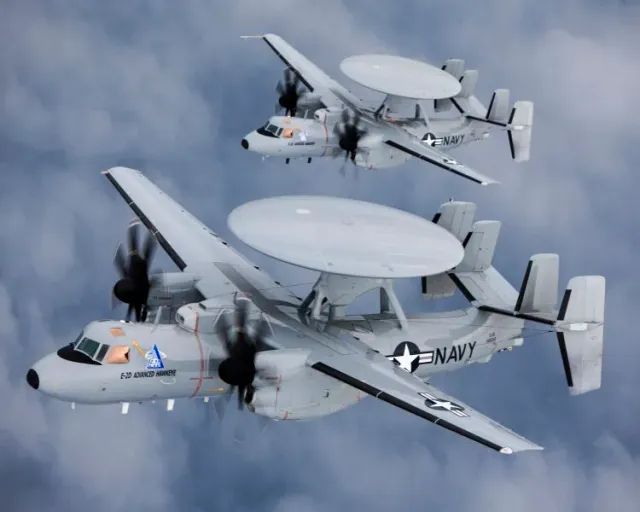
The E-2D Advanced Hawkeye is the U.S. Navy's newest carrier-based airborne early warning and battle-management aircraft. Its APY-9 radar adds 360-degree scanning and better small-target detection, while the five-person crew and glass cockpit support multi-mission command and control. U.S. E-2Ds were documented supporting Operation Epic Fury in 2026.

Role in Conflicts

Role in conflict
Carrier airborne early warning and battle management

2020 United States-Iran Conflict: used by U.S. Navy carrier air wings in support of Operation Epic Fury aboard USS Gerald R. Ford and USS Abraham Lincoln on Feb. 28, 2026.

What Sets It Apart

The E-2D is a carrier sensor node first. The Navy's program pages show a platform built to extend the fleet's reach, keep the crew workload flexible, and stay on station longer when aerial refueling is available.

FeatureSource-backed detailWhy it matters
RadarAN/APY-9 radar with 360-degree coverage and simultaneous air/ground tracking.Improves wide-area surveillance and battle management from the carrier deck.
Crew / cockpitFive-person crew with the option for the co-pilot to act as a fourth mission systems operator.Lets the crew share command-and-control work during long sorties.
Mission setAirborne strike support, land-force support, rescue operations, communications relay, and drug interdiction support.Shows the aircraft's role as a multi-mission airborne command post, not just a radar plane.
Program / cost benchmarkNorthrop's 2007 pilot-production contract totaled $408 million for the next three E-2Ds.Gives readers a public price reference point for the early production run.
Profile / Specs

Profile

Origin
United States
Type
Carrier-based airborne early warning and control aircraft
Service note
2010s-present
Designed
2007 pilot-production phase
Unit cost
About $136 million per aircraft in Northrop Grumman's 2007 pilot-production contract for the next three E-2D Advanced Hawkeyes.
Produced
2007-present
Developed from
E-2C Hawkeye

Specifications

Length
57 ft. 8.75 in
Crew
Five
Speed
300+ kts
Ceiling
37,000 ft
Power plant
Two Rolls-Royce T56-A-427A turboprop engines, 5,100 shp each
Radar
AN/APY-9 UHF radar with 360-degree coverage and simultaneous air/ground tracking
Installed Radar

The E-2D's mission fit centers on the AN/APY-9 radar.

Carried itemItem typeCarriage evidence
AN/APY-9 Radar, Airborne early warning radar, Air DefenseAN/APY-9 RadarAirborne early warning radar

Official E-2D sources identify AN/APY-9 as the aircraft's radar and primary sensor, showing the E-2D carries the system as part of its mission fit.

Sources: Navy accepts delivery of E-2D Advanced Hawkeye, Lockheed Martin APY-9 radar

Timeline

E-2D Advanced Hawkeye Key Events

  1. Northrop Grumman wins pilot-production contract

    Northrop Grumman announced a $408 million U.S. Navy pilot-production contract for the E-2D program and said the next three aircraft would be delivered in 2010.

    Sources: Northrop Grumman Awarded $408 Million U.S. Navy Pilot Production Contract for E-2D Advanced Hawkeye; System Development and Demonstration Ongoing

  2. First deliveries planned for the fleet

    Northrop Grumman said the first three pilot-production E-2Ds were to be delivered in 2010, marking the aircraft's move toward fleet introduction.

    Sources: Northrop Grumman Awarded $408 Million U.S. Navy Pilot Production Contract for E-2D Advanced Hawkeye; System Development and Demonstration Ongoing

  3. U.S. Navy declares IOC

    NAVAIR identifies October 2014 as the E-2D Advanced Hawkeye's initial operational capability date.

    Sources: NAVAIR E-2D Advanced Hawkeye

  4. Aerial refueling joins the mission set

    NAVAIR says the E-2D achieved aerial-refueling IOC in FY2020, extending time on station for carrier operations.

    Sources: NAVAIR E-2D Advanced Hawkeye

  5. Carrier air wings support Operation Epic Fury

    DVIDS and CENTCOM documented U.S. Navy E-2Ds flying in support of Operation Epic Fury from USS Gerald R. Ford and USS Abraham Lincoln.

    Sources: DVIDS U.S. Forces Launch Operation Epic Fury, CENTCOM USS Abraham Lincoln Flight Ops Support Operation Epic Fury

Media
Related Weapon Systems
AN/TPQ-53 multimission radar, Mobile multimission counterfire and air-surveillance radar, Electronic WarfareElectronic WarfareAN/TPQ-53 multimission radarMobile multimission counterfire and air-surveillance radarThe AN/TPQ-53, commonly called Q-53, is a Lockheed Martin mobile active electronically scanned array radar that began as the Army's counterfire replacement for AN/TPQ-36 and AN/TPQ-37 Firefinder radars. Its baseline mission is to detect, classify, track, and locate mortar, artillery, and rocket launches in 90-degree or 360-degree modes, while software and open-architecture upgrades have extended the same family into counter-UAS, air-surveillance, and wider multimission radar roles.
EA-18G Growler, Carrier-capable airborne electronic attack aircraft, Electronic WarfareElectronic WarfareEA-18G GrowlerCarrier-capable airborne electronic attack aircraftThe EA-18G Growler is a Boeing-built electronic attack derivative of the two-seat F/A-18F Super Hornet, fielded to jam, detect, and attack hostile radars, communications, and air-defense networks while retaining missile carriage for suppression missions. U.S. Navy and Australian Growlers provide carrier or land-based electronic warfare support, with early combat deployment in Iraq and Libya in 2010-2011 and later documented use in 2014 Operation Inherent Resolve, Red Sea operations against Houthi forces, and the U.S.-Iran strike context.
Gulfstream G550 Nachshon Eitam, Airborne early warning and control aircraft, Aircraft & UAVsAircraft & UAVsGulfstream G550 Nachshon EitamAirborne early warning and control aircraftThe Gulfstream G550 Nachshon Eitam is Israel's conformal airborne early warning and control version of the G550 business jet, modified by Israel Aerospace Industries and ELTA with the EL/W-2085 AESA radar and mission systems. Operated by Israeli Air Force 122 Squadron, it provides airborne surveillance, battle management, and command-and-control support for air defense and long-range strike operations, including documented use during Iron Swords and the 2025 Israel-Iran conflict.
F-35 Electro Optical Targeting System (EOTS), Internally mounted electro-optical targeting sensor subsystem, Support EquipmentSupport EquipmentF-35 Electro Optical Targeting System (EOTS)Internally mounted electro-optical targeting sensor subsystemThe F-35 Electro Optical Targeting System (EOTS) is the AN/AAQ-40 sensor installation built into the F-35 Lightning II for precision air-to-air and air-to-surface targeting. Lockheed Martin describes it as a low-observable, internally mounted system that combines forward-looking infrared and infrared-search-and-track functions, and Janes reported F-35I EOTS footage from an Israeli cruise-missile interception during the 2023 Israel-Hamas War.
E-11A airborne communications relay aircraft, Airborne communications relay aircraft, Aircraft & UAVsAircraft & UAVsE-11A airborne communications relay aircraftAirborne communications relay aircraftThe E-11A is a modified Bombardier Global 6000/BD-700 or Global 6500 business jet used by the U.S. Air Force as the Battlefield Airborne Communications Node, or BACN. It relays and translates voice, imagery, tactical data links, and IP-based traffic between otherwise incompatible air, ground, maritime, and coalition networks. The type entered combat in Afghanistan in 2008, CENTCOM listed it among Operation Epic Fury assets in 2026, and nine airframes had been delivered by September 2025 even as the Air Force's FY2027 posture statement planned full divestment in FY2028.

Sources