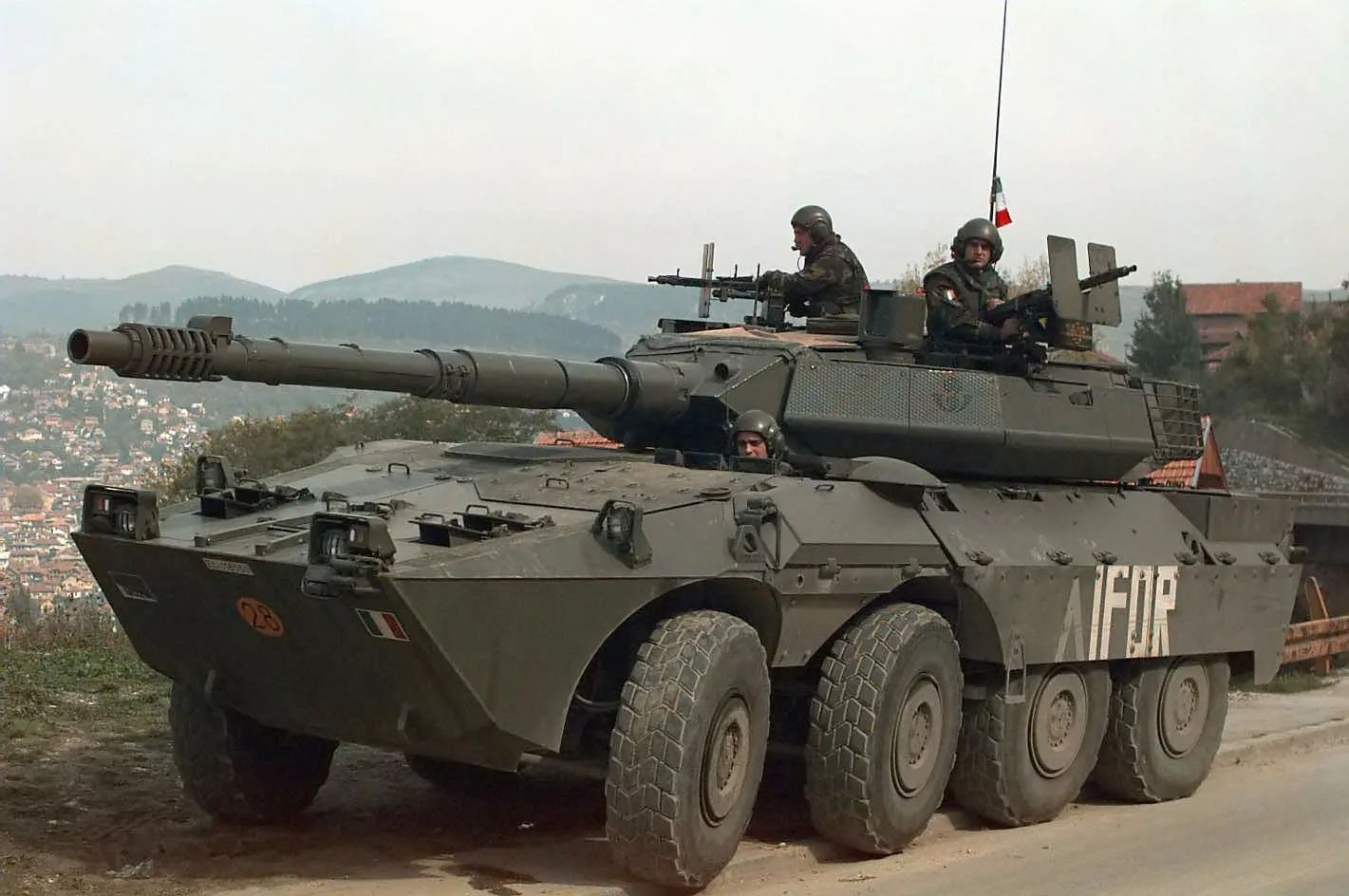
Italian Centauro heavy armored cars served with the UNOSOM II-era Italian contingent in Mogadishu; official Italian honors material identifies Andrea Millevoi as commander of a Centauro platoon during the July 2, 1993 Checkpoint Pasta fighting.
Armored Vehicles
Centauro B1
Also known as
- B1 Centauro
- Centauro
- Blindo Armata Centauro
- Centauro 105
- Centauro 105mm
- Centauro 105/52
- VRCC Centauro
- VRCC-105 Centauro
- Vehiculo de Reconocimiento y Combate de Caballeria Centauro
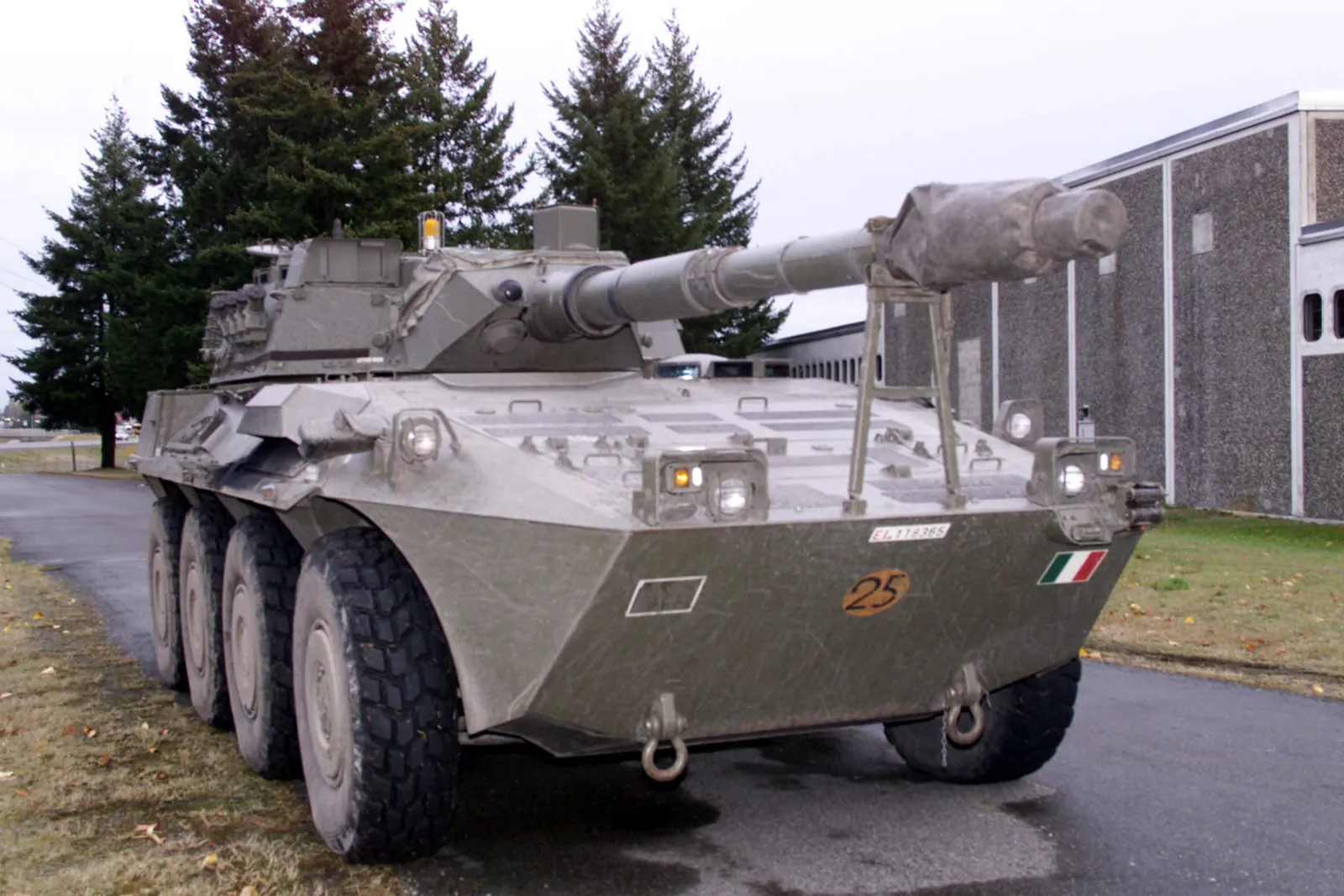
The Centauro B1 is an Italian 8x8 wheeled tank destroyer built for cavalry reconnaissance, rapid road movement, and direct-fire support rather than main-battle-tank protection. Developed by the IVECO-Fiat and OTO Melara consortium, it combines an OTO Melara 105 mm/52 rifled gun, a four-person crew, long road range, and a comparatively light wheeled chassis; documented conflict use includes Italian UNOSOM II fighting in Somalia, coalition employment in Iraq, and Ukrainian service where crews have added anti-drone protection and used the gun from closed firing positions.
Role in Conflicts

Centauro armored cars were fielded by coalition forces in Iraq, including Italian Centauro elements in the 2004 Nasiriyah bridge battles and Spanish 105/52 mm Centauros sent to reinforce Spain's Iraq contingent.
Role details- Side
- Ukraine

Ukrainian Air Assault Forces footage and later Army TV reporting confirmed Italian Centauro B1 vehicles with the 78th Separate Air Assault Brigade; 2026 reports describe anti-drone cage and hood modifications and closed-position fire-support use.
Role detailsUkraine Adaptation
In Ukrainian service, the Centauro B1 is documented less as a classic road-mobile tank hunter and more as a protected direct-fire platform adapted to a drone-heavy front. Reporting tied to Army TV footage shows the 78th Separate Air Assault Brigade operating vehicles with cage and hood-style anti-drone additions, while crew accounts describe firing from concealed closed positions when direct armored engagements are too exposed.
Visible protection
Footage and stills show Ukrainian-added cage armor, protective hood structures, and layered anti-drone screens over factory armor.
Sources: Rare Footage of Italy's B1 Centauro Tank in Ukraine; Rare B1 Centauro Tank Destroyer Spotted With Ukraine's 78th Air Assault Brigade.
Fire role
Ukrainian crew accounts describe using the 105 mm gun from closed positions, including a reported long-range shot around 11 km.
Sources: Rare Footage of Italy's B1 Centauro Tank in Ukraine; Business Insider Centauro 11 Kilometer Shot.
Known limit
Open reporting still leaves the number of vehicles delivered and the scale of frontline deployment undisclosed.
Sources: Ukraine Receives B1 Centauro Wheeled Tanks; Rare B1 Centauro Tank Destroyer Spotted With Ukraine's 78th Air Assault Brigade.
Profile / Specs
Profile
- Origin
- Italy
- Built by
- IVECOOTO Melara
- Type
- 8x8 wheeled tank destroyer
- Service note
- Entered Italian Army production in 1990/1991; documented in Somalia, Iraq, and Ukrainian service
- Designer
- IVECO-Fiat and OTO Melara consortium
- Designed
- Italian Army requirement defined in 1984; complete prototypes trialed from 1987
- Produced
- 1990/1991-2006
- Number built
- About 493 B1 Centauro vehicles including 120 mm export examples, excluding prototypes
- Developed into
- Centauro II / B2 Centauro wheeled tank-destroyer family
Specifications
- Crew
- 4: commander, gunner, loader, and driver
- Main armament
- OTO Melara / OTO-Breda 105 mm/52 rifled gun
- Ammunition
- 40 x 105 mm rounds; 14 in the turret and 26 in the hull
- Secondary armament
- 7.62 mm machine guns; roof machine-gun fit varies by operator and batch
- Engine
- IVECO V6 turbocharged diesel, about 520 hp / 382 kW
- Maximum road speed
- About 105-110 km/h depending on source, operator, and configuration
- Range
- About 800 km
- Combat weight
- About 24-27 tonnes depending on batch, armor fit, and operator
- Mobility features
- 8x8 driveline, hydropneumatic suspension, run-flat tires, and central tire-pressure regulation
- Protection
- Welded steel armor; later Italian batches added improved ballistic protection, laser warning, and GALIX smoke launchers
- Fire control
- Stabilized sighting/fire-control system with ballistic computer; designed to fire on the move
- Ammunition compatibility
- 105 mm NATO-standard kinetic and chemical-energy tank-gun ammunition; manufacturer material also describes 120 mm weapon compatibility in Centauro I/HITFACT turret context
- Fire-on-the-move capability
- Fully stabilized main weapon; manufacturer material says the Centauro I can fire on the move, including broad traverse angles relative to the hull
Design Tradeoff
The B1 Centauro gives cavalry units a tank-caliber direct-fire weapon on a lighter wheeled chassis. That makes road movement, reconnaissance support, and rapid displacement central to the design, while protection remains lighter than a main battle tank.
Firepower
The 105 mm/52 rifled gun fires NATO-standard 105 mm tank ammunition, with 40 rounds carried in the vehicle.
Sources: Centauro 1; b1 centauro mgs 105.
Mobility
The 8x8 chassis uses an IVECO V6 diesel around 520 hp, hydropneumatic suspension, run-flat tires, and central tire-pressure control for high-speed road movement and cross-country travel.
Sources: Centauro 1; Farnesio Regiment Centauro.
Protection Limit
Open sources describe welded-steel armor and later batch improvements, but the vehicle remains a gun-armed cavalry system rather than a heavy tank substitute.
Sources: Blindo Armata Centauro; Centauro 1.
105 mm Gun Context
The Centauro B1 and Spanish VRCC gun context is a NATO tank-gun ammunition relationship, not a 105 mm howitzer-ammunition relationship. Manufacturer material describes the Centauro I turret with 105 mm or 120 mm main-weapon options firing standard NATO kinetic or chemical-energy ammunition, while Spanish Army material identifies the VRCC with a 105/52 mm gun. The existing 105 mm Royal Ordnance L7 record is useful as related NATO 105 mm tank-gun context; it should not be treated as proof that the Centauro mounts an unmodified British-built L7 rather than the OTO Melara 105/52 gun.
Sources: Centauro I - IDV OTO Melara; Division San Marcial Materials; VRCC Centauro 105 mm Ammunition Framework.
Variants
Centauro B1 designations vary by operator and batch. The baseline record covers the 105 mm Italian-family wheeled tank destroyer; later Centauro II/B2 vehicles are better treated as successors rather than simple B1 variants.
| Variant | Configuration | Designation notes |
|---|---|---|
| B1 Centauro first series | Early Italian production configuration | Italian Army material distinguishes an initial group of pre-series and first-series vehicles from later better-protected batches. Sources: Blindo Armata Centauro |
| B1 Centauro second and third series | Improved Italian Army batches | Later Italian batches added improved ballistic protection, laser-warning equipment, GALIX smoke launchers, and limited scout-carrying options according to the Italian Army. Sources: Blindo Armata Centauro |
| VRCC-105 Centauro | Spanish reconnaissance and cavalry combat vehicle | Spanish Army material identifies VRCC Centauro as an Italian-origin reconnaissance and combat vehicle with a 105/52 mm gun; Spanish reporting says the fleet totals 84 vehicles, with first arrivals in 1999 and later replacement planning under way. Sources: Division San Marcial Materials, Farnesio Regiment Centauro, VRCC Centauro 105 mm Ammunition Framework |
| Centauro 120 mm | 120 mm gun derivative/export configuration | The Centauro family includes 120 mm gun configurations, but these are separated from the baseline B1 105 mm conflict-use evidence on this page. Sources: Centauro 1 |
Timeline
Centauro B1 Key Events
Italian Army requirement
The Italian Army formulated a requirement for a highly mobile wheeled tank destroyer with a NATO-standard 105 mm rifled tank gun.
Sources: Centauro 1
Prototype trials begin
Army Recognition reports that the first complete prototype was finished in January 1987, followed by additional prototypes and trials.
Sources: Centauro 1
Production starts
Italian Army and Army Recognition sources place production start around 1990/1991, with first production vehicles completed in 1991 and later production continuing into the 2000s.
Sources: Blindo Armata Centauro, Centauro 1
Checkpoint Pasta fighting
Centauro heavy armored cars were tied to the Italian contingent's fighting in Mogadishu during the UNOSOM II-era Checkpoint Pasta battle.
Sources: Quirinale Andrea Millevoi Gold Medal Citation, Mogadiscio 2 luglio 1993
Spanish VRCC deliveries begin
Spanish reporting says the first Centauro B1/VRCC vehicles arrived in Spain in 1999; later reporting describes an 84-vehicle Spanish fleet.
Sources: VRCC Centauro 105 mm Ammunition Framework
Spanish Iraq reinforcement reported
El Pais reported that Spain would reinforce its Iraq deployment with six 105/52 mm Centauro armored vehicles.
Sources: Espana refuerza su despliegue en Irak con seis blindados
Nasiriyah bridge battles
Italian Centauro vehicles appeared in reporting on the 2004 Nasiriyah bridge fighting during Operation Antica Babilonia.
Sources: Iraq Italian Lessons Learned, La battaglia dei ponti
Ukrainian service visually confirmed
Army Recognition reported that Ukrainian 78th Air Assault Regiment imagery showed Centauro B1 vehicles in Ukrainian service with improvised protection.
Sources: Ukraine Fields Italy's Centauro B1, Italy's Tank-Killer Centauro B1 Rolls Into Frontlines in Ukraine
Army TV shows 78th Brigade Centauros
Ukrainian Army TV footage and follow-on reporting showed B1 Centauro vehicles with the 78th Separate Air Assault Brigade, including anti-drone add-ons and crew accounts of closed-position fire.
Sources: Rare Footage of Italy's B1 Centauro Tank in Ukraine, Rare B1 Centauro Tank Destroyer Spotted With Ukraine's 78th Air Assault Brigade, Business Insider Centauro 11 Kilometer Shot
Media
Related Weapon Systems


Sources
Blindo Armata CentauroPublisher: Esercito Italiano | Note: Supports Italian Army nomenclature, production/batch context, 105 mm gun, stabilized firing, mobility, improved later-series protection, GALIX smoke launchers, and laser-warning context. | Accessed: 2026-07-13Centauro 1Publisher: Army Recognition | Note: Supports Centauro B1 design history, IVECO Defence Vehicles and OTO Melara manufacturer roles, prototype and production chronology, armament, ammunition stowage, protection, propulsion, mobility, and variant context. | Accessed: 2026-07-13b1 centauro mgs 105Publisher: Army Guide | Note: Supports crew, 105 mm/52 gun, NATO ammunition compatibility, ammunition stowage, IVECO V6 diesel power, transmission, fire-control, and mobility details. | Accessed: 2026-07-13Division San Marcial MaterialsPublisher: Spanish Army | Note: Supports Spanish VRCC Centauro designation, Italian origin, reconnaissance/combat role, weight, speed, range, and 105/52 mm armament. | Accessed: 2026-07-13Farnesio Regiment CentauroPublisher: Ejercito de Tierra | Note: Supports Spanish VRCC Centauro specifications including 105 km/h speed, 520 CV engine, 800 km range, 105 mm gun, and machine-gun armament. | Accessed: 2026-07-13Centauro IIPublisher: Iveco Defence Vehicles | Note: Supports Centauro II as the successor evolution of Centauro I and the broader 8x8 wheeled tank-destroyer family context. | Accessed: 2026-07-13Leonardo Centauro II ContractPublisher: Leonardo | Note: Supports the current Iveco-Oto Melara consortium and Leonardo successor context for the Centauro family. | Accessed: 2026-07-13Centauro I - IDV OTO MelaraPublisher: IDV - OTO Melara | Note: Supports current manufacturer legacy-page framing for Centauro I, road speed, mobility, ballistic-steel hull, add-on armor, HITFACT turret, 105 mm/120 mm main-weapon options, NATO-standard kinetic/chemical-energy ammunition compatibility, stabilized fire on the move, and extreme-environment testing. | Accessed: 2026-07-13VRCC Centauro 105 mm Ammunition FrameworkPublisher: InfoDefensa | Note: Supports Spanish VRCC Centauro context, including 105 mm anti-tank ammunition procurement, four-person crew, 105/52 mm rifled gun, 84-vehicle Spanish fleet, first arrivals in 1999, and replacement-planning context. | Accessed: 2026-07-13Quirinale Andrea Millevoi Gold Medal CitationPublisher: Presidency of the Italian Republic | Note: Supports 1991 Somali Civil War direct use by identifying Andrea Millevoi as commander of a Centauro heavy armored-car platoon in the Italian contingent in Somalia during fighting in Mogadishu. | Accessed: 2026-07-13Mogadiscio 2 luglio 1993Publisher: Il Corno d'Africa | Note: Supports 1991 Somali Civil War direct-use context by describing Italian B1 Centauro heavy armored cars in the July 2, 1993 Checkpoint Pasta fighting and evacuation/fire-support context. | Accessed: 2026-07-13Iraq Italian Lessons LearnedPublisher: Military Review | Note: Supports 2003 Iraq War direct use by documenting Italian Operation Antica Babilonia forces moving with Centauro armored reconnaissance vehicles during 2004 fighting in Iraq. | Accessed: 2026-07-13La battaglia dei pontiPublisher: Analisi Difesa | Note: Supports 2003 Iraq War direct fire use by describing Centauro armored-vehicle involvement during the Nasiriyah bridge battle. | Accessed: 2026-07-13Espana refuerza su despliegue en Irak con seis blindadosPublisher: El Pais | Note: Supports 2003 Iraq War deployment context by reporting Spain's decision to send six 105/52 mm Centauro combat vehicles to its Iraq contingent. | Accessed: 2026-07-13Ukraine Fields Italy's Centauro B1Publisher: Army Recognition | Note: Supports 2014 Russia-Ukraine War direct use by reporting Ukrainian 78th Separate Airborne Assault Regiment footage showing Centauro B1 vehicles in Ukrainian frontline service. | Accessed: 2026-07-13Ukraine Receives B1 Centauro Wheeled TanksPublisher: Defense Express | Note: Supports 2014 Russia-Ukraine War direct use by reporting first public imagery of a B1 Centauro in Ukrainian service with the 78th Separate Air Assault Regiment and added anti-drone protection. | Accessed: 2026-07-13Rare Footage of Italy's B1 Centauro Tank in UkrainePublisher: Defense Express | Note: Supports 2014 Russia-Ukraine War direct use by describing Army TV footage of Ukrainian 78th Separate Air Assault Brigade Centauro B1 vehicles, anti-drone protection, and crew accounts of closed-position fire. | Accessed: 2026-07-13Rare B1 Centauro Tank Destroyer Spotted With Ukraine's 78th Air Assault BrigadePublisher: UNITED24 Media | Note: Supports 2014 Russia-Ukraine War direct use by linking the Army TV video to Ukrainian 78th Separate Air Assault Brigade Centauro B1 operations, visible anti-drone modifications, and undisclosed delivery scale. | Accessed: 2026-07-13Business Insider Centauro 11 Kilometer ShotPublisher: Business Insider | Note: Supports 2014 Russia-Ukraine War direct use by reporting Ukrainian 78th Separate Air Assault Brigade crew accounts of a B1 Centauro firing from a closed position at about 11.1 km and operating with anti-drone cage and netting. | Accessed: 2026-07-13Italy's Tank-Killer Centauro B1 Rolls Into Frontlines in UkrainePublisher: United24 Media | Note: Supports 2014 Russia-Ukraine War direct use by citing Ukrainian Air Assault Forces and Defense Express reporting that Centauro B1 vehicles are operating in Ukrainian service; also supports the 105 mm Oto Melara/L7 lineage and standard NATO ammunition context. | Accessed: 2026-07-13Wikimedia Commons - Centauro01.JPEGPublisher: Wikimedia Commons | Note: Supports image provenance for a public-domain U.S. military image of an IFOR-marked Italian Army Centauro B1 on patrol in Sarajevo, Bosnia-Herzegovina. | Accessed: 2026-07-13Wikimedia Commons - A B1 Centauro wheeled tank destroyer in Fort LewisPublisher: Wikimedia Commons | Note: Supports image provenance for a public-domain U.S. federal government/NARA image of a B1 Centauro at Fort Lewis, Washington. | Accessed: 2026-07-13