Defense Express reported September 2025 photographs of VCC-1 Camillino carriers from Italian storage being transported toward Ukraine; MilitaryLand later reported VCC-1s in Ukrainian brigade service, and Oryx listed four Ukrainian VCC-1 losses.
Role detailsVCC-1 Camillino
- VCC-1
- VCC 1
- VCC-1 Camallino
- VCC-1 Camilino
- Camillino
- Italian VCC-1
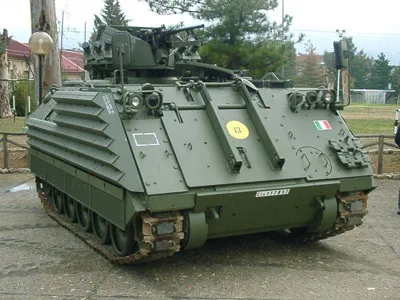
The VCC-1 Camillino is an Italian OTO Melara M113A1 derivative that traded some troop capacity for sloped side armor, firing ports, and a protected machine-gun position. It sits between the baseline M113 family and later Italian infantry fighting vehicles, and 2025-2026 open reporting documented VCC-1 vehicles transported toward Ukraine, identified in Ukrainian brigade service, and later listed among visually documented Ukrainian losses.
Role in Conflicts
Profile / Specs
Profile
- Origin
- Italy
- Built by
- OTO Melara
- Type
- Tracked armored personnel carrier
- Service note
- Cold War Italian service with later Ukrainian service reporting
- Designer
- OTO Melara / OTO-Breda
- Designed
- 1970s development; 1980s Italian service
- Produced
- Late-1970s development with early-1980s production approval and conversion period
- Number built
- Open-source estimates vary; Tank-AFV separates about 600 Italian Army VCC-1 vehicles from about 200 Saudi TOW-under-armor vehicles, while broader VCC-family figures can include VCC-2 conversions
- Developed from
- M113A1 armored personnel carrier
Specifications
- Crew and passengers
- FAS lists one driver and eight transported troops; Tank-AFV describes a two-person crew plus seven infantry including the gunner
- Armament
- 12.7 mm machine gun and rear 7.62 mm machine gun in the common APC fit
- Dimensions
- About 5.04 m long, 2.68 m wide, and roughly 2.08 m high
- Combat weight
- About 11.6-12 tonnes depending source and fit
- Mobility
- About 64 km/h maximum road speed with roughly 450 km range
- Protection
- M113-derived aluminum hull with added steel armor and sloped troop-compartment sides reported for the VCC-1
- Lineage
- Italian M113A1 derivative with later VCC-2 and TOW-under-armor related variants
M113-Derived Layout
The VCC-1 kept the basic tracked M113 architecture but changed the troop compartment around protected movement and onboard firing. The result was a compact APC with better frontal and side protection than a baseline M113A1, at the cost of fewer dismounts.
Army Recognition and Tank-AFV describe added armor, sloped troop-compartment sides, and protected firing positions as the main distinction from the M113A1.
Sources: Army Recognition VCC-1 Ukraine options; Tank-AFV VCC-1 Camillino.
FAS gives a driver plus eight transported troops, while Tank-AFV describes a two-person crew and seven infantry including the gunner; both point to reduced carried infantry compared with a standard M113.
Sources: FAS VCC-1 Camallino; Tank-AFV VCC-1 Camillino.
The conflict row is based on transfer evidence, MilitaryLand's visual-identification report of Ukrainian brigade service, and Oryx loss documentation. It does not claim a specific Ukrainian combat mission for the VCC-1 beyond those source-backed observations.
Sources: Defense Express VCC-1 en route to Ukraine; MilitaryLand Italian vehicle shipments; Oryx Ukrainian equipment losses.
Variants
The VCC-1 name covers the sloped-side Italian M113 derivative; closely related Italian and export vehicles used the same family base for different troop and anti-armor roles.
| Variant | Configuration | Designation notes |
|---|---|---|
| VCC-1 baseline | Italian tracked APC | Baseline VCC-1 vehicles added sloped rear-compartment armor, firing ports, and roof machine-gun protection while reducing carried infantry compared with the standard M113. Sources: Army Recognition VCC-1 Ukraine options, Tank-AFV VCC-1 Camillino |
| VCC-1 TUA | Saudi anti-tank missile carrier | FAS notes that Systems & Electronics produced a TOW Under-Armour turret on the VCC-1 chassis for Saudi Arabia. Sources: FAS VCC-1 Camallino |
![]() | Simpler M113-family conversion | Tank-AFV describes the VCC-2 as a less advanced related conversion with flatter side armor and greater passenger capacity than the VCC-1. Sources: Tank-AFV VCC-1 Camillino |
Timeline
VCC-1 Camillino Key Events
Italian M113 improvement path
Italian Army requirements focused on improving the licensed M113's protected firepower, troop firing positions, and armor; Tank-AFV places VCC-1 design work in the late 1970s before early-1980s production approval.
Sources: Army Recognition VCC-1 Ukraine options, Tank-AFV VCC-1 Camillino
Italian Army service
Tank-AFV places VCC-1 service with Italian armored and mechanized infantry brigades through the 1980s and reports about 600 built for the Italian Army.
Sources: Tank-AFV VCC-1 Camillino
VCC-1 vehicles reported en route to Ukraine
Defense Express reported new photographs showing VCC-1 Camillino carriers from Italian storage being transported toward Ukraine.
Sources: Defense Express VCC-1 en route to Ukraine
VCC-1s reported in Ukrainian brigade service
MilitaryLand reported VCC-1s first seen in transport during September and October 2025, then spotted in service with Ukraine's 129th Heavy Mechanized Brigade while undergoing survivability modifications.
Sources: MilitaryLand Italian vehicle shipments
Related Weapon Systems


