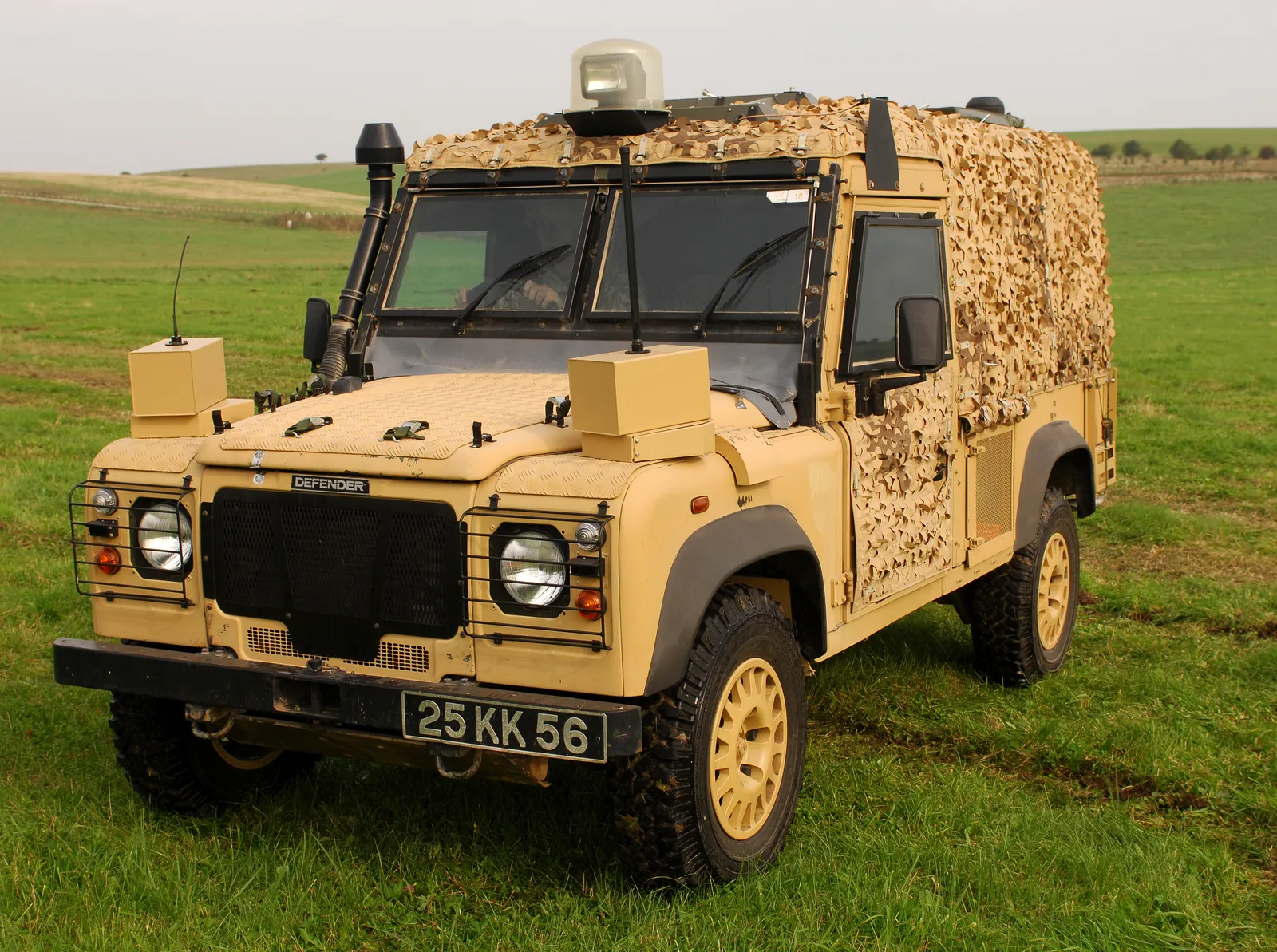

British forces used armoured Snatch Land Rovers for patrols in Iraq, including documented IED attacks in Al Amarah and Basrah; parliamentary reporting found the vehicle fast and manoeuvrable but vulnerable to IED and RPG attack as threats evolved.
Role detailsArmored Vehicles
Land Rover Snatch
Also known as
- Snatch Land Rover
- CAV-100
- CAV 100
- CAV-100D
- CAV 100D
- Truck Utility Medium with Vehicle Protection Kit
- TUM VPK
- Snatch 1
- Snatch 1.5
- Snatch 2
- Snatch 2A
- Snatch 2B
- Snatch Vixen
- Land Rover Snatch Vixen
- Snatch Vixen Plus
- Vixen+
The Land Rover Snatch is a British light protected patrol vehicle based on the Defender 110 chassis and fitted with composite armor for low-profile internal-security, patrol, escort, communications, and protected-mobility work. It entered British Army service as the CAV-100/Snatch family after a 1991 Ministry of Defence contract, later drew heavy scrutiny in Iraq and Afghanistan because roadside bombs and rocket-propelled grenades outgrew its protection level, and was progressively supplemented or replaced by heavier protected patrol vehicles and the Foxhound.
Role in Conflicts


British forces operated armoured Snatch Land Rovers in Afghanistan; a 2007 MOD fatality notice describes one escorting a road-survey team near Lashkar Gah when it was caught in an explosion.
Profile / Specs
Profile
- Origin
- United Kingdom
- Built by
- Land RoverNP Aerospace
- Type
- Light protected patrol vehicle
- Service note
- Introduced for British Army protected patrol work in the early 1990s and deployed in Iraq and Afghanistan during the 2000s
- Designer
- NP Aerospace with Land Rover Defender 110 chassis integration
- Designed
- 1991-1992 development and initial procurement period
- Produced
- 1990s onward, with later Snatch Vixen and theatre upgrade work
- Number built
- 991 Snatch vehicles delivered to the British Army by late 2006, with about 1,200 CAV-100-family vehicles estimated on Land Rover Defender 110 chassis
Specifications
- Chassis
- Land Rover Defender 110 4x4 chassis with CAV-100 protected body
- Protection
- Advanced fibre-reinforced composite armor with transparent armor; protection could be tailored for fragments, 5.56 mm or 7.62 mm small-arms fire, and limited blast threats
- Crew and passengers
- Driver and commander plus four or six personnel in the rear on side seats, depending on configuration
- British Army designations
- Snatch 1/1.5 were TUM hardtop VPK Land Rover 110 V8 petrol standards; Snatch 2, 2A, and 2B were TUM HS hardtop VPK refurbishments recorded by the MOD in 2006
- Powertrain
- Original CAV-100/Snatch vehicles used a 3.5 litre V8 petrol engine; Army Guide lists CAV-100D with a 2.5 litre Tdi diesel, while MOD answers place engine and drivetrain changes in the Vixen upgrade path
- Vixen upgrade
- Snatch Vixen used running gear, chassis, engine, automotive, mobility, and protection modifications to raise payload for protection and mobility improvements
- Vixen Plus figures
- DESA listed Vixen+ with a 4,760 kg maximum gross weight, 4.55 m length, 2.08 m width, 2.50 m height, 80 km/h maximum road speed, and 352 km average range
- Mobility
- 4x4 wheeled patrol vehicle; CAV-100D export figures list up to 700 km road range and 120 km/h average road speed
- Typical roles
- Internal security, escort, ambulance, explosive-ordnance disposal, logistics, peacekeeping, communications, and protected relief-agency movement
Protection And Mobility Tradeoff
The Snatch filled a narrow patrol niche: it was smaller and less aggressive than heavy armor, but it did not provide mine-resistant protection. Parliament's Defence Committee recorded British personnel describing the vehicle as fast and manoeuvrable in Iraq while also vulnerable to IEDs and RPGs, a tradeoff that pushed the MOD toward Mastiff, Vector, Vixen upgrades, and eventually Foxhound.
Sources: House of Commons Medium-Weight Vehicle Requirement; UK Operations in Iraq Defence Report; Dstl Annual Report 2010-11.
Variants
The Snatch designation covers British Army TUM VPK upgrade standards and the export CAV-100/CAV-100D line: early V8 petrol Snatch 1/1.5 vehicles were refurbished into Snatch 2/2A/2B standards, while Snatch Vixen and Vixen Plus were later Afghanistan-focused protection and mobility upgrades.
| Variant | Configuration | Designation notes |
|---|---|---|
| Snatch 1 | Original British Army protected Land Rover | The original 1992 British Army version was officially a TUM hardtop with VPK on a Land Rover 110 V8 petrol platform; a 2006 parliamentary answer listed 30 vehicles remaining in this standard. Sources: Hansard Snatch Land Rover Variants |
| Snatch 1.5 | Desertised theatre variant | Snatch 1.5 kept the V8 petrol TUM VPK base but added desertisation; the 2006 answer listed 278 vehicles refurbished from Snatch 1. Sources: Hansard Snatch Land Rover Variants |
| Snatch 2 | Left-hand-drive 2005 refurbishment standard | Snatch 2 was the TUM HS hardtop with VPK in left-hand-drive, 12-volt form with air conditioning, refurbished in 2005; the MOD listed 77 modified from Snatch 1 and 1.5 vehicles. Sources: Hansard Snatch Land Rover Variants |
| Snatch 2A | 24-volt air-conditioned refurbishment standard | Snatch 2A was the 24-volt TUM HS hardtop with VPK and air conditioning, with a 2006 refurbishment programme then ongoing for 351 vehicles; by April 2009 the MOD said Snatch Vixen would reduce the 2A role until it was used only inside camps. Sources: Hansard Snatch Land Rover Variants, Hansard Snatch 2A Role Reduction |
| Snatch 2B | 24-volt non-air-conditioned refurbishment standard | Snatch 2B was a 24-volt TUM HS hardtop with VPK refurbished in 2005 without the air-conditioning wording used for 2/2A; the 2006 MOD answer listed 225 refurbished from Snatch 1.5 vehicles. Sources: Hansard Snatch Land Rover Variants |
| CAV-100D | Diesel export CAV-100 variant | Army Guide identifies CAV-100D as the diesel export line, including VIP and escort versions on the Defender 110 chassis and French and Canadian diplomatic/protection orders in 1994. Sources: Army Guide CAV-100 |
| Snatch Vixen | Afghanistan-focused protection and mobility upgrade | The MOD described Vixen as a new variant generated by modifications to Snatch mobility and protection; another 2008 answer attributed its increased payload to running gear, chassis, engine, and automotive-component changes. Sources: Hansard Snatch Vixen Variant, Hansard Snatch Vixen Reconfiguration |
| Snatch Vixen Plus | Later deployed Afghanistan upgrade standard | By July 2010, the MOD said Snatch 2A, Snatch Vixen, and Snatch Vixen Plus were deployed in Afghanistan; a later DESA fact sheet described Vixen+ as a Land Rover 110-based protected patrol vehicle with a 2.8 litre 300TDI engine, automatic gearbox, air conditioning, upgraded braking, and modified suspension. Sources: Hansard Afghanistan Snatch Deployment, House of Commons Afghanistan Operations Evidence, DESA Vixen Plus Fact Sheet |
Defender Chassis Basis
The Snatch/CAV-100 family is documented as a protected conversion of the Defender 110 rather than a clean-sheet patrol vehicle.
| Compatible item | Item type | Compatibility evidence |
|---|---|---|
 | 4x4 utility vehicle chassis family | Army Guide describes the CAV-100/Snatch as based on the Land Rover Defender 110 4x4 chassis, with NP Aerospace fitting the ballistic-protection package for British Army service. Sources: Army Guide CAV-100 |
Timeline
Land Rover Snatch Key Events
CAV-100 contract placed
Army Guide reports that the British MOD placed an approximately GBP50 million contract with NP Aerospace for about 1,000 lightly protected 4x4 vehicles after a 1991 competition.
Sources: Army Guide CAV-100
Original Snatch produced
A 2006 MOD parliamentary answer stated that the original Snatch Land Rover was produced in 1992 and that 991 were procured for the British Army.
Sources: Hansard Snatch Land Rover Variants
Al Amarah Snatch patrol hit
The MOD reported that a patrol of three armoured Snatch Land Rovers was struck by an IED in Al Amarah, killing three soldiers from 1st Battalion The Staffordshire Regiment.
Sources: MOD Iraq Snatch Fatality Notice
Basrah City Snatch attacked
The MOD reported that an armoured Snatch Land Rover was attacked by an IED in Basrah City, killing Major Matthew Bacon and seriously injuring three other British soldiers.
Sources: MOD Basrah Snatch Notice
MOD lists five Snatch standards
Hansard recorded the MOD's breakdown of Snatch 1, 1.5, 2, 2A, and 2B, including official TUM VPK designations, 2005 refurbishments, and the statement that protection levels would not be disclosed.
Sources: Hansard Snatch Land Rover Variants
Afghanistan road-survey escort attacked
The MOD reported that Drummer Thomas Wright was killed near Lashkar Gah when an armoured Snatch Land Rover escorting a road-survey team was caught in an explosion.
Sources: MOD Afghanistan Snatch Fatality Notice
Snatch Vixen described as new variant
MOD written answers described Snatch Vixen as a new Afghanistan-focused variant created through running gear, chassis, engine, automotive, mobility, and protection modifications.
Sources: Hansard Snatch Vixen Reconfiguration, Hansard Snatch Vixen Variant
Snatch 2A outside-wire use ceased
House of Commons Afghanistan operations evidence said the arrival of Snatch Vixen Plus and Husky was enough for all Snatch 2A Land Rover and Vector outside-the-wire use to cease before the end of April 2010.
Sources: House of Commons Afghanistan Operations Evidence
Foxhound replacement requirement defined
Dstl said the MOD identified an urgent requirement to replace the Snatch Land Rover with a lightweight patrol vehicle offering higher protection, leading to Foxhound.
Sources: Dstl Annual Report 2010-11
Media
Land Rover Snatch Videos
Related Weapon Systems


Sources
Army Guide CAV-100Publisher: Army Guide | Note: Supports CAV-100 manufacturer attribution to NP Aerospace, Land Rover Defender chassis basis, 1991 MOD contract, roles, protection concept, crew layout, powertrain, range, British Army delivery count, and Iraq/Afghanistan service background. | Accessed: 2026-07-13Hansard Snatch Land Rover VariantsPublisher: UK Parliament | Note: Supports original 1992 production, 991 British Army Snatch vehicles procured, official TUM/VPK designations, counts for Snatch 1/1.5/2/2A/2B, 2005 refurbishment distinctions, and the MOD's refusal to disclose protection levels. | Accessed: 2026-07-13Hansard Snatch Vixen ReconfigurationPublisher: UK Parliament | Note: Supports Snatch Vixen as an Afghanistan reconfiguration with running gear, chassis, engine, and automotive-component changes that increased payload for mobility and protection enhancements. | Accessed: 2026-07-13Hansard Snatch Vixen VariantPublisher: UK Parliament | Note: Supports Snatch Vixen as a new variant generated by a programme of mobility and protection modifications for operations in Iraq and Afghanistan. | Accessed: 2026-07-13Hansard Snatch 2A Role ReductionPublisher: UK Parliament | Note: Supports the MOD statement that Snatch Vixen introduction would reduce the Snatch 2A role until 2A was used only within camps. | Accessed: 2026-07-13Hansard Afghanistan Snatch DeploymentPublisher: UK Parliament | Note: Supports 2001 War in Afghanistan direct-use context: the MOD said Snatch 2A, Snatch Vixen, and Snatch Vixen Plus were deployed in Afghanistan in July 2010, with 2A and Vixen used only inside base locations. | Accessed: 2026-07-13House of Commons Afghanistan Operations EvidencePublisher: UK Parliament | Note: Supports 2001 War in Afghanistan direct-use context: evidence to the Defence Committee said Snatch Vixen Plus and Husky deliveries allowed all Snatch 2A Land Rover and Vector outside-the-wire use to cease before the end of April 2010. | Accessed: 2026-07-13DESA Vixen Plus Fact SheetPublisher: Defence Equipment Sales Authority | Note: Supports Vixen+ protected patrol vehicle specifications, Land Rover 110 chassis basis, upgraded 2.8 litre 300TDI engine, automatic gearbox, air conditioning, braking and suspension changes, dimensions, weight, speed, range, and typical command, reconnaissance, liaison, logistic, and administrative roles. | Accessed: 2026-07-13House of Commons Medium-Weight Vehicle RequirementPublisher: UK Parliament | Note: Supports 2003 Iraq War and 2001 War in Afghanistan direct conflict-use context: British forces used Snatch Land Rovers in both theatres, where Parliament recorded operational vulnerability to IED and RPG attack and the need for more protected expeditionary vehicles. | Accessed: 2026-07-13UK Operations in Iraq Defence ReportPublisher: UK Parliament | Note: Supports 2003 Iraq War direct conflict-use context by documenting British Snatch Land Rover patrol use around Basra and the low-profile patrol rationale; also supports 2001 War in Afghanistan direct-use context by describing Afghanistan as another operation where Snatch had been a popular patrol option. | Accessed: 2026-07-13MOD Iraq Snatch Fatality NoticePublisher: Ministry of Defence | Note: Supports 2003 Iraq War direct conflict-use: a patrol of three armoured Snatch Land Rovers in Al Amarah was engaged by an IED on July 16, 2005. | Accessed: 2026-07-13MOD Basrah Snatch NoticePublisher: Ministry of Defence | Note: Supports 2003 Iraq War direct conflict-use: British personnel were travelling in an armoured Snatch Land Rover attacked by an improvised explosive device in Basrah City on September 11, 2005. | Accessed: 2026-07-13MOD Afghanistan Snatch Fatality NoticePublisher: Ministry of Defence | Note: Supports 2001 War in Afghanistan direct conflict-use: an armoured Snatch Land Rover escorting a road-survey team near Lashkar Gah was caught in an explosion on June 24, 2007. | Accessed: 2026-07-13Dstl Annual Report 2010-11Publisher: Defence Science and Technology Laboratory | Note: Supports Foxhound replacement context, the MOD requirement to replace Snatch with a higher-protection lightweight patrol vehicle, and CAMAC armor background from Dstl and NP Aerospace. | Accessed: 2026-07-13Wikimedia Commons Snatch-Vixen ImagePublisher: Wikimedia Commons | Note: Supports image provenance for the Land Rover Snatch-Vixen image: Crown Copyright / Defence Images, author Cpl Russ Nolan RLC, licensed under the Open Government Licence v1.0. | Accessed: 2026-07-13