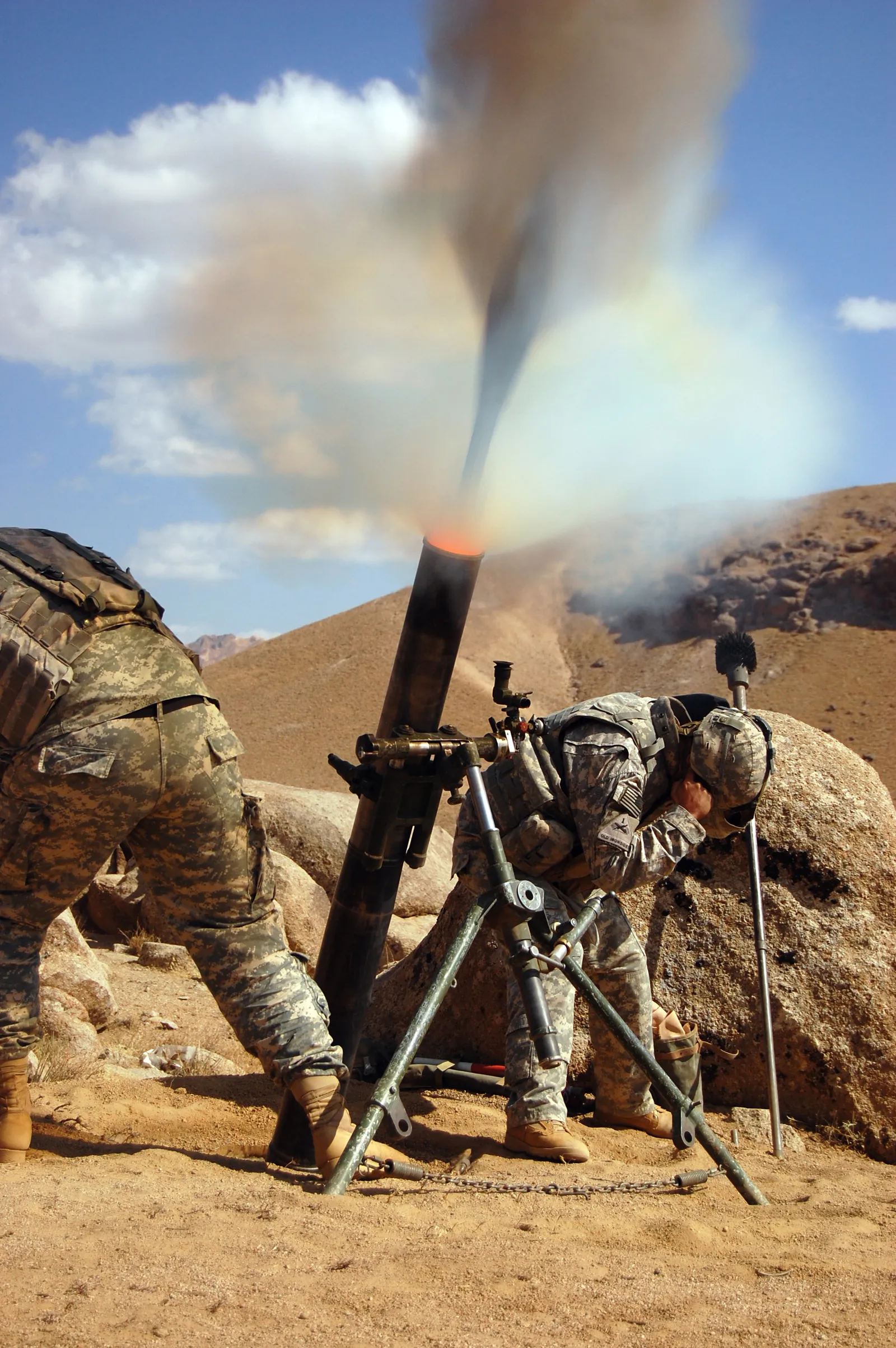


U.S. Army and DVIDS records document M120 mortar firing and emplacement in Afghanistan, including a 2007 combat operation in Zabol Province, 2011 precision-guided 120 mm mortar firing in Paktika Province, and 2013 base-defense emplacement at Forward Operating Base Lightning.
Artillery
120mm Soltam K6
Also known as
- Soltam K6
- K6 mortar
- K6 120mm mortar
- Soltam K6 mortar
- M120 mortar
- M120 120mm mortar
- M120 mortar system
- M121 mortar
- M121 120mm mortar
The 120mm Soltam K6 is an Israeli smoothbore heavy mortar family that became the U.S. Army's M120 towed mortar and M121 carrier-mounted mortar. It gives infantry, mechanized, and partner-force units battalion-level high-angle fire support from a 120 mm tube, with direct source records spanning Afghanistan, Iraq, the anti-ISIS campaign, and K-6/M120 transfer and training context for Ukraine.
Role in Conflicts
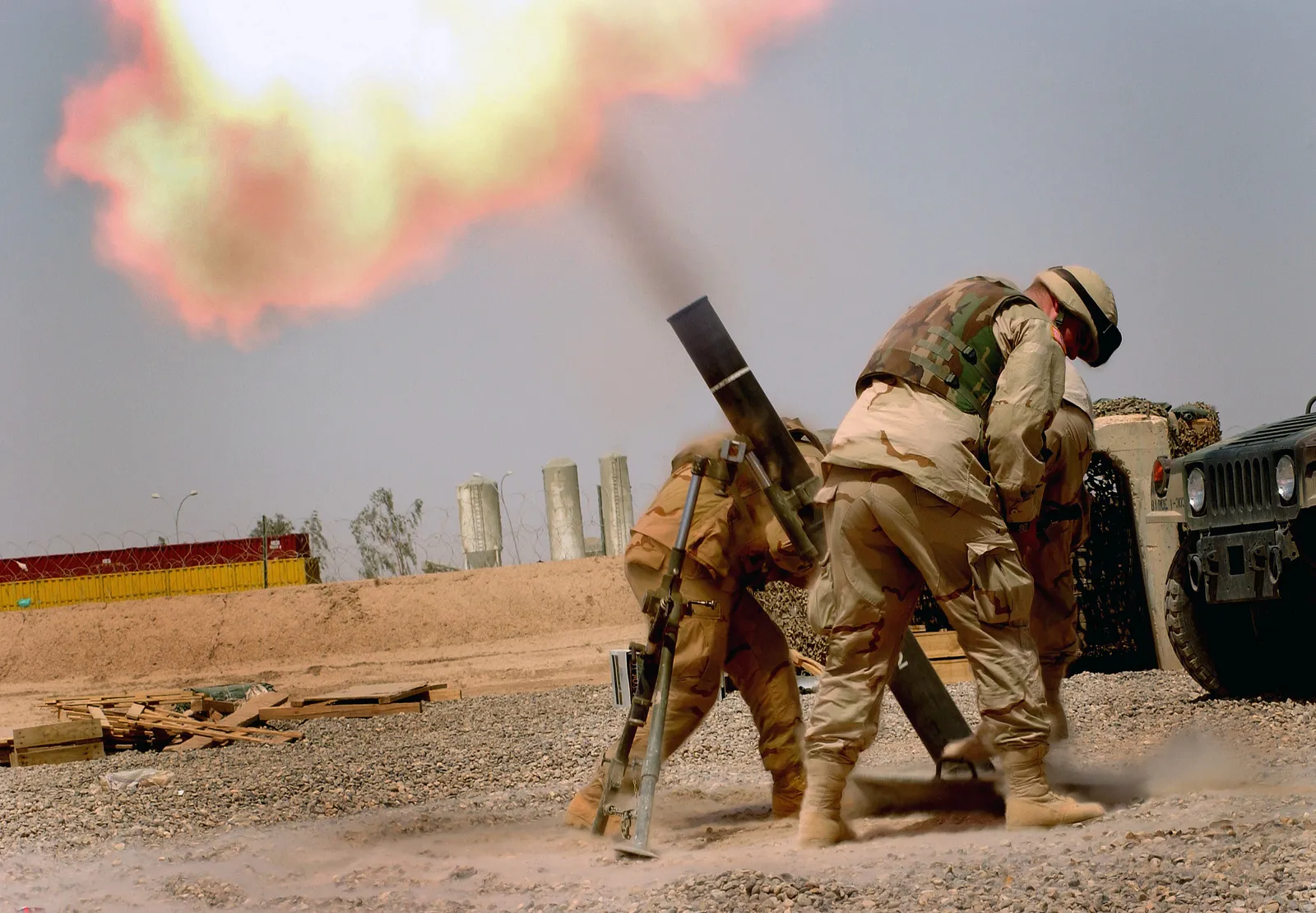
U.S. military image metadata preserved by Wikimedia Commons identifies U.S. Army soldiers at Logistics Support Area Anaconda, Iraq, firing an M120 120 mm mortar in support of Operation Iraqi Freedom on May 21, 2004.
DVIDS records document U.S. Coalition Forces firing an M120 mortar round at an ISIS location in southeast Syria in September 2018, Syrian Democratic Forces adjusting an M120 during a Deir ez-Zor fire mission in November 2018, and coalition advisers training Iraqi troops on newly acquired U.S. M120 systems.
- Side
- Ukraine

SIPRI transfer-register data list K-6 120mm mortars delivered to Ukraine from the United States and Denmark in 2022; a U.S. Defense Department briefing separately identified a 2022 U.S. aid package of 120 mm mortar systems and associated ammunition, and a DoD Inspector General audit lists M120 Mortar among platforms on which Ukrainian personnel trained.
Role detailsProfile / Specs
Profile
- Origin
- Israel; U.S. M120/M121 production and service derivatives
- Built in
- IsraelUnited States
- Type
- 120 mm smoothbore heavy mortar
- Service note
- Late Cold War design lineage; U.S. M120/M121 service from the 1990s through the Afghanistan, Iraq, and anti-ISIS campaigns, with K-6 transfers to Ukraine documented in 2022
- Designer
- Soltam Systems, drawing on Tampella-derived 120 mm mortar design lineage
- Designed
- K6 development described as late 1970s; U.S. M120 service followed in the early 1990s
- Unit cost
- About $50,000 for an M121 in 2006 according to WeaponSystems.net
- Produced
- Late 1970s-present in K6-family and U.S. M120/M121 forms
Specifications
- Caliber
- 120 mm smoothbore mortar
- Crew
- 4-5
- Weight
- 144 kg in firing position; 418 kg on two-wheel carriage in K6 data
- Tube
- 1.75 m barrel / tube
- Range
- 180 m minimum; 7.2 km maximum in K6 data
- Rate of fire
- 10 rounds per minute maximum / standard short-duration figure; 5 rounds per minute sustained in WeaponSystems.net data
- Elevation
- +40 to +85 degrees
- Traverse
- 14 degrees on bipod; 360 degrees on baseplate
- U.S. designations
- M120 for the towed / ground-mounted U.S. service form; M121 for the vehicle-mounted U.S. service form
- Precision ammunition
- APMI / XM395 GPS-guided 120 mm mortar cartridge fired from the M120 system
Design And U.S. Configuration
The K6 sits between portable infantry mortars and heavier artillery: it is a 120 mm smoothbore system that can be broken into major components, towed on a carriage, or installed in a carrier mount. U.S. M120 and M121 designations keep the same K6-family fire-support role while separating ground-mounted and vehicle-mounted use.
Tube and ammunition
WeaponSystems.net lists a 120 mm smoothbore tube with 7.2 km maximum range for K6, while Army reporting identifies APMI/XM395 precision ammunition as a GPS-guided 120 mm round fired from the M120 system.
Sources: WeaponSystems.net 120mm Soltam K6; Picatinny APMI Afghanistan Fielding.
Mobility model
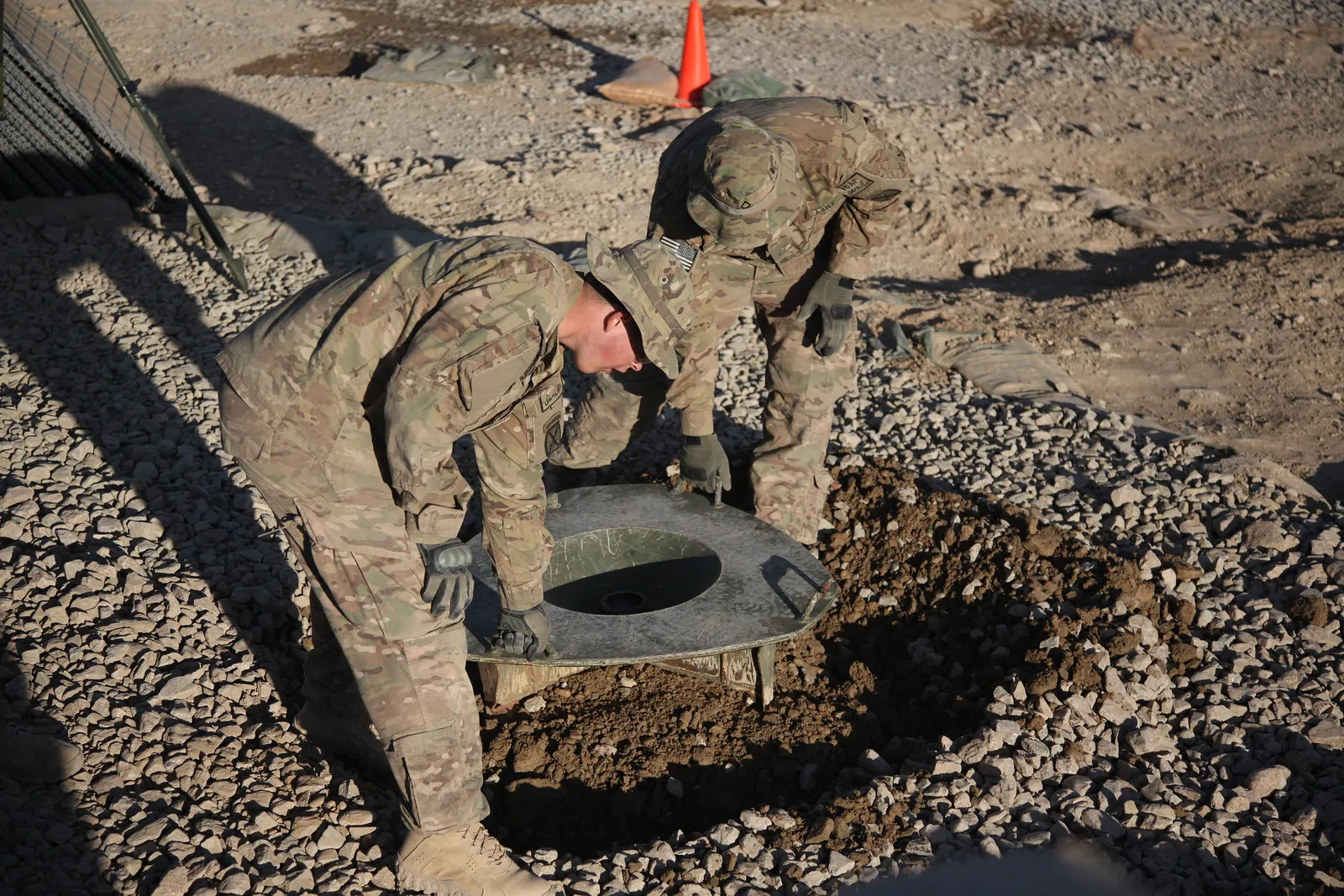
The towed system uses a two-wheel carriage, with WeaponSystems.net noting short-distance crew movement and light vehicle or truck towing; U.S. sources show field emplacement at Afghan forward operating bases.
Sources: WeaponSystems.net 120mm Soltam K6; DVIDS FOB Lightning M120 Image.
Fire-support role
Army and DVIDS records show the K6/M120 family used for base defense, direct fire missions, and partner-force indirect-fire training across Afghanistan, Iraq, and the anti-ISIS campaign.
Sources: Army First Precision-Guided Mortar Afghanistan; Wikimedia M120 Iraq Image; DVIDS Coalition M120 Syria Image.
Ukraine transfer record
SIPRI records K-6 120mm mortar deliveries to Ukraine from the United States and Denmark in 2022, and a DoD Inspector General audit lists M120 Mortar among platforms on which Ukrainian personnel trained.
Sources: SIPRI K-6 Ukraine Transfers; DoD IG Ukraine Training Audit.
Variants
K6 is the Israeli baseline designation; U.S. service separates the family into the towed M120 and vehicle-mounted M121 configurations.
| Variant | Configuration | Designation notes |
|---|---|---|
| Soltam K5 | Earlier light 120 mm mortar branch | WeaponSystems.net describes the K5 as the preceding lightweight Soltam 120 mm mortar branch, with the K6 improving performance mainly through its heavier barrel. Sources: WeaponSystems.net 120mm Soltam K6 |
| M120 | U.S. towed / ground-mounted K6 derivative | U.S. Army and DVIDS sources identify the M120 as the 120 mm mortar system used by U.S. units; WeaponSystems.net identifies M120 as the K6 in U.S. service. Sources: WeaponSystems.net 120mm Soltam K6, DVIDS FOB Lightning M120 Image |
| M121 | U.S. carrier-mounted K6 derivative | WeaponSystems.net identifies M121 as the vehicle-mounted K6 model in U.S. service, and Army material links M120/M121 procurement and modernization under U.S. 120 mm mortar systems. Sources: WeaponSystems.net 120mm Soltam K6, Picatinny APMI Afghanistan Fielding |
| K6 vehicle mount / TT6 turntable | Vehicle-mounted configuration | WeaponSystems.net describes a modified K6 version with a different bipod for turntable mounting, including installation in M113-derived mortar carriers. Sources: WeaponSystems.net 120mm Soltam K6 |
Ammunition Fired
U.S. Army sources identify the M120 as the firing system for XM395/APMI precision 120 mm mortar ammunition.
| Ammunition | Ammunition type | Firing evidence |
|---|---|---|
 | GPS-guided 120 mm mortar cartridge | Picatinny reporting says the APMI XM395 cartridge uses a standard M934 high-explosive 120 mm projectile body and is fired from the M120 mortar system. Sources: Picatinny APMI Afghanistan Fielding |
Timeline
120mm Soltam K6 Key Events
K6 branch developed
WeaponSystems.net places K6 development in the late 1970s after the earlier K5 light 120 mm mortar branch.
Sources: WeaponSystems.net 120mm Soltam K6
U.S. M120 service era begins
Public reference material identifies the U.S. M120 as the K6-family 120 mm mortar adopted for U.S. Army service in the early 1990s.
Sources: WeaponSystems.net 120mm Soltam K6
M120 fired in Zabol Province
A U.S. Army public-domain image record describes Alpha Company, 1st Battalion, 4th Infantry ISAF soldiers firing an M120 during a joint Afghan National Army and ISAF combat operation in Zabol Province.
Sources: Wikimedia M120 Zabol Image
M120 fired at LSA Anaconda
U.S. military image metadata identifies soldiers from the 303rd Armor attached to the 81st Brigade firing an M120 120 mm mortar at Logistics Support Area Anaconda, Iraq, in support of Operation Iraqi Freedom.
Sources: Wikimedia M120 Iraq Image
Precision 120 mm mortar round fired in Afghanistan
Army reporting from Paktika Province says Company C, 1-506th Infantry fired a 120 mm Precision Guided Mortar Munition round in Afghanistan and hit within four meters of the target.
Sources: Army First Precision-Guided Mortar Afghanistan
M120 set up at FOB Lightning
DVIDS imagery documents 3rd Squadron, 71st Cavalry soldiers setting up an M120 mortar firing system at Forward Operating Base Lightning for base defense.
Sources: DVIDS FOB Lightning M120 Image
OEF XIV live-fire video recorded
DVIDS published public-domain video of 120 mm mortars from Bandit Troop, 3rd Battalion, 71st Cavalry at FOB Lightning during Operation Enduring Freedom XIV.
Sources: DVIDS OEF XIV 120mm Mortar Video
Coalition M120 fire mission in Syria
DVIDS imagery documents U.S. Coalition Forces firing an M120 mortar round at an ISIS location in southeast Syria during Operation Inherent Resolve.
Sources: DVIDS Coalition M120 Syria Image
SDF M120 fire mission near Deir ez-Zor
A DVIDS image record says a Syrian Democratic Forces mortar team adjusted an M120 mortar system onto an ISIS target during a fire mission near Deir ez-Zor.
Sources: DVIDS SDF M120 Deir ez-Zor Image
Elbit America receives U.S. Army mortar-system contract
Elbit announced a five-year U.S. Army ID/IQ contract through Elbit Systems of America to provide 120 mm mortar systems.
Sources: Elbit U.S. Army 120mm Mortar Contract
K-6 transfers to Ukraine recorded
SIPRI transfer-register data list K-6 120mm mortars delivered to Ukraine from the United States and Denmark in 2022, while U.S. Defense Department sources identified 120 mm mortar-system assistance and M120 Mortar training for Ukrainian personnel.
Sources: SIPRI K-6 Ukraine Transfers, DoD August 2022 Ukraine 120mm Mortars, DoD IG Ukraine Training Audit
Media
120mm Soltam K6 Images
Related Weapon Systems


Sources
WeaponSystems.net 120mm Soltam K6Publisher: WeaponSystems.net | Note: Supports K6 identity, Israeli origin, Soltam production, U.S. M120/M121 designations, K5/K6 relationship, dimensions, firing data, mobility, and configuration background. | Accessed: 2026-07-13DVIDS FOB Lightning M120 ImagePublisher: DVIDS | Note: Supports 2001 War in Afghanistan direct conflict-use: U.S. Soldiers set up a 120 mm M120 mortar firing system at Forward Operating Base Lightning in Afghanistan for base defense; also supports gallery image provenance. | Accessed: 2026-07-13Wikimedia M120 Zabol ImagePublisher: Wikimedia Commons | Note: Supports 2001 War in Afghanistan direct conflict-use and primary image provenance: the file description identifies U.S. Army ISAF soldiers firing an M120 mortar during a joint Afghan National Army and ISAF combat operation in Zabol Province. | Accessed: 2026-07-13Army First Precision-Guided Mortar AfghanistanPublisher: U.S. Army | Note: Supports 2001 War in Afghanistan direct conflict-use: U.S. Army mortarmen fired a 120 mm Precision Guided Mortar Munition round in Paktika Province; also supports battalion-level fire-support role and precision-mortar context. | Accessed: 2026-07-13Picatinny APMI Afghanistan FieldingPublisher: U.S. Army | Note: Supports 2001 War in Afghanistan direct fielding context for 120 mm GPS-guided mortar cartridges, describes APMI/XM395 technology, and states the cartridge is fired from the M120 mortar system. | Accessed: 2026-07-13Army Vanguard APMI M120Publisher: U.S. Army | Note: Supports M120 background by identifying APMI as a GPS-guided round fired from the M120 mortar system and describing precision effects in 120 mm mortar fire. | Accessed: 2026-07-13Wikimedia M120 Iraq ImagePublisher: Wikimedia Commons | Note: Supports 2003 Iraq War direct conflict-use and gallery image provenance: the file description identifies U.S. Army soldiers firing an M120 120 mm mortar at Logistics Support Area Anaconda, Iraq, in support of Operation Iraqi Freedom. | Accessed: 2026-07-13DVIDS OEF XIV 120mm Mortar VideoPublisher: DVIDS | Note: Supports 2001 War in Afghanistan direct conflict-use: public-domain DVIDS video shows 120 mm mortars from Bandit Troop, 3rd Battalion, 71st Cavalry on Forward Operating Base Lightning during Operation Enduring Freedom XIV. | Accessed: 2026-07-13DVIDS Coalition M120 Syria ImagePublisher: DVIDS | Note: Supports 2014 War Against the Islamic State direct conflict-use: U.S. Coalition Forces fired an M120 mortar round at an ISIS location in southeast Syria during Operation Inherent Resolve. | Accessed: 2026-07-13Elbit 120mm MortarsPublisher: Elbit Systems | Note: Supports current Elbit 120 mm mortar-system background, manufacturer continuity, and modern range/mobility context for Elbit's 120 mm mortar portfolio. | Accessed: 2026-07-13Elbit Soltam AcquisitionPublisher: PR Newswire | Note: Supports manufacturer background: Elbit Systems completed acquisition of Mikal holdings in Soltam in 2010 and held 100 percent of Soltam after completion. | Accessed: 2026-07-13Elbit U.S. Army 120mm Mortar ContractPublisher: PR Newswire | Note: Supports current manufacturer and production context: Elbit Systems of America received a five-year U.S. Army ID/IQ contract to provide 120 mm mortar systems. | Accessed: 2026-07-13SIPRI K-6 Ukraine TransfersPublisher: Stockholm International Peace Research Institute | Note: Supports 2014 Russia-Ukraine War direct transfer context: SIPRI transfer-register query results for recipient Ukraine list K-6 120mm mortars delivered from the United States and Denmark in 2022. | Accessed: 2026-07-13DoD August 2022 Ukraine 120mm MortarsPublisher: U.S. Department of Defense | Note: Supports 2014 Russia-Ukraine War direct assistance context: the Defense Department identified 20 120 mm mortar systems and associated mortar ammunition in an August 2022 U.S. drawdown package for Ukraine. | Accessed: 2026-07-13DVIDS SDF M120 Deir ez-Zor ImagePublisher: DVIDS | Note: Supports 2014 War Against the Islamic State direct conflict-use: a Syrian Democratic Forces mortar team adjusted an M120 mortar system onto an ISIS target during a fire mission near Deir ez-Zor, Syria. | Accessed: 2026-07-13DVIDS Iraqi M120 TrainingPublisher: DVIDS | Note: Supports 2014 War Against the Islamic State direct conflict-use: coalition advisers trained Iraqi troops on newly acquired U.S. M120 mortar systems to improve indirect fires in the fight against ISIS. | Accessed: 2026-07-13DoD IG Ukraine Training AuditPublisher: U.S. Department of Defense Office of Inspector General | Note: Supports 2014 Russia-Ukraine War direct transfer and training context: the audit lists M120 Mortar among platforms on which Ukrainian Armed Forces personnel trained at Grafenwoehr in 2022. | Accessed: 2026-07-13