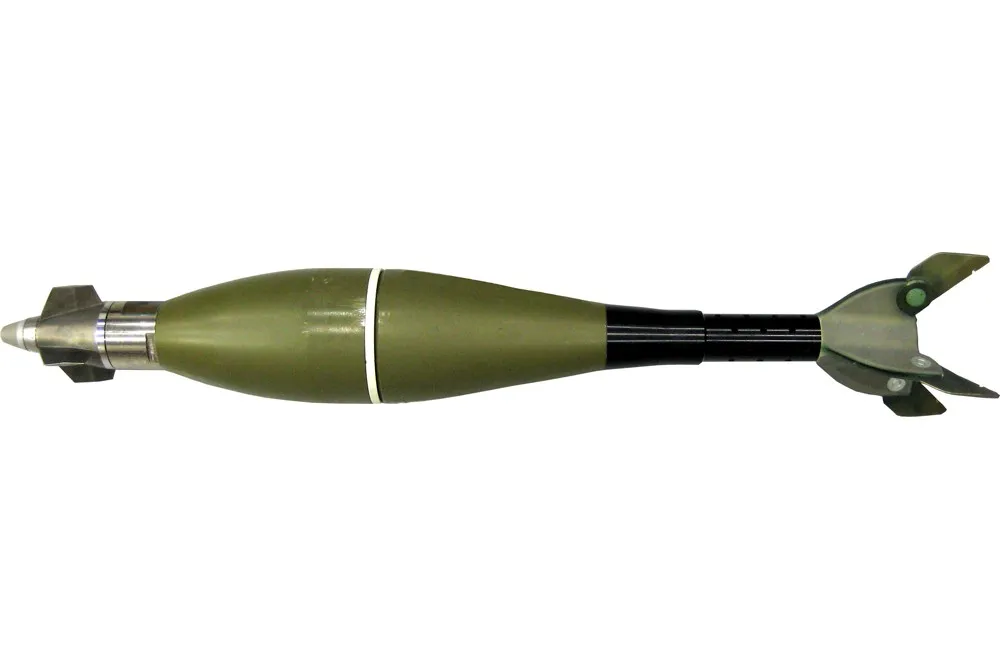


U.S. Army sources document XM395 APMI fielding to Operation Enduring Freedom in March 2011, including a Company C, 1-506th Infantry precision-mortar firing at FOB Kushamond, Paktika Province, on March 26.
Role detailsMunitions
XM395 Accelerated Precision Mortar Initiative
Also known as
- XM395 APMI
- APMI
- XM395 precision guided mortar munition
- XM395 precision munition
- XM395 PGMM
- Precision Guided Mortar Munition
- Mortar Guidance Kit
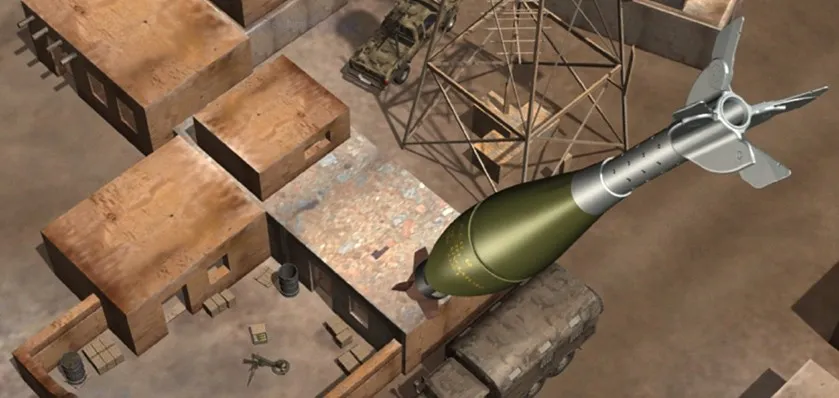
XM395 Accelerated Precision Mortar Initiative is a U.S. Army 120 mm GPS-guided mortar cartridge developed by ATK and fielded with U.S. forces in Afghanistan in March 2011. Army and NDIA materials describe a standard M934 high-explosive body fitted with GPS guidance, multi-option fuzing, and fire-control programming for ground-mounted and Stryker-mounted 120 mm mortar systems.
Role in Conflicts
Profile / Specs
Profile
- Origin
- United States
- Built by
- Alliant Techsystems (ATK)
- Type
- 120 mm GPS-guided mortar cartridge
- Service note
- 2000s-present
- Designed
- 2000s
Specifications
- Caliber
- 120 mm
- Guidance
- GPS with Selective Availability Anti-Spoofing Module (SAASM) in Army/DSCA descriptions
- Fuzing
- Proximity, point detonation, or delay
- Compatibility
- Ground-mounted and Stryker-mounted 120 mm mortar systems
- Projectile body
- Standard M934 high-explosive 120 mm body
- Range
- Up to 6,300 m in Army fielding reporting; 6.2 km threshold and 7.0 km objective in NDIA presentation
- Accuracy requirement
- 10 m CEP threshold; 5 m CEP objective
- Control surfaces
- GPS receiver and computer-controlled directional fins in the nose plus folding tail fins
- Programming
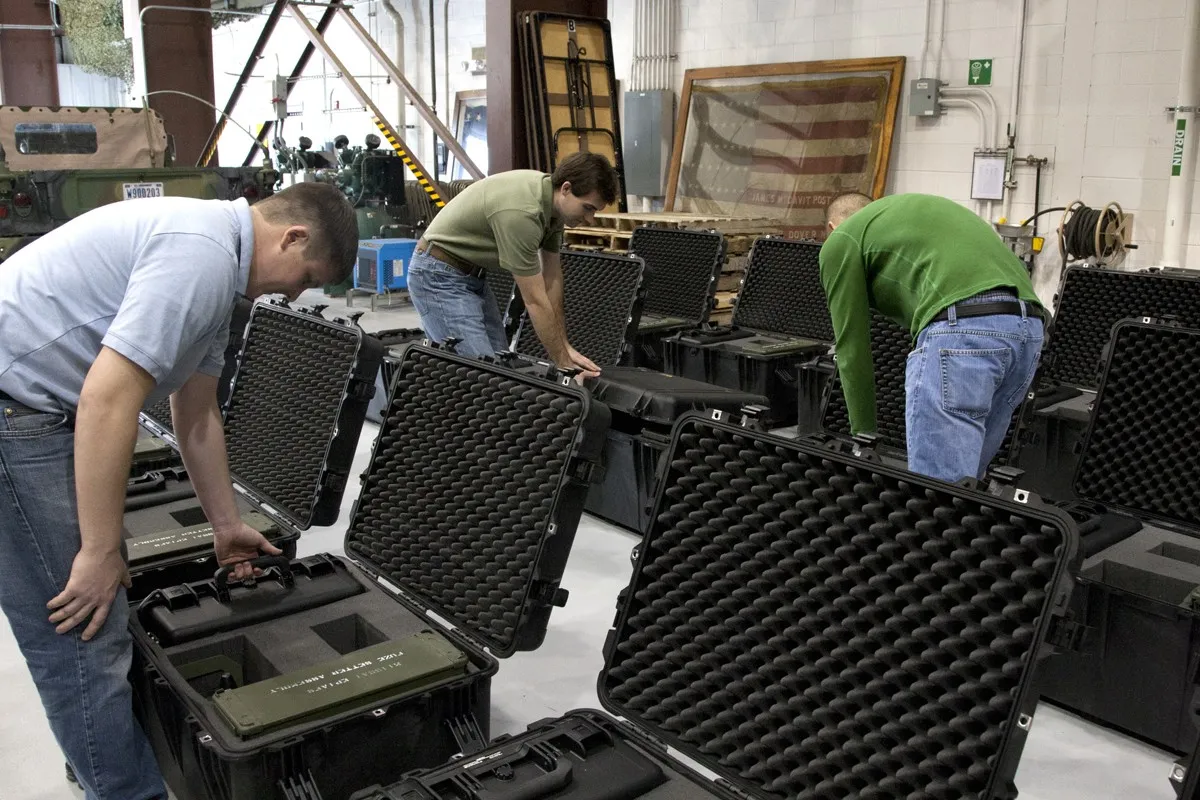
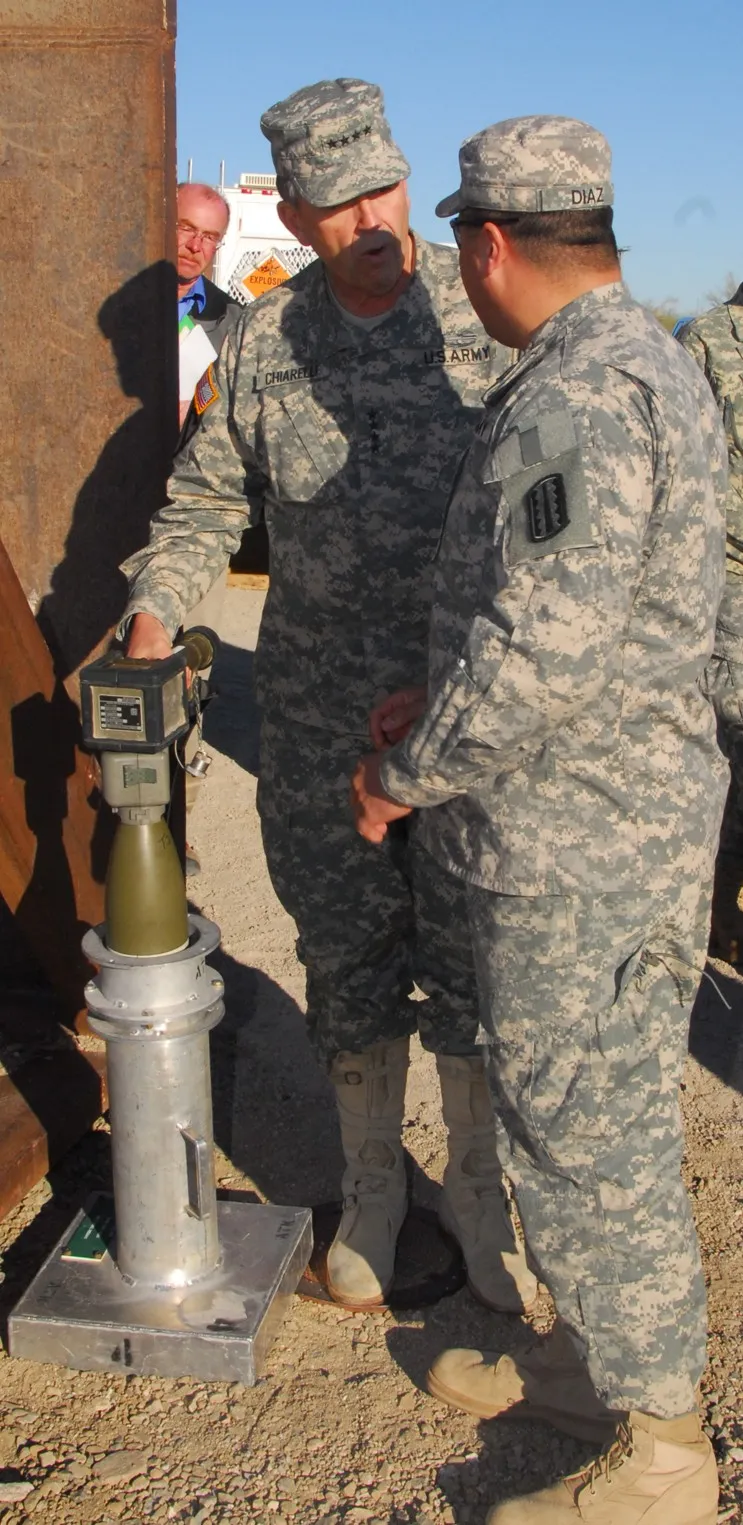
- Programmable by M95 MFCS, M150 MFCS-D, or M32 LHMBC; mission and GPS data loaded through a setting device
- Reliability
- Greater than 90 percent requirement reported as being met during pre-fielding testing
Guidance And Programming
APMI adapted a standard 120 mm high-explosive mortar body with a GPS-guided control section, a setting device, and fire-control software instead of requiring a new mortar tube.
Mission data
The Federal Register notice describes PLUMSS/iPIK loading GPS coordinates, mission trajectory, and fuze-mode data into the round.
Guidance package
The NDIA-hosted APMI presentation lists GPS SAASM guidance, U.S. 120 mm smoothbore mortar compatibility, a 10 m CEP threshold, and a 5 m CEP objective.
Variants
Sources use XM395 across related precision-mortar efforts. This record treats APMI as the fielded GPS-guided urgent-release cartridge while noting the earlier PGMM designation path.
| Variant | Configuration | Designation notes |
|---|---|---|
| XM395 Precision Guided Mortar Munition (PGMM) | Earlier XM395 guided-mortar designation | NDIA mortar-ammunition material identifies PGMM and APMI as two XM395 versions; the APMI presentation says APMI reused PGMM fin-assembly work. Sources: Mortar Ammunition Across the Globe, NDIA Guided Mortar for APMI |
Firing Weapons
Army materials describe XM395 APMI as a 120 mm GPS-guided mortar cartridge for U.S. 120 mm mortar systems.
| Firing weapon | Weapon type | Firing evidence |
|---|---|---|
 | 120 mm smoothbore mortar system | The Army APMI product page and NDIA presentation identify XM395 as compatible with U.S. 120 mm mortar systems, including ground-mounted and Stryker-mounted configurations. Sources: XM395 Accelerated Precision Mortar Initiative (APMI), NDIA Guided Mortar for APMI |
 | Stryker mortar carrier vehicle platform | The Army reported that APMI was integrated with the Stryker Double-V Hull Mortar Carrier Vehicle in Afghanistan, allowing the mobile platform to fire APMI precision-guided mortars as well as conventional 120 mm rounds. Sources: Stryker units in Afghanistan now equipped with precision mortars |
Timeline
XM395 Accelerated Precision Mortar Initiative Key Events
Afghanistan field request starts APMI
Army reporting says APMI grew from a February 2009 request by a field commander in Afghanistan for a precision 120 mm mortar capability.
Sources: Soldiers to receive new precision mortar round
ATK selected for APMI supply
Inside GNSS reported that ATK won the competitive APMI XM395 demonstration program in April 2010 and supplied the munition under an urgent material-release effort.
Sources: Army fields GPS-guided mortar in Afghanistan, NDIA Guided Mortar for APMI
Fielded to U.S. forces in Afghanistan
Army and PEO Ammunition reporting place the first APMI fielding with an infantry brigade combat team in Afghanistan, with additional deployed IBCT fielding planned.
Sources: XM395 Accelerated Precision Mortar Initiative (APMI), Picatinny fields first precision-guided mortars to troops in Afghanistan, Army fields GPS-guided mortar in Afghanistan
First Afghanistan firing reported
Army reporting says Company C, 1-506th Infantry, 4th Brigade Combat Team, 101st Airborne Division fired a 120 mm precision-guided mortar round at FOB Kushamond in Paktika Province and landed within four meters of the target.
Sources: Soldiers fire first precision-guided mortar in Afghanistan
Stryker mortar carriers added in Afghanistan
Army reporting says APMI had been fielded first to dismounted troops in Afghanistan and was then being fielded to Stryker Brigade Combat Teams using Stryker Double-V Hull Mortar Carrier Vehicles.
Sources: Stryker units in Afghanistan now equipped with precision mortars
Conditional materiel release noted
The Army APMI product page states that APMI was approved for conditional materiel release under a 31 October 2014 memorandum for non-standard equipment assigned to GRF and ACF missions.
Sources: XM395 Accelerated Precision Mortar Initiative (APMI)
Singapore sale notice published
A Federal Register notice listed a proposed Foreign Military Sale to Singapore for 2,000 XM395 APMI rounds, support services, and associated equipment with an estimated cost of $66 million.
Sources: Federal Register Singapore XM395 APMI Sale
Related Weapon Systems


Sources
XM395 Accelerated Precision Mortar Initiative (APMI)Publisher: U.S. Army Capability Program Executive Ammunition & Energetics | Note: 2001 War in Afghanistan: supports XM395 APMI being fielded to Operation Enduring Freedom in March 2011, plus the designation, GPS-guided 120 mm cartridge role, multi-option fuzing, standard M934 body context, and ground-mounted/Stryker-mounted compatibility. | Accessed: 2026-07-01Army fields GPS-guided mortar in AfghanistanPublisher: Inside GNSS | Note: 2001 War in Afghanistan: supports APMI cartridges being fielded to U.S. soldiers in Afghanistan, plus ATK supplier/manufacturer context, April 2010 demonstration-program selection, the 10 m CEP requirement, and the cartridge's precision-mortar role. | Accessed: 2026-07-01Picatinny fields first precision-guided mortars to troops in AfghanistanPublisher: U.S. Army | Note: 2001 War in Afghanistan: supports APMI cartridges being fielded to troops in Afghanistan in March 2011, plus image provenance for the primary image and gallery photos. | Accessed: 2026-07-01Soldiers to receive new precision mortar roundPublisher: U.S. Army | Note: Supports the February 2009 Afghanistan field request, pre-fielding range, reliability, planned 5,480-round delivery quantity, and immediate-response precision indirect-fire role. | Accessed: 2026-07-01Soldiers fire first precision-guided mortar in AfghanistanPublisher: U.S. Army | Note: Supports the March 26, 2011 precision-guided mortar firing by Company C, 1-506th Infantry at FOB Kushamond, Paktika Province, and the accuracy and battalion-level fire-support context. | Accessed: 2026-07-01Stryker units in Afghanistan now equipped with precision mortarsPublisher: U.S. Army | Note: 2001 War in Afghanistan: supports APMI combat rounds being fired in Afghanistan and fielded to Stryker Brigade Combat Teams, plus Stryker Double-V Hull Mortar Carrier Vehicle integration and 10 m CEP performance context. | Accessed: 2026-07-01Mortar Ammunition Across the GlobePublisher: National Defense Industrial Association | Note: Supports precision-mortar designation context that distinguishes XM395 PGMM and XM395 APMI as related U.S. guided-mortar versions. | Accessed: 2026-07-01NDIA Guided Mortar for APMIPublisher: National Defense Industrial Association | Note: Supports APMI system context, Afghanistan operational-need background, XM395 precision-munition designation, fire-control and setting-device components, SAASM guidance, accuracy thresholds, and U.S. 120 mm smoothbore mortar compatibility. | Accessed: 2026-07-01Federal Register Singapore XM395 APMI SalePublisher: Federal Register | Note: Supports the 2017 Singapore Foreign Military Sale notice, 2,000-round quantity, estimated value, PLUMSS/iPIK programming description, SAASM context, and Orbital ATK prime-contractor note for that proposed sale. | Accessed: 2026-07-01