
Oryx documented Syrian Arab Army 160 mm M-160 mortars in civil-war service, describing heavy early-war urban shelling use and later listing two 160 mm M160 mortars captured during the 2020 Idlib fighting.
Artillery
160mm M160
Also known as
- 160 mm M-160
- 160mm M-160
- M-160 mortar
- M160 mortar
- 160 mm mortar M-160
- 160-mm divisional mortar M-160
- 52-M-853
- SKB-21
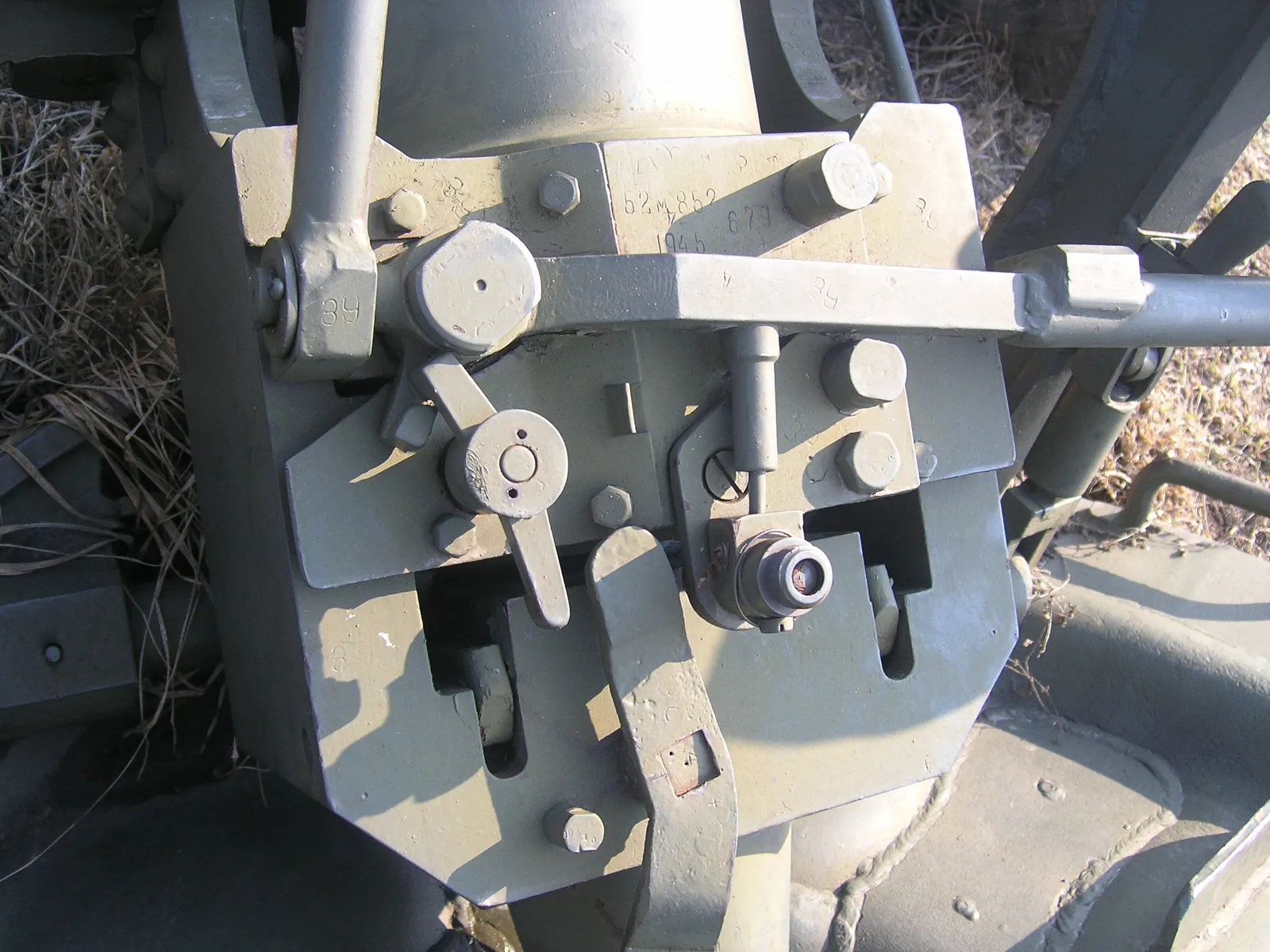
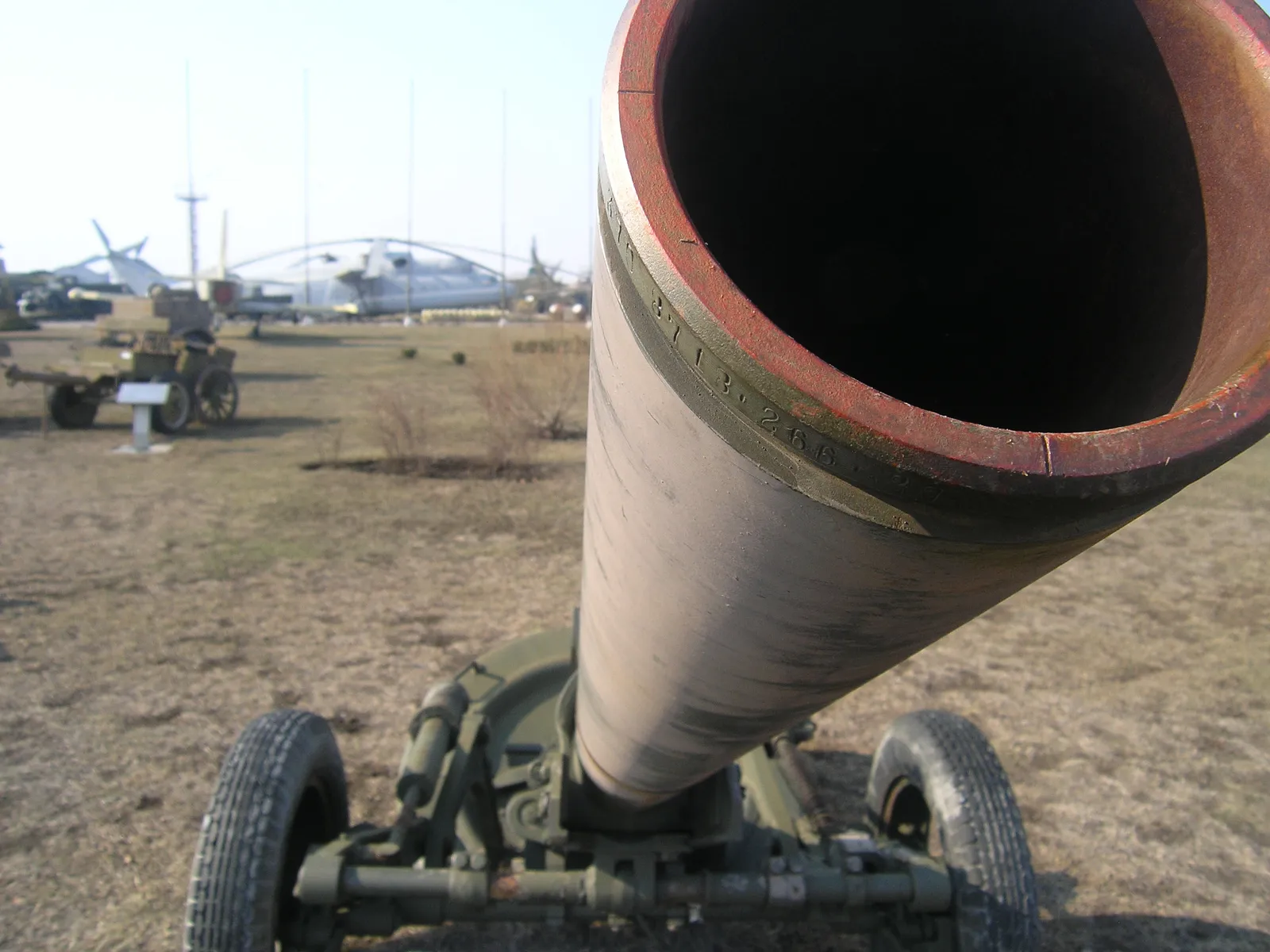
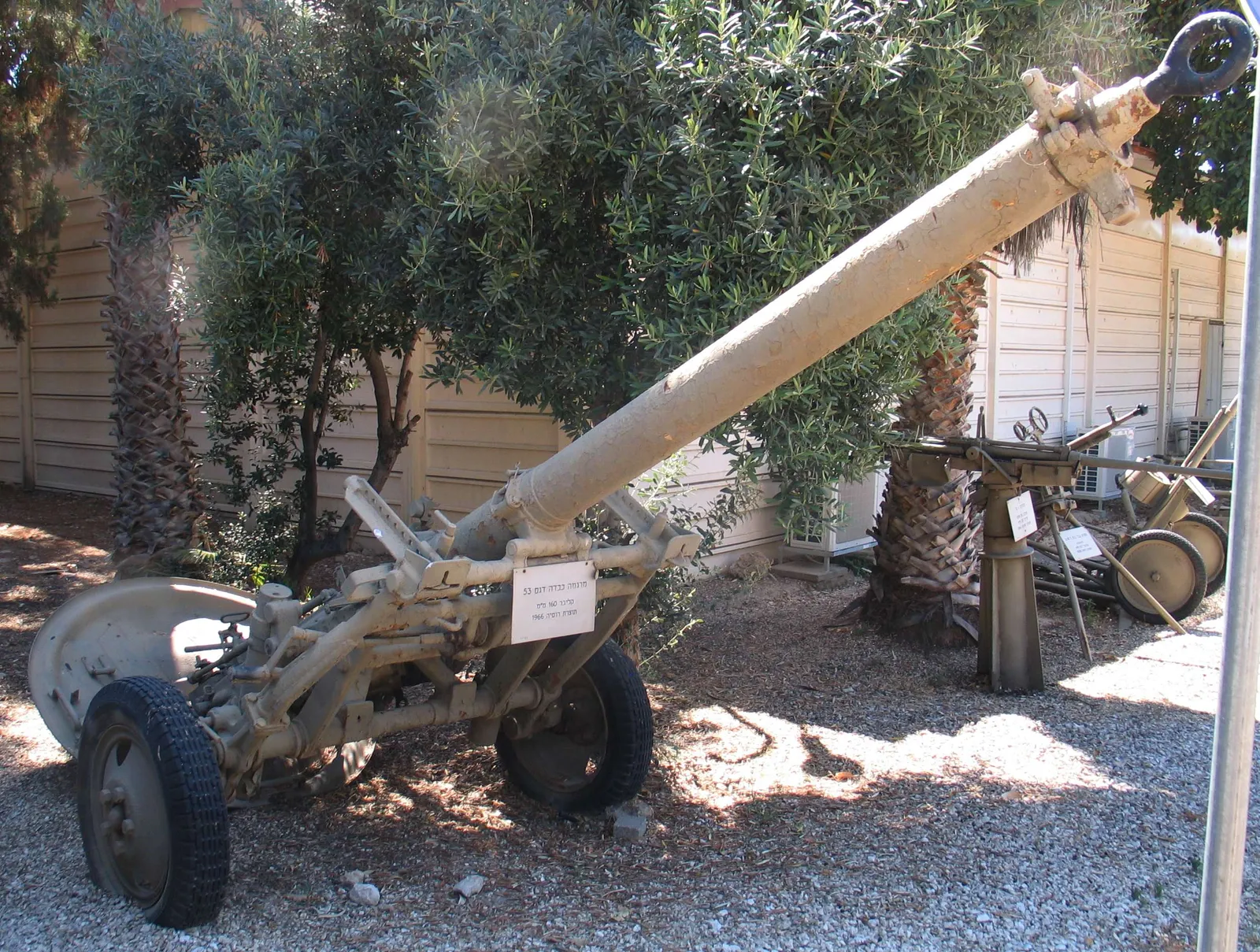
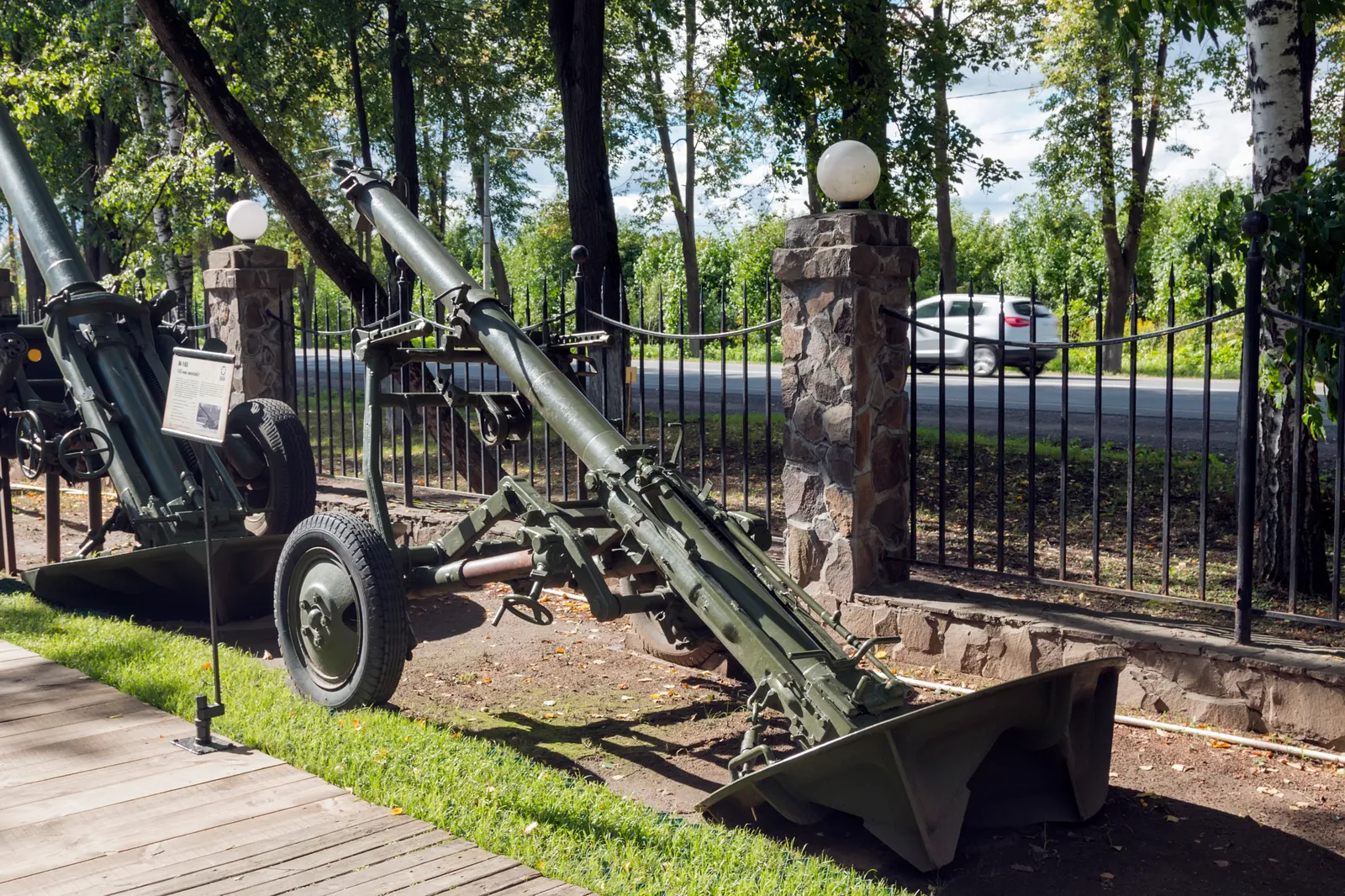
The 160mm M160 is a Soviet postwar breech-loading heavy mortar developed as a longer-ranged successor to the wartime 160mm PM-43. Its hinged rear-loading barrel, large baseplate, and two-wheel carriage made it closer to a towed artillery piece than a man-portable mortar, trading mobility for a 40 kg-class bomb and an 8 km indirect-fire reach.
Role in Conflicts
- Side
- Iraq

A U.S. National Archives image record identifies an Iraqi M-160 160 mm mortar abandoned at an outpost after Iraqi forces withdrew from Kuwait City during Operation Desert Storm.
Role detailsProfile / Specs
Profile
- Origin
- Soviet Union
- Built by
- TulamashzavodNo. 172 Plant
- Type
- 160 mm towed heavy mortar
- Service note
- Introduced in 1949 after 1945-1947 development; produced through 1957 and retained by some former Soviet clients
- Designer
- SKB-21 at the Kolomna Special Design Bureau of Smoothbore Artillery under B. I. Shavyrin
- Designed
- 1945-1947
- Produced
- 1949-1957
- Number built
- 2,353
- Developed from
- 160mm PM-43
Specifications
- Caliber
- 160 mm
- Weapon type
- Smoothbore breech-loading heavy mortar
- Crew
- 6-8; Victory Museum lists 7
- Weight
- 1,300 kg in firing position; 1,470 kg in travelling configuration
- Barrel length
- 4.55 m
- Bomb weight
- About 40-41.2 kg depending on mine type
- Explosive fill
- About 7.7-9 kg in listed 160 mm high-explosive mines
- Maximum range
- 8,040 m
- Minimum range
- 750 m
- Rate of fire
- About 3 rounds per minute
- Muzzle velocity
- 157-343 m/s depending on charge
- Elevation
- +50 degrees to +80 degrees
- Traverse
- 24 degrees at +50 degrees elevation; wider high-elevation traverse reported in reference data
- Mobility
- Two-wheel towed carriage with a muzzle towing lug; towed by truck or tracked tractor up to about 50 km/h
Breech-Loading Heavy Mortar Layout
The M-160 kept the Soviet 160 mm mortar family's rear-loading approach because a 40 kg-class bomb was impractical to drop into a long tube from the muzzle. The barrel pivots for loading, the baseplate absorbs recoil into the ground, and the fixed wheel carriage doubles as part of the firing mount.
Predecessor change
WeaponSystems.net describes the M160 as a longer-barreled successor to the 160-PM-43, built to extend range beyond the wartime design.
Handling tradeoff
The mortar could be towed at road speed, but its mass made infantry manhandling impractical once away from prepared positions.
Ammunition effect
Victory Museum data lists 40 kg and 41.2 kg high-explosive mines with fuze settings for blast or fragmentation effect.
Variants
Open references treat the M-160 as the Soviet 1949 divisional mortar and distinguish it from the wartime PM-43/MT-13 predecessor; China produced a related Type 56 copy.
| Variant | Configuration | Designation notes |
|---|---|---|
 | wartime predecessor | WeaponSystems.net describes the M160 as the longer-ranged successor to the World War II-era 160-PM-43. Sources: WeaponSystems.net 160mm M160 |
| Type 56 heavy mortar | Chinese copy | GlobalSecurity identifies China's Type 56 heavy mortar as a copy of the Soviet 160 mm M-160 heavy mortar. |
Timeline
160mm M160 Key Events
Postwar development begins
Reference accounts place development of the SKB-21/M-160 design in 1945-1947 at the Kolomna artillery design bureau under B. I. Shavyrin.
Sources: Victory Museum M-160 Mortar
Adopted and production starts
The M-160 won the postwar competition and entered serial production in 1949, initially at Plant No. 535.
Sources: Victory Museum M-160 Mortar
Production continues at Plant No. 172
Open reference data says serial production continued at Plant No. 172 from 1952 until the production run ended in 1957.
Sources: Victory Museum M-160 Mortar
Syrian Army use documented
Oryx published a photo report identifying 160 mm M-160 mortars with the Syrian Arab Army and describing their early-war urban shelling use.
Sources: Oryx Syrian Arab Army Photo Report
Captured in Idlib fighting
Oryx listed two 160 mm M160 mortars as captured during Turkish and rebel operations against Syrian government equipment in Idlib.
Sources: Oryx Idlib Turkey Shoot
Ukraine identification disputed
A 2025 Ukrainian media report described an M-160 in Ukrainian service, but Defence Express later assessed the visible weapon as a captured 2B23 Nona-M1 rather than an M-160; the catalog does not treat that episode as a direct M-160 conflict-use row.
Sources: Pryamiy Ukrainian M-160 Report, Defence Express Nona-M1 Identification
Media
Related Weapon Systems


Sources
Victory Museum M-160 MortarPublisher: Victory Museum / Central Museum of the Great Patriotic War 1941-1945 | Note: Supports M-160 identity, 1949 model designation, SKB-21/Kolomna/Shavyrin development, Plant No. 535 and Plant No. 172 production sequence, production dates and total, Soviet service context, specifications, ammunition notes, and towing arrangement. | Accessed: 2026-07-06WeaponSystems.net 160mm M160Publisher: WeaponSystems.net | Note: Supports Soviet origin, heavy-mortar type, PM-43 successor relationship, crew range, weight, barrel length, muzzle velocity, elevation, traverse, rate of fire, range, carriage, towing vehicle, and export-user context. | Accessed: 2026-07-06GlobalSecurity Chinese Towed ArtilleryPublisher: GlobalSecurity.org | Note: Supports Type 56 as a Chinese heavy-mortar copy related to the Soviet 160 mm M-160 family. | Accessed: 2026-07-06Oryx Syrian Arab Army Photo ReportPublisher: Oryx | Note: Supports 2011 Syrian Civil War direct conflict-use by identifying Syrian Arab Army 160 mm M-160 mortars and describing heavy early-war shelling use in cities. | Accessed: 2026-07-06Oryx Idlib Turkey ShootPublisher: Oryx | Note: Supports 2011 Syrian Civil War direct conflict materiel evidence by listing two 160 mm M160 mortars captured during the 2020 Idlib fighting. | Accessed: 2026-07-06NARA Iraqi M-160 Desert Storm ImagePublisher: U.S. National Archives via NARA and DVIDS Public Domain Archives | Note: Supports 1990 Gulf War direct conflict materiel evidence by identifying an Iraqi M-160 160 mm mortar abandoned at a Kuwait City outpost after Iraqi forces withdrew during Operation Desert Storm. | Accessed: 2026-07-06Pryamiy Ukrainian M-160 ReportPublisher: Pryamiy | Note: Documents a June 2025 Ukrainian media report that identified a seen weapon as an M-160; used only with the Defence Express correction as a disputed-identification timeline note, not as direct conflict-use support. | Accessed: 2026-07-06Defence Express Nona-M1 IdentificationPublisher: Defense Express | Note: Supports the caveat that a 2025 Ukrainian video first described as M-160 was later assessed as a captured 2B23 Nona-M1 rather than an M-160. | Accessed: 2026-07-06Commons 160 mm M-160 4055 ImagePublisher: Wikimedia Commons | Note: Supports image provenance and licensing for the primary M-160 photograph at Technical Museum Togliatti; the file page lists own work by ShinePhantom under CC BY-SA 3.0. | Accessed: 2026-07-06Commons 160 mm M-160 4052 ImagePublisher: Wikimedia Commons | Note: Supports gallery-image provenance for a second M-160 photograph at Technical Museum Togliatti; the file page lists own work by ShinePhantom under CC BY-SA 3.0. | Accessed: 2026-07-06Commons Batey ha-Osef M-160 ImagePublisher: Wikimedia Commons | Note: Supports gallery-image provenance for a 160 mm M1949/M-160 mortar at Batey ha-Osef Museum in Tel Aviv; the file page lists own work by Bukvoed under CC BY 3.0. | Accessed: 2026-07-06Commons M-160 Museum of Technique ImagePublisher: Wikimedia Commons | Note: Supports gallery-image provenance for an M-160 160 mm mortar museum photograph; the file page lists own work by Mike1979 Russia under CC BY-SA 4.0. | Accessed: 2026-07-06