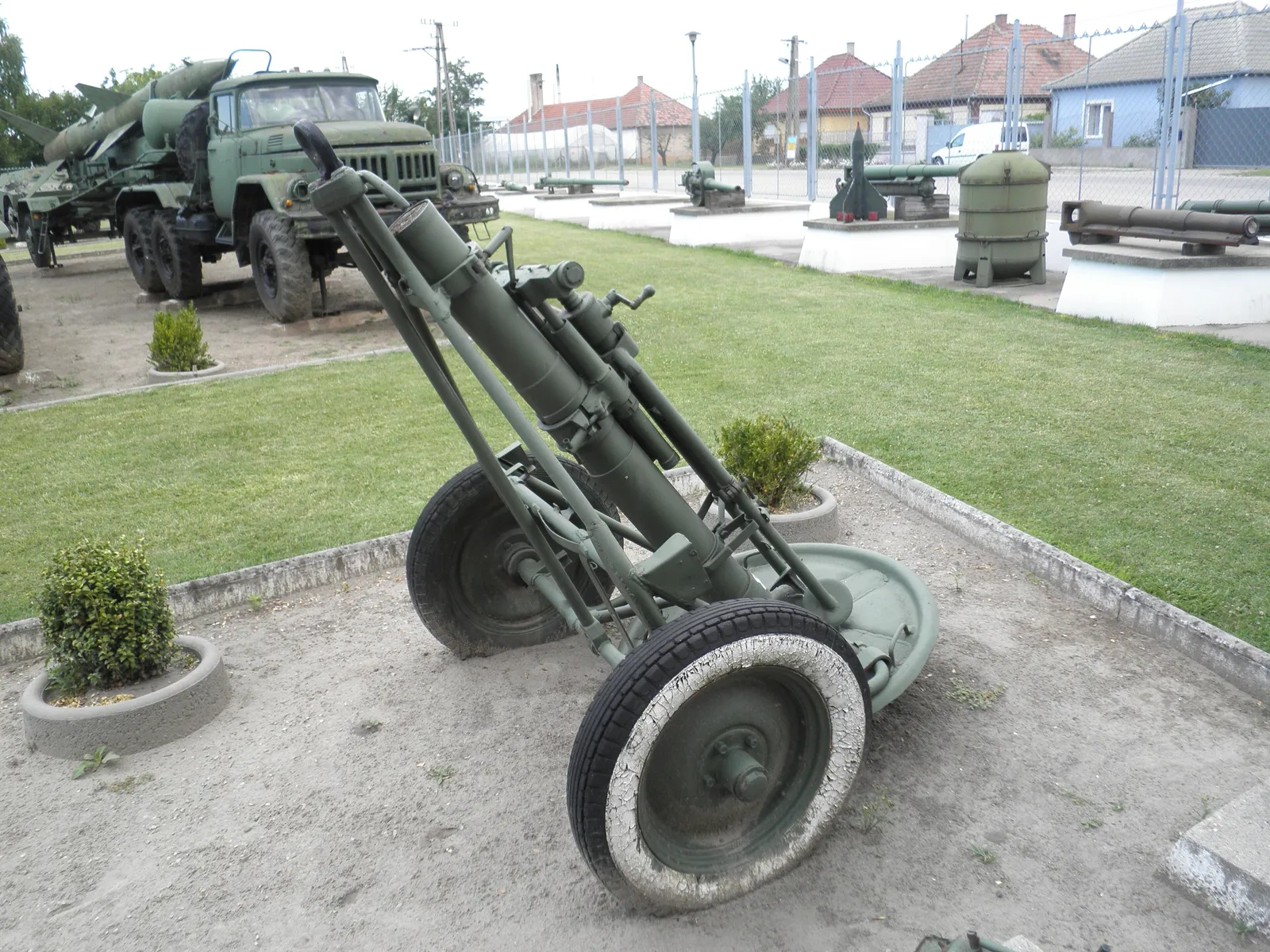


OSCE monitoring during the Donbas phase documented PM-38 120 mm mortars at a DPR-controlled heavy-weapons holding area in 2015 and later listed PM-38 or PM-120/PM-38 mortars missing from government-controlled holding or storage sites; Army Recognition, citing The Military Balance 2021, separately listed 30 M-1938 (PM-38) mortars in Ukrainian army holdings before the 2022 full-scale invasion.
Role detailsArtillery
120-PM-38
Also known as
- PM-38
- M1938 mortar
- M-1938 heavy mortar
- 120 mm mortar model 1938
- 120 mm battalion mortar model 1938
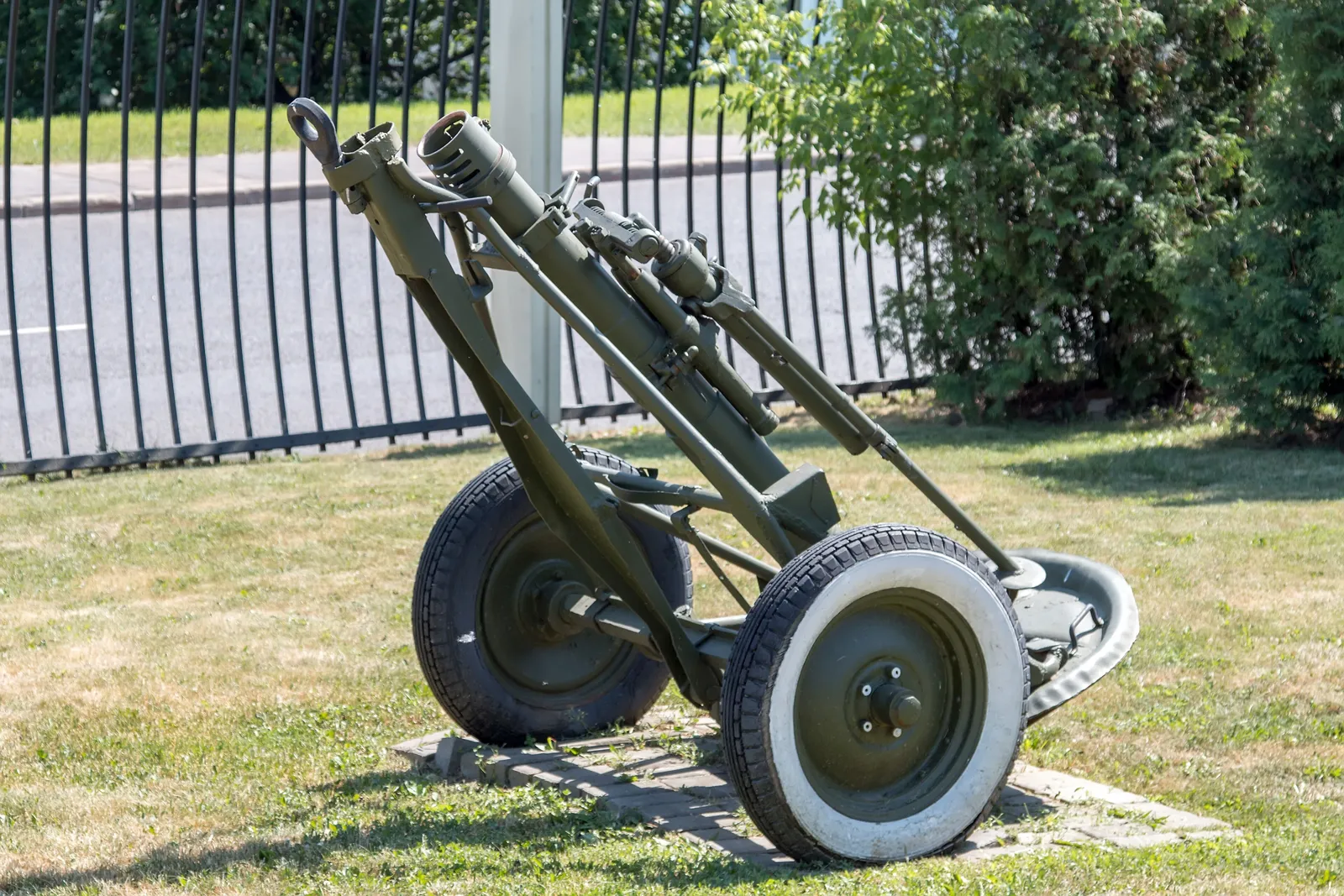
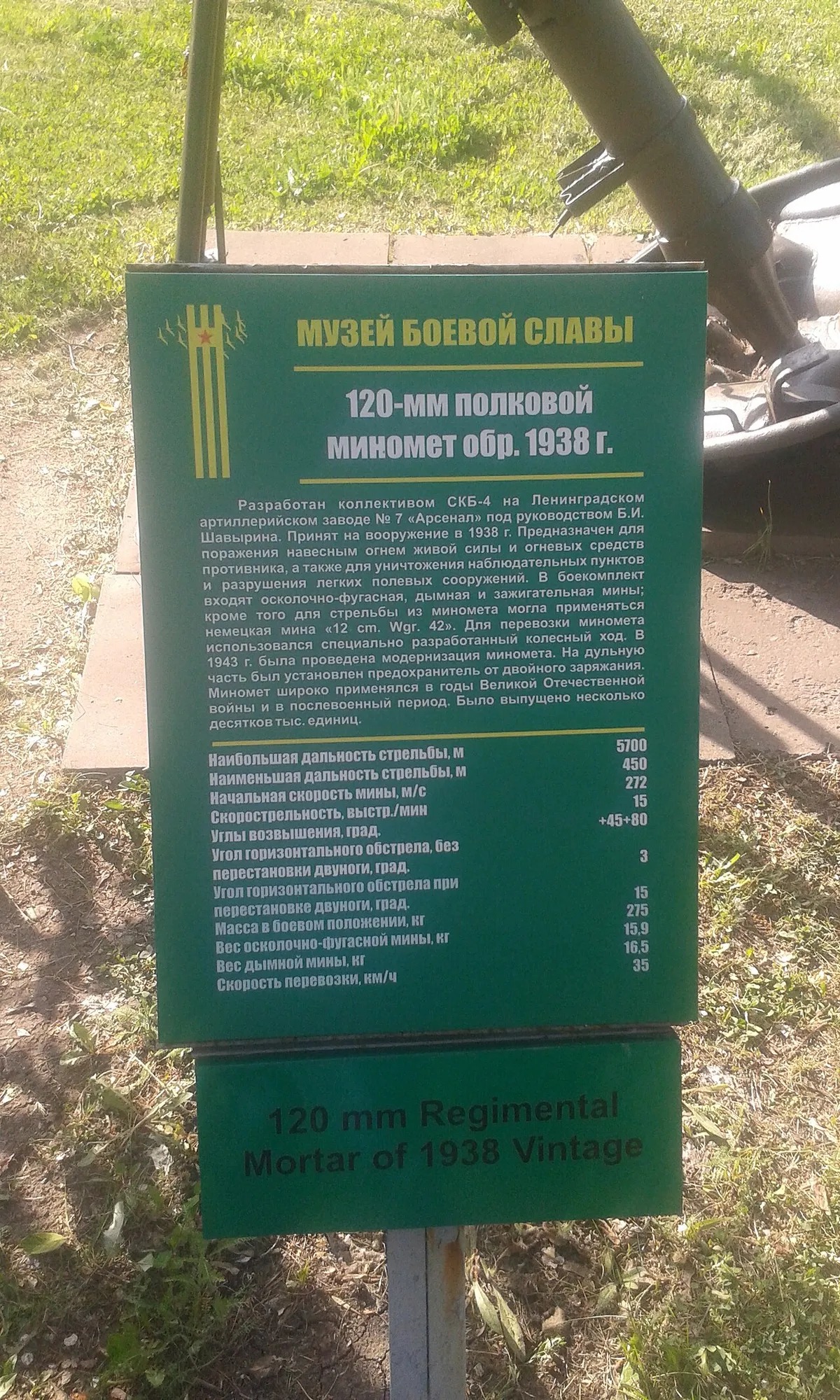
The 120-PM-38, also known as the M1938, is a Soviet 120 mm smoothbore heavy mortar designed under B. I. Shavyrin and built for infantry fire support. Its large bomb, two-wheel transport arrangement, and roughly 5.7 km range made it a durable regimental mortar design; OSCE monitoring documented PM-38 mortars in Donbas heavy-weapons holding and storage records during the 2014 Russia-Ukraine War, while Oryx listed M-1938 heavy mortars in Yemen's pre-war army inventory.
Role in Conflicts

Oryx listed the 120 mm M-1938 heavy mortar in pre-war Yemeni Army service and framed the inventory as equipment available to Yemeni parties on the battlefield after the 2014-2015 Houthi takeover; HRW and UN reporting support Houthi-Saleh access to Yemeni Army weapons and 120 mm mortar fire, but do not identify a specific PM-38 tube in a named firing incident.
Role detailsProfile / Specs
Profile
- Origin
- Soviet Union
- Built by
- Plant No. 92 Nizhny Novgorod
- Type
- 120 mm towed heavy mortar
- Service note
- Introduced in 1938; retained in limited inventories during recent conflicts
- Designer
- Design bureau led by B. I. Shavyrin
- Designed
- 1937-1938
- Unit cost
- Not publicly available
- Produced
- From 1939
- Number built
- About 3,800 in Red Army service by 22 June 1941
- Developed into
- 120-PM-43
Specifications
- Caliber
- 120 mm
- Crew
- 6
- Maximum range
- 5,700 m
- Weight
- 557 kg listed by National Defence University of Ukraine
- Rate of fire
- 6 to 15 rounds per minute
- Ammunition load
- 80 rounds listed for the system
Variants
Open references treat the PM-38 as the 1938 base design for a wartime Soviet 120 mm mortar family, with the PM-43 as the linked successor and several foreign or local designations attached to later copies.
| Variant | Configuration | Designation notes |
|---|---|---|
| 120 mm battalion mortar model 1941 | Wartime Soviet revision | National Defence University of Ukraine lists a 1941 120 mm battalion mortar model among the immediate successor designs after the PM-38 entered Soviet service. Sources: 120-mm PM-38 mortar |
 | 1943 successor mortar | WeaponSystems.net describes the PM-43 as an improved 1943 development of the PM-38, and the linked catalog record carries the separate PM-43 service context. Sources: 120mm PM-43 |
| 12 cm Granatwerfer 42 | German wartime copy | WeaponSystems.net notes that Germany copied captured PM-38 mortars as the 12 cm Granatwerfer 42 during the Second World War. Sources: 120mm PM-43 |
| Type 53 / Type 55 / UK2 | Postwar local-copy designations | MilitaryFactory's PM-43 profile lists Type 53, Type 55, and UK2 among local-copy designations in the PM-38-derived 120 mm mortar family. |
Ammunition Fired
VMZ lists 120 mm mortar rounds for PM-38 compatibility, including HE-fragmentation and thermobaric types.
| Ammunition | Ammunition type | Firing evidence |
|---|---|---|
 | 120 mm mortar ammunition | VMZ states its 120 mm HE-FRAG mortar bomb is intended to function when fired from PM-38 mortars, and ODIN describes the PM-38 as firing 120 mm ammunition including HE-fragmentation and smoke natures. Sources: 120 mm ROUND WITH HE-FRAG MORTAR BOMB, PM-38 (M1938) Russian 120mm Towed Mortar |
 | 120 mm thermobaric mortar round | VMZ's product sheet lists PM-38 among the mortars that can fire this 120 mm thermobaric round. Sources: VMZ 120 mm Thermobaric Mortar Round |
Design And Family Notes
Open references describe the PM-38 as the 1938 base weapon in a compact Soviet regimental-mortar family, with later wartime and foreign-copy designations branching from the same 120 mm smoothbore pattern.
| Topic | Source-backed detail | Reader note |
|---|---|---|
| Design origin | Designed in 1937-1938 under a bureau led by B. I. Shavyrin. | National Defence University of Ukraine is the main source for design and manufacturer attribution. |
| Production scale | Series delivery began in 1939, with about 500 made that year and about 3,800 in Red Army service by 22 June 1941. | These figures are useful for scale but are not modern conflict-use evidence. |
| Family relationship | The PM-43 is treated by open references as a 1943 development of the PM-38 family. | The PM-43 has separate service history, conflict evidence, and image sourcing. |
| Ammunition relationship | VMZ and ODIN sources connect PM-38 mortars with 120 mm mortar ammunition, including HE-fragmentation and smoke natures; VMZ separately lists a compatible thermobaric round. | Conflict rows should still be read as launcher evidence, not proof that every listed round was used in those conflicts. |
Timeline
120-PM-38 Key Events
PM-38 design work begins
National Defence University of Ukraine attributes the mortar to a design bureau led by B. I. Shavyrin and dates the design period to 1937-1938.
Sources: 120-mm PM-38 mortar
Entered Soviet service
National Defence University of Ukraine says the 120 mm PM-38 entered service in 1938.
Sources: 120-mm PM-38 mortar
Series deliveries begin
National Defence University of Ukraine gives 1939 as the start of series delivery and says about 500 were made that year.
Sources: 120-mm PM-38 mortar
Large wartime inventory on hand
National Defence University of Ukraine lists about 3,800 PM-38 mortars in Red Army service at the start of the German-Soviet war.
Sources: 120-mm PM-38 mortar
OSCE lists PM-38 mortars in Donetsk region
The OSCE Special Monitoring Mission reported PM-120/PM-38 120 mm mortars missing from a Ukrainian government-controlled heavy-weapons holding area in Donetsk region.
Sources: Latest from the OSCE Special Monitoring Mission to Ukraine, 19 March 2019
Media
120-PM-38 Images
Related Weapon Systems


Sources
120 mm ROUND WITH HE-FRAG MORTAR BOMBPublisher: VMZ | Note: Supports the published compatibility line stating that the 120 mm HE-FRAG mortar bomb functions when fired from PM-38 mortars. | Accessed: 2026-06-30PM-38 (M1938) Russian 120mm Towed MortarPublisher: ODIN | Note: Supports the PM-38 designation and its 120 mm ammunition relationship for the pairing note. | Accessed: 2026-06-30120-mm PM-38 mortarPublisher: National Defence University of Ukraine | Note: Supports PM-38 background, designer/manufacturer attribution, service date, production context, and listed specifications. | Accessed: 2026-06-30VMZ 120 mm Thermobaric Mortar RoundPublisher: VMZ | Note: Supports the thermobaric 120 mm round designation, technical data, and the published compatibility line that includes PM-38. | Accessed: 2026-06-30Latest from the OSCE Special Monitoring Mission to Ukraine, 19 March 2019Publisher: Organization for Security and Co-operation in Europe | Note: Directly documents PM-120/PM-38 120 mm mortars missing from a government-controlled heavy-weapons holding area in Donetsk region during the 2014 Russia-Ukraine War. | Accessed: 2026-06-30OSCE SMM Daily Report 6 December 2015Publisher: Organization for Security and Co-operation in Europe | Note: Directly documents PM-38 120 mm mortars at a DPR-controlled heavy-weapons holding area during the 2014 Russia-Ukraine War. | Accessed: 2026-07-01Analysis: Discover list new artillery weapons of Ukrainian army after delivery of foreign equipmentPublisher: Army Recognition | Note: Directly supports 2014 Russia-Ukraine War operator context by reporting that the Ukrainian army fielded or retained 30 M-1938 (PM-38) 120 mm mortars before the 2022 full-scale invasion. | Accessed: 2026-06-30120mm PM-43Publisher: WeaponSystems.net | Note: Supports PM-38 family context by describing the PM-43 as an improved wartime development of the PM-38 and noting the German 12 cm Granatwerfer 42 copy. | Accessed: 2026-06-30M1943 120mm (120-PM 43) Heavy Field MortarPublisher: Military Factory | Note: Supports PM-38-derived family context by listing Type 53, Type 55, UK2, and other local-copy designations for the PM-43 family. | Accessed: 2026-06-30Handbook Of Pre-War Yemeni Fighting VehiclesPublisher: Oryx | Note: Supports 2014 Yemen Civil War context: fielded by the pre-war Yemeni Army as 120mm M-1938 heavy mortars and described as equipment available to Yemeni parties on the battlefield after the Houthi takeover. | Accessed: 2026-06-30UN Panel of Experts Yemen 2016Publisher: United Nations Panel of Experts on Yemen via Iran Watch | Note: Supports 2014 Yemen Civil War access context by reporting diversion of weapons and military support from regular Yemeni Army units to Houthi-Saleh forces. | Accessed: 2026-07-04HRW Houthi Artillery in AdenPublisher: Human Rights Watch | Note: Supports 2014 Yemen Civil War use context by documenting pro-Houthi mortar attacks in Aden and impact-site/remnant evidence consistent with 120 mm mortar fire from Houthi-held positions. | Accessed: 2026-07-04HRW Artillery Attacks in TaizzPublisher: Human Rights Watch | Note: Supports 2014 Yemen Civil War use context by documenting Houthi-Saleh artillery and mortar fire in Taizz and identifying a May 2017 attack as involving a 120 mm mortar projectile. | Accessed: 2026-07-04File:120 mm PM38 02.JPGPublisher: Wikimedia Commons | Note: Image provenance for a PM38 mortar photographed at the Army History Museum and Park in Kecel, licensed CC BY-SA 3.0 by Cooper6. | Accessed: 2026-06-30Category:120 mm mortar M1938Publisher: Wikimedia Commons | Note: Supports image provenance for additional M1938/120-PM-38 gallery views from Commons file pages and identifies the system as a Soviet-origin towed 120 mm mortar family. | Accessed: 2026-06-30