Artillery

120mm MO-120-AM50

Also known as
  • MO-120-AM50
  • MO-120 AM50
  • MO 120 AM50
  • MO-120-AM-50
  • MO-120 AM-50
  • Brandt AM-50
  • Brandt 120 mm AM50
  • MW-50
  • MW-50 120mm
  • MW-50 120 mm
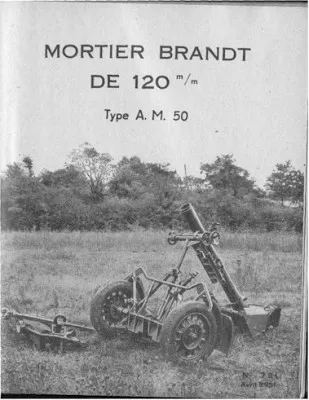
  • Mortier Brandt de 120mm type A. M. 50

The 120mm MO-120-AM50 is a French Brandt smoothbore heavy mortar developed after World War II and fielded from the 1950s as a towed, baseplate-fired, or carriage-fired infantry support weapon. It predates the later MO-120 RT rifled mortar family and appears in the catalog through two direct evidence lanes: an Imperial War Museums object record for an Argentine Army Brandt 120 mm mortar captured during the Falklands War, and SIPRI transfer data recording Denmark's 2024 delivery of MW-50 120mm mortars to Ukraine.

Role in Conflicts

Profile / Specs

Profile

Origin
France
Built by
Brandt
Type
120 mm smoothbore heavy mortar
Service note
Early Cold War design with later limited service
Designer
Brandt
Designed
Late 1940s
Produced
1950s-1970s
Number built
At least several hundred

Specifications

Caliber
120 mm smoothbore mortar
Crew
4
Weight
242 kg in firing position; 402 kg on carriage
IWM object dimensions
102 in long in towed mode; 78 in long in deployed mode; 120 mm calibre
Component weights
76 kg barrel including towing eye; 86 kg bipod; 80 kg baseplate; 137 kg carriage
Range
0.5-6.6 km
Rate of fire
12 rounds per minute maximum; 8 rounds per minute normal
Elevation
+45 to +85 degrees
Traverse
17 degrees total at 60 degrees elevation; 360 degrees on baseplate
Ammunition examples
M44 high-explosive, Mk 62 illumination, Mk 62 smoke, and PEPA rocket-assisted mortar bombs
Mobility
Separate two-wheel carriage, normally towed by a 4x4 light truck
Design And Carriage

The AM50 is a conventional muzzle-loaded smoothbore heavy mortar built around a 120 mm tube, adjustable bipod, large baseplate, and separate two-wheel carriage. The carriage allowed towing by a light truck and also allowed firing from the wheeled mount when the axle was locked, while normal emplacement used the bipod and baseplate.

Tube architecture

Smoothbore 120 mm mortar rather than the rifled tube used on the later MO-120 RT family.

Movement

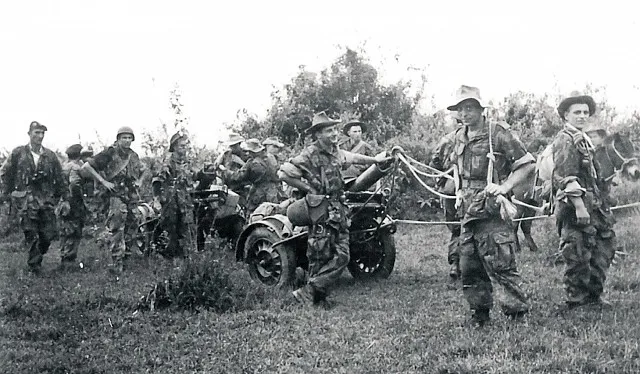
Separate two-wheel carriage for light-truck towing; Military Periscope describes the barrel horizontal in travel position with the baseplate folded behind the wheels.

Firing envelope

Reference data lists a 0.5 km minimum range, 6.6 km maximum range, +45 to +85 degree elevation, and 17 degrees of traverse at 60 degrees elevation.

Variants

AM50 is treated as the earlier smoothbore Brandt 120 mm mortar branch; the later MO-120 RT page covers the heavier rifled successor family.

VariantConfigurationDesignation notes
MO-120 RT, 120 mm rifled towed heavy mortar, ArtilleryMO-120 RTLater rifled 120 mm mortar successor family

WeaponSystems.net identifies the MO-120 RT as the heavier, longer-range rifled mortar that replaced the AM50 in France and several other armies.

Sources: WeaponSystems.net MO-120-AM50

Ammunition Fired

Reference sources describe the AM50 as a 120 mm smoothbore mortar that fires conventional heavy-mortar bomb families rather than the later rifled MO-120 RT ammunition package.

AmmunitionAmmunition typeFiring evidence
Mortar bombs, 120mm, Heavy mortar ammunition, MunitionsMortar bombs, 120mm120 mm mortar ammunition

Military Periscope lists M44 high-explosive, Mk 62 illuminating, Mk 62 smoke, and PEPA rocket-assisted ammunition for the AM50 120 mm mortar.

Sources: Military Periscope AM 50 Mortar

Timeline

120mm MO-120-AM50 Key Events

  1. Postwar development

    WeaponSystems.net places AM50 development in the late 1940s as an early Cold War French heavy-mortar design.

    Sources: WeaponSystems.net MO-120-AM50

  2. Service entry

    Reference data places the MO-120-AM50 in service during the 1950s, with production continuing into the 1970s.

    Sources: WeaponSystems.net MO-120-AM50

  3. Falklands War captured example

    Imperial War Museums catalogues a Brandt 120 mm mortar associated with the Argentine Army and captured during the Falklands War.

    Sources: Imperial War Museums MO-120-AM50 Mortar

  4. Danish MW-50 transfer to Ukraine

    SIPRI records Denmark delivering ten MW-50 120mm mortars to Ukraine during the full-scale phase of the Russia-Ukraine war.

    Sources: SIPRI Arms Transfers Database MW-50

Media
Related Weapon Systems
MO-120 RT, 120 mm rifled towed heavy mortar, ArtilleryArtilleryMO-120 RT120 mm rifled towed heavy mortarThe MO-120 RT is a French 120 mm rifled towed heavy mortar developed by Brandt and later associated with TDA/Thales production. Its rifled barrel, two-wheel carriage, and rocket-assisted ammunition option give it longer range than many smoothbore infantry mortars, while keeping the system towable by light or medium vehicles. The family also appears through derivatives such as the U.S. Marine Corps M327 EFSS and Turkey's HY-12, giving the page conflict evidence from Ukraine, Mali, Afghanistan, Yemen, and Colombia.
120 mm mortar launcher, Heavy mortar launcher, ArtilleryArtillery120 mm mortar launcherHeavy mortar launcherA 120 mm mortar launcher is a heavy indirect-fire weapon class used to fire high-angle mortar bombs from a tube, baseplate, and bipod, a towed mount, or a vehicle system. This generic entry is for source-backed cases where public evidence identifies the caliber and mortar role but not a precise national model, including Ukrainian 120-mm mortar fire near Chasiv Yar, probable 120 mm mortar shelling in Yemen, Gaddafi-era use around Misratah, and a Nigerien seizure from Boko Haram fighters.
120 mm M75 mortar, 120 mm towed smoothbore mortar, ArtilleryArtillery120 mm M75 mortar120 mm towed smoothbore mortarThe 120 mm M75 mortar is a Yugoslav-designed towed smoothbore mortar associated with the M74/M75 light-mortar family and post-Yugoslav export literature. Yugoimport describes it as infantry close-support artillery for high-angle fire, smoke, illumination, and difficult terrain, while Serbian sources and later defense reporting show the legacy weapon being paired with modern fire-control equipment. Direct records place M75 mortars in JNA fire support around Dubrovnik in 1991 and in Armenian/Artsakh losses during the 2020 Nagorno-Karabakh war.
120mm Type W86, 120 mm towed heavy mortar, ArtilleryArtillery120mm Type W86120 mm towed heavy mortarThe 120mm Type W86 is a Chinese smoothbore heavy mortar developed by Norinco as a longer-ranged replacement for older Type 55-pattern 120 mm mortars. It uses a conventional tube, bipod, baseplate, sight, and two-wheel carriage, with public sources documenting Chinese origin, export service, vehicle-mounted installations, W86-pattern ammunition, and a 2025 Sahel conflict event involving jihadist use of a Type W86 mortar with rocket-assisted ammunition.
120 mm M1982 mortar, 120 mm towed heavy mortar, ArtilleryArtillery120 mm M1982 mortar120 mm towed heavy mortarThe 120 mm M1982 mortar is a Romanian smoothbore heavy mortar built as a late Cold War replacement for older Reșița and Soviet PM-43-pattern 120 mm mortars. It combines a conventional tube, bipod, triangular baseplate, and two-wheel transport carriage with Romanian service adaptations for truck towing, short-distance crew movement, and mountain-troop pack transport. Direct conflict evidence is narrow but usable: Romanian troops are documented firing the M1982 in Afghanistan in 2008.

Sources