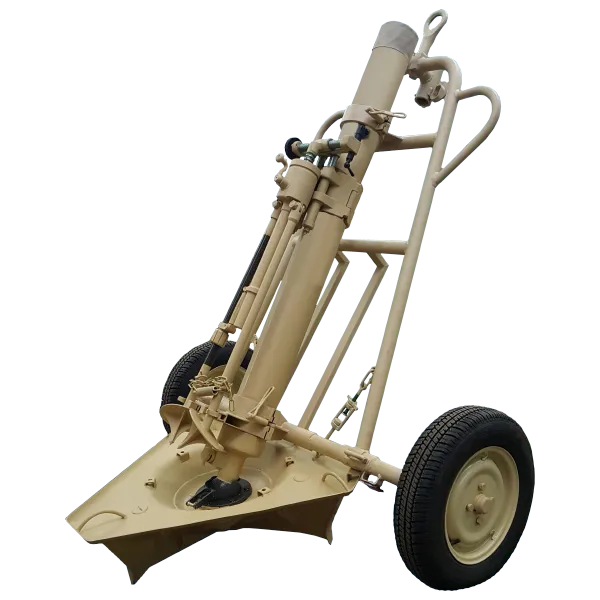

Armenian / Artsakh forces fielded the M74 in the 2020 fighting, and Oryx recorded four captured examples in its Nagorno-Karabakh loss list.
Artillery
120 mm M74 mortar
Also known as
- M74
- M-74
- 120 mm M74
The 120 mm M74 is a Yugoslav-origin towed mortar developed in the mid-1970s as part of the M74/M75 light-mortar generation. Current Serbian, Bosnian, Polish, and SIPRI records keep the system in the export-industrial and wartime-transfer record, while open-source conflict documentation places captured examples in Nagorno-Karabakh and a CIG-identified M74 in RSF-linked fighting at El Fasher.
Role in Conflicts

Conflict Insights Group geolocated a January 2025 El Fasher video showing apparent Colombian fighters supporting the RSF siege with a Serbian M74 mortar and M62P10 shell.
- Side
- Ukraine

Polish export reporting lists an actual 2023 export to Ukraine of 22 M74 120 mm mortars, while SIPRI's transfer register records 22 M-74 120mm mortars supplied from Bosnia-Herzegovina to Ukraine with 2023 deliveries.
Role detailsProfile / Specs
Profile
- Origin
- Yugoslavia / Serbia / Bosnia and Herzegovina
- Built in
- SerbiaBosnia and Herzegovina
- Type
- 120 mm smoothbore towed mortar
- Service note
- Mid-1970s design still marketed by Serbian and Bosnian industry
- Designed
- Mid-1970s
- Unit cost
- Not publicly documented
- Produced
- Mid-1970s onward
- Number built
- Not publicly documented
Specifications
- Caliber
- 120 mm
- Barrel length
- 1,692 mm with breech piece / tube with stand
- Maximum range
- 6,440 m with 120 mm M62P3 mortar bomb
- Minimum range
- 266 m in Yugoimport product data
- Rate of fire
- 12 rounds per minute
- Crew
- 1 + 4 operators
- Combat weight
- 120 kg
- Transport weight
- 219 kg
- Elevation
- 45 to 85 degrees
- Traverse
- 3 degrees left/right without shifting the bipod; 360 degrees with bipod displacement
- Maximum barrel pressure
- Under 835 bar
- Sight
- NSB-4 / NSB-4B
Mobility And Fire Profile
The M74 is presented in official product literature as a light 120 mm close-support mortar for high-angle fire, smoke, illumination, and infantry support in broken terrain.
Fire mission
Yugoimport describes the mortar as a close infantry-support weapon for personnel, firing points, light fortifications, smoke-screen work, and night illumination.
Firing arc
Product sheets give 45 to 85 degrees of elevation, 3 degrees left/right traverse without shifting the bipod, and all-around traverse after bipod displacement.
M62P3 baseline
Both PPT Namenska and Yugoimport tie the public 6,440 m maximum range figure to the 120 mm M62P3 mortar bomb or mine.
Variants
VTI history treats the M74 and M75 as related second-generation 120 mm light mortars developed from the mid-1970s Yugoslav fire-support program.
| Variant | Configuration | Designation notes |
|---|---|---|
 | Heavier related 120 mm light mortar | VTI places the M74 and M75 together in the same mid-1970s light-mortar generation that followed the M52 and preceded the longer-range M95. Sources: VTI Mortar History |
Ammunition Fired
PPT Namenska and Yugoimport list the M74 mortar with the 120 mm M62P3 mine or ammunition as its maximum-range round, and ITC catalogs the same designation as a 120 mm HE mortar bomb.
| Ammunition | Ammunition type | Firing evidence |
|---|---|---|
 | 120 mm high-explosive mortar bomb | PPT Namenska and Yugoimport list the M74's 6,440 m maximum range with 120 mm M62P3 ammunition, and ITC catalogs the 120 mm HE mortar bomb M62P3 as a standard round in the same caliber. Sources: PPT Namenska Mortars, 120 mm M74 Product Sheet, ITC Mortar Ammunition |
Timeline
120 mm M74 mortar Key Events
Developed and introduced into service
An official VTI history says the light M74 and M75 mortars were developed and introduced into service in the middle of the 1970s.
Sources: VTI Mortar History
Captured examples documented in Nagorno-Karabakh
Oryx's 27 September 2020 Nagorno-Karabakh roundup lists four captured 120 mm M74 mortars on the Armenian / Artsakh side.
Sources: Oryx Nagorno-Karabakh Losses
M74 mortar identified at El Fasher
Conflict Insights Group reported that a geolocated video from El Fasher showed apparent Colombian fighters supporting the Rapid Support Forces siege with a Serbian M74 mortar and M62P10 shell.
Sources: Conflict Insights Blood Money Report
M74 mortars recorded in Ukraine transfer reporting
Polish export reporting and SIPRI transfer-register data both record 2023 deliveries of 22 M74 / M-74 120 mm mortars to Ukraine, supporting a wartime transfer context rather than confirmed battlefield firing.
Sources: Polish 2023 Arms Export Report, SIPRI Arms Transfers Database
Media
120 mm M74 mortar Videos
120 mm M74 mortar Images
Related Weapon Systems





Sources
PPT Namenska MortarsPublisher: PPT Namenska | Note: Supports manufacturer background, image provenance, and published specifications for the 120 mm M74 mortar and its product-page photo set, including the M62P3-linked 6,440 m maximum range. | Accessed: 2026-07-07Yugoimport 120 mm MortarsPublisher: Yugoimport-SDPR | Note: Supports background context by listing the 120 mm M74 mortar among Serbian export mortar documents. | Accessed: 2026-07-07VTI Mortar HistoryPublisher: Scientific Technical Review | Note: Supports the mid-1970s development, introduction into service, and infantry-battalion fire-support role for the M74 and M75 light mortar family. | Accessed: 2026-07-07120 mm M74 Product SheetPublisher: Yugoimport-SDPR | Note: Supports technical background, export-product context, M62P3 ammunition compatibility, and detailed specifications for the 120 mm M74 mortar. | Accessed: 2026-07-07ITC Mortar AmmunitionPublisher: ITC Ltd. Zenica | Note: Supports the M62P3 identity as a 120 mm high-explosive mortar bomb compatible with the M74-linked ammunition designation. | Accessed: 2026-07-07UnisGroup Weapons ProfilePublisher: UnisGroup | Note: Supports BNT Novi Travnik manufacturer context and a Bosnian product listing for the 120mm M74 mortar. | Accessed: 2026-07-07Oryx Nagorno-Karabakh LossesPublisher: Oryx | Note: Supports 2020 Nagorno-Karabakh Conflict direct conflict-use evidence: fielded by Armenian / Artsakh forces and captured by Azerbaijan as 120 mm M74 mortars. | Accessed: 2026-07-07Conflict Insights Blood Money ReportPublisher: Conflict Insights Group | Note: Supports 2023 Sudan War direct conflict-use evidence: apparent Colombian fighters supporting the Rapid Support Forces siege at El Fasher used a Serbian M74 mortar and M62P10 shell in a geolocated January 2025 video. | Accessed: 2026-07-07Polish 2023 Arms Export ReportPublisher: Polish Ministry of Foreign Affairs | Note: Supports 2014 Russia-Ukraine War direct transfer evidence: Poland's 2023 arms-export report lists an actual export to Ukraine of 22 M74 120 mm mortars. | Accessed: 2026-07-07Polish Aid to Ukraine 2022-2023Publisher: Polish Institute Kyiv | Note: Supports 2014 Russia-Ukraine War direct transfer context: the report says Ukraine purchased 22 120 mm M74 mortars from Poland during the 2022-2023 aid and export period. | Accessed: 2026-07-07SIPRI Arms Transfers DatabasePublisher: Stockholm International Peace Research Institute | Note: Supports 2014 Russia-Ukraine War direct transfer evidence: the SIPRI transfer-register export generated on 2026-07-07 lists Ukraine as recipient, Bosnia-Herzegovina as supplier, 22 M-74 120mm mortars ordered in 2022 and delivered in 2023. | Accessed: 2026-07-07