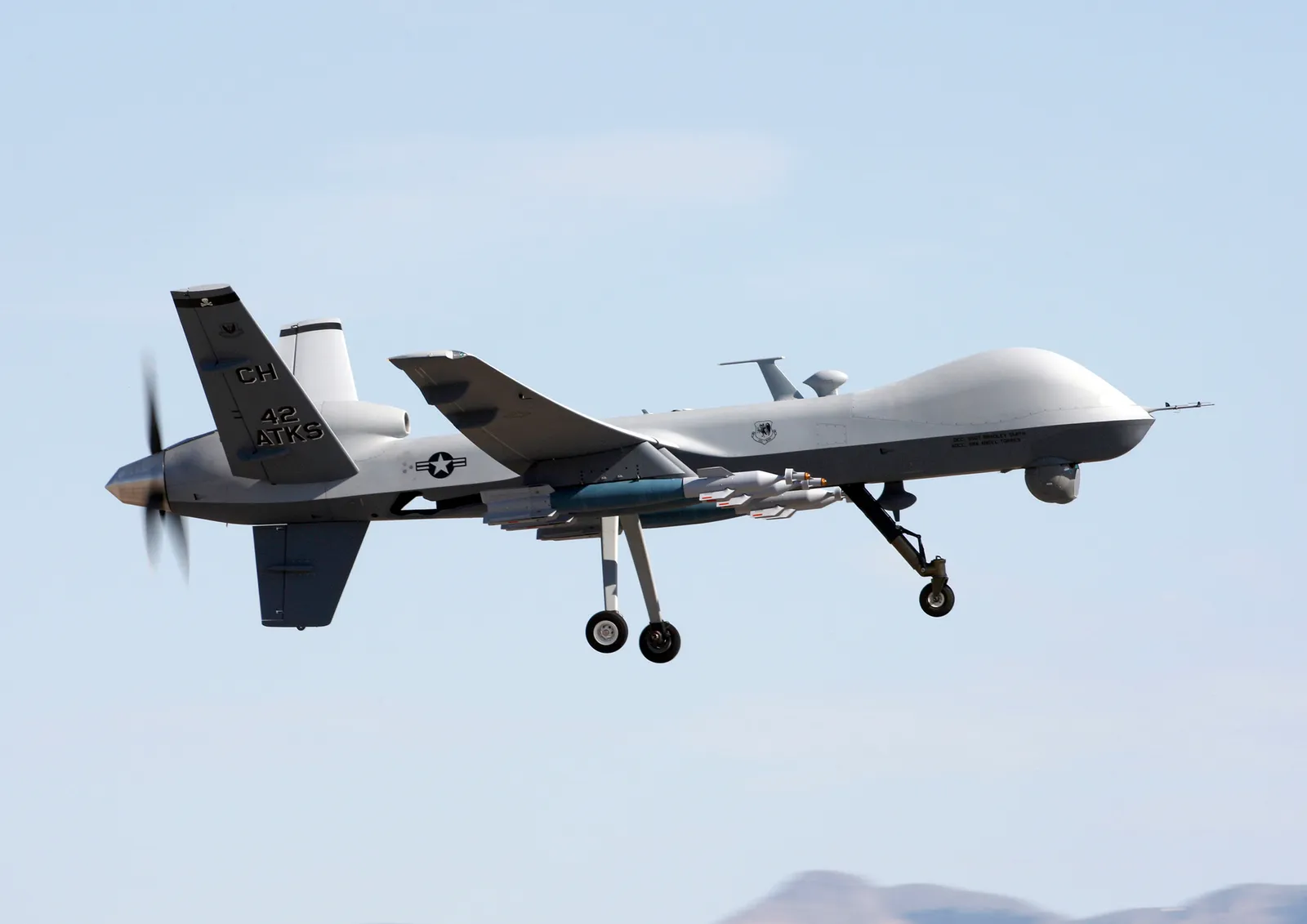


U.S. Air Force MQ-9s operated from Kandahar Airfield in 2018 for deliberate strikes, close air support, and aerial reconnaissance during the post-2015 Afghanistan mission.
Role detailsAircraft & UAVs
MQ-9 Reaper
Also known as
- MQ-9A
- MQ-9A Reaper
- Predator B
- Reaper
The MQ-9 Reaper is a General Atomics medium-altitude, long-endurance remotely piloted aircraft built for persistent intelligence collection and precision strike. Larger and more powerful than the MQ-1 Predator, it combines satellite control, electro-optical and infrared sensors, laser designation, and weapons such as Hellfire missiles and guided bombs, making it a recurring U.S. and coalition platform in counterterrorism, maritime-security, and regional-strike operations.
Role in Conflicts
The U.S. Air Force reported that an MQ-9 Reaper dropped a 500-pound bomb on anti-Iraqi forces near Balad on August 16, 2008 after the type began operational missions in Iraq.
Role detailsMQ-9 Reaper aircrews were heavily integrated into the 2017 Raqqah operation, providing close air support, tactical reconnaissance, overwatch, buddy lasing, and precision strikes against ISIS.
- Side
- United States and Libyan Government of National Accord

MQ-9 Reaper aircrews supported the Libyan Government of National Accord and coalition partners during the August-December 2016 campaign to remove ISIS from Sirte.
- Side
- United States
U.S. Central Command reported that a U.S. MQ-9 was shot down over Yemen on June 6, 2019 by a Houthi SA-6 surface-to-air missile assessed as enabled by Iranian assistance.
Role detailsA U.S. MQ-9 Reaper was confirmed shot down by Houthi forces off Yemen over the Red Sea on November 8, 2023, during the opening phase of the Red Sea shipping crisis.
Role details- Side
- United States
During the 2020 United States-Iran Conflict, a U.S. MQ-9 Reaper was used in the January 3, 2020 Baghdad airport strike that killed Qassem Soleimani.
- Side
- United States
During the 2025 Israel-Iran Conflict, U.S. MQ-9 Reapers were used for ISR over Iranian-controlled battlespace in Operation Epic Fury, and Iranian forces claimed a U.S.-made MQ-9 Reaper shootdown near the Strait of Hormuz after renewed U.S. strikes.
Role details- Side
- Israel

U.S. officials said unarmed MQ-9 Reaper flights operated over Gaza after the October 7, 2023 Hamas attack to support hostage-recovery efforts and assist Israel, without confirming combat-strike support.
Role detailsProfile / Specs
Profile
- Origin
- United States
- Type
- Medium-altitude long-endurance unmanned combat aerial vehicle
- Service note
- Entered U.S. Air Force service in 2007 and remains in post-2015 combat and surveillance use.
- Designer
- General Atomics Aeronautical Systems, Inc.
- Designed
- First flown in 2001
- Unit cost
- $56.5 million for a system including four aircraft, sensors, ground control station, and satellite link in FY2011 dollars
- Produced
- 2000s-present
- Developed from
- General Atomics MQ-1 Predator
Specifications
- Primary function
- Intelligence collection in support of strike, coordination, and reconnaissance missions
- Crew
- Two remote crew members: pilot and sensor operator
- Endurance
- More than 27 hours for MQ-9A; about 34 hours for MQ-9A Extended Range
- Payload
- 3,750 lb (1,701 kg) total payload according to the U.S. Air Force
- Ceiling
- Up to 50,000 ft
- Speed
- Up to 240 KTAS
- Armament
- AGM-114 Hellfire missiles and GBU-12, GBU-38, GBU-49, or GBU-54 guided bombs
- Dimensions
- 66 ft wingspan, 36 ft length, and 12.5 ft height
Variants
The MQ-9A Reaper record covers the baseline Predator B-derived combat aircraft; related GA-ASI family rows below separate the Extended Range configuration from newer MQ-9B airframes.
| Variant | Configuration | Designation notes |
|---|---|---|
| MQ-9A Extended Range | Endurance-focused configuration | General Atomics lists an Extended Range configuration with about 34 hours of endurance, compared with more than 27 hours for the baseline MQ-9A. Sources: MQ-9A Reaper (Predator B) |
| MQ-9B SkyGuardian | Next-generation RPAS airframe | General Atomics describes SkyGuardian as an MQ-9B remotely piloted aircraft designed for over-the-horizon satellite operation and civil-airspace integration. Sources: MQ-9B SkyGuardian |
| MQ-9B SeaGuardian | Maritime-focused MQ-9B configuration | General Atomics describes SeaGuardian as the maritime-focused sibling of SkyGuardian with bolt-on/bolt-off maritime sensors. Sources: MQ-9B SeaGuardian |
Carried Munitions
Official Air Force sources list Hellfire missiles and several 500-pound guided bombs in the MQ-9 Reaper's armament, while other official videos and trials document additional carried or demonstrated weapons.
| Carried item | Item type | Carriage evidence |
|---|---|---|
 | Air-to-ground missile family | The Air Force fact sheet and Lockheed Martin source document the MQ-9 Reaper as able to carry and employ AGM-114 Hellfire missiles. Sources: MQ-9 Reaper Fact Sheet, First Live Warhead Flight for Lockheed Martin's Multi-Purpose HELLFIRE II Missile |
 | 500-pound GPS-guided bomb | The Air Force fact sheet lists the GBU-38 among guided bombs carried by the MQ-9 Reaper. Sources: MQ-9 Reaper Fact Sheet |
 | 500-pound dual-mode guided bomb | The Air Force fact sheet lists the GBU-49 as part of the MQ-9 Reaper guided-bomb armament set. Sources: MQ-9 Reaper Fact Sheet |
 | 500-pound laser/GPS-guided bomb | The Air Force fact sheet lists the GBU-54 as an MQ-9 Reaper guided-bomb option. Sources: MQ-9 Reaper Fact Sheet |
 | Precision-guided glide bomb | An official U.S. loading video showed GBU-39 Small Diameter Bombs loaded on an MQ-9 Reaper at Creech Air Force Base. |
Demonstrated Launched Munitions
MBDA and UK government reporting document the MQ-9 Reaper as a Brimstone launch platform during firing trials.
| Launched item | Item type | Launch evidence |
|---|---|---|
 | Anti-tank guided missile | The UK government reported a trial firing of a dual-mode Brimstone precision missile from a Reaper, and MBDA later said Brimstone had been demonstrated from Reaper RPAS. Sources: Ambassador Westmacott visits RAF Squadron in Nevada, Brimstone - When missing is not an option |
Mission Systems and Loadout
The MQ-9 is built around persistent remotely piloted surveillance that can transition into precision attack when weapons are carried. Official Air Force and General Atomics material describe the aircraft as a satellite-controlled platform with electro-optical and infrared sensing, laser designation, synthetic-aperture radar, and multi-hardpoint carriage for missiles and guided bombs.
| Area | Documented configuration | Why it matters |
|---|---|---|
| Control crew | Remote pilot and sensor operator | Separates aircraft control from sensor and targeting work during long ISR or strike missions. |
| Sensor package | Electro-optical/infrared sensors, laser designation, and synthetic-aperture radar | Supports surveillance, target tracking, and laser-guided weapon employment from the same orbit. |
| Weapons fit | Hellfire missiles plus GBU-12, GBU-38, GBU-49, and GBU-54 guided bombs in Air Force listings | Gives the aircraft a mix of missile and bomb options for armed reconnaissance and precision fires. |
| Endurance split | More than 27 hours for MQ-9A; about 34 hours for MQ-9A Extended Range in GA-ASI data | Explains why the Reaper is often represented as a persistent orbit rather than a short-duration strike aircraft. |
Timeline
MQ-9 Reaper Key Events
Predator B first flight
General Atomics traces the MQ-9A Reaper family to the Predator B first flight in 2001.
Sources: MQ-9A Reaper (Predator B)
U.S. Air Force service entry
The U.S. Air Force fact sheet lists 2007 as the MQ-9 Reaper's service-entry year.
Sources: MQ-9 Reaper Fact Sheet
Iraq combat strike
An MQ-9 Reaper dropped a 500-pound bomb on anti-Iraqi forces near Balad during early operational use in Iraq.
Sources: Reaper Drops Bomb on Anti-Iraqi Forces
Raqqah operation coverage
Air Force reporting described MQ-9 crews as integral to coalition close air support, reconnaissance, overwatch, buddy lasing, and precision strikes around Raqqah.
Sources: Combat RPAs Integral in Defeating ISIS
Baghdad airport strike
Reporting on the Soleimani strike identified a U.S. MQ-9 Reaper as the aircraft used in the Baghdad airport attack.
Sources: A visual guide to the US airstrike that killed Qassem Suleimani
Red Sea shootdown
USNI News reported the Houthi shootdown of a U.S. MQ-9 over the Red Sea during the crisis around Yemen-linked attacks on shipping.
Sources: Houthis Shoot Down U.S. MQ-9 Reaper Over Red Sea
Media
MQ-9 Reaper Videos
MQ-9 Reaper Images
Related Weapon Systems




Related News
Sources
MQ-9 Reaper Fact SheetPublisher: U.S. Air Force | Note: Supports U.S. Air Force role, contractor, service entry, armament, dimensions, payload, unit-cost, and crew details. | Accessed: 2026-06-20GBU-39 Small Diameter Bombs Loaded on MQ-9 B-RollPublisher: Secretary of the Air Force Office of Energy, Installations, and Environment | Note: Official U.S. loading video showing GBU-39 Small Diameter Bombs loaded on an MQ-9 Reaper at Creech Air Force Base. | Accessed: 2026-06-28First Live Warhead Flight for Lockheed Martin's Multi-Purpose HELLFIRE II MissilePublisher: Lockheed Martin | Note: Supports MQ-9 carriage and employment of AGM-114 Hellfire missiles during the first live warhead flight. | Accessed: 2026-06-28Ambassador Westmacott visits RAF Squadron in NevadaPublisher: UK Ministry of Defence | Note: Supports Reaper trial firing of Brimstone during UK and U.S. testing in Nevada. | Accessed: 2026-06-28Brimstone - When missing is not an optionPublisher: MBDA | Note: Supports Reaper Brimstone firing-trial and launch-platform context. | Accessed: 2026-06-28MQ-9A Reaper (Predator B)Publisher: General Atomics Aeronautical Systems | Note: Supports manufacturer background, first-flight context, endurance, speed, altitude, payload, mission systems, and ER variant details. | Accessed: 2026-06-20MQ-9B SkyGuardianPublisher: General Atomics Aeronautical Systems | Note: Supports adjacent MQ-9B SkyGuardian family context, endurance framing, satellite-control description, and civil-airspace integration claims. | Accessed: 2026-07-01MQ-9B SeaGuardianPublisher: General Atomics Aeronautical Systems | Note: Supports adjacent MQ-9B SeaGuardian family context and maritime sensor configuration claims. | Accessed: 2026-07-01File: MQ-9 Reaper - 090609-F-0000M-777.JPGPublisher: Wikimedia Commons | Note: Public-domain U.S. Air Force image of an MQ-9 Reaper in flight, used for primary image provenance. | Accessed: 2026-06-20File: First MQ-9 Reaper Taxies at Creech AFB 2007Publisher: Wikimedia Commons | Note: Public-domain U.S. Air Force image of the first MQ-9 Reaper taxiing at Creech Air Force Base, used for gallery context. | Accessed: 2026-07-01MQ-9 Reaper Keeps Eyes on TargetsPublisher: Defense Visual Information Distribution Service | Note: Directly documents post-2015 Afghanistan conflict use: MQ-9 operations from Kandahar Airfield. | Accessed: 2026-06-20Reaper Drops Bomb on Anti-Iraqi ForcesPublisher: U.S. Air Force | Note: Directly documents 2003 Iraq War conflict use: a U.S. MQ-9 Reaper dropped a 500-pound bomb on anti-Iraqi forces near Balad in August 2008. | Accessed: 2026-07-01Combat RPAs Integral in Defeating ISISPublisher: U.S. Air Force | Note: Supports 2014 War Against the Islamic State direct conflict use under Operation Inherent Resolve: Directly documents 2014 Operation Inherent Resolve conflict use: MQ-9 Reapers in Raqqah combat operations against ISIS. | Accessed: 2026-06-20Providing Freedom from Terror: MQ-9s Help Reclaim SirtePublisher: Defense Visual Information Distribution Service | Note: Directly documents 2016 U.S. Campaign Against ISIS in Libya conflict use: MQ-9 Reapers in the 2016 Sirte campaign by U.S. and Libyan Government of National Accord forces. | Accessed: 2026-06-20Statement from U.S. Central Command on Attacks Against U.S. Observation AircraftPublisher: U.S. Central Command | Note: Directly documents 2014 Yemen Civil War conflict use: a U.S. MQ-9 shot down over Yemen by Houthi-aligned forces in June 2019. | Accessed: 2026-06-20Houthis Shoot Down U.S. MQ-9 Reaper Over Red SeaPublisher: USNI News | Note: Directly documents 2023 Red Sea Crisis conflict use: the November 2023 Houthi shootdown of a U.S. MQ-9 Reaper over the Red Sea. | Accessed: 2026-06-20A visual guide to the US airstrike that killed Qassem SuleimaniPublisher: The Guardian | Note: Directly documents 2020 United States-Iran Conflict use: an American MQ-9 Reaper used by U.S. forces carried out the Baghdad strike that killed Qassem Soleimani. | Accessed: 2026-06-20US Flying Drones Above Gaza in Search for HostagesPublisher: ABC News | Note: Directly documents 2023 Israel-Hamas War conflict use: U.S. officials said unarmed MQ-9 Reaper flights operated over Gaza for hostage-recovery support after the October 7 attack. | Accessed: 2026-06-20Tracking US Military Assets in the Iran WarPublisher: Atlantic Council | Note: Directly documents 2025 Israel-Iran Conflict use: MQ-9 Reapers were used by the United States in Operation Epic Fury, with several aircraft loitering over enemy airspace at a time. | Accessed: 2026-06-22Deep Suspicion of US Lingers as Iran Ponders Agreement to End WarPublisher: Al Jazeera | Note: Directly documents 2025 Israel-Iran Conflict use: Iranian forces said they shot down a U.S.-made MQ-9 Reaper drone during the U.S.-Israel war on Iran after renewed U.S. strikes. | Accessed: 2026-06-22