Profile
- Type
- Tracked amphibious infantry fighting vehicle
- Conflict side
- Ukraine
- Origin
- France
- Service note
- Cold War design; retired from French service before the full-scale Russia-Ukraine War
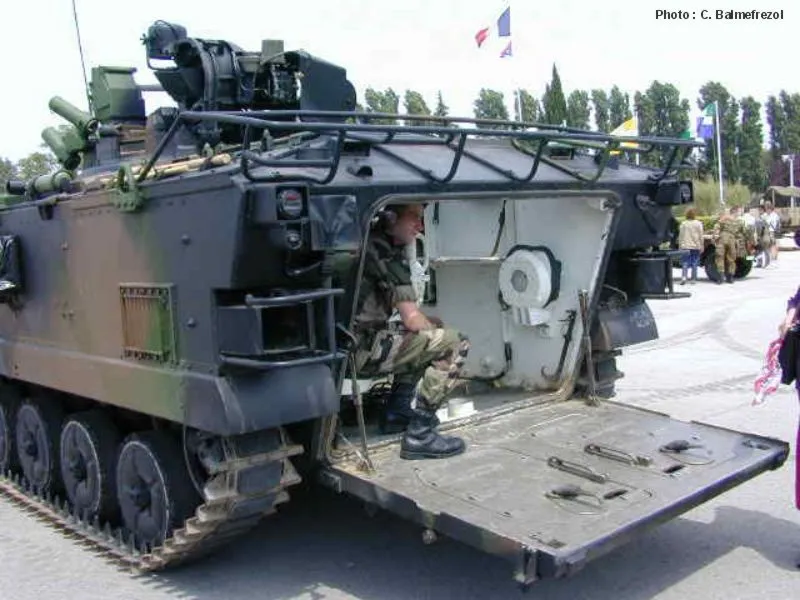
The AMX-10P is a French tracked amphibious infantry fighting vehicle built by GIAT Industries to carry mechanized infantry with a 20 mm autocannon and light armor protection. Its Russia-Ukraine War entry is included with caution: late-2024 reporting tied the vehicle to Ukrainian operations around Kursk, while other defense reporting disputed both official transfer evidence and the Russian identification.
Reported in Russia-Ukraine War coverage after Russian claims of a destroyed AMX-10P in the Kursk region, but Ukrainian-service evidence remains disputed because France had not officially announced AMX-10P transfers and independent vehicle identification was contested.
BMP-3Tracked amphibious infantry fighting vehicleThe BMP-3 is a Soviet-designed, Russian-built tracked amphibious infantry fighting vehicle notable for combining a 100 mm gun-launcher, 30 mm autocannon, and machine guns in a light armored troop carrier. In the Russia-Ukraine War it has appeared in Russian mechanized formations and fire-support roles, where its heavy armament is useful but its protection remains vulnerable to anti-armor weapons and drones.
Bandvagn 206Articulated tracked all-terrain carrierThe Bandvagn 206 is a Swedish articulated tracked all-terrain carrier developed by Hagglunds for military mobility in snow, marsh, and other soft ground. Its two powered tracked units and amphibious layout make it useful as a troop, cargo, command, ambulance, or specialist support vehicle; Germany has documented deliveries of BV206 vehicles to Ukraine during the Russia-Ukraine War.
BMD-1Airborne amphibious infantry fighting vehicleThe BMD-1 is a Soviet airborne infantry fighting vehicle built for paratroop units, combining a very light amphibious tracked chassis with the BMP-1-style 73 mm 2A28 Grom gun and anti-tank missile armament. Its low weight and hydropneumatic suspension made it air-droppable, but the same design priorities left limited armor protection. In the Russia-Ukraine War archive, it is documented through Ukrainian Air Assault Forces service around Kramatorsk and Sloviansk in 2014.
BMD-2Airborne infantry fighting vehicleThe BMD-2 is a Soviet airborne infantry fighting vehicle built for paratrooper units, combining a very light amphibious tracked chassis with a 30 mm 2A42 cannon and anti-tank missile launcher. Its air-droppable design gives Russian VDV formations mobile fire support, but the same weight limits leave the vehicle lightly protected against modern anti-armor weapons and artillery fragments documented in Ukraine.
BMD-4/BMD-4MAirborne amphibious infantry fighting vehicleThe BMD-4/BMD-4M is a Russian airborne amphibious infantry fighting vehicle built for VDV units, combining a light, parachutable tracked chassis with the Bakhcha-U turret's 100 mm gun-launcher, 30 mm autocannon, and coaxial machine gun. In the Russia-Ukraine War it appears as a Russian airborne assault vehicle, with open-source loss documentation and later production batches showing how Russia has continued fielding and modifying the type for a drone- and artillery-heavy battlefield.
BMP-2Tracked amphibious infantry fighting vehicleThe BMP-2 is a Soviet tracked infantry fighting vehicle that replaced the BMP-1's low-velocity gun with a stabilized 30 mm 2A42 autocannon while retaining an anti-tank missile launcher and amphibious mobility. Its mix of troop carriage, direct fire, and ATGM capability keeps it widely present in post-Soviet armored units, including documented Russian and Ukrainian use during the Russia-Ukraine War.