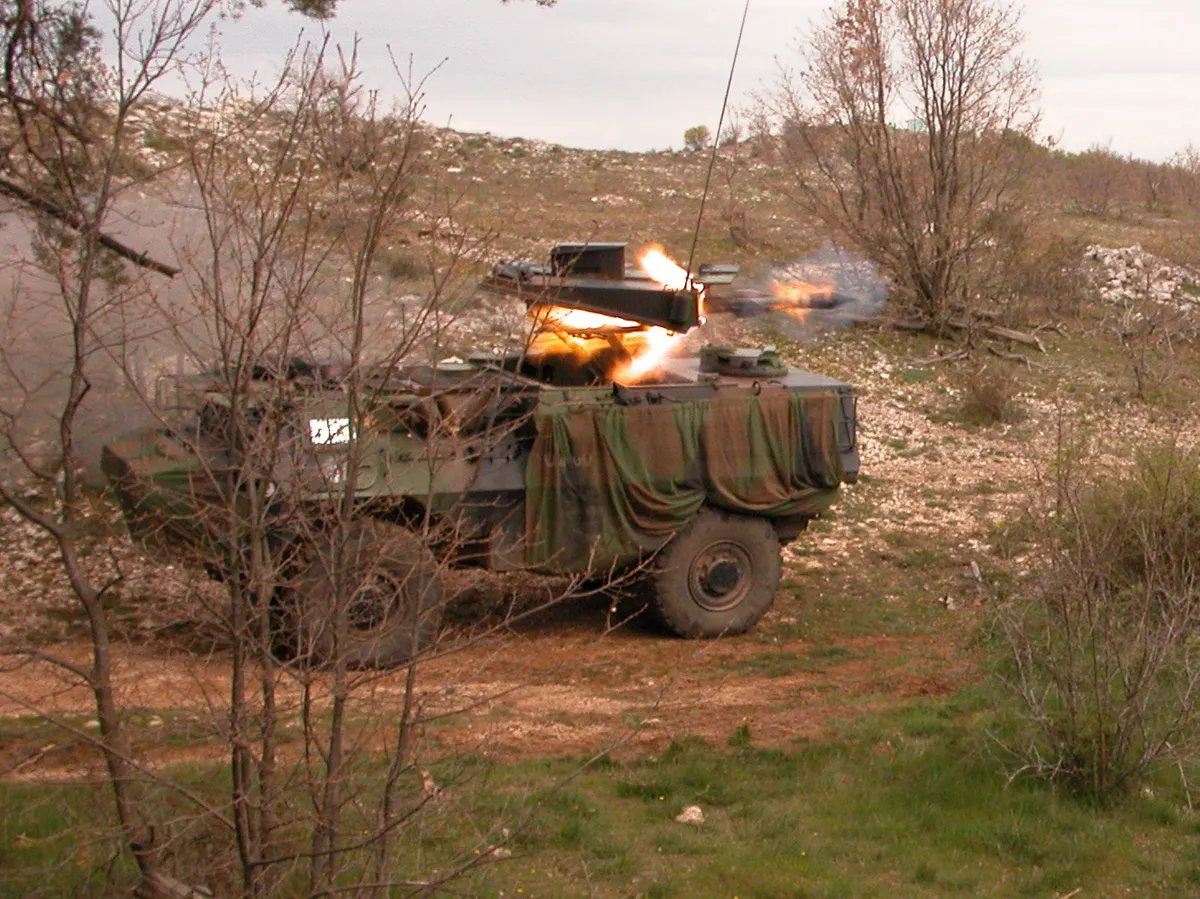
French Division Daguet used HOT missiles from VAB HOT/MEPHISTO vehicles and Gazelle helicopters during the February 1991 ground campaign, including roughly sixty VAB-fired missiles and 328 HOT missiles reported for the airmobile group.
Role detailsHOT anti-tank guided missile
- HOT
- HOT missile
- HOT-1
- HOT-2
- HOT-2MP
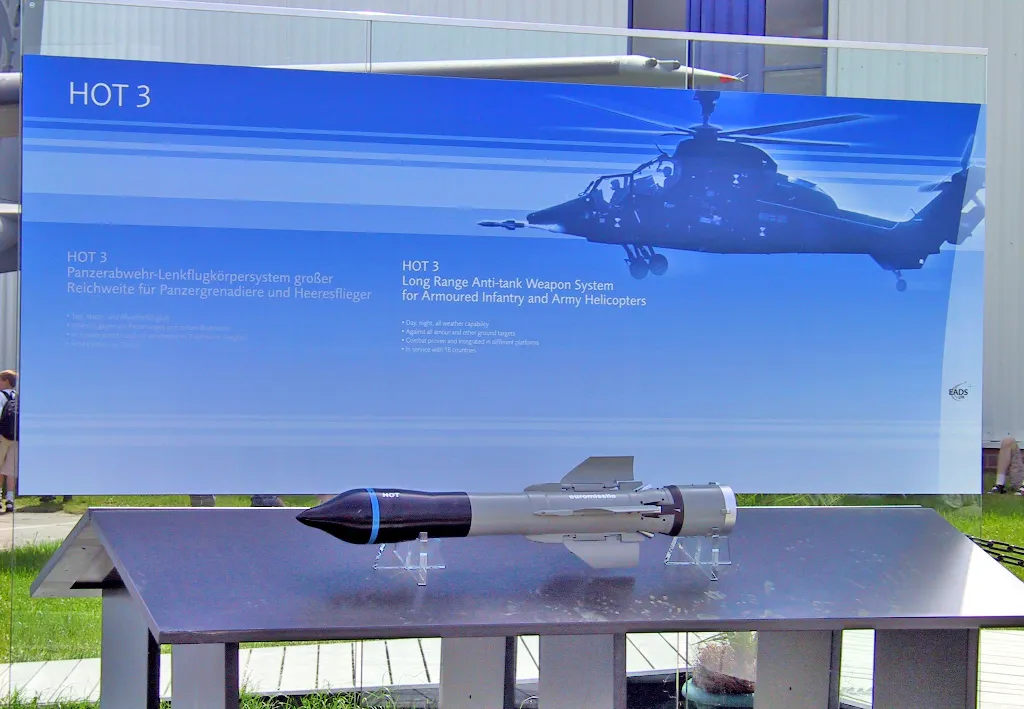
- HOT-3
- Haut subsonique Optiquement Teleguide Tire d'un Tube
HOT is a Franco-German wire-guided anti-tank missile family developed by Euromissile and carried by armored vehicles and helicopters. The family moved from the baseline HOT missile through improved HOT-2 and tandem-warhead HOT-3 rounds, with direct public evidence for French and Syrian HOT missile use in the Gulf War, the Syrian Civil War, and the 2011 Libya intervention.
Role in Conflicts
Bellingcat reported that Syrian SA-342 Gazelles armed with HOT missiles saw heavy action against Islamic State vehicles around Tabqa.
Role detailsFrench Army Aviation helicopters fired hundreds of HOT missiles during Operation Harmattan, the French contribution to the NATO-led Libya intervention.
Profile / Specs
Profile
- Origin
- France and West Germany
- Built by
- EuromissileMBDA
- Built in
- France and Germany
- Type
- Anti-tank guided missile
- Service note
- Cold War-era missile family still fielded from vehicles and helicopters in later conflicts
- Designer
- Nord Aviation and Bolkow
- Designed
- 1960s-1970s development
- Unit cost
- Not consistently published
- Produced
- From the late 1970s
- Number built
- More than 80,000 missiles reported sold; Deagel lists total production at 90,000
Specifications
- Guidance
- Wire-guided SACLOS
- Launch platforms
- Ground vehicles and helicopters, including VAB Mephisto and SA.342 Gazelle integrations
- Range
- 75 m to 4.0 km for HOT-1/HOT-2; up to 4.3 km for HOT-3
- Missile weight
- About 23.5 kg for HOT-1/HOT-2 and 24.5 kg for HOT-3
- Warhead
- HEAT or tandem HEAT, depending on variant
- Speed
- About 864 km/h
- Dimensions
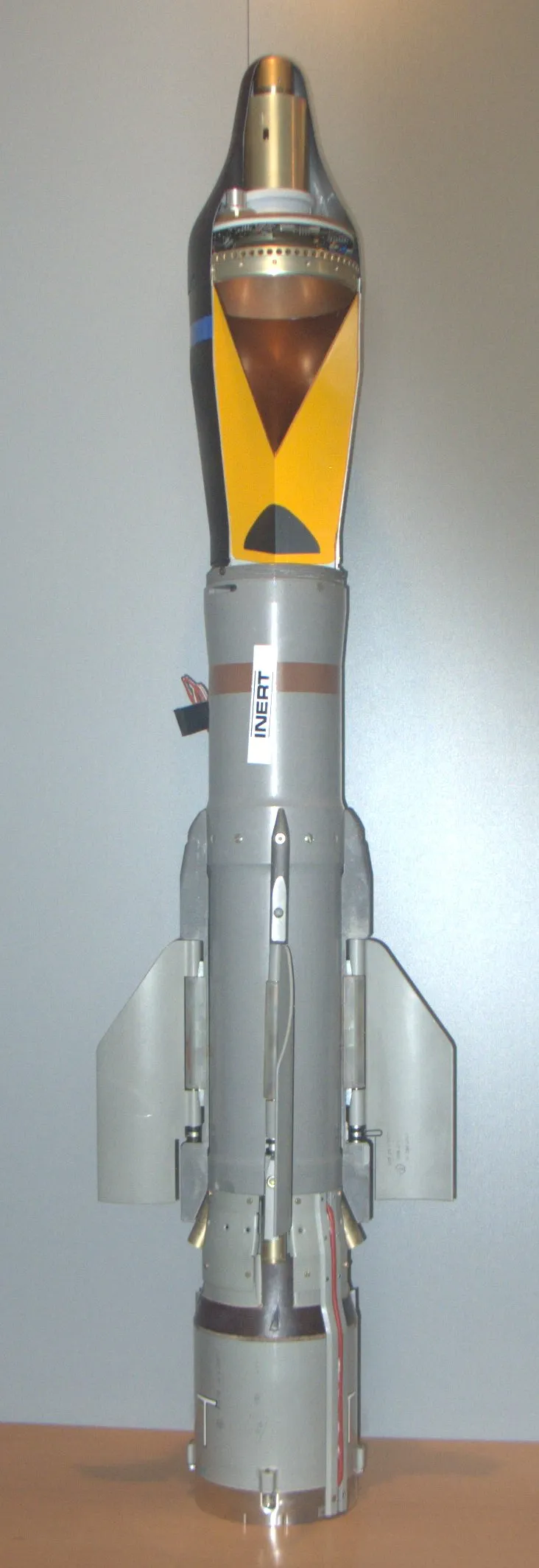
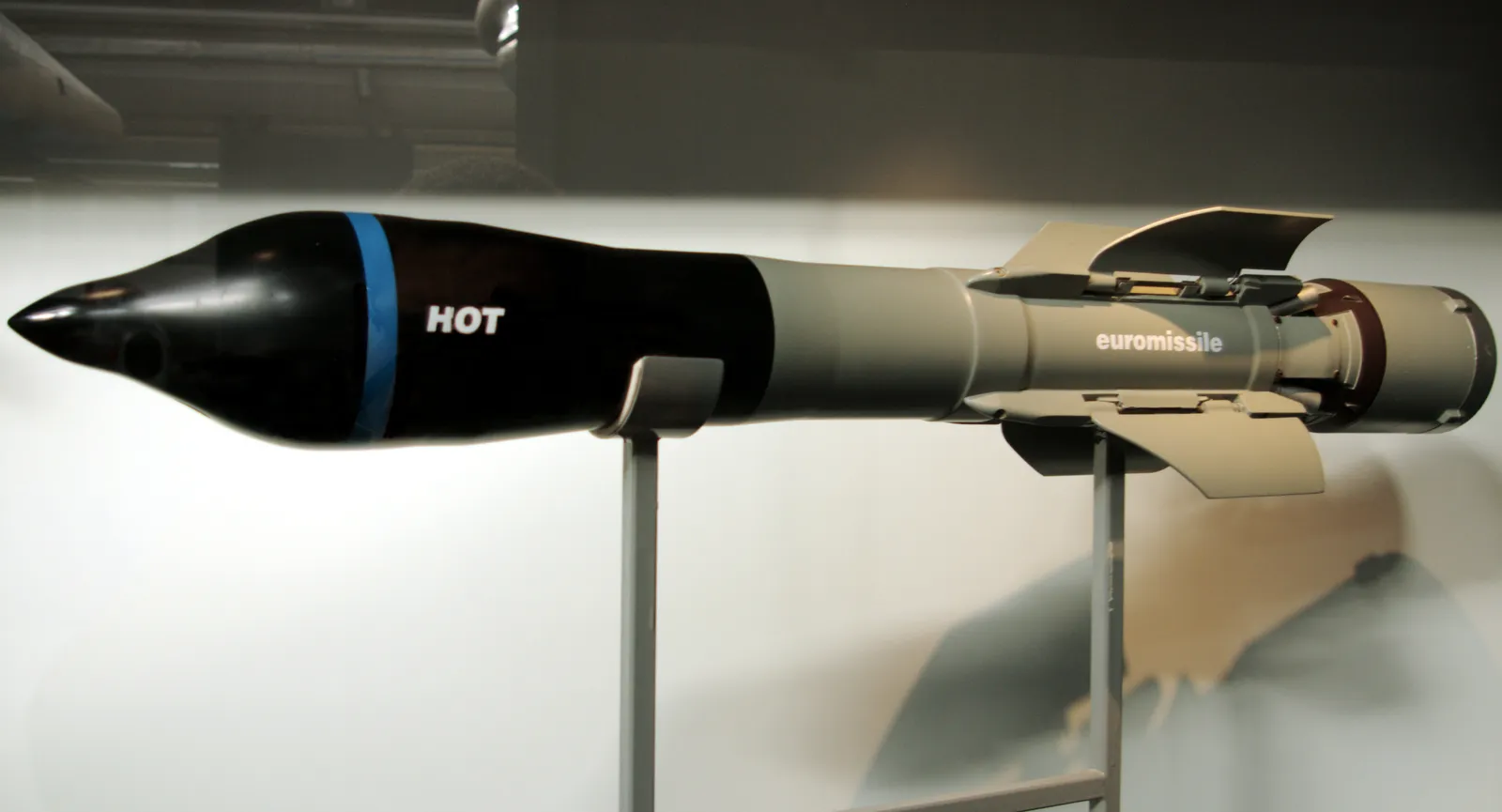
- About 1.27-1.30 m long with 0.31 m wingspan
Guidance And Warhead Notes
HOT kept the gunner in the loop: the operator tracked the target optically while guidance commands travelled through wires from the launch tube. Later variants concentrated on warhead effects and countermeasures rather than changing the missile into a fire-and-forget round.
SACLOS optical tracking with wire command guidance, described by Deagel as jam-resistant wire guidance.
Documented integrations include VAB, AMX-10, Panhard M3-family HOT, Jaguar 1, BO 105, Gazelle, A129, AW109, and Tiger-family references across the cited sources.
HOT-2 improved the warhead; HOT-2MP added a multi-purpose effect; HOT-3 introduced tandem HEAT and sensor updates for reactive-armor targets.
Variants
HOT family designations mainly distinguish warhead and anti-jamming improvements while preserving tube launch, optical tracking, wire command guidance, and vehicle or helicopter integration.
| Variant | Configuration | Designation notes |
|---|---|---|
| HOT-1 | Baseline anti-armor missile | The original production missile used SACLOS wire guidance and a single HEAT warhead in the 75 m to 4 km engagement band. Sources: HOT System Profile, HOT Weapon Record |
| HOT-2 | Improved-warhead missile | Deagel identifies HOT 2 as the 1986 follow-on with an improved warhead compared with the initial HOT missile. Sources: HOT Weapon Record |
| HOT-2MP | Multi-purpose warhead variant | Weaponsystems.net distinguishes HOT-2MP from the anti-tank HOT-2 by its multi-purpose warhead and lower armor penetration figure. Sources: HOT System Profile |
| HOT-3 | Tandem-warhead missile | HOT-3 added a tandem HEAT warhead for explosive-reactive armor targets, a CCD sensor, and a 4.3 km maximum range in the cited specifications. Sources: HOT Weapon Record |
Carrier Platforms
HOT was integrated on armored vehicles and helicopters rather than used as a shoulder-fired infantry missile. The linked catalog entries below cover existing public platform records with source-backed HOT compatibility.
| Carrier | Carrier type | Carriage evidence |
|---|---|---|
![]() | Tracked amphibious infantry fighting vehicle | France developed an AMX-10P variant that replaced the standard 20 mm turret with a Lancelot HOT launcher and carried 20 missiles. Sources: AMX-10 HOT ATGM Launcher Vehicle |
![]() | Light attack helicopter | GlobalSecurity's A109 specifications page lists HOT among the helicopter's antitank missile options. Sources: GlobalSecurity A109 specifications |
![]() | 4x4 armored personnel carrier | Arquus describes an M3-family HOT configuration using the UTM 800 turret with four ready missiles and additional HOT rounds carried in the hull. Sources: Arquus Panhard M3 HOT |
![]() | Attack helicopter | Deagel states that HOT 3 was selected for the Tiger attack helicopter program; this relationship is specific to HOT-armed Tiger branches and should not be read as applying to every Tiger variant. Sources: HOT Weapon Record |
Timeline
HOT anti-tank guided missile Key Events
Franco-German development starts
MBDA's company history identifies 1964 Franco-German development contracts for MILAN, HOT, and Roland by Nord Aviation and Bolkow.
Initial operational capability
Deagel lists HOT initial operational capability in 1974 and describes the baseline missile as the first family member.
HOT-2 appears
Deagel records HOT 2 as the 1986 improved-warhead follow-on to the original HOT missile.
HOT-3 introduced
Deagel records HOT 3 in 1998 with a tandem warhead, CCD sensor, and anti-ERA purpose.
French Libya munitions figures released
French parliamentary reporting and later summaries attributed 431 HOT missile launches to French helicopters during the Libya operation.
Media
HOT anti-tank guided missile Images
Related Weapon Systems