- Side
- Ukraine

Supplied to and deployed by Ukraine after 2022 as a networked air defense system for countering Russian missile and drone attacks against cities, people, and infrastructure.
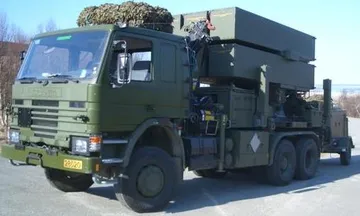
Role detailsNASAMS is a Kongsberg-Raytheon network-centric air defense family built around a Fire Distribution Center, distributed launchers, and networked sensors. Developed with the Royal Norwegian Air Force and fielded from 1994, the system evolved through the NASAMS II upgrade, which added NATO-standard integration features such as Link 16, and now supports a multi-missile mix spanning AMRAAM, AMRAAM-ER, and AIM-9X.
Supplied to and deployed by Ukraine after 2022 as a networked air defense system for countering Russian missile and drone attacks against cities, people, and infrastructure.
Role detailsNASAMS was reported as part of Al Udeid's layered air defense during Iran's June 2025 missile attack on the U.S.-used base in Qatar.
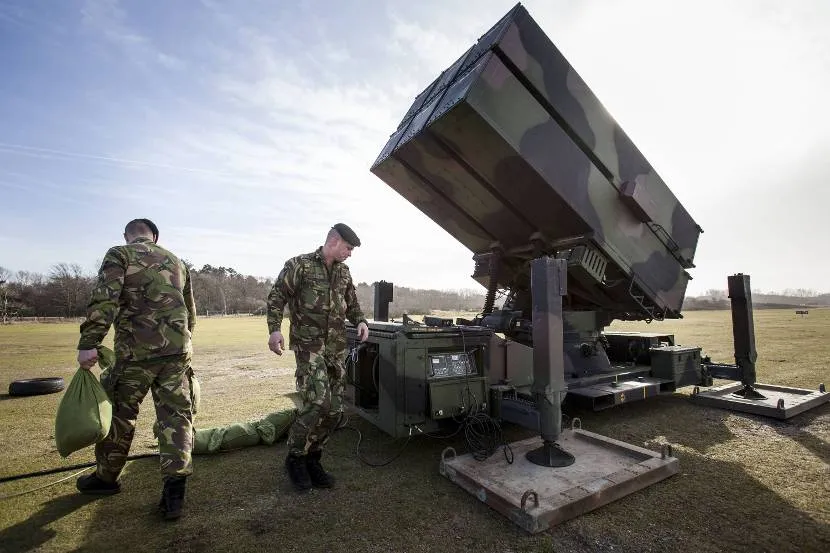
Kongsberg calls NASAMS the world's first operational network-centric short-to-medium range ground-based air defense system. Raytheon describes the architecture as a Sentinel radar, Kongsberg Fire Distribution Center, launcher, and Raytheon effector mix.
| Component | Documented detail | Why it matters |
|---|---|---|
| Command node | Fire Distribution Center (FDC) | It is the system's command-and-control core and enables open-architecture integration. |
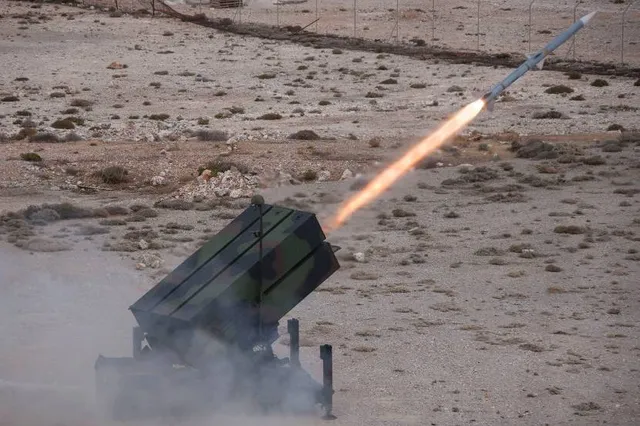
| Launcher | Multi-missile launcher with up to six ready missiles | A single launcher can carry different effector types for flexible loadouts. |
| Sensors | AN/MPQ-64 Sentinel radar and other integrated sensors | Sensor choice can be tailored to the mission and network. |
| Distributed elements | Radar and launcher nodes can be placed more than 20 km from the FDC | Dispersal lets a small fire unit defend a wider area and improves survivability. |
| Effectors | AIM-120 AMRAAM, AMRAAM-ER, AIM-9X-2 Sidewinder | The missile mix gives NASAMS layered engagement options from the same launcher family. |
NASAMS II was a modernization path for the Norwegian-developed NASAMS architecture, centered on command-and-control updates, NATO-standard networking, and later launcher electronics and software improvements.
| Milestone | Documented change | Operational significance |
|---|---|---|
| 2002 upgrade contracts | Kongsberg identified Royal Norwegian Air Force contracts to update command-and-control functions and integrate the system with other NATO systems. | The upgrade moved NASAMS toward multinational air-defense operations rather than a closed national configuration. |
| 2005 Link 16 contract | Kongsberg announced a Link 16 tactical data-link contract for NASAMS II. | Link 16 connected weapons, sensors, and decision-makers through a NATO-standard network. |
| 2013 launcher upgrade | Kongsberg announced upgraded electronics and software for existing NASAMS II launchers. | The follow-on work extended launcher service life and improved performance within the same family architecture. |
NASAMS is a modular air-defense family with upgrade, launcher, and effector configurations layered onto the same distributed command-and-control architecture.
| Variant | Configuration | Designation notes |
|---|---|---|
| NASAMS II | Mid-life upgrade and NATO-interoperable command-and-control path | Kongsberg documented the 2002 upgrade contracts for command-and-control modernization, a 2005 Link 16 contract for NASAMS II, and a 2013 follow-on for existing NASAMS II launcher electronics and software. Sources: Air defence contracts worth MNOK 250, MNOK 48 anti-aircraft contract, Contract for upgrading Norway's NASAMS II air defence system |
| High Mobility Launcher | Mobile launcher configuration | Kongsberg announced delivery of the first NASAMS high-mobility launcher to the Norwegian Armed Forces in 2013. |
| Multi-missile launcher configuration | AMRAAM, AMRAAM-ER, and AIM-9X launch architecture | Kongsberg describes a launcher and canister architecture able to transport, support, and fire multiple missile types from the same NASAMS launcher rail. Sources: Multi-Missile Launcher - KONGSBERG, Raytheon Family of Missiles - KONGSBERG |
Kongsberg describes AMRAAM as the NASAMS baseline missile and says the multi-missile launcher can also support AMRAAM-ER and AIM-9X Sidewinder Block II. The linked missile rows below cover systems with their own published weapon pages.
| Launched item | Item type | Launch evidence |
|---|---|---|
 | baseline active-radar missile | Kongsberg identifies Raytheon's AMRAAM as the baseline NASAMS missile, using the same missile family carried by fighter aircraft. Sources: NASAMS Air Defence System |
 | short-range infrared missile | Kongsberg lists AIM-9X Sidewinder Block II as one of the missiles the NASAMS launcher can fire from the same rail and canister architecture. Sources: Multi-Missile Launcher - KONGSBERG, Raytheon Family of Missiles - KONGSBERG |
Kongsberg says NASAMS was developed in the early 1990s with Raytheon and the Royal Norwegian Air Force.
Sources: Full Spectrum Air Defence – the future of integrated airspace protection
Raytheon says NASAMS reached operational capability in 1994 and was first deployed by the Royal Norwegian Air Force.
Sources: Defending the skies together: Partnership powers the NASAMS air defense system
Kongsberg's annual report says the Norwegian Air Force contracted in 2002 to upgrade the system to NASAMS II.
Sources: Kongsberg Annual Report 2004, Air defence contracts worth MNOK 250
Kongsberg announced a Norwegian Air Force contract to supply a Link 16 tactical data link for NASAMS II, connecting the system to NATO-standard networked operations.
Sources: MNOK 48 anti-aircraft contract
Kongsberg reports that NASAMS has protected the U.S. National Capital Region around Washington, D.C. since 2005.
Sources: Finland selects KONGSBERG/Raytheon air defence system
Kongsberg announced a Royal Norwegian Air Force contract to upgrade existing NASAMS II launchers with new electronics and software.
Sources: Contract for upgrading Norway's NASAMS II air defence system
Kongsberg announced delivery of the first NASAMS high-mobility launcher to the Norwegian Armed Forces.
Sources: New capability in the NASAMS air defence system
Raytheon said NASAMS had logged more than 300 live-fire and combat engagements by 2024.
Sources: Defending the skies together: Partnership powers the NASAMS air defense system
Kongsberg announced a EUR 500 million NASAMS procurement package for Denmark in November 2025.
Sources: Denmark acquires NASAMS air defence from KONGSBERG