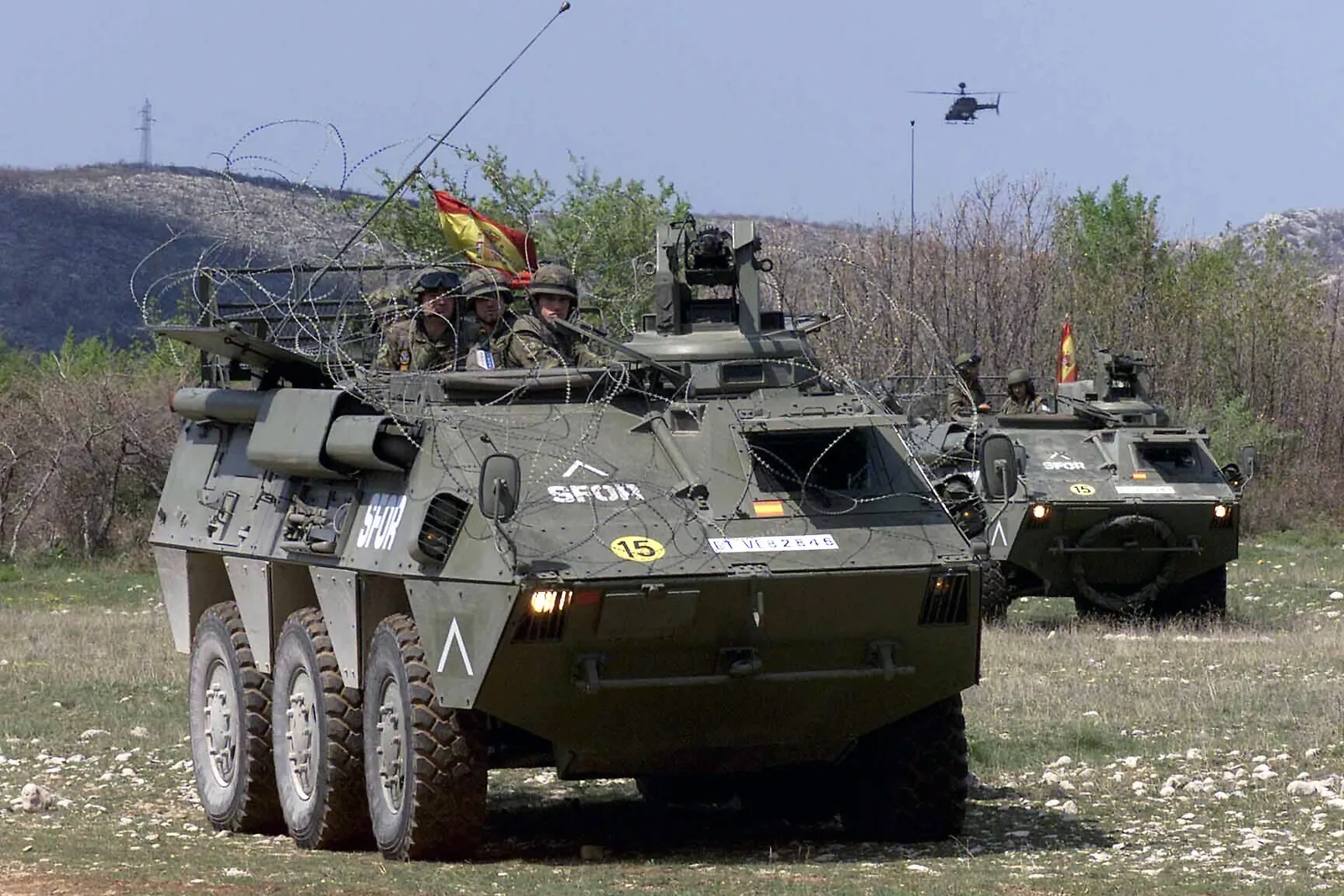


Spanish reporting documented BMR vehicles in ISAF convoy and escort use in Afghanistan, including BMRs supporting Spanish OMLT movement with Afghan forces.
Armored Vehicles
BMR-600 Pegaso
Also known as
- Pegaso BMR
- BMR 600
- BMR-600
- BMR M1
- BMR-600 M1
- BMR-2
- BMR2
- BMR M-600
- BMR 3560
- Pegaso 3560
- Pegaso 3560 BMR
- Blindado Medio de Ruedas 600
The BMR-600 Pegaso is a Spanish 6x6 armored personnel carrier family developed from the ENASA-Pegaso program and later supported through Santa Barbara and General Dynamics Santa Barbara Sistemas. It gives the catalog a Spanish wheeled-armor reference point: a troop carrier with amphibious capability, mortar, command, ambulance, recovery, anti-tank, and reconnaissance derivatives, and direct conflict evidence from Spanish deployments in Afghanistan and Iraq, Spanish-supplied variants in Ukraine, and Saudi-led coalition use and losses in Yemen.
Role in Conflicts
Plus Ultra Brigade reporting described Spanish BMR and VEC armored vehicles supporting coalition operations around Diwaniyah and Najaf.
Role details- Side
- Ukraine

Spain prepared BMR-600-based armored medical vehicles for Ukraine, and later reporting identified a BMR-600 VRAC-derived vehicle in Ukrainian service.
Role details
El Pais reported BMR-600 Pegaso vehicles in Yemen, including Saudi vehicles captured or destroyed around Harad after Saudi Marine deployments and losses.
Profile / Specs
Profile
- Origin
- Spain
- Type
- 6x6 wheeled armored personnel carrier
- Service note
- Late Cold War design with post-1990s modernization and continued export-service use
- Designer
- ENASA-Pegaso with Spanish Army armored-vehicle development authorities
- Designed
- Spanish Army requirements were set in 1972; engineering development began in 1973
- Unit cost
- Forecast International listed a basic unarmed BMR at $323,600 in 2005 U.S. dollars
- Produced
- Production began in 1978, with initial Spanish Army deliveries in 1979; production was dormant by the mid-2000s
- Number built
- Forecast International listed 1,504 BMR-600 and 345 VEC vehicles produced through 2004
Specifications
- Crew and passengers
- Two crew, typically commander and driver, plus 10 infantrymen in the baseline technical description
- Configuration
- 6x6 wheeled armored personnel carrier
- Combat weight
- About 14 tonnes for the basic BMR-600; Spanish Army current listing gives 15.4 tonnes
- Dimensions
- 6.15 m long, 2.50 m wide, about 2.0-2.36 m high depending configuration/source
- Engine
- Pegaso 9157/8 six-cylinder diesel in the original vehicle; upgraded Spanish vehicles used a Scania DS9-series diesel
- Road speed
- About 96-103 km/h depending configuration/source
- Road range
- About 800-1,000 km depending configuration/source
- Amphibious speed
- About 9 km/h with waterjets in the baseline technical description
- Protection
- Aluminum alloy armor with spaced frontal armor in the baseline description; Spanish M1 upgrades added armor plates and chemical/biological protection
- Armament
- Typically a 12.7 mm machine gun on the basic personnel carrier, with family variants carrying other weapons or mission equipment
Design And Service Context
The BMR-600 was built as a modular 6x6 troop carrier rather than a single-purpose fighting vehicle. Forecast International describes a two-person crew with room for ten infantrymen, aluminum armor, independent hydropneumatic suspension, run-flat tires, a rear ramp, and amphibious waterjet mobility. The same family structure supported command, mortar, ambulance, recovery, radio, anti-tank, CBRN, and VEC reconnaissance derivatives.
Mobility layout
6x6 wheeled chassis with hydropneumatic independent suspension and amphibious waterjet capability.
Protection concept
Aluminum alloy armor with added frontal spaced armor in the baseline technical description.
Family use
The chassis supports troop-carrier, mortar, command, recovery, ambulance, anti-tank, and reconnaissance configurations.
Sources: Forecast International BMR 600; FAS BMR-600
Variants
BMR-600 family designations cover troop-carrier, command, mortar, ambulance, recovery, anti-tank, electronic-warfare, CBRN, and reconnaissance derivatives. The VEC cavalry reconnaissance vehicle shares the family lineage but is treated here as a related derivative rather than the base APC.
| Variant | Configuration | Designation notes |
|---|---|---|
| BMR-600 | Base 6x6 infantry carrier | Basic vehicle with two crew plus infantry dismounts, amphibious mobility, hydropneumatic suspension, and typical 12.7 mm machine-gun armament. Sources: Forecast International BMR 600 |
| BMR 600-2 / BMR2 | Modernized Spanish configuration | Spanish modernization replaced the original Pegaso powerpack with a Scania diesel and added armor, protection, fire-suppression, ventilation, braking, and driver-warning improvements. Sources: Spanish Army Museum BMR M1, Forecast International BMR 600 |
| Model 3560.53E | 81 mm mortar carrier | Forecast International lists the 3560.53E as a BMR-600 mortar variant. Sources: Forecast International BMR 600 |
| Model 3560.54 | Armored ambulance | The BMR ambulance configuration is relevant to Spanish-prepared medical vehicles supplied for Ukrainian patient evacuation and medical care. Sources: Forecast International BMR 600, Army Recognition Ukraine BMR Ambulances |
| Model 3560.55 | Maintenance and recovery vehicle | Forecast International identifies the 3560.55 as a BMR-600 maintenance and recovery variant. Sources: Forecast International BMR 600 |
| VEC | Cavalry reconnaissance derivative | The VEC is a related reconnaissance vehicle from the BMR/VEC family, with separate turreted scout-vehicle configurations. Sources: Forecast International BMR 600, GDELS heritage page |
Fitted Armament
BMR-600 records describe the base carrier and mission variants with fitted crew-served weapons rather than a single fixed armament package.
| Carried item | Item type | Carriage evidence |
|---|---|---|
 | Heavy machine gun | Spanish Army and technical references list the personnel-carrier BMR with a 12.7 mm machine gun fit, commonly represented by the M2HB class. Sources: Spanish Army BMR Equipment Page, Forecast International BMR 600, FAS BMR-600 |
 | 81 mm mortar launcher | Forecast International identifies the Model 3560.53E as the BMR-600 81 mm mortar-carrier variant. Sources: Forecast International BMR 600 |
Timeline
BMR-600 Pegaso Key Events
Spanish Army requirement set
FAS traces the BMR requirement to a Spanish Army need for a wheeled vehicle able to move an infantry squad to and within the battle area.
Sources: FAS BMR-600
Engineering development begins
Forecast International places the start of BMR engineering development in mid-1973.
Sources: Forecast International BMR 600
Initial Spanish Army deliveries
Forecast International records initial BMR-600 deliveries to the Spanish Army in 1979.
Sources: Forecast International BMR 600
Spanish modernization starts
The modernization program added a Scania diesel, applique armor, spall liners, fire suppression, ventilation, braking, and driver-warning improvements.
Sources: Forecast International BMR 600, Spanish Army Museum BMR M1
Upgrade program complete
Forecast International says the Spanish upgrade program was complete by mid-2002 and that the upgraded vehicle was known as BMR 600-2 or BMR2.
Sources: Forecast International BMR 600
BMR-600 ambulances prepared for Ukraine
Army Recognition reported that two BMR-600 APCs had been converted into armored medical ambulances for Ukraine after a Ukrainian Ministry of Health request through the European Civil Protection Mechanism.
Sources: Army Recognition Ukraine BMR Ambulances
Related Weapon Systems


Sources
Spanish Army BMR Equipment PagePublisher: Ejercito de Tierra | Note: Supports current Spanish Army BMR identity, manufacturer attribution to Santa Barbara, dimensions, weight, road speed, range, armament, and crew/passenger listing. | Accessed: 2026-07-13Forecast International BMR 600Publisher: Forecast International | Note: Supports BMR-600 specifications, variants, production totals, timeline, modernization, and General Dynamics Santa Barbara Sistemas prime-contractor context. | Accessed: 2026-07-13FAS BMR-600Publisher: Federation of American Scientists | Note: Supports baseline BMR-600 identity, Spanish Army requirement context, service users, modernization, and technical specifications. | Accessed: 2026-07-13Spanish Army Museum BMR M1Publisher: Ejercito de Tierra | Note: Supports Spanish Army BMR/VEC production figures and M1 modernization details including Scania engine replacement, additional armor, and chemical/biological protection. | Accessed: 2026-07-13GDELS heritage pagePublisher: General Dynamics European Land Systems | Note: Supports manufacturer lineage: ENASA-Pegaso's defense business, maker of the BMR/VEC 6x6 family, joined Santa Barbara, later acquired by General Dynamics. | Accessed: 2026-07-13Revista Espanola de Defensa Afghanistan BMR AttackPublisher: Ministerio de Defensa de Espana | Note: Supports 2001 War in Afghanistan direct conflict-use by describing a Spanish OMLT convoy in Afghanistan with five BMR vehicles, including a BMR ambulance, after an attack near Shindand. | Accessed: 2026-07-13El Pais Afghanistan BMR ConvoyPublisher: El Pais | Note: Supports 2001 War in Afghanistan direct conflict-use by documenting Spanish BMR convoy and escort use in Afghanistan. | Accessed: 2026-07-13Small Arms Review Plus-Ultra BrigadePublisher: Small Arms Review | Note: Supports 2003 Iraq War direct conflict-use by describing Spanish Plus Ultra Brigade BMR and VEC armored vehicles used in coalition operations in Iraq. | Accessed: 2026-07-13Army Recognition Ukraine BMR AmbulancesPublisher: Army Recognition | Note: Supports 2014 Russia-Ukraine War direct conflict-use by reporting BMR-600-based armored medical vehicles prepared for Ukraine and a BMR-600 VRAC-derived medical evacuation vehicle in Ukrainian service. | Accessed: 2026-07-13El Pais Yemen Spanish WeaponsPublisher: El Pais | Note: Supports 2014 Yemen Civil War direct conflict-use by reporting BMR-600 Pegaso vehicles in Yemen, including Saudi vehicles captured or destroyed around Harad. | Accessed: 2026-07-13Wikimedia Commons Spanish Army BMR-600Publisher: Wikimedia Commons | Note: Supports public-domain image provenance for the BMR-600 photograph from U.S. military/NARA holdings. | Accessed: 2026-07-13Wikimedia Commons Egyptian BMR-600Publisher: Wikimedia Commons | Note: Supports public-domain gallery image provenance for an Egyptian BMR-600 during Operation Desert Shield. | Accessed: 2026-07-13Wikimedia Commons Peruvian BMRPublisher: Wikimedia Commons | Note: Supports public-domain gallery image provenance for a Pegaso BMR photographed by the U.S. Marine Corps during an exercise at Ancon, Peru. | Accessed: 2026-07-13Wikimedia Commons Spanish BMR AfghanistanPublisher: Wikimedia Commons | Note: Supports open-license gallery image provenance for a Spanish Army Afghanistan image associated with the BMR. | Accessed: 2026-07-13