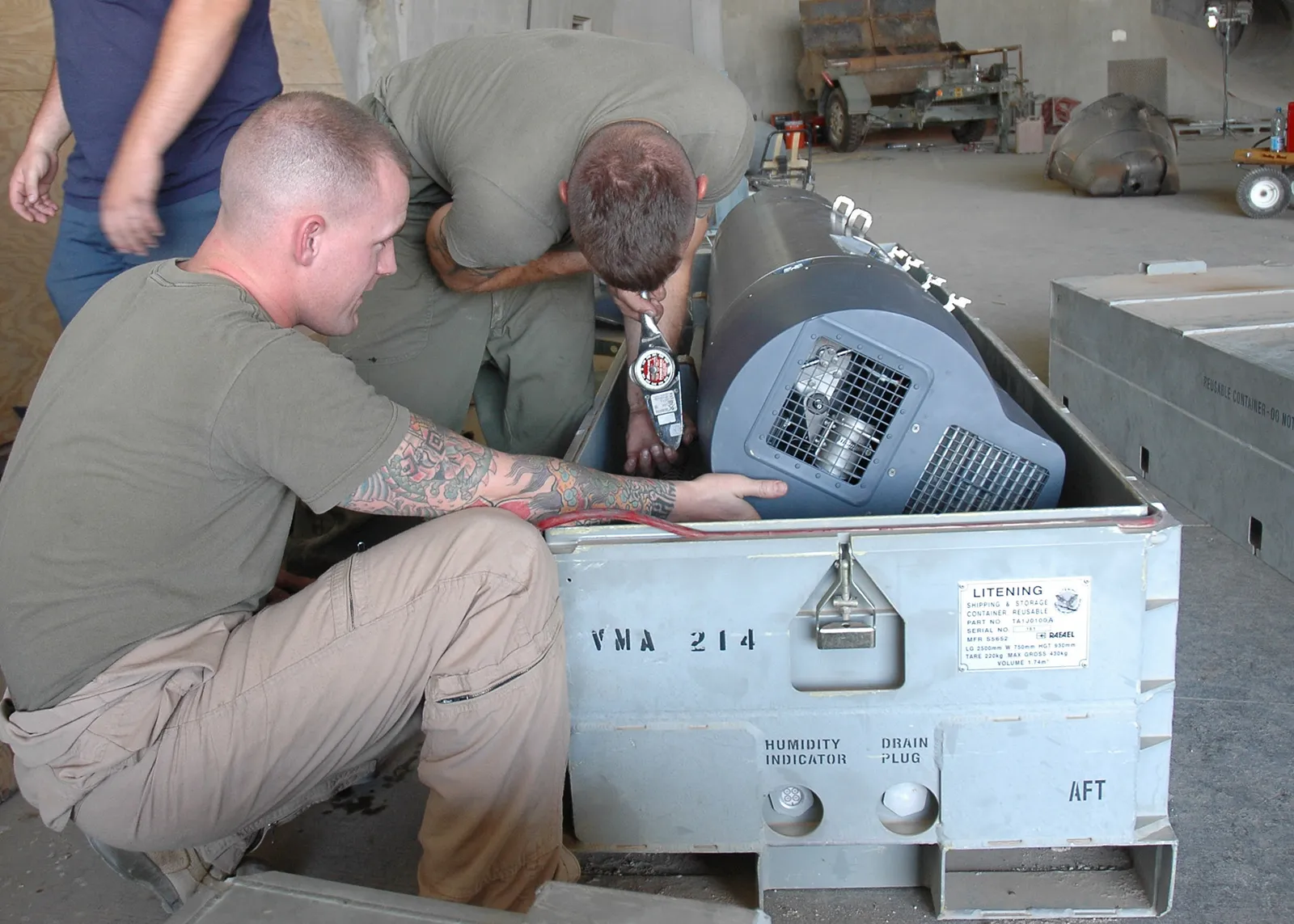

On April 11, 2003, U.S. B-52 crews used a LITENING II pod during Operation Iraqi Freedom to identify and designate targets at a northern Iraq airfield for GBU-12 laser-guided bombs.
Role detailsSupport Equipment
LITENING II Pod
Also known as
- AN/AAQ-28
- AN/AAQ-28 Litening II
- Litening II targeting pod
- LITENING pod
LITENING II is the early U.S. AN/AAQ-28 electro-optical/infrared targeting pod developed from Rafael's LITENING work with Northrop Grumman support. Fielded first with Air National Guard and Air Force Reserve F-16s in 1999, it gave aircraft a FLIR/CCD-TV sensor package, laser rangefinding, laser designation, and spot tracking before ER and AT upgrades expanded the family.
Role in Conflicts
Profile / Specs
Profile
- Origin
- Israel / United States
- Type
- Electro-optical/infrared targeting pod
- Service note
- 1999-2003
- Designer
- Rafael Missiles Division; further developed with Northrop Grumman from 1995
- Unit cost
- $1.4 million (Air Force fact sheet, current as of August 2015)
- Developed from
- LITENING I
Specifications
- Role
- Electro-optical/infrared targeting and strike-support pod
- Sensors
- 256 FLIR, CCD-TV, laser designator, laser rangefinder, and laser spot tracker
- Physical data
- 87 in length; 16 in diameter; 440 lb
- Fielding
- Initial fielding with Air National Guard and Air Force Reserve Command F-16s in 1999
- Aircraft integration
- Documented early use or integration on F-16, AV-8B Harrier, and B-52 aircraft
- Mission functions
- Target identification, laser designation for guided munitions, laser ranging, spot tracking, and non-traditional ISR support
Early Configuration
LITENING II sits between the Israeli LITENING I baseline and later U.S. ER/AT configurations. The early U.S. fielded pod combined infrared and visible-light target imagery with laser ranging, laser designation, and spot tracking, while later upgrades focused on improved FLIR and image-processing capability.
Initial U.S. users
Air National Guard and Air Force Reserve Command F-16 units fielded LITENING II in 1999; NAVAIR then documented AV-8B integration work in 2000-2001.
Harrier role
NAVAIR described the pod as giving AV-8B crews autonomous precision-guided-munition delivery support, better day/night target acquisition, and improved low-level night-flight capability.
Combat evidence
The strongest direct conflict-use source for this exact early pod is the Air Force report of B-52 LITENING II use during Operation Iraqi Freedom on April 11, 2003.
Variants
This record covers the early LITENING II configuration. U.S. Air Force material distinguishes it from the later ER and AT steps by its initial 256 FLIR fit and 1999 fielding before the ER 512 FLIR and AT image-processing upgrades; NAVAIR also used LITENING II wording for later Marine Corps AN/AAQ-28 pods with a 640-by-512 FLIR camera.
| Variant | Configuration | Designation notes |
|---|---|---|
| LITENING ER | Enhanced Range upgrade | The Air Force describes ER as the follow-on configuration that incorporated a third-generation 512 FLIR after LITENING II; NAVAIR's 2001 AV-8B reporting shows public naming could still call improved 640-by-512 AN/AAQ-28 pods LITENING II. Sources: LITENING ADVANCE TARGETING, NAVAIR improved FLIR targeting pod |
| LITENING AT | Advanced Targeting configuration | The Air Force says subsequent image-processing improvements led to the AT configuration, which began fielding in 2003 and became the U.S. standard. Sources: LITENING ADVANCE TARGETING |
Carrier Aircraft
Early LITENING II reporting ties the pod to reserve-component F-16s, Marine AV-8B Harriers, and B-52 combat employment.
| Carrier | Carrier type | Carriage evidence |
|---|---|---|
 | Multirole fighter | The Air Force says LITENING II was initially fielded with Air National Guard and Air Force Reserve Command F-16s in 1999; NAVAIR separately described the pod as operational with ANG and AFRC F-16 aircraft in 2001. Sources: LITENING ADVANCE TARGETING, NAVAIR Harrier Litening II testing success |
 | V/STOL attack aircraft | NAVAIR reported AV-8B LITENING II integration, including the first Harrier pod in August 2000, completion of integration testing in 2001, and later Marine Corps acceptance of AN/AAQ-28 pods with improved FLIR cameras. Sources: NAVAIR Litening II boosts Harrier targeting, NAVAIR Harrier Litening II testing success, NAVAIR improved FLIR targeting pod |
 | Strategic bomber | Air Force reporting described B-52 integration of the LITENING II pod in April 2003 and then reported B-52 combat use to identify and designate targets for laser-guided bombs in northern Iraq. Sources: B-52 dons new upgrade, B-52 Litening II pod used in combat |
Timeline
LITENING II Pod Key Events
Joint development work continues
The Air Force fact sheet says Northrop Grumman and Rafael continued development after the original LITENING pod work and before later family variants.
Sources: LITENING ADVANCE TARGETING
LITENING II fielding begins
The Air Force fact sheet says LITENING II was initially fielded with Air National Guard and Air Force Reserve Command F-16s in 1999.
Sources: LITENING ADVANCE TARGETING
First AV-8B pod arrives
NAVAIR reported that the AV-8B Harrier received its first LITENING II targeting pod in August 2000, adding laser target designation and improved day/night targeting functions.
Sources: NAVAIR Litening II boosts Harrier targeting
Harrier integration testing milestone
NAVAIR reported completion of LITENING II integration testing for the AV-8B and said the pod was already in operational use with Air National Guard and Air Force Reserve F-16s.
Sources: NAVAIR Harrier Litening II testing success
Improved FLIR pods accepted for AV-8B
The Marine Corps accepted the first AN/AAQ-28 LITENING II targeting pods with a 640-by-512 FLIR camera for the AV-8B Harrier.
Sources: NAVAIR improved FLIR targeting pod
LITENING AT enters production context
The Air Force fact sheet places the later LITENING AT upgrade in 2003, after the earlier LITENING II configuration had already entered service.
Sources: LITENING ADVANCE TARGETING
B-52 integration publicly described
Air Force reporting described rapid B-52 integration of the LITENING II pod to improve target verification, self-lasing, coordinate generation, and battle-damage-assessment support.
Sources: B-52 dons new upgrade
B-52 combat use in Iraq
A U.S. Air Force report said a B-52 used a LITENING II targeting pod to identify and designate targets for GBU-12 laser-guided bombs at an airfield in northern Iraq.
Sources: B-52 Litening II pod used in combat
Media
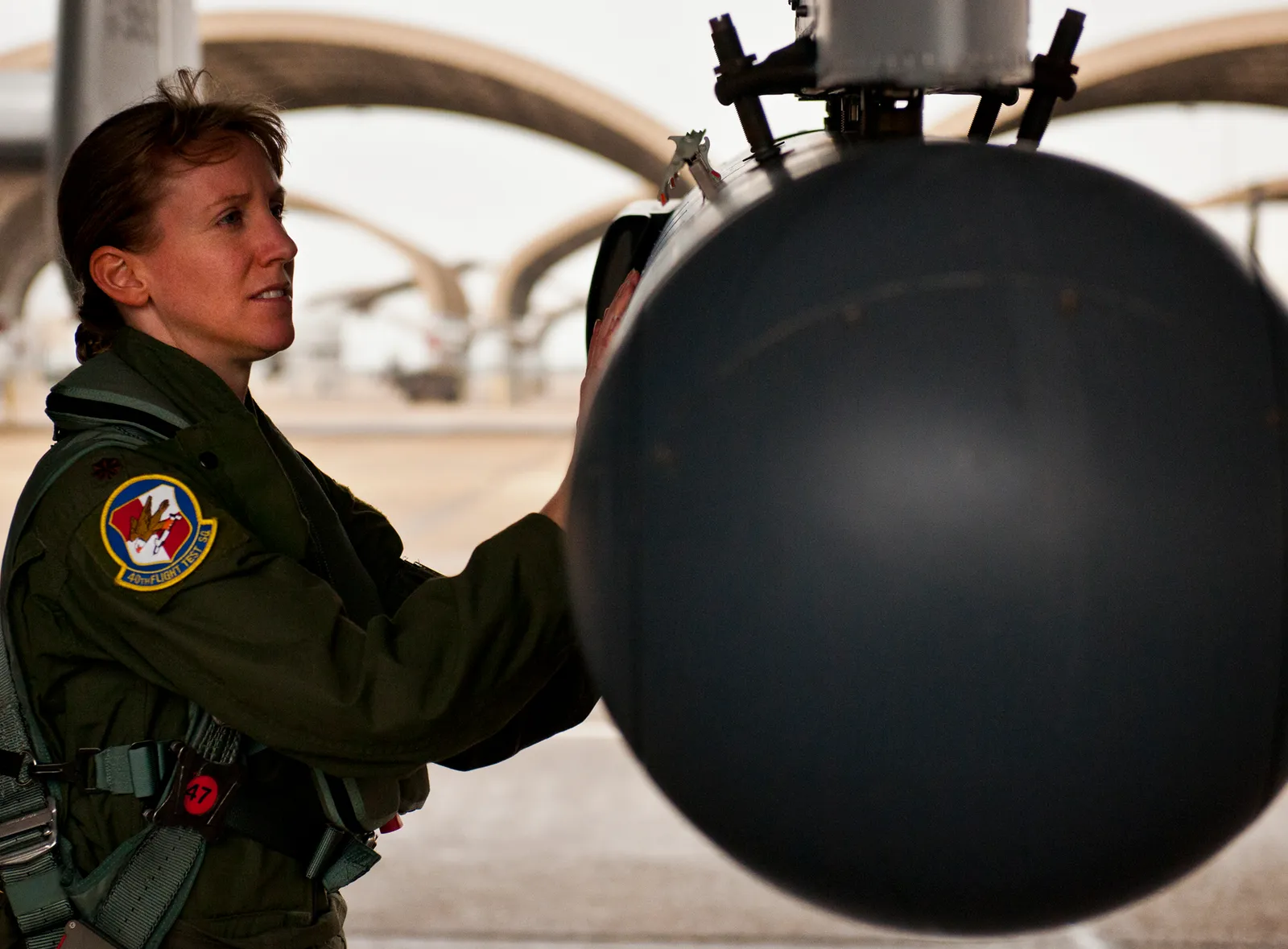
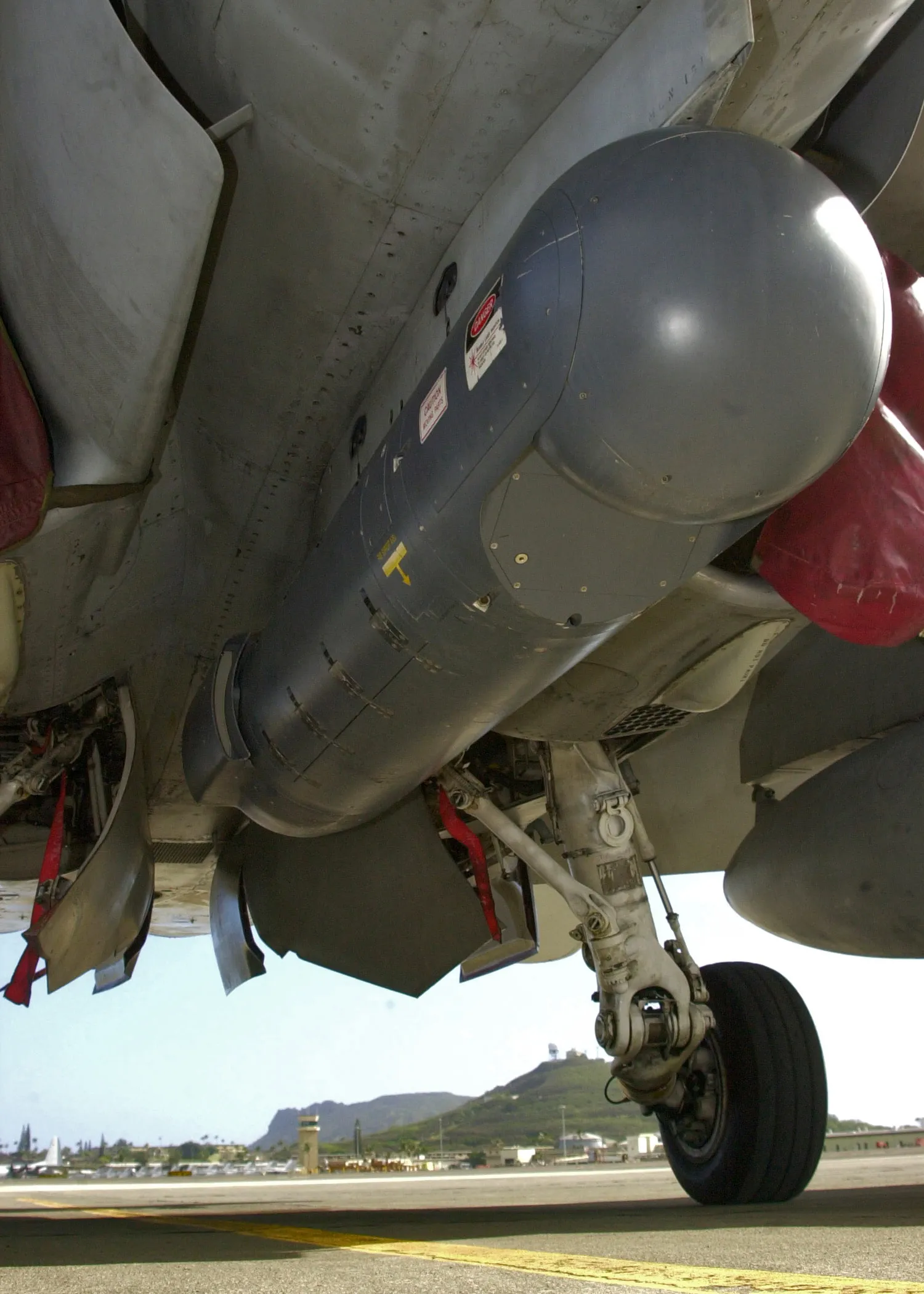
LITENING II Pod Images
Related Weapon Systems


Sources
LITENING ADVANCE TARGETINGPublisher: U.S. Air Force | Note: Supports the LITENING family description, Northrop Grumman and Rafael development context, LITENING II initial fielding in 1999, the 256 FLIR/CCD-TV/laser designator/laser rangefinder/laser spot tracker sensor suite, physical dimensions, and the listed unit cost. | Accessed: 2026-07-04NAVAIR Litening II boosts Harrier targetingPublisher: Naval Air Systems Command | Note: Supports the first AV-8B Harrier LITENING II pod delivery in August 2000 and the pod's laser-designation, day/night target-acquisition, low-level night-flight, and air-to-air capability context. | Accessed: 2026-07-04NAVAIR Harrier Litening II testing successPublisher: Naval Air Systems Command | Note: Supports AV-8B LITENING II integration testing, planned purchase of 47 pods through an Air Force contract, and operational use by Air National Guard and Air Force Reserve F-16 aircraft by March 2001. | Accessed: 2026-07-04NAVAIR improved FLIR targeting podPublisher: Naval Air Systems Command | Note: Supports Marine Corps acceptance of AN/AAQ-28 LITENING II pods for AV-8B Harriers, including the improved 640-by-512 FLIR camera configuration and Northrop Grumman manufacturing context. | Accessed: 2026-07-04B-52 dons new upgradePublisher: U.S. Air Force | Note: Supports B-52 integration and operational utility evaluation with the LITENING II targeting pod, including target verification, self-lasing, coordinate generation, and battle-damage-assessment roles. | Accessed: 2026-07-04B-52 Litening II pod used in combatPublisher: U.S. Air Force | Note: 2003 Iraq War: used by U.S. forces during Operation Iraqi Freedom when a B-52 used a LITENING II targeting pod to identify and designate targets for GBU-12 laser-guided bombs in northern Iraq. | Accessed: 2026-07-04Commons USMC-18310 Litening IIPublisher: Wikimedia Commons | Note: Supports image provenance for the AV-8B-mounted LITENING pod photograph. | Accessed: 2026-07-04Commons A-10 LITENING II imagePublisher: Wikimedia Commons | Note: Supports image provenance for the A-10 photograph showing the LITENING advanced targeting pod. | Accessed: 2026-07-04Commons Litening Pod on FA-18Publisher: Wikimedia Commons | Note: Supports image provenance for the F/A-18 Litening pod photograph. | Accessed: 2026-07-04