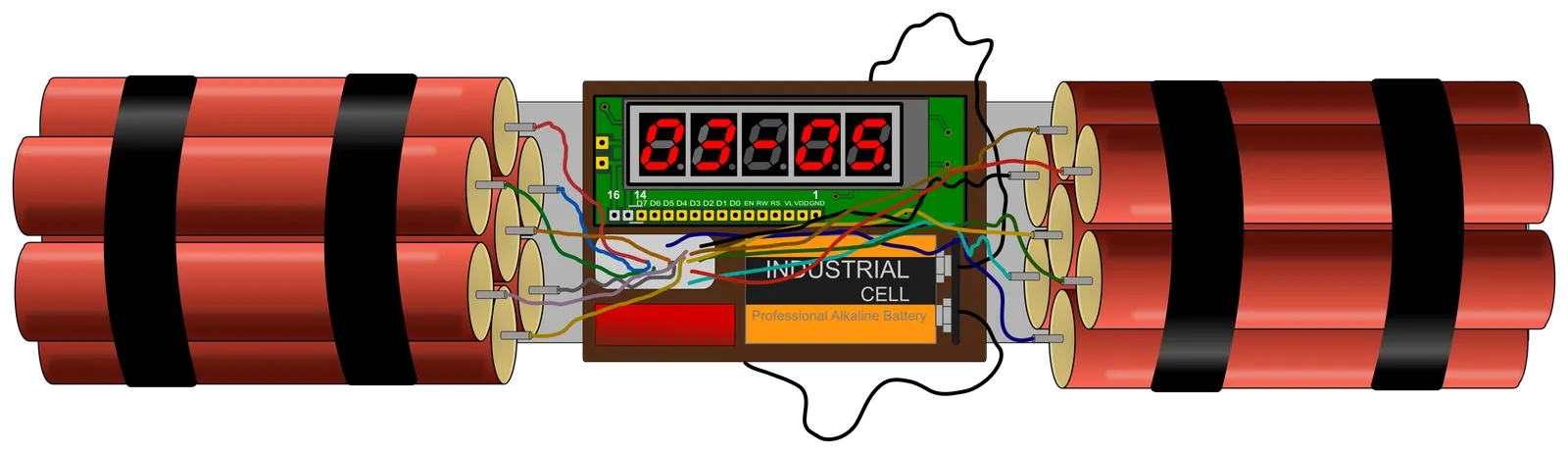

In the 2014 Yemen Civil War, Houthi forces used locally fabricated improvised explosive devices on the west coast and repurposed old aviation bombs as IEDs in civilian areas.
Role detailsMunitions
Improvised explosive device
Also known as
- IED
- improvised bomb
- roadside bomb
- roadside IED
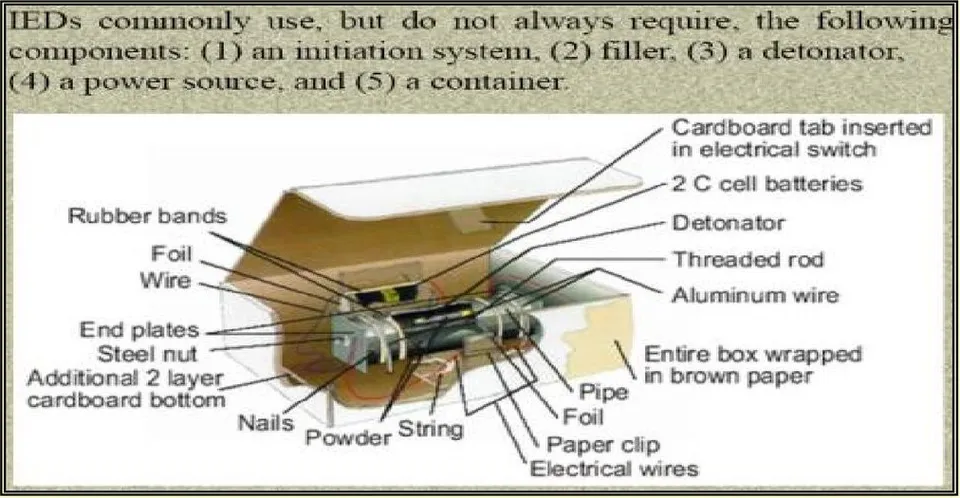
Improvised explosive devices are field-built bombs assembled from commercial, homemade, or military components and triggers. The documented family spans roadside and pressure-plate bombs, vehicle-borne suicide devices, radio-controlled charges, water-borne attack craft, booby traps, and repurposed ordnance across insurgent, terrorist, and state use cases.
Role in Conflicts
- Side
- Pakistan

In the 2019 India-Pakistan Border Skirmishes, Jaish-e-Mohammad used a vehicle-borne suicide car bomb against a CRPF convoy in Pulwama; reporting identified RDX and ammonium nitrate in the device.

In the 2017 Battle of Marawi, Maute group militants used stockpiled IEDs and left booby traps in the main battle area to slow Philippine government advances and complicate post-battle clearance.
In the 2009 Boko Haram Insurgency, Boko Haram used improvised explosive devices including victim-activated devices functioning as anti-personnel or anti-vehicle mines, roadside IEDs, vehicle-borne IEDs, and suicide bombs against civilians and security forces.

In the 2016 Colombian FARC Dissident Conflict, FARC-EP dissident forces equipped members with mines and IEDs; NCTC listed an April 2026 IED attack on a bus along the Pan-America Highway and a 2021 VBIED attack on a Colombian Army base.
- Side
- Hezbollah

In the 2023 Israel-Hezbollah Conflict, Hezbollah said explosive devices planted by its operatives hit an IDF armored-vehicle convoy between Taybeh and Deir Siryan in April 2026.
In the 1984 Kurdish-Turkish Conflict, the PKK used vehicle-borne improvised explosive devices against police and security facilities in Van and Sirnak in 2016, while Turkey also imposed controls on ammonium nitrate to reduce terrorist IED use.

In the 2014 Second Libyan Civil War, LNA forces and Wagner Group mercenaries planted improvised explosive devices and land mines while withdrawing from Tripoli's southern suburbs in 2020.
- Side
- Rebel and jihadist armed groups
In the 2012 Mali War, Al Qaeda- and Islamic State-linked extremist groups used anti-vehicle mines and IEDs against convoys and vehicles, with IED attacks becoming MINUSMA's most frequent and most lethal attack type.
In the 2011 Sinai Insurgency, Wilayat Sinai increased its use of improvised explosive devices on North Sinai roads, where a UK government-commissioned analysis described hundreds of IEDs and identified them as a leading source of casualties and destruction.

In the 2023 Sudan War, 2023 Sudan War Monitor reporting cited by Africa Defense Forum said the Sudanese Armed Forces used barrel bombs against civilians in Darfur and Kordofan; the report describes barrel bombs as improvised explosive devices made from oil drums or similar containers packed with explosives.
- Side
- Islamic State
In the 2014 War Against the Islamic State, Islamic State forces used large numbers of anti-personnel landmines and IEDs across Iraq and Syria to fortify territory, target vehicles, and contaminate civilian infrastructure after territorial defeat.

In the 2001 War in Afghanistan, the Taliban used improvised explosive devices at large scale against Afghan government and international forces, including pressure-plate devices that remained in use through the insurgency's final years.
Role details- Side
- Islamic State
In the 2013 War in Iraq, Islamic State used large numbers of victim-initiated IEDs, dense IED fields, and up-armored suicide vehicle-borne IEDs against Peshmerga and Iraqi-aligned forces in northern Iraq.
Profile / Specs
Profile
- Origin
- Local or non-state fabrication
- Built in
- Various
- Type
- Improvised explosive device
- Service note
- Recent conflicts, 2015-present
- Unit cost
- Not publicly documented
Specifications
- Construction
- Assembled from commercial, homemade, or military components.
- Initiation
- Command-detonated, radio-controlled, victim-operated, and time-delay triggers are documented IED patterns.
- Delivery
- Can be concealed in vehicles, hidden in structures, buried roadside, or mounted on watercraft.
- Payload
- Variable explosive fill that can include homemade explosives or repurposed ordnance.
Documented IED Forms
UNMAS and CAR show that the IED family spans several delivery and initiation methods rather than a single bomb shape.
| Compatible item | Item type | Compatibility evidence |
|---|---|---|
 | Vehicle-borne IED | UNMAS treats VBIED as a standard IED subtype delivered by or concealed in a ground vehicle. Sources: UNMAS IED Lexicon |
 | Radio-controlled IED | UNMAS defines RCIED as an IED initiated by radio command rather than direct contact. Sources: UNMAS IED Lexicon |
 | Water-borne IED | CAR documented a water-borne improvised explosive device deployed by Houthi forces in Yemen. Sources: ANATOMY OF A 'DRONE BOAT' |
 | Victim-operated trap | UNMAS includes victim-operated devices among IED initiation patterns, and Marawi reporting says Maute militants left booby traps and planted IEDs in the battle area. Sources: UNMAS IED Lexicon, More than 2,000 bombs, IEDs recovered in Marawi |
How IEDs Are Classified
The IED label covers several tactical choices. The same family can be triggered remotely, touched off by a victim, hidden in a vehicle, or adapted to waterborne delivery.
| Class | What the sources document | Operational effect |
|---|---|---|
| Initiation | UNMAS describes command-detonated, radio-controlled, victim-operated, and time-delay initiation patterns. | Separates remote command, victim-operated, and timed initiation methods for reader classification. |
| Delivery | UNMAS classifies vehicle-borne devices, and CAR documented a water-borne IED in Yemen. | Expands the family beyond roadside bombs into VBIEDs and maritime attack craft. |
| Payload | The UN panel on Yemen reported old aviation bombs used as IEDs in civilian areas. | Shows how repurposed ordnance can be turned into improvised weapons. |
Timeline
Improvised explosive device Key Events
CAR documents a water-borne IED in Yemen
Conflict Armament Research published an analysis of a water-borne improvised explosive device deployed by Houthi forces in Yemen, showing that IEDs can be adapted to maritime delivery.
Sources: ANATOMY OF A 'DRONE BOAT'
Marawi clearance teams recover more than 2,000 bombs and IEDs
Philippine reporting said more than 2,000 bombs and IEDs were recovered after the battle for Marawi, underlining the scale of the explosive-hazard problem left behind by militants.
Sources: More than 2,000 bombs, IEDs recovered in Marawi
Pulwama attack shows the lethality of a VBIED
NDTV and forensic reporting said Jaish-e-Mohammad used a vehicle-borne suicide bomb against a CRPF convoy in Pulwama, with RDX and ammonium nitrate identified in the device.
Sources: NDTV: Vehicle Used In Pulwama Attack Was Mini-Van, Hindustan Times: RDX, ammonium nitrate used in Pulwama attack
UN panel reports repurposed aviation bombs in Yemen
The UN Panel of Experts on Yemen reported that old aviation bombs were used as IEDs in civilian areas, showing how captured ordnance can be adapted into improvised devices.
Sources: UN Panel of Experts on Yemen Report S/2022/50
Media
Improvised explosive device Videos
Improvised explosive device Images
Related Weapon Systems


Sources
UNMAS IED LexiconPublisher: United Nations Digital Library | Note: Supports the general IED definition as a nonstandard device fabricated from readily available materials. | Accessed: 2026-07-04Conflict Armament Research: Mines and IEDs on Yemen's West CoastPublisher: Conflict Armament Research | Note: 2014 Yemen Civil War: used by Houthi forces on the west coast; CAR reported improvised and domestically produced landmines and IEDs. | Accessed: 2026-07-04UN Panel of Experts on Yemen Report S/2022/50Publisher: United Nations Digital Library | Note: 2014 Yemen Civil War: used by Houthi forces; the UN Panel reported old aviation bombs used as IEDs in civilian areas. | Accessed: 2026-06-20ANATOMY OF A 'DRONE BOAT'Publisher: Conflict Armament Research | Note: 2014 Yemen Civil War: used by Houthi forces; CAR analysis documents a water-borne improvised explosive device deployed in Yemen. | Accessed: 2026-07-04NDTV: Vehicle Used In Pulwama Attack Was Mini-VanPublisher: NDTV | Note: 2019 India-Pakistan Border Skirmishes: used by Jaish-e-Mohammad in the Pulwama suicide car bombing. | Accessed: 2026-06-20Hindustan Times: RDX, ammonium nitrate used in Pulwama attackPublisher: Hindustan Times | Note: 2019 India-Pakistan Border Skirmishes: used by Jaish-e-Mohammad in the Pulwama suicide car bombing; forensic reporting identified RDX and ammonium nitrate in the bomb. | Accessed: 2026-06-20More than 2,000 bombs, IEDs recovered in MarawiPublisher: The Philippine Star | Note: 2017 Battle of Marawi: used by Maute group militants; reporting citing Western Mindanao Command said Maute forces depended on stockpiled IEDs, planted IEDs that killed soldiers, and left booby traps in Marawi. | Accessed: 2026-06-21Mine Action Review: Nigeria Clearing the Mines 2017Publisher: Mine Action Review | Note: 2009 Boko Haram Insurgency: used by Boko Haram in northeast Nigeria; documents IEDs planted by Boko Haram in 2016-17, including victim-activated devices functioning as anti-personnel or anti-vehicle mines. | Accessed: 2026-06-21Boko HaramPublisher: National Counterterrorism Center | Note: 2009 Boko Haram Insurgency: used by Boko Haram; describes the group's increasing use of IEDs, vehicle-borne IEDs, and female suicide attacks. | Accessed: 2026-06-21NCTC FARC-EP ProfilePublisher: National Counterterrorism Center | Note: 2016 Colombian FARC Dissident Conflict: used by FARC dissident groups; NCTC says FARC-EP equips members with mines and IEDs and lists 2026 IED and 2021 VBIED attacks in Colombia. | Accessed: 2026-06-22Times of Israel: Hezbollah says it planted IEDPublisher: The Times of Israel | Note: 2023 Israel-Hezbollah Conflict: used by Hezbollah; the report says Hezbollah took responsibility for explosive devices planted by its operatives against an IDF armored-vehicle convoy. | Accessed: 2026-06-22Country Reports on Terrorism 2016: TurkeyPublisher: U.S. Department of State via Refworld | Note: 1984 Kurdish-Turkish Conflict: used by PKK; the report lists PKK VBIED attacks in Van and Sirnak and Turkish measures to reduce terrorist IED use. | Accessed: 2026-06-222020 Country Reports on Human Rights Practices: LibyaPublisher: U.S. Department of State | Note: 2014 Second Libyan Civil War: used by LNA and Wagner Group forces; the report says they planted improvised explosive devices and land mines while withdrawing from Tripoli's southern suburbs. | Accessed: 2026-06-22UNIDIR: Peacekeeping in hostile environmentsPublisher: United Nations Institute for Disarmament Research | Note: 2012 Mali War: used by Al Qaeda- and Islamic State-linked extremists; the report documents extremist use of anti-vehicle mines and IEDs against convoys and vehicles in Mali. | Accessed: 2026-06-22K4D Sinai Conflict AnalysisPublisher: UK Government K4D Helpdesk | Note: 2011 Sinai Insurgency: used by Wilayat Sinai; the analysis reports the group's increasing use of IEDs on North Sinai roads. | Accessed: 2026-06-22ADF: Evidence Supports Claim That Sudan Army Used Chlorine Gas Against RSFPublisher: Africa Defense Forum | Note: 2023 Sudan War: used by Sudanese Armed Forces; the report cites 2023 Sudan War Monitor that SAF used barrel bombs and describes barrel bombs as improvised explosive devices. | Accessed: 2026-06-22ICCT: The Threat of the Islamic State's Extensive Use of Improvised ExplosivesPublisher: International Centre for Counter-Terrorism | Note: 2014 War Against the Islamic State: used by Islamic State; the article documents extensive Islamic State use of anti-personnel landmines and IEDs across Iraq and Syria. | Accessed: 2026-06-22Afghanistan Analysts Network: How the Taleban used IEDsPublisher: Afghanistan Analysts Network | Note: 2001 War in Afghanistan: used by Taliban forces; the report documents Taliban use of improvised explosive devices and pressure-plate IEDs during the insurgency. | Accessed: 2026-06-22Army University Press: Tactics, Techniques, and Procedures of the Islamic StatePublisher: Army University Press | Note: 2013 War in Iraq: used by Islamic State; the article documents IS use of victim-initiated IEDs, IED fields, and suicide vehicle-borne IEDs in northern Iraq. | Accessed: 2026-06-22Improvised explosive device schematicPublisher: Wikimedia Commons | Note: Public-domain schematic used for the primary image. | Accessed: 2026-06-20Common IED componentsPublisher: Wikimedia Commons | Note: Public-domain Commons image used in the gallery. | Accessed: 2026-06-20IED detonatorPublisher: Wikimedia Commons | Note: Public-domain Commons image used in the gallery. | Accessed: 2026-06-20