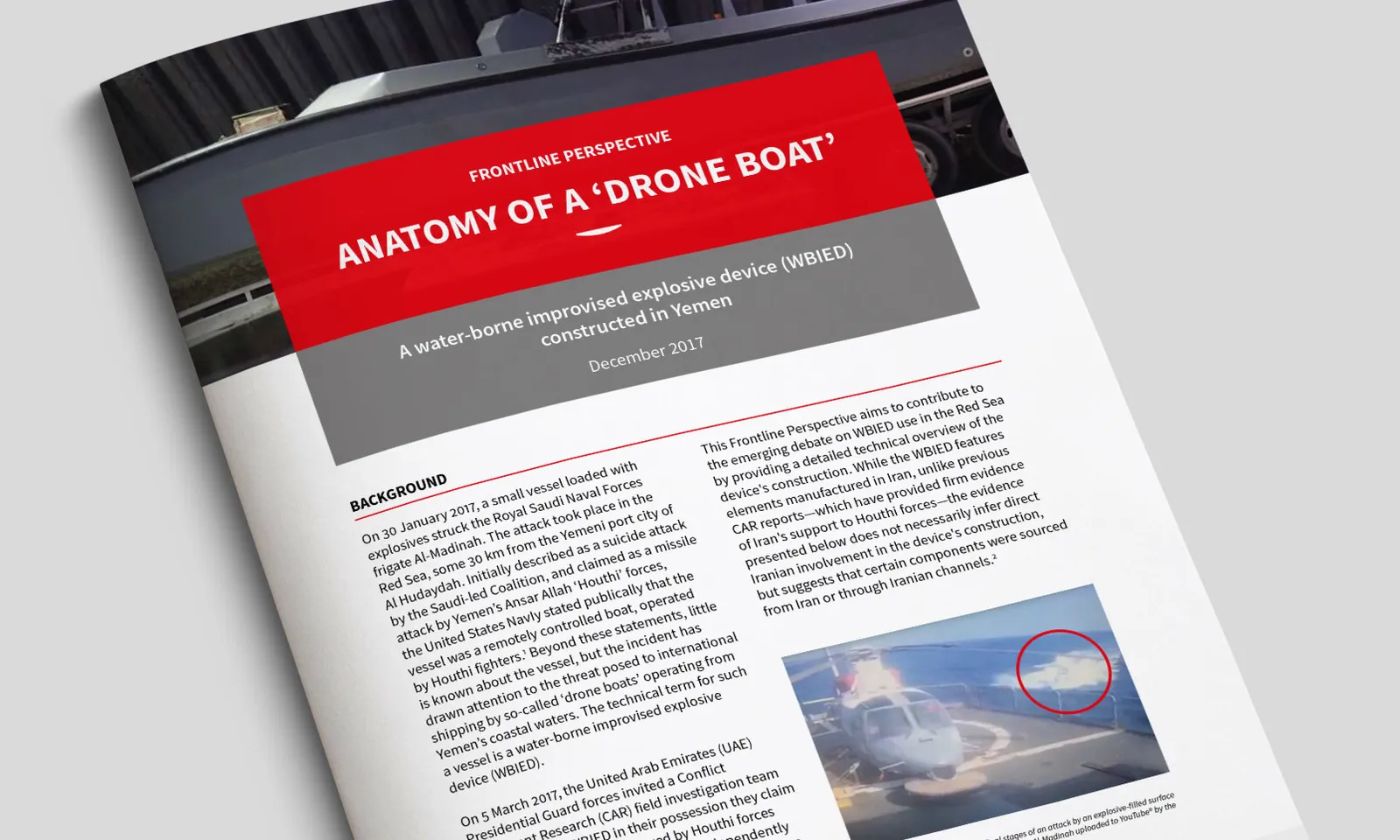

Used by Houthi-aligned forces in the 2014 Yemen Civil War for remote-controlled explosive boat attacks against Saudi naval and port targets in the Red Sea theater, including the January 2017 Al Madinah strike and the September 2018 Jizan Port attempt.
Role detailsNaval Systems
Waterborne improvised explosive device
Also known as
- drone boat
- WBIED
- water-borne improvised explosive device
- water-borne IED
- remote-controlled explosive boat
- explosive unmanned surface vessel
The waterborne improvised explosive device is a Houthi-modified explosive boat pattern documented in Yemen's Red Sea theater. Conflict Armament Research examined a 10-meter patrol boat converted for remote command with video, GPS, autopilot, and throttle connections, twin Yamaha outboards, and an explosive train built around an RDX charge and a repurposed P-15 Termit warhead.
Role in Conflicts
Profile / Specs
Profile
- Origin
- Yemen
- Built by
- Houthi movement
- Type
- Remote-controlled explosive boat
- Service note
- 2014 Yemen Civil War
Specifications
- Platform
- 10-meter Al Fattan patrol boat conversion originally supplied to Yemeni naval forces
- Control
- Purpose-built radio-control unit connected to video, GPS, compass, and throttle systems
- Payload
- RDX-filled first main charge initiating a P-15 Termit warhead as the second main charge
- Propulsion
- Twin Yamaha L200A 200 hp outboard engines
- Guidance aids
- Remotely operated video camera, Garmin GPS antenna, and Nexus autopilot compass documented by CAR
Recovered Configuration
CAR's 2017 field examination makes this record unusually concrete for an improvised naval weapon. The recovered craft was a 10-meter patrol boat whose original hull and engines were retained while external systems were added for remote command, guidance, and impact-initiated detonation.
Hull
The base craft was an Al Fattan 10-meter patrol boat, a type CAR says the UAE had donated to the Yemeni Navy before the war.
Source: Anatomy of a 'Drone Boat' PDF.
Remote command
An improvised computerized control unit connected to a camera, GPS antenna, autopilot compass, power supply, and throttle output.
CAR did not directly document the added steering actuator, but inferred remote steering from the autopilot hardware.
Propulsion
The recovered boat retained twin Yamaha L200A 200 hp outboard engines traced to a 2013 supply chain for the original patrol craft.
Source: Anatomy of a 'Drone Boat' PDF.
Explosive train
Four pressure switches, an arming switch, an improvised detonator, an RDX-filled manifold, and a P-15 Termit warhead formed the detonation chain.
The P-15 component was a warhead repurposed as a charge, not a fired anti-ship missile.
Repurposed Payload Component
CAR documented the recovered WBIED as carrying a repurposed anti-ship missile warhead, not a complete missile launch installation.
| Carried item | Item type | Carriage evidence |
|---|---|---|
 | Repurposed anti-ship missile warhead | CAR identified the WBIED's second main charge as the warhead section of a Soviet-manufactured P-15 Termit / Styx anti-ship missile dated 1988. Sources: Anatomy of a 'Drone Boat' PDF |
Timeline
Waterborne improvised explosive device Key Events
Al Madinah is struck off Hudaydah
A small explosive craft struck the Royal Saudi Naval Forces frigate Al Madinah near Hudaydah; MARAD listed the threat type as a waterborne improvised explosive device, and USNI later reported the U.S. Navy assessment that the boat was unmanned and remotely guided.
Sources: MARAD Southern Red Sea WBIED alert, Navy: Saudi Frigate Attacked by Unmanned Bomb Boat, Video Shows Houthi Boat Attack on Saudi Frigate
CAR documents a recovered WBIED
Conflict Armament Research documented a recovered 10-meter patrol boat converted into a remote-controlled explosive craft with camera, GPS, autopilot, and throttle connections and a P-15 Termit warhead payload.
Sources: Anatomy of a 'Drone Boat' PDF, Anatomy of a 'Drone Boat'
Two remote-controlled boats target Jizan Port
ONI reported that Houthi forces deployed two explosives-laden remote-controlled boats against Saudi Arabia's Jizan Port; Maritime Executive reporting said Saudi forces intercepted and destroyed both craft.
Sources: Worldwide Threat to Shipping report excerpt, Saudi Navy Intercepts Two Explosives-Filled Drone Boats
Media
Waterborne improvised explosive device Videos
Related Weapon Systems


Sources
Anatomy of a 'Drone Boat' PDFPublisher: Conflict Armament Research | Note: CAR report on a water-borne improvised explosive device deployed by Houthi forces in the 2014 Yemen Civil War; documents the recovered 10-meter patrol boat conversion, remote-control electronics, Yamaha outboards, explosive train, RDX charge, and P-15 Termit warhead. | Accessed: 2026-07-03Anatomy of a 'Drone Boat'Publisher: Conflict Armament Research | Note: CAR analysis landing page for a water-borne improvised explosive device deployed by Houthi forces in Yemen; used for image provenance and background context. | Accessed: 2026-07-03MARAD Southern Red Sea WBIED alertPublisher: U.S. Maritime Administration | Note: Supports 2014 Yemen Civil War direct-use context: MARAD reported a January 30, 2017 maritime attack against a Saudi frigate near Hudaydah, Yemen, and identified the threat type as a waterborne improvised explosive device. | Accessed: 2026-07-03Navy: Saudi Frigate Attacked by Unmanned Bomb BoatPublisher: USNI News | Note: Supports 2014 Yemen Civil War direct-use context: USNI reported the U.S. Navy assessment that the Al Madinah craft was unmanned, remotely guided, and linked to Houthi rebels. | Accessed: 2026-07-03Video Shows Houthi Boat Attack on Saudi FrigatePublisher: USNI News | Note: Supports 2014 Yemen Civil War direct-use and video-selection context: USNI identified footage of a Houthi explosive boat striking the Royal Saudi frigate Al Madinah on January 30, 2017. | Accessed: 2026-07-03Worldwide Threat to Shipping report excerptPublisher: Office of Naval Intelligence | Note: Supports 2014 Yemen Civil War direct-use context: ONI reported that the Houthis deployed two explosives-laden remote-controlled boats against Saudi Arabia's Jizan Port on September 30, 2018. | Accessed: 2026-07-03Saudi Navy Intercepts Two Explosives-Filled Drone BoatsPublisher: The Maritime Executive | Note: Supports 2014 Yemen Civil War direct-use context: reporting on Saudi coalition statements that two remote-controlled explosive boats targeting Jizan Port were intercepted and destroyed. | Accessed: 2026-07-03