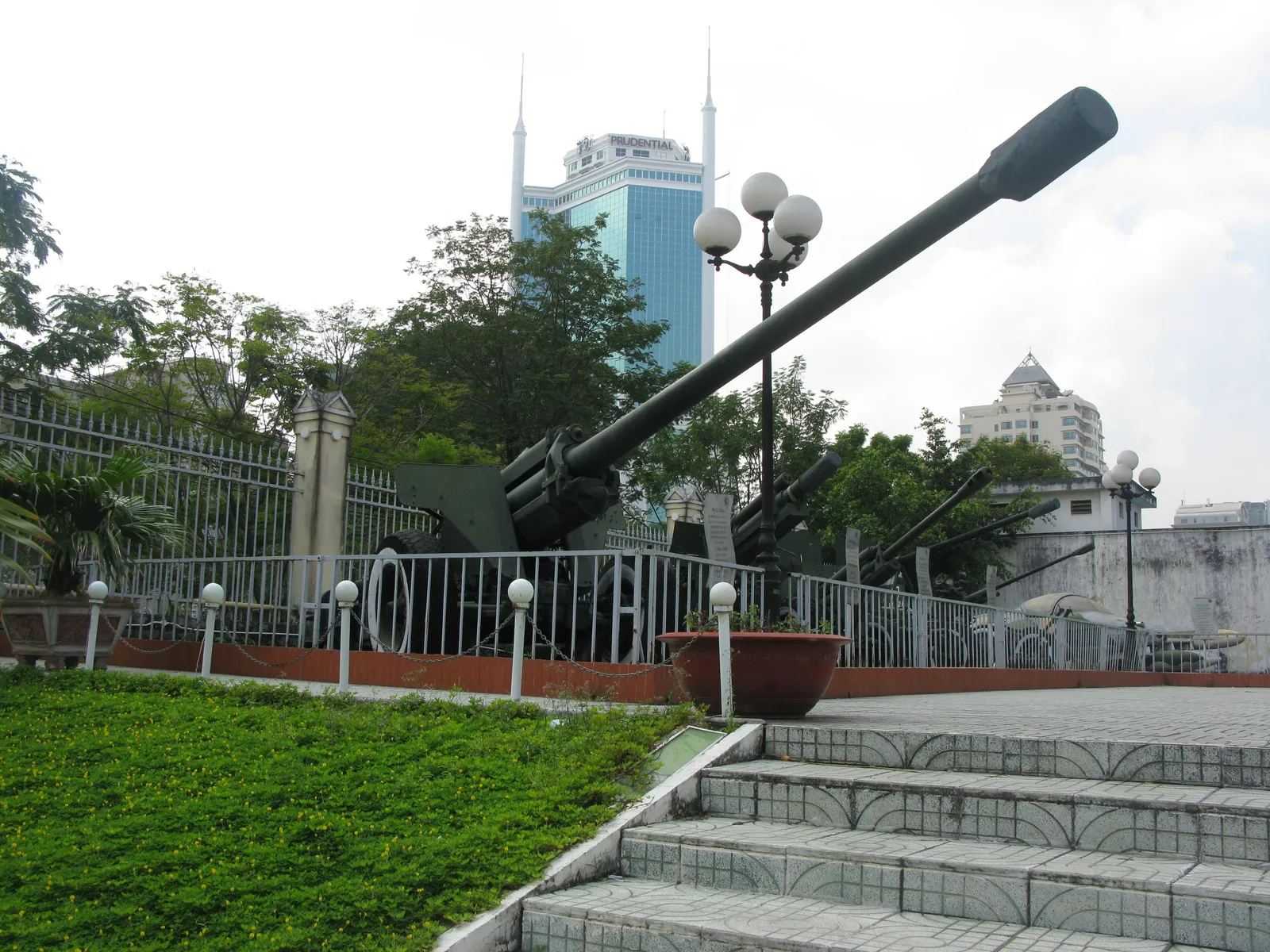


Ukrainian forces received about 15 Croatian M-46H1 130 mm field guns in 2022, while Russian forces were documented reactivating M-46 130 mm guns in 2024 and firing them with scarce 130 mm ammunition, including DPRK-marked projectiles.
Role detailsArtillery
M-46
Also known as
- 130 mm M-46
- M1954
- 130 mm towed field gun M1954
- M-46 130 mm field gun
- M-46H1
- Type 59 130 mm gun
- Type 59-1 130 mm gun
- GM-45
The M-46 is a Soviet 130 mm towed field gun built for long-range counter-battery and field-artillery missions. Its high-velocity gun, long standard range, and licensed Chinese Type 59 branch kept the design in Iraqi, Syrian, Yemeni, Pakistani, Ethiopian, Russian, and Ukrainian conflict contexts decades after its first Cold War fielding.
Role in Conflicts
- Side
- Iraq

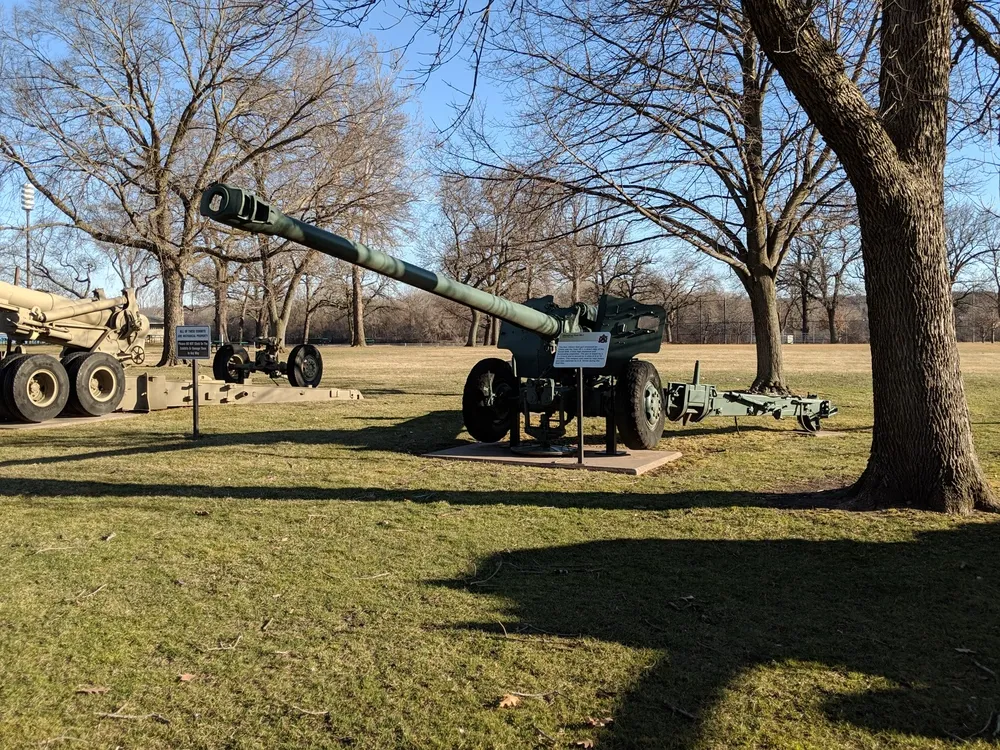
U.S. Army Sustainment Command identifies a Type 59-1 130 mm gun displayed at Rock Island Arsenal as a Chinese lightweight M-46 variant sold to Iraq and one of about 675 Iraqi-inventory guns during Operation Desert Storm.
Role detailsA Marine Corps history of the 2003 invasion lists Type-59-1 and M-46 towed howitzer battalions among Iraqi 51st Division artillery around Az Zubayr that coalition shaping fires targeted before the 1st Marine Division crossed into Iraq.
Role details
Syrian government forces used locally mounted 130 mm M-46 guns on heavy trucks, including documented crew and ammunition imagery in 2015 and later reported operational use around Aleppo and eastern Hama.
Role details
M-46 130 mm field guns were documented in pre-war Yemeni Army stocks, and a Washington Institute report said AQAP cells and affiliated local forces secured M-46 howitzers from army bases during the March-April 2015 collapse.
Role details- Side
- Pakistan

2019 India-Pakistan Border Skirmishes: Pakistani forces used 130 mm medium guns on the Line of Control during the 2019 artillery exchanges, according to a December 2019 Line of Control artillery assessment.
- Side
- Tigray forcesEthiopian government and allies

Oryx documented nine 130 mm M-46 field guns operated by the Tigray Defence Forces from photo or video evidence during the 2020 Tigray War; AP/Maxar reporting also documented an M-46 field-gun battery positioned by Eritrean forces near the Tigray border during the renewed 2022 offensive.
Profile / Specs
Profile
- Origin
- Soviet Union; supplied to Ukraine from Croatian stocks
- Built by
- Motovilikha PlantNorinco
- Built in
- Soviet UnionChina
- Type
- 130 mm towed field gun
- Service note
- Early Cold War design; supplied to Ukraine during the 2022 full-scale Russian invasion
- Designer
- Factory No. 172 design bureau
- Designed
- Late 1940s
- Unit cost
- Not publicly reported
- Produced
- 1951-1971 in Soviet production
- Number built
- Several thousand produced in the Soviet Union
Specifications
- Crew
- 8 to 10
- Caliber
- 130 mm
- Armament
- One 130 mm L/58 gun
- Weight
- About 7.7 t in firing position; about 8.45 t with limber
- Maximum range
- About 27.2-27.5 km with standard rounds
- Assisted range
- More than 23 miles with assisted ammunition
- Rate of fire
- About 5-6 rounds per minute
- Muzzle velocity
- About 930 m/s with 53-OF-482M ammunition
- Mobility
- Towed by truck; up to about 50 km/h on road
- Projectile examples
- High-explosive and illuminating projectiles
Ammunition And Range Context
The M-46's 130 mm caliber is central to both its range advantage and its modern logistics limits.
Standard reach
Open technical references put standard high-explosive fire at roughly 27 km, with assisted ammunition extending beyond that envelope.
Modern supply issue
Defense Express described Russian use in Ukraine as constrained by the unusual 130 mm caliber and tied June 2024 imagery to DPRK-marked 130 mm HE-fragmentation projectiles.
Projectile examples
Public references identify high-explosive fragmentation, armor-piercing, smoke, illuminating, and assisted-range projectile families for M-46/Type 59 service.
Variants
The catalog treats the M-46 as a gun family entry because directly documented conflict use includes Soviet-built guns, Croatian M-46H1 guns, and Chinese Type 59/Type 59-1 derivatives.
| Variant | Configuration | Designation notes |
|---|---|---|
| Type 59 | Chinese licensed M-46 version | U.S. Army Sustainment Command describes the Type 59 as the Chinese licensed version of the Soviet M-46. |
| Type 59-1 | Lightweight Chinese variant | The Type 59-1 used a lighter Type 60/D-74-derived carriage and weighed about 1.4 tons less than the M-46. |
| GM-45 | Chinese export designation | U.S. Army Sustainment Command identifies the GM-45 as the export version of the Chinese Type 59 line. |
| M-46H1 | Croatian 130 mm field-gun variant supplied to Ukraine | Croatian M-46H1 guns were documented among Croatian artillery supplied to Ukraine in 2022. Sources: Croatia donates M-46 field guns to Ukraine, Arms From The Adriatic: Croatia's Military Support For Ukraine |
Timeline
M-46 Key Events
Early Soviet fielding
U.S. Army Sustainment Command says the original M-46 was first fielded shortly after the Korean War began.
Sources: The Ordnance of Rock Island Arsenal: Type 59-1 Gun
Public Moscow display
The M-46 was publicly displayed at Moscow's May Day Parade in 1954, giving the weapon its common M1954 Western identification.
Sources: The Ordnance of Rock Island Arsenal: Type 59-1 Gun
Iraqi Type 59-1 inventory in Desert Storm
A Type 59-1 later displayed at Rock Island Arsenal is identified by the U.S. Army as a Chinese M-46 variant sold to Iraq and present in Iraqi inventory during Operation Desert Storm.
Sources: The Ordnance of Rock Island Arsenal: Type 59-1 Gun
Iraqi M-46 and Type-59-1 battalions targeted
A Marine Corps history lists Type-59-1 and M-46 towed howitzer battalions around Az Zubayr among Iraqi artillery targeted in the opening fire plan.
Sources: With the 1st Marine Division in Iraq, 2003
Croatian M-46H1 guns sent to Ukraine
Shephard and Oryx documented Croatia's transfer of roughly 15 M-46H1 130 mm field guns to Ukraine after Russia's full-scale invasion.
Sources: Croatia donates M-46 field guns to Ukraine, Arms From The Adriatic: Croatia's Military Support For Ukraine
Russian reactivation reported
Army Recognition reported Russian forces reintroducing M-46 130 mm towed guns in Ukraine as legacy artillery stocks were drawn back into service; Defense Express separately described imagery of Russian crews using M-46 guns with DPRK-marked 130 mm high-explosive fragmentation projectiles.
Sources: Russian Forces reintroduce 1940s M-46 130mm towed guns in Ukraine, Russian Military Use Rare Korean 130 mm Projectiles for M-46 Gun
Why It Stayed Relevant
- Range gave it a long afterlife. U.S. Army Sustainment Command describes the M-46 as one of the longest-ranged guns of its generation, with about 17 miles unassisted and more than 23 miles with assisted ammunition.
- The Chinese branch matters for conflict records. The Type 59 was a licensed Chinese version, while the Type 59-1 was a lighter derivative sold to Iraq and documented in Operation Desert Storm inventory.
- Old stocks still mattered in modern wars. Croatia-supplied M-46H1 guns reached Ukraine in 2022, Russian M-46 reactivation was reported in 2024, and Syrian forces adapted M-46 guns to heavy truck chassis during the 2011 Syrian Civil War.
Related Weapon Systems


Sources
130mm M-46Publisher: WeaponSystems.net | Note: Supports origin, development, manufacturer, production period, design role, and technical specifications. | Accessed: 2026-07-08M-46 / Type 59 130-mm Towed GunPublisher: GlobalSecurity.org | Note: Supports Factory No. 172 development, Motovilikha serial production, adoption context, and Chinese Type 59 licensed-production background. | Accessed: 2026-07-08Croatia donates M-46 field guns to UkrainePublisher: Shephard Media | Note: Directly supports Croatia's delivery of at least 15 M-46 130 mm towed field guns to Ukraine during the 2014 Russia-Ukraine War. | Accessed: 2026-07-08Arms From The Adriatic: Croatia's Military Support For UkrainePublisher: Oryx | Note: Lists approximately 15 Croatian 130 mm M-46H1 field guns supplied to Ukraine in August 2022. | Accessed: 2026-07-08Russian Forces reintroduce 1940s M-46 130mm towed guns in UkrainePublisher: Army Recognition | Note: Directly supports M-46 130 mm towed guns used by Russian forces in the 2014 Russia-Ukraine War in 2024. | Accessed: 2026-07-08Russian Military Use Rare Korean 130 mm Projectiles for M-46 GunPublisher: Defense Express | Note: Directly supports 2014 Russia-Ukraine War context for Russian M-46 field-gun use in 2024 and the reported use of DPRK-marked 130 mm HE-fragmentation projectiles with those guns. | Accessed: 2026-07-08The Ordnance of Rock Island Arsenal: Type 59-1 GunPublisher: U.S. Army Sustainment Command | Note: Supports M-46 development, range, Chinese Type 59/Type 59-1/GM-45 variant context, and 1990 Gulf War direct conflict-use context for an Iraqi Type 59-1 130 mm gun during Operation Desert Storm. | Accessed: 2026-07-08With the 1st Marine Division in Iraq, 2003Publisher: U.S. Marine Corps History Division | Note: Directly supports 2003 Iraq War conflict-use context by listing Type-59-1 and M-46 towed howitzer battalions among Iraqi 51st Division artillery around Az Zubayr targeted by coalition shaping fires in 2003. | Accessed: 2026-07-08Chinese BEE4 BB/RA 130 mm projectiles in SyriaPublisher: Armament Research Services | Note: Directly supports 130 mm M-46 truck-mounted guns used by Syrian Arab Army forces in the 2011 Syrian Civil War in 2015. | Accessed: 2026-07-08130 mm M-46 Field Gun on IVECO TRAKKER and Mercedes-Benz Actros ChassisPublisher: Tank Encyclopedia | Note: Supports 2011 Syrian Civil War operational context for truck-mounted M-46 guns, including reported use around Aleppo in 2016 and eastern Hama in 2017. | Accessed: 2026-07-08Handbook Of Pre-War Yemeni Fighting VehiclesPublisher: Oryx | Note: Directly supports 2014 Yemen Civil War context: M-46 130 mm field guns were fielded by the Yemeni Army before the 2014-2015 Houthi takeover and described as available to Yemeni parties on the battlefield. | Accessed: 2026-07-08Gulf Coalition Targeting AQAP in YemenPublisher: The Washington Institute for Near East Policy | Note: Directly supports 2014 Yemen Civil War context: M-46 howitzers were captured by AQAP-aligned forces from Yemeni army bases during the March-April 2015 force collapse. | Accessed: 2026-07-08Use of Precision Artillery on the Line of ControlPublisher: Vivekananda International Foundation | Note: 2019 India-Pakistan Border Skirmishes: Pakistani forces used 130 mm medium guns on the Line of Control during the 2019 artillery exchanges discussed in this assessment. | Accessed: 2026-07-08The Tigray Defence Forces - Documenting Its Heavy WeaponryPublisher: Oryx | Note: 2020 Tigray War: directly supports 130 mm M-46 field guns used by the Tigray Defence Forces, listing nine photo- or video-documented examples. | Accessed: 2026-07-08Satellite images show Eritrea military buildup near TigrayPublisher: Associated Press via ClickOnDetroit | Note: 2020 Tigray War: directly supports M-46 field guns fielded by Eritrean forces near the Tigray border during the renewed 2022 offensive. | Accessed: 2026-07-08130 mm towed field gun M1954 (M-46).jpgPublisher: Wikimedia Commons | Note: Public-domain image of an M1954/M-46 field gun, released by the author for unrestricted reuse. | Accessed: 2026-07-08Type 59-1 at RIA's Memorial FieldPublisher: DVIDS / U.S. Army Sustainment Command | Note: Public-domain gallery image source for the Type 59-1 130 mm gun display at Rock Island Arsenal; the gallery uses the DVIDS 9129441/1000w_q95.jpg image derivative. | Accessed: 2026-07-08