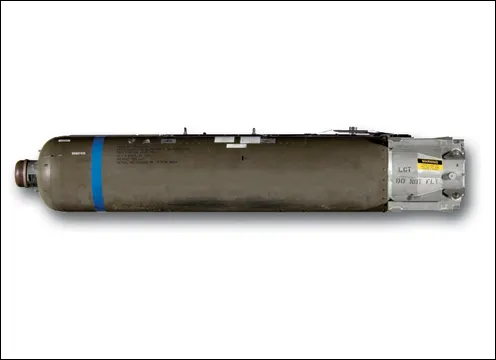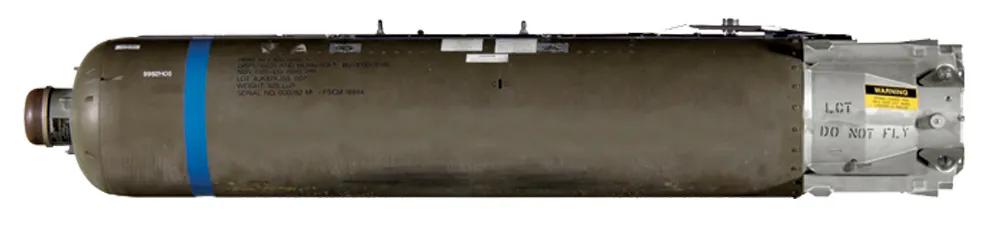
- Side
- Coalition forces

Human Rights Watch reported that U.S. forces used 10,035 CBU-87 cluster munitions during the 1991 Persian Gulf War.
Role detailsThe CBU-87 cluster munition is a U.S. air-delivered Combined Effects Munition built around the SUU-65/B Tactical Munitions Dispenser and 202 BLU-97/B bomblets. It saw documented U.S. or NATO use in the 1990 Gulf War, Operation Allied Force, Afghanistan, and the 2003 Iraq War, while the related CBU-103/B added a Wind Corrected Munitions Dispenser tail kit to the same CEM body.
Human Rights Watch reported that U.S. forces used 10,035 CBU-87 cluster munitions during the 1991 Persian Gulf War.
Role detailsHuman Rights Watch documented CBU-87 use by NATO aircraft in Yugoslavia, including U.S. F-15E and F-16 drops and later reported U.S. and Dutch CBU-87 expenditure totals for Operation Allied Force.
Human Rights Watch reported that U.S. forces primarily used CBU-87 and CBU-103 cluster bombs in Afghanistan, with B-1 bombers believed to have dropped 50 CBU-87s during the first week of the air campaign.
Role detailsHuman Rights Watch's Iraq air-war appendix listed 118 unguided CBU-87 cluster bombs among U.S. Air Force munitions used in the 2003 Iraq War.
Role detailsThe CBU-87/B combines a tactical munitions dispenser with a dense payload of BLU-97/B combined-effects bomblets.
SUU-65/B Tactical Munitions Dispenser.
202 BLU-97/B submunitions in each CBU-87/B.
BLU-97/B combines fragmentation, shaped-charge anti-armor, and zirconium incendiary effects.
CBU-87/B designations cover the baseline Combined Effects Munition body, while CBU-103/B applies the WCMD guidance tail-kit program to the CBU-87/B payload.
| Variant | Configuration | Designation notes |
|---|---|---|
| CBU-87B/B | Variant | |
| CBU-87C/B | Variant | |
| CBU-87(D2)/B | Variant | |
| CBU-87(T-1)/B | Variant | |
 | WCMD-guided derivative | Forecast International describes the CBU-103/B as the CBU-87/B fitted with the Wind Corrected Munitions Dispenser guidance kit. |
| CBU-87/B training munition | Variant |
The CBU-87/B dispenser carries BLU-97/B bomblets as its combined-effects payload.
| Carried item | Item type | Carriage evidence |
|---|---|---|
 | Cluster submunition | Each CBU-87/B carries 202 BLU-97/B submunitions inside the SUU-65/B dispenser. Sources: CBU-87/B Combined Effects Munition report, U.S. CBU series, HRW Cluster Bombs in Afghanistan Backgrounder |
The CBU-87/B was cleared for multiple U.S. and NATO tactical aircraft, while the B-1B fact sheet lists CBU-87 cluster munitions among the bomber's internal loads.
| Carrier | Carrier type | Carriage evidence |
|---|---|---|
 | Long-range bomber | The U.S. Air Force B-1B fact sheet says the bomber's internal bays can accommodate 30 CBU-87/89 cluster munitions or CBU-97 Sensor Fused Weapons. Sources: B-1B Lancer |
 | Multirole fighter | Human Rights Watch reported that F-16 aircraft dropped CBU-87 cluster bombs during Operation Allied Force and listed F-16s among aircraft approved for CBU-87 use. Sources: HRW NATO Cluster Munitions in Yugoslavia, HRW Cluster Bombs in Afghanistan Backgrounder |
 | Close air support aircraft | Human Rights Watch listed the A-10 among aircraft approved for CBU-87 use. |
 | Long-range bomber | Human Rights Watch listed the B-52 among aircraft approved for CBU-87 use. |
Forecast International places the CBU-87/B program's development start in the mid-1970s, followed by development and testing from 1978 to 1982.
Sources: CBU-87/B Combined Effects Munition report
Forecast International says first production deliveries of the CBU-87/B were made in December 1983.
Sources: CBU-87/B Combined Effects Munition report
Human Rights Watch reported that U.S. forces used 10,035 CBU-87s during the 1991 Persian Gulf War.
Sources: HRW Iraq Cluster Munition Hazard Briefing
Human Rights Watch documented U.S. and Dutch CBU-87 use during NATO's 1999 air campaign against Yugoslavia.
Sources: HRW NATO Cluster Munitions in Yugoslavia, HRW Cluster Bombs in Afghanistan Backgrounder
Human Rights Watch reported that U.S. forces used both older CBU-87 and newer CBU-103 cluster bombs in Afghanistan.
Sources: HRW Fatally Flawed Afghanistan Cluster Bomb Report, HRW Cluster Bombs in Afghanistan Backgrounder
Forecast International listed no new CBU-87/B orders and no 2003-2012 all-up weapon production forecast.
Sources: CBU-87/B Combined Effects Munition report
DVIDS documented 422nd Test and Evaluation Squadron testing of CBU-87 and CBU-103 munitions at the Nevada Test and Training Range.
Sources: Cluster Bomb Unit Testing And Training