

In the 2001 War in Afghanistan, Human Rights Watch reported that U.S. forces used the newer WCMD-equipped CBU-103 during the air campaign and described Afghanistan as the model's first combat use.
Role detailsMunitions
CBU-103 Wind-Corrected Munitions Dispenser
Also known as
- CBU-103/B
- CBU-87/B with WCMD
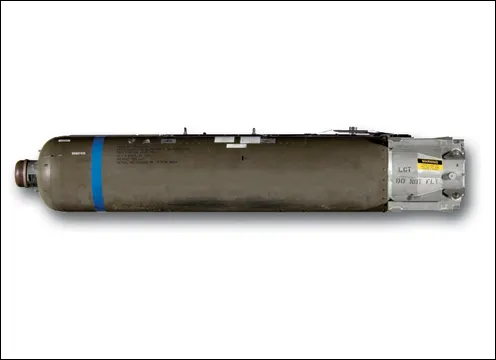
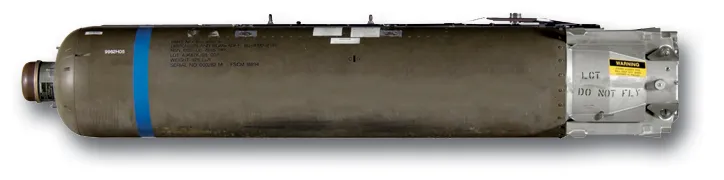
The CBU-103 Wind-Corrected Munitions Dispenser is the WCMD-equipped version of the U.S. CBU-87/B Combined Effects Munition, pairing the free-fall cluster bomb body with a wind-correcting tail kit for more accurate delivery. Human Rights Watch reported CBU-103 use in Afghanistan and cited U.S. Air Force reporting that CBU-103s were among the cluster munitions used in Iraq.
Role in Conflicts
During the 2003 Iraq War, Human Rights Watch cited U.S. Air Force reporting that Iraq cluster-bomb expenditure included 818 CBU-103 Wind Corrected Munitions Dispensers.
Role detailsProfile / Specs
Profile
- Origin
- United States
- Built by
- Lockheed Martin
- Type
- Wind-corrected munition dispenser
- Service note
- Late 1990s-present
- Unit cost
- WCMD baseline kit about $23,073 per unit in FY2005 procurement data; all-up CBU-103 cost not separately standardized
- Produced
- Late 1990s-present
Specifications
- Weight
- About 951 lb (431 kg)
- Length
- About 7 ft 8 in (2.3 m)
- Diameter
- About 15 in (38 cm)
- Base dispenser
- CBU-87/B CEM with SUU-65/B tactical munitions dispenser
- Payload
- 202 BLU-97/B combined-effects bomblets
- Guidance
- WCMD tail kit corrects launch transients, ballistic errors, and wind drift
- Accuracy
- Baseline WCMD guidance cited at about 26 m (85 ft) CEP
- Stand-off range
- About 16 km (10 miles) from a 40,000 ft release in baseline WCMD configuration
WCMD Conversion Logic
The CBU-103 is best read as a guided conversion of the CBU-87/B Combined Effects Munition rather than a clean-sheet bomb body.
Base body
CBU-87/B CEM with the SUU-65/B tactical munitions dispenser and 202 BLU-97/B combined-effects bomblets.
Guidance kit
WCMD replaces the tail section with an inertial guidance package and flip-out control fins that correct release errors and winds aloft.
Family position
CBU-104 and CBU-105 use the same WCMD designation logic on the CBU-89 Gator and CBU-97 Sensor Fuzed Weapon families.
Variants
The CBU-103 designation applies the WCMD tail-kit family to the CBU-87/B Combined Effects Munition; adjacent WCMD designations use the same guidance-kit concept on other tactical munition dispensers.
| Variant | Configuration | Designation notes |
|---|---|---|
 | Base CEM dispenser | The CBU-103/B is the WCMD-guided derivative of the CBU-87/B Combined Effects Munition. Sources: Lockheed Martin WCMD designations |
| CBU-103A/B | CBU-87A/B WCMD configuration | Designation-Systems lists CBU-103A/B as the WCMD configuration associated with CBU-87A/B. Sources: Lockheed Martin WCMD designations |
| CBU-103B/B | CBU-87B/B WCMD configuration | Designation-Systems lists CBU-103B/B as the WCMD configuration associated with CBU-87B/B and BLU-97A/B bomblets. Sources: Lockheed Martin WCMD designations |
 | WCMD Gator mine-dispenser member | The CBU-104/B applies the WCMD tail kit to the CBU-89/B Gator mine dispenser rather than the CBU-87/B CEM body. Sources: Lockheed Martin WCMD designations |
 | WCMD sensor-fuzed family member | The CBU-105/B applies the WCMD tail kit to the CBU-97/B Sensor Fuzed Weapon family. Sources: Lockheed Martin WCMD designations |
Carrier Aircraft
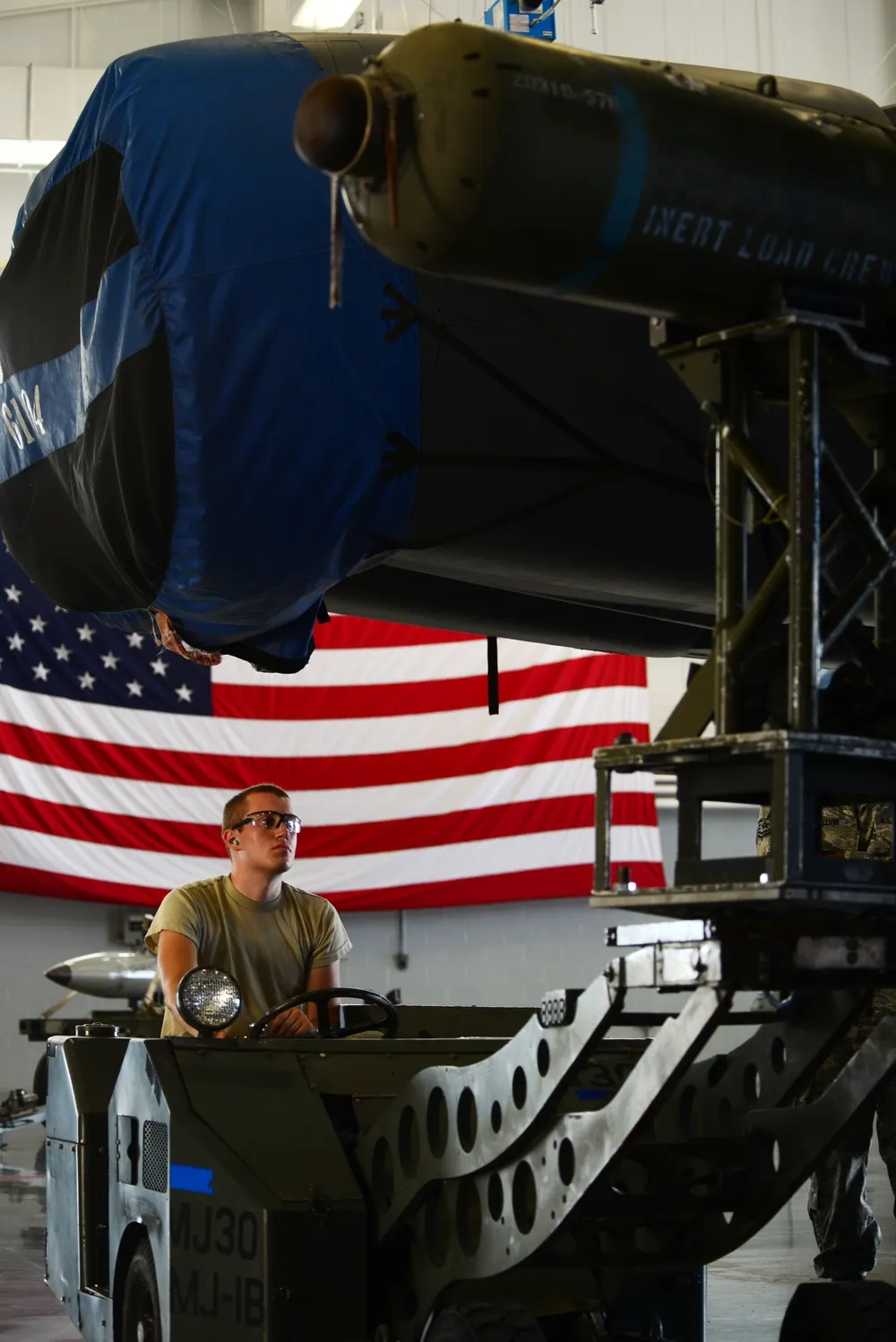
The B-1B Lancer fact sheet lists CBU-103 Wind-Corrected Munitions Dispensers in the bomber's armament.
| Carrier | Carrier type | Carriage evidence |
|---|---|---|
 | Long-range bomber | The B-1B fact sheet lists CBU-103 Wind-Corrected Munitions Dispensers in the bomber's armament. Sources: B-1B Lancer |
 | Multirole fighter | Lockheed Martin reported CBU-103/104/105 WCMD capability in a Block 40/42 F-16 software update and later BRU-57 certification for the CBU-103/104/105/107 WCMD series on Block 40/42/50/52 F-16 aircraft; DVIDS also documents a CBU-103 being loaded onto an F-16 at Osan. Sources: Lockheed Martin F-16 smart weapons update, DVIDS CBU-103 F-16 load crew image, Lockheed Martin BRU-57 certification release |
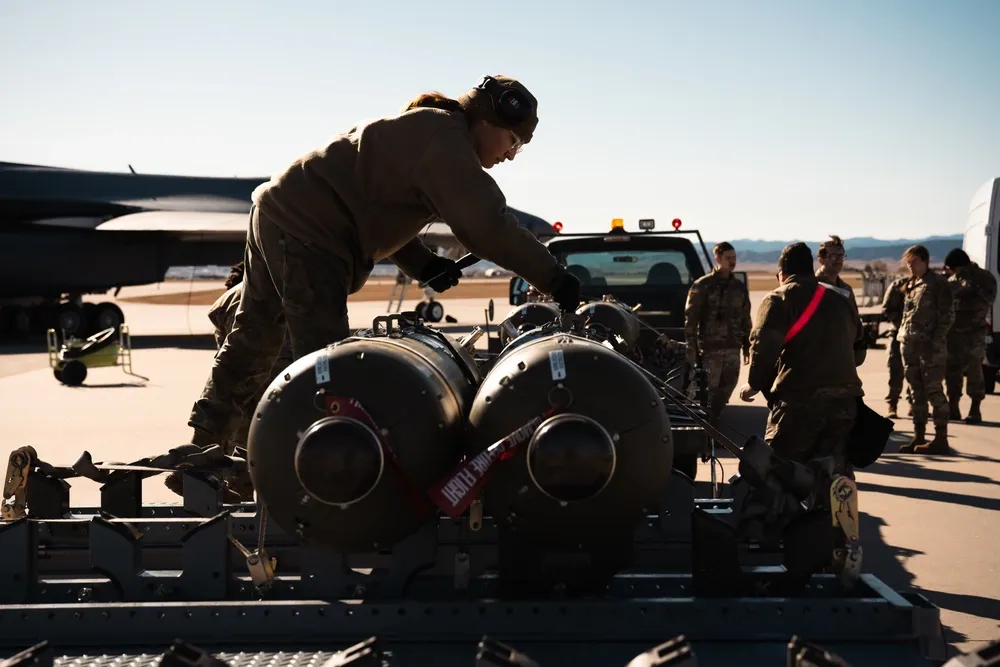
 | Long-range bomber | Air Force Global Strike Command reported that 23rd Bomb Squadron B-52H crews carried and dropped live CBU-103 munitions during night training at the Nevada Test and Training Range. Sources: AFGSC B-52 CBU-103 training mission, DVIDS B-52 CBU-103 load crew image |
Timeline
CBU-103 Wind-Corrected Munitions Dispenser Key Events
WCMD development begins
Designation-Systems places WCMD development in the 1995-1996 period as a guidance-kit program for tactical munition dispensers.
Sources: Lockheed Martin WCMD designations
Low-rate production starts
Designation-Systems says Lockheed Martin began low-rate WCMD production in 1998.
Sources: Lockheed Martin WCMD designations
Full-rate WCMD production
Designation-Systems records full-rate WCMD production beginning in 2001 after operational readiness in 2000.
Sources: Lockheed Martin WCMD designations
First combat use in Afghanistan
Human Rights Watch reported that the United States used the newer CBU-103 in Afghanistan and described that campaign as the model's first combat use.
Sources: HRW Fatally Flawed Afghanistan Cluster Bomb Report, UK Hansard Afghanistan Cluster Bomb Policy
CBU-103 use reported in Iraq
Human Rights Watch cited U.S. Air Force reporting that Iraq cluster-bomb expenditure included 818 CBU-103s.
Sources: HRW Air Force WCMD procurement requests
F-16 BRU-57 certification announced
Lockheed Martin said the U.S. Air Force certified the CBU-103/104/105/107 WCMD series on Block 40/42/50/52 F-16 aircraft using the BRU-57 rack.
Sources: Lockheed Martin BRU-57 certification release
Media
CBU-103 Wind-Corrected Munitions Dispenser Images
Related Weapon Systems




Sources
B-1B LancerPublisher: U.S. Air Force | Note: Supports the carrier-aircraft relationship by listing CBU-103 Wind-Corrected Munitions Dispensers in the B-1B's armament. | Accessed: 2026-06-27HRW Air Force WCMD procurement requestsPublisher: Human Rights Watch | Note: Supports 2003 Iraq War direct use: cites U.S. Air Force reporting that Iraq cluster-bomb expenditure included 818 CBU-103 Wind Corrected Munitions Dispensers. | Accessed: 2026-07-01HRW Fatally Flawed Afghanistan Cluster Bomb ReportPublisher: Human Rights Watch | Note: Supports 2001 War in Afghanistan direct use: reports that U.S. forces used CBU-103 cluster bombs during the Afghanistan air campaign and describes Afghanistan as the model's first combat use. | Accessed: 2026-07-01UK Hansard Afghanistan Cluster Bomb PolicyPublisher: UK Parliament Hansard | Note: Supports 2001 War in Afghanistan direct use: a UK minister stated that CBU-103 cluster munitions had been used in Afghanistan. | Accessed: 2026-07-01Lockheed Martin WCMD designationsPublisher: Designation-Systems | Note: Supports WCMD family designation logic, CBU-103/B relation to CBU-87/B, CBU-103A/B and CBU-103B/B subdesignations, baseline WCMD guidance performance, and development/production timeline. | Accessed: 2026-07-01Lockheed Martin BRU-57 certification releasePublisher: Lockheed Martin | Note: Supports F-16 carriage context for the CBU-103/104/105/107 WCMD series using the BRU-57 rack on Block 40/42/50/52 aircraft. | Accessed: 2026-07-01Lockheed Martin F-16 smart weapons updatePublisher: Lockheed Martin | Note: Supports F-16 compatibility context by listing CBU-103/104/105 WCMD weapons as enabled by a USAF Block 40/42 F-16C/D software update. | Accessed: 2026-07-01AFGSC B-52 CBU-103 training missionPublisher: U.S. Air Force Global Strike Command | Note: Supports B-52 carriage and live training-release context for CBU-103 munitions. | Accessed: 2026-07-01DVIDS B-1B CBU-103 live fire imagePublisher: DVIDS | Note: Supports primary image provenance and B-1B loading context for CBU-103 munitions; DVIDS marks the U.S. Air Force photo as public domain. | Accessed: 2026-07-01DVIDS B-52 CBU-103 load crew imagePublisher: DVIDS | Note: Supports gallery image provenance and B-52 loading context for a CBU-103; DVIDS marks the U.S. Air Force photo as public domain. | Accessed: 2026-07-01DVIDS CBU-103 F-16 load crew imagePublisher: DVIDS | Note: Supports gallery image provenance and F-16 loading context for a CBU-103; DVIDS marks the U.S. Air Force photo as public domain. | Accessed: 2026-07-01Air Force Magazine CBU-103 referencePublisher: Air Force Magazine | Note: Supports CBU-103/104/105 WCMD family background, contractor names, dimensions, weight, payload, and performance figures for the WCMD-equipped CBU-103/B. | Accessed: 2026-06-27WCMD Procurement ProgramPublisher: U.S. Air Force | Note: Supports WCMD procurement cost and Lockheed Martin Orlando production context for the CBU-103 tail-kit program. | Accessed: 2026-06-27CBU-87 b.jpgPublisher: Wikimedia Commons | Note: Supports image provenance and the file description linking the CBU-87 family to the WCMD tail kit used for CBU-103/104/105 variants. | Accessed: 2026-06-27CBU-87 xxl.jpgPublisher: Wikimedia Commons | Note: Supports image provenance for the alternate CBU-87 family photograph shown in the gallery. | Accessed: 2026-06-27