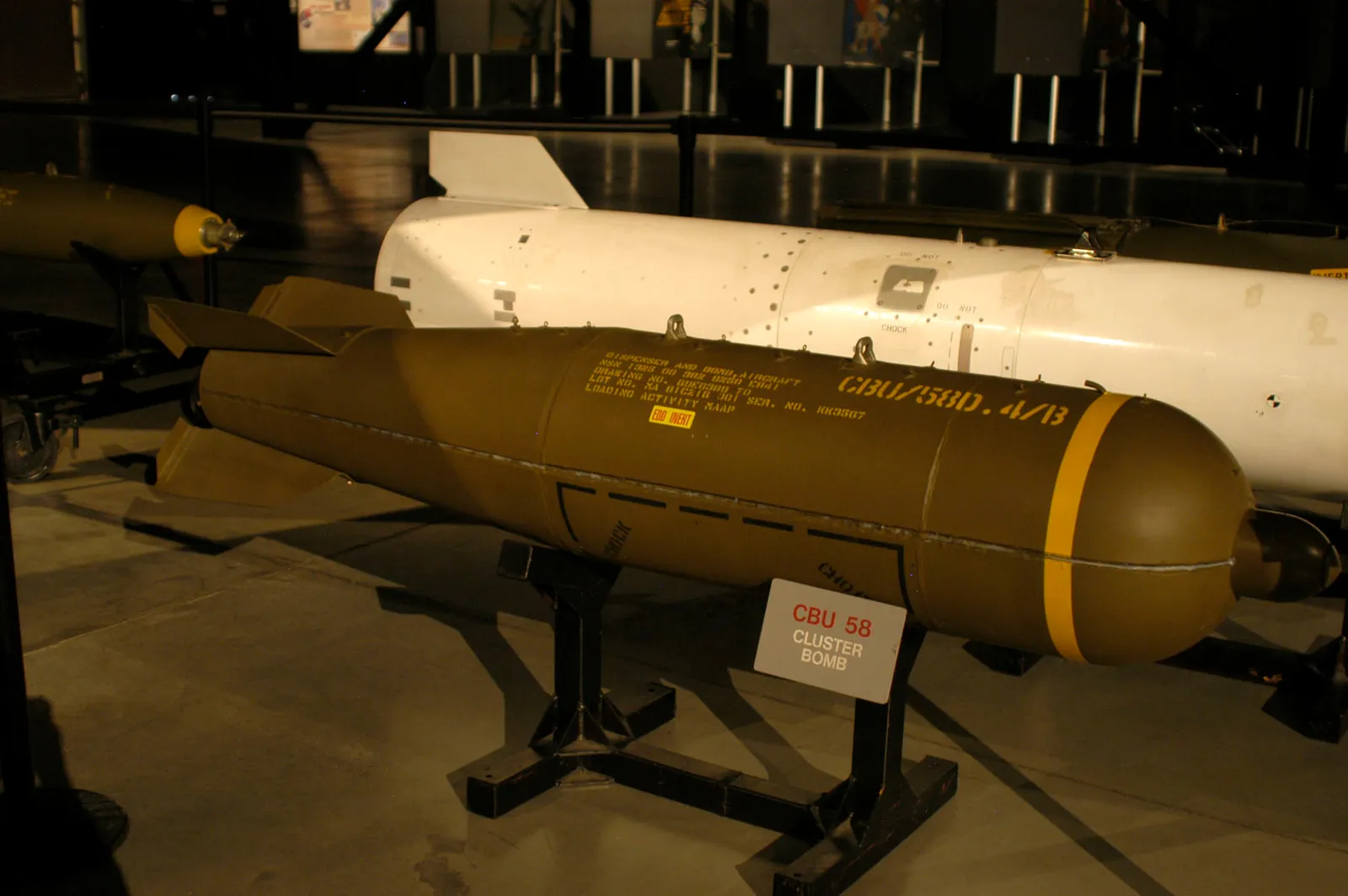

Human Rights Watch documented remnants of CBU-58 cluster bombs after Saudi-led coalition air attacks on residential neighborhoods in Sanaa on January 6, 2016, including markings on a CBU-58 remnant from the al-Zira'a Street area.
Role detailsMunitions
CBU-58A/B cluster bomb
Also known as
- CBU-58
The CBU-58A/B is a U.S.-origin air-delivered cluster bomb built around the SUU-30H/B dispenser and 650 BLU-63A/B submunitions. GAO records a 1971 Air Force loading request for 5,955 bombs at $208.80 each, and Human Rights Watch documented CBU-58 remnants in Sanaa in 2016.
Role in Conflicts
Profile / Specs
Profile
- Origin
- United States
- Built by
- Milan Army Ammunition PlantU.S. Army Munitions CommandAjax Hardware Manufacturing CorporationUnknown
- Type
- Air-delivered cluster bomb
- Service note
- Cold War-era munition documented in Yemen in 2016
- Designer
- United States Air Force Armament Laboratory
- Designed
- Late 1960s to early 1970s
- Unit cost
- 1971 Air Force loading request: $208.80 per CBU-58/B, or $1,243,404 for 5,955 bombs
- Produced
- Early 1970s loading request; Human Rights Watch documented a Yemen remnant marked as manufactured in 1978 at Milan Army Ammunition Plant
- Number built
- 5,955 CBU-58/B cluster bombs requested for U.S. Air Force loading in 1971
Specifications
- Delivery
- Externally carried, air-delivered cluster bomb for aircraft release
- Dispenser
- SUU-30-series dispenser; OSMP identifies the Yemen-documented configuration as SUU-30H/B
- Submunitions
- 650 BLU-63A/B or BLU-63/B anti-personnel bomblets
- Explosive fill
- About 163 lb (74 kg) total COMP B explosive in the BLU-63A/B payload, according to OSMP
- Intended effect
- Area fragmentation effects against personnel, soft-skinned vehicles, materiel, and similar exposed targets
Variants
- CBU-58/B
- CBU-58A/B
- SUU-30H/B dispenser configuration
Dispenser Body
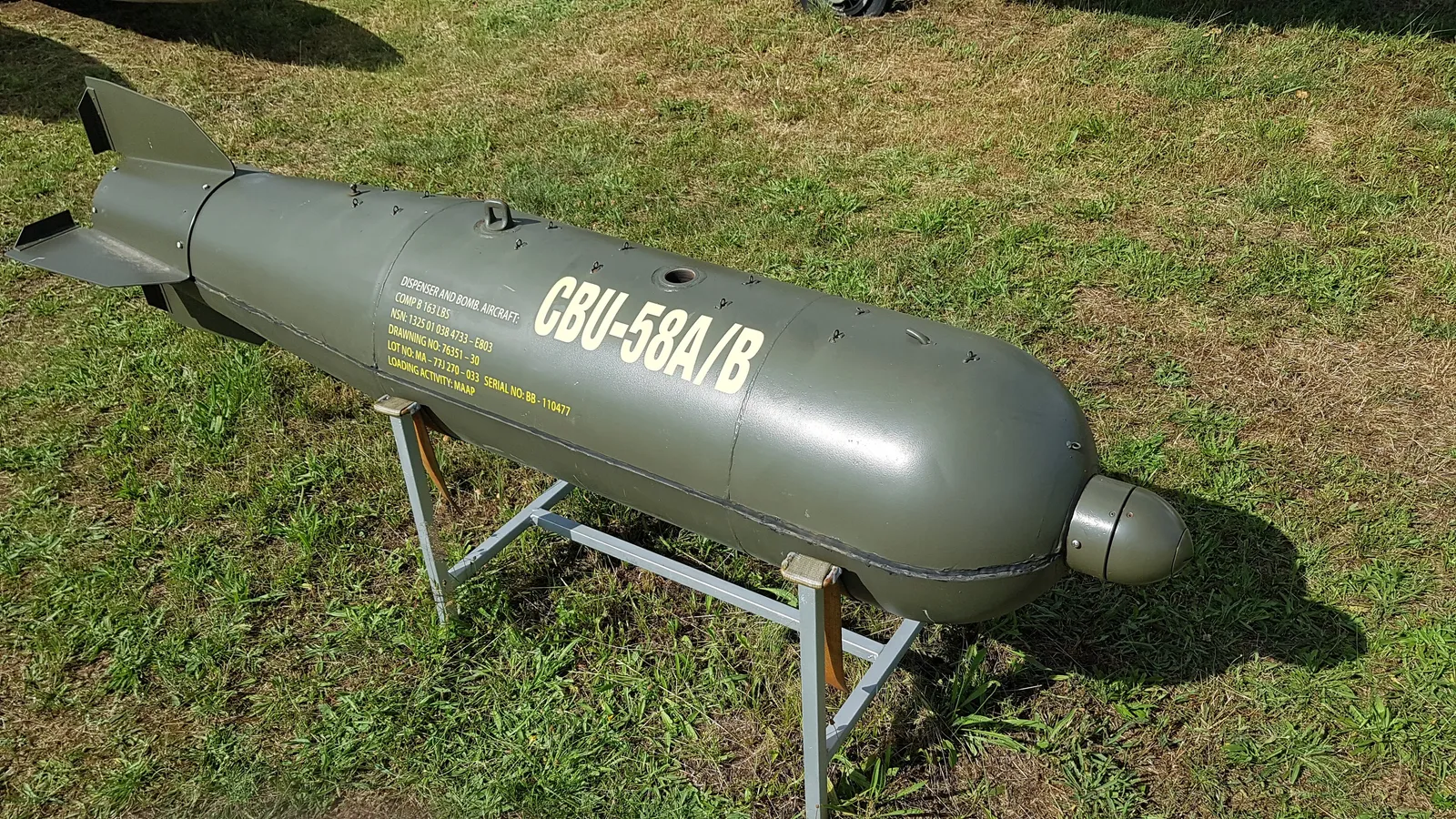
The Yemen-documented configuration identifies the CBU-58A/B as an SUU-30H/B dispenser body carrying BLU-63A/B submunitions.
| Compatible item | Item type | Compatibility evidence |
|---|---|---|
 | Submunition dispenser | OSMP identifies the remnant as an SUU-30H/B air-delivered dispenser that comprised a CBU-58A/B cluster bomb unit. Sources: CBU-58A/B |
Submunition Payload
The bomb's battlefield effect came from the bomblets released after the dispenser opened in flight.
| Carried item | Item type | Carriage evidence |
|---|---|---|
 | Anti-personnel submunition | OSMP says the CBU-58A/B carries 650 BLU-63A/B submunitions and about 163 lb of COMP B explosive, matching the BLU-63 family documented in Yemen. Sources: CBU-58A/B |
Documented Configuration
Open-source reporting ties the Yemen-documented CBU-58A/B to a specific dispenser body, submunition payload, and 1971 loading request.
| Topic | Documented detail | Source |
|---|---|---|
| Dispenser body | SUU-30H/B air-delivered dispenser configured as a CBU-58A/B cluster bomb unit. | CBU-58A/B |
| Payload | 650 BLU-63A/B submunitions with about 163 lb of COMP B explosive. | CBU-58A/B |
| Loading order | 5,955 CBU-58/B bombs requested at $208.80 each for 1971 Army loading. | Review of BLU-63/B Bomblet Program |
| Remnant marking | HRW recorded a CBU-58 remnant in Sanaa marked as manufactured at Milan Army Ammunition Plant in 1978. | Yemen: Coalition Drops Cluster Bombs in Capital |
Timeline
CBU-58A/B cluster bomb Key Events
Air Force loading request is priced
The Air Force requested the Army to produce 5,955 CBU-58/B cluster bombs at $208.80 each, with deliveries scheduled to start in July 1971.
Sources: Review of BLU-63/B Bomblet Program
Human Rights Watch documents Sanaa remnants
Human Rights Watch identified CBU-58 remnants in Sanaa and said the bomb markings showed 1978 manufacture at Milan Army Ammunition Plant.
Sources: Yemen: Coalition Drops Cluster Bombs in Capital
Media
CBU-58A/B cluster bomb Images
Related Weapon Systems




Sources
Yemen: Coalition Drops Cluster Bombs in CapitalPublisher: Human Rights Watch | Note: Supports 2014 Yemen Civil War direct use: CBU-58 cluster bombs used by Saudi-led coalition forces in Sanaa on January 6, 2016, with photographed remnants and manufacturer markings. | Accessed: 2026-06-20Yemen: Cluster Munitions Wounding CiviliansPublisher: Human Rights Watch | Note: Supports 2014 Yemen Civil War background: Saudi-led coalition forces used U.S.-supplied cluster munitions in Yemen and were assessed by HRW as responsible for most documented cluster-munition attacks. | Accessed: 2026-06-20CBU-58A/BPublisher: Open Source Munitions Portal | Note: Supports specifications and background for the CBU-58A/B, including the SUU-30H/B dispenser, 650 BLU-63A/B submunitions, and total explosive weight. | Accessed: 2026-06-20Review of BLU-63/B Bomblet ProgramPublisher: U.S. Government Accountability Office | Note: Supports manufacturer and specification context: CBU-58/B used an SUU-30A/B dispenser with BLU-63/B bomblets, with U.S. Army loading and Ajax Hardware BLU-63/B production contract details. | Accessed: 2026-06-20CBU 58 Cluster BombPublisher: National Museum of the U.S. Air Force | Note: Supports image provenance and public-domain status for the CBU-58 cluster bomb display photograph. | Accessed: 2026-06-20Cluster bomb CBU-58.jpgPublisher: Wikimedia Commons | Note: Supports image provenance and CC BY-SA 4.0 reuse for the gallery image showing a CBU-58A/B at Flugplatzmuseum Cottbus. | Accessed: 2026-06-26