

During Operation Iraqi Freedom, U.S. Air Force reporting said B-52 crews first used CBU-105 Wind Corrected Munitions Dispensers in combat on April 2, 2003, striking an Iraqi tank column moving south from Baghdad.
Role detailsMunitions
CBU-105 Sensor Fuzed Weapon
Also known as
- CBU-105
- CBU-105/B
- CBU-105D/B
- CBU-97
- CBU-97/B
- Sensor Fuzed Weapon
- Sensor Fused Weapon
- SFW
- WCMD SFW
The CBU-105 Sensor Fuzed Weapon is the WCMD-guided configuration of the CBU-97 anti-armor cluster munition, pairing an SUU-66 dispenser with ten BLU-108 submunitions and forty Skeet warheads. U.S. Air Force reporting documents CBU-105 combat use in the 2003 Iraq War, while Human Rights Watch documented later Saudi-led coalition use and malfunctioning remnants in Yemen.
Role in Conflicts

Human Rights Watch documented Saudi-led coalition use of CBU-105 Sensor Fuzed Weapons in Yemen from April 2015, including attacks in Saada, Sanaa, Amran, and Hodaida, while noting remnants that failed to function as intended.
Role detailsProfile / Specs
Profile
- Origin
- United States
- Built by
- Textron Systems
- Type
- Sensor-fuzed cluster munition
- Service note
- Late Cold War development; U.S. production ended in the 2000s and export production wound down in 2017
- Designer
- Textron Defense Systems and the U.S. Air Force
- Designed
- Full-scale development contract awarded in 1985; low-rate production decision reviewed in 1991
- Unit cost
- Not publicly standardized; Saudi Arabia's 2011 FMS notification estimated 404 live rounds and support at $355 million
- Produced
- 1990s-2017
- Number built
- U.S. Air Force 2007 handbook listed about 90 CBU-97 and 3,100 CBU-105 weapons; later export production continued before Textron's final deliveries in 2017
Specifications
- Weight
- About 427 kg, or roughly the 1,000-pound class
- Length
- About 2.3 m
- Diameter
- About 400 mm
- Payload
- 10 BLU-108 submunitions, each dispensing four Skeet warheads
- Warheads
- 40 sensor-fuzed, top-attack explosively formed penetrator warheads
- Sensors
- Skeet warheads use infrared and laser sensing to classify vehicle-like targets
- Guidance
- WCMD inertial tail kit corrects wind drift and release errors
- Coverage
- Air Force handbook and manufacturer literature describe up to about 30 acres of coverage
- Standoff range
- Air Force handbook lists CBU-105 range at up to about 10 nautical miles
- Primary target set
- Armored vehicles, vehicle columns, strongpoints, dug-in positions, and some maritime targets
Design And Payload
The CBU-105 is best read as the guided member of the CBU-97 Sensor Fuzed Weapon family rather than a separate bomb body. WCMD adds wind correction to the 1,000-pound-class dispenser while preserving the BLU-108/Skeet top-attack payload.
Dispenser
An SUU-66 tactical munitions dispenser releases ten BLU-108 submunitions over the target area.
Submunitions
Each BLU-108 ejects four Skeet warheads, giving one round forty top-attack warheads intended for vehicle-like targets.
Guidance
The WCMD tail kit corrects release and wind errors, allowing more accurate medium- and high-altitude delivery than the ballistic CBU-97 body.
Safety Claims
Manufacturer and U.S. export documents describe self-destruct or self-deactivation features, but Yemen field reports documented BLU-108 remnants that did not function as intended.
Variants
The CBU-105 designation applies the Wind Corrected Munitions Dispenser tail kit to the CBU-97 Sensor Fuzed Weapon family.
| Variant | Configuration | Designation notes |
|---|---|---|
| CBU-97/B Sensor Fuzed Weapon | Baseline ballistic dispenser | The unguided CBU-97/B carries the same Sensor Fuzed Weapon payload without the WCMD tail kit that creates the CBU-105 configuration. Sources: U.S. Air Force Handbook 2007, ARES CBU-97/CBU-105 briefing |
| CBU-105D/B Sensor Fuzed Weapon | WCMD-guided all-up round | DSCA export notices identify the CBU-105D/B as the Wind Corrected Munitions Dispenser Sensor Fuzed Weapon configuration supplied for foreign military sales. Sources: DSCA Saudi CBU-105 notification, Federal Register Oman CBU-105 notification |
Carrier Aircraft
These aircraft are documented as carrying or using CBU-105 Sensor Fuzed Weapons.
| Carrier | Carrier type | Carriage evidence |
|---|---|---|
 | Multirole fighter | Boeing's Advanced F-15 weapons inventory lists CBU-105 Sensor Fuzed Weapon among the aircraft's external carriage options. Sources: Advanced F-15 Weapons Inventory |
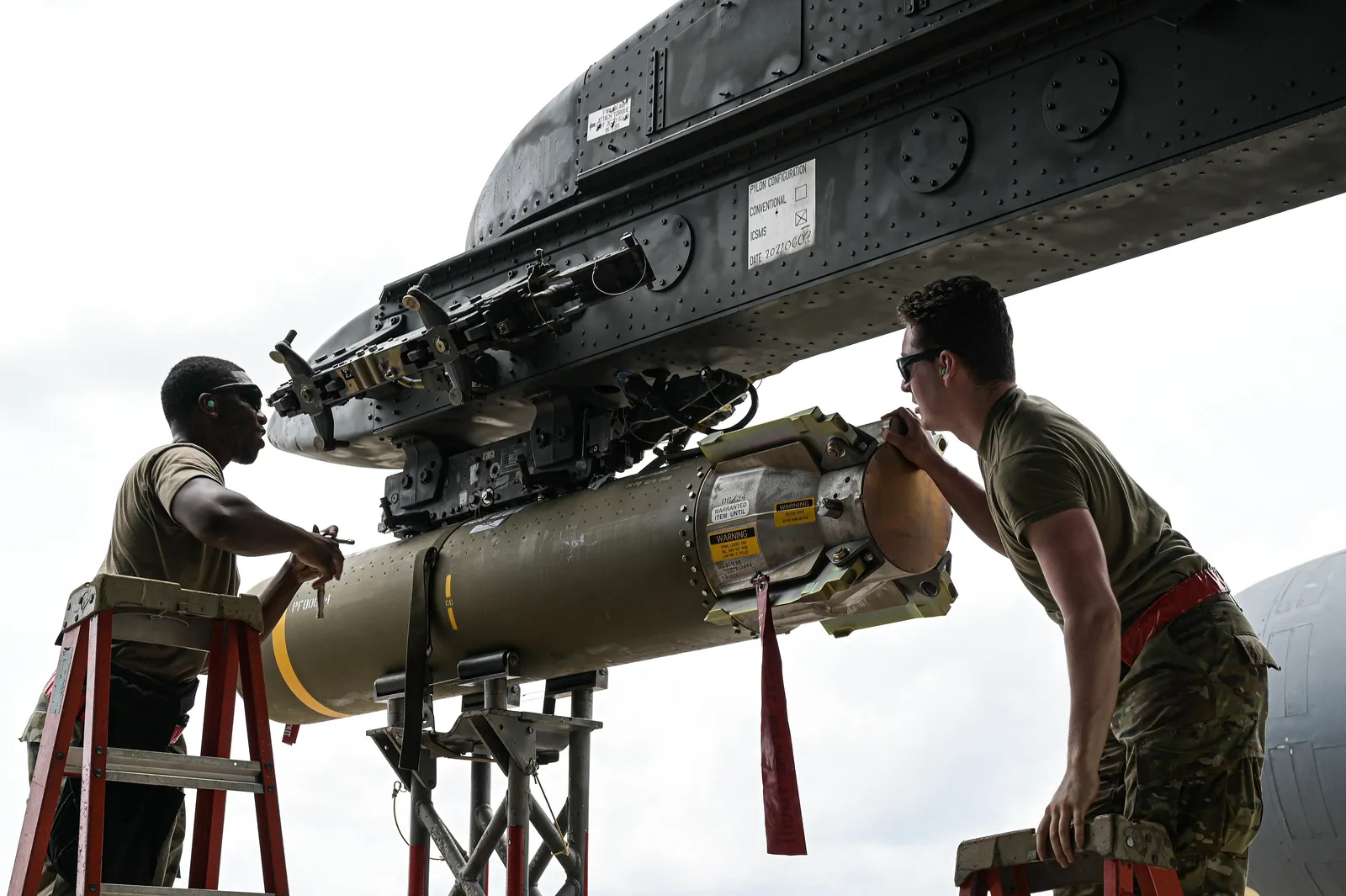
 | Strategic bomber | An Air Force photo caption shows CBU-105 munitions loaded onto a B-52H Stratofortress, and an Air Force article says B-52 crews used CBU-105 sensor-fused cluster bombs in combat. Sources: Load 'er up, B-52 crews use 'smart-guided' cluster bomb |
 | Long-range bomber | The Air Force B-1B fact sheet lists CBU-105 Sensor Fuzed Weapons among the bomber's carried ordnance. Sources: B-1B Lancer CBU-105 load |
 | Multirole fighter | Lockheed Martin said the F-16's smart-weapon capacity was doubled after certification of the BRU-57 multiple weapon rack for the CBU-103/104/105/107 WCMD family on Block 40/42/50/52 aircraft. |
Timeline
CBU-105 Sensor Fuzed Weapon Key Events
Full-scale development contract
The U.S. Air Force awarded Textron Defense Systems a full-scale development contract for the Sensor Fuzed Weapon after defining a requirement to attack multiple tanks and armored vehicles in one aircraft pass.
Sources: GAO SFW Production Review
GAO reviewed production readiness
GAO reported that testing had overcome earlier technical problems but warned that production decisions still depended on unresolved cost-effectiveness and interdiction-analysis questions.
Sources: GAO SFW Production Review
First reported CBU-105 combat use
U.S. Air Force reporting said B-52 crews used CBU-105 WCMDs in combat against an Iraqi tank column during Operation Iraqi Freedom.
Sources: B-52 crews use 'smart-guided' cluster bomb
U.S. production endpoint listed
The U.S. Air Force handbook listed FY2007 as the final production year for the CBU-105 in U.S. inventory planning.
Sources: U.S. Air Force Handbook 2007
Saudi CBU-105 sale notification
DSCA notified Congress of a possible Saudi purchase of 404 CBU-105D/B weapons, integration test assets, and support equipment with Textron Systems as prime contractor.
Sources: DSCA Saudi CBU-105 notification
Textron discontinued production
Textron told investors it would discontinue sensor-fuzed weapon production because of reduced orders and difficulty obtaining export approvals in the political environment then facing the product line.
Sources: Textron SEC sensor-fuzed weapon discontinuation
Media
CBU-105 Sensor Fuzed Weapon Images
Related Weapon Systems




Sources
U.S. Air Force Handbook 2007Publisher: U.S. Air Force / GovInfo | Note: Supports CBU-97/CBU-105 specifications, mission, inventory figures, production endpoint, aircraft compatibility, and WCMD range context. | Accessed: 2026-07-04GAO SFW Production ReviewPublisher: U.S. Government Accountability Office | Note: Supports Sensor Fuzed Weapon development history, Textron full-scale development contract, payload sequence, and intended anti-armor/interdiction role. | Accessed: 2026-07-04ARES CBU-97/CBU-105 briefingPublisher: Armament Research Services | Note: Supports CBU-97/CBU-105 designation context, CBU-105 dimensions and payload details, BLU-108/Skeet technical context, and submunition safety-mode caveats. | Accessed: 2026-07-04Load 'er upPublisher: U.S. Air Force | Note: Supports CBU-105 loading onto a B-52H Stratofortress during Combat Hammer. | Accessed: 2026-07-04B-52 crews use 'smart-guided' cluster bombPublisher: U.S. Air Force | Note: Supports 2003 Iraq War direct use: B-52 crews used CBU-105 Wind Corrected Munitions Dispensers against an Iraqi tank column during Operation Iraqi Freedom. | Accessed: 2026-07-04B-1B Lancer CBU-105 loadPublisher: U.S. Air Force | Note: Supports the B-1B's carriage of CBU-105 Sensor Fuzed Weapons. | Accessed: 2026-07-04HRW Yemen cluster munitions reportPublisher: Human Rights Watch | Note: Supports 2014 Yemen Civil War direct use: Human Rights Watch documented CBU-105 remnants and Saudi-led coalition use in Yemen, including reported attacks in Hajjah and other governorates. | Accessed: 2026-07-04HRW Yemen Saudis using US cluster munitionsPublisher: Human Rights Watch | Note: Supports 2014 Yemen Civil War direct use: Human Rights Watch documented Saudi-led coalition CBU-105 use in at least six Yemen airstrikes, including Amran, Hodaida, Saada, and Sanaa, and noted failed BLU-108 remnants. | Accessed: 2026-07-04Lockheed Martin smart weapons releasePublisher: Lockheed Martin | Note: Supports WCMD guidance-kit context, CBU-103/104/105 family relationship, and manufacturer/background claims for the CBU-105 system. | Accessed: 2026-07-04Lockheed Martin BRU-57 certification releasePublisher: Lockheed Martin | Note: Supports BRU-57 compatibility with the CBU-103/104/105/107 WCMD family on F-16 Block 40/42/50/52 aircraft. | Accessed: 2026-07-04Advanced F-15 Weapons InventoryPublisher: Boeing | Note: Supports F-15 family carriage of CBU-105 Sensor Fuzed Weapon in Boeing's external carriage matrix. | Accessed: 2026-07-04DSCA Saudi CBU-105 notificationPublisher: Defense Security Cooperation Agency | Note: Supports Saudi Arabia's 2011 request for 404 CBU-105D/B Sensor Fuzed Weapons, integration test assets, estimated cost, end-use restrictions, and Textron Systems as prime contractor. | Accessed: 2026-07-04Federal Register Oman CBU-105 notificationPublisher: Federal Register / Defense Security Cooperation Agency | Note: Supports CBU-105D/B all-up-round description, SUU-66 tactical munitions dispenser, ten BLU-108 submunitions, four Skeets per submunition, and intended target set. | Accessed: 2026-07-04Textron SEC sensor-fuzed weapon discontinuationPublisher: U.S. Securities and Exchange Commission / Textron Inc. | Note: Supports Textron's 2016 plan to discontinue sensor-fuzed weapon production because of reduced orders and export-approval conditions. | Accessed: 2026-07-04CBU-105 SFW.jpgPublisher: Wikimedia Commons | Note: Supports image provenance for the public-domain CBU-105 SFW photograph. | Accessed: 2026-07-04Load 'er up.jpgPublisher: Wikimedia Commons | Note: Supports image provenance for the public-domain CBU-105 loading photograph. | Accessed: 2026-07-04