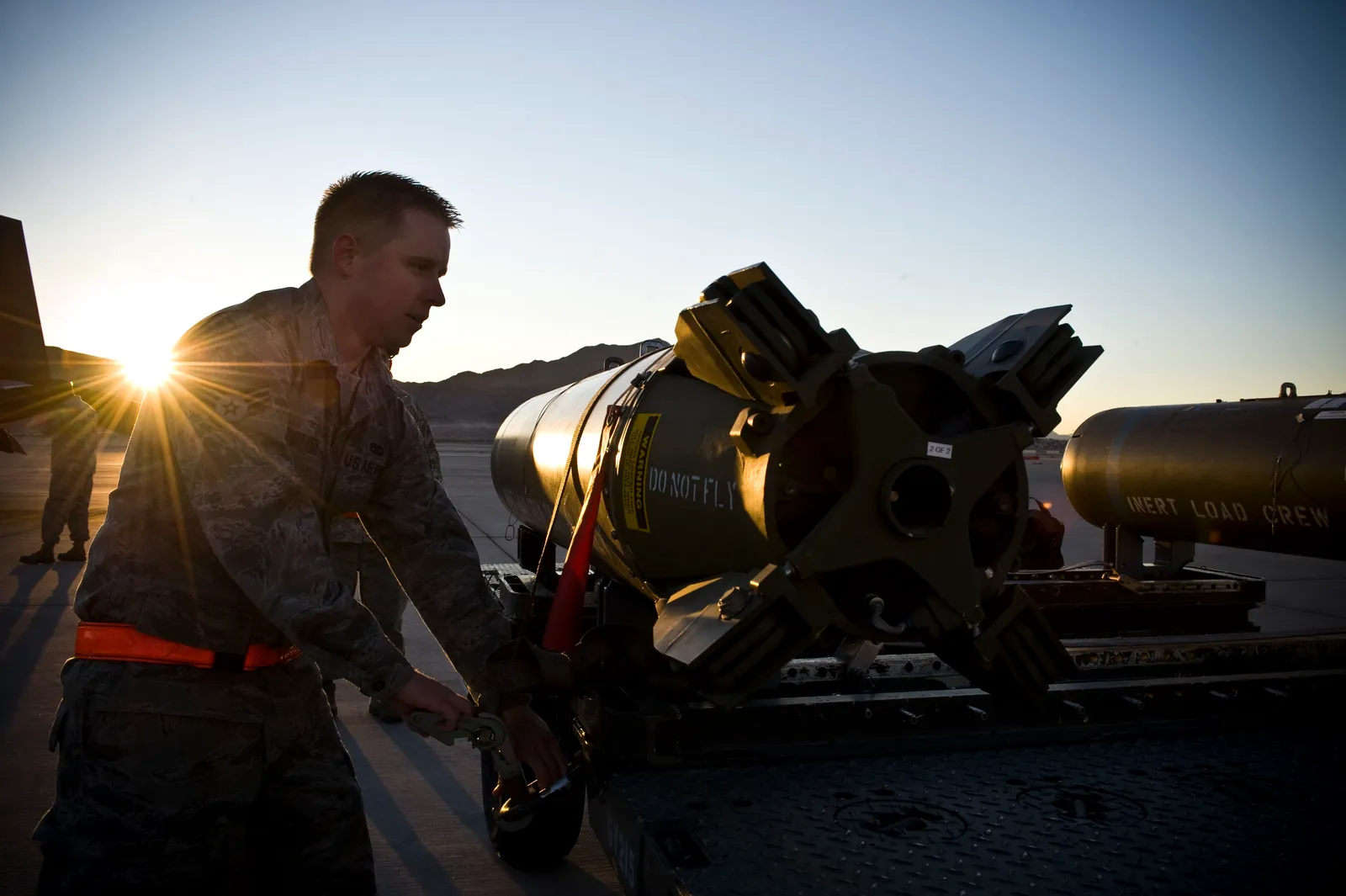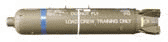
- Side
- Coalition forces

GAO and Human Rights Watch sources document U.S. Air Force employment of 1,105 CBU-89 Gator systems during the 1990 Gulf War, dispersing BLU-91 antitank and BLU-92 antipersonnel mines in Kuwait and Iraq.
Role detailsThe CBU-89 Gator mine is a U.S. Air Force air-delivered scatterable mine cluster munition that uses the SUU-64/B Tactical Munitions Dispenser to lay mixed antitank and antipersonnel minefields. GAO and Human Rights Watch sources document its 1990 Gulf War employment, while reference sources describe a 1,000-pound-class weapon carrying 72 BLU-91/B antitank mines, 22 BLU-92/B antipersonnel mines, and an optional FZU-39 proximity sensor.
GAO and Human Rights Watch sources document U.S. Air Force employment of 1,105 CBU-89 Gator systems during the 1990 Gulf War, dispersing BLU-91 antitank and BLU-92 antipersonnel mines in Kuwait and Iraq.
Role detailsThe CBU-89 is best read as a dispenser for a mixed minefield, not as a unitary bomb. Its payload combines antiarmor and antipersonnel effects, and conflict-use claims should identify whether a source documents the CBU-89 dispenser itself or only Gator-family submunitions.
| Question | Supported reading | Source |
|---|---|---|
| What did a 1990 Gulf War CBU-89 release contain? | GAO counted 79,560 BLU-91 antitank mines and 24,310 BLU-92 antipersonnel mines from 1,105 CBU-89 systems. | GAO 1990 Gulf War land mines |
| What does the antitank mine do? | GlobalSecurity describes the BLU-91/B as the Gator system's antitank mine, using electronics to detect armored vehicles and fire when a target reaches a vulnerable point. | CBU-89 Gator Mine |
| What is the antipersonnel component? | Human Rights Watch identifies the BLU-92/B antipersonnel mine as part of the Air Force CBU-89/B payload. | HRW Ticking Time Bombs |
| Why not list 2026 Iran as CBU-89 conflict use? | Bellingcat identified BLU-91/B Gator antitank mines in Iran, but the available imagery did not establish whether the dispenser was a CBU-89, CBU-78, or another Gator-compatible system. | Bellingcat Gator mine identification |
The baseline CBU-89/B is the unguided Air Force Gator dispenser. The CBU-104 combines the same Gator mine payload with a Wind-Corrected Munitions Dispenser tail kit.
| Variant | Configuration | Designation notes |
|---|---|---|
 | WCMD-equipped Gator dispenser | Air Force Magazine lists the CBU-104 as the wind-corrected version of the CBU-89 Gator, with the same 72 BLU-91 and 22 BLU-92 mine payload. Sources: Air Force Magazine CBU-89/104 Gator |
The B-1B fact sheet lists CBU-87/89 cluster munitions among the bomber's internal weapons-bay loads.
| Carrier | Carrier type | Carriage evidence |
|---|---|---|
 | Long-range bomber | The B-1B fact sheet says the bomber can carry CBU-87/89 cluster munitions in its internal weapons bays. Sources: B-1B Lancer |
Reference sources describe the Gator mine as a 1,000-pound class munition built around a tactical munitions dispenser and a mixed mine payload.
| Component | Detail | Source |
|---|---|---|
| Dispenser | SUU-64/B Tactical Munitions Dispenser. | CBU-89 Gator Mine |
| Antitank mines | 72 BLU-91/B mines. | CBU-89 Gator Mine |
| Antipersonnel mines | 22 BLU-92/B mines. | CBU-89 Gator Mine |
| Proximity sensor | Optional FZU-39 proximity sensor. | DVIDS Weapons Systems Almanac |
| Wind-corrected derivative | CBU-104 uses the CBU-89 Gator payload with a WCMD tail kit. | Air Force Magazine CBU-89/104 Gator |
GAO reported U.S. use of 1,105 CBU-89 Gator systems during the 1991 1990 Gulf War, accounting for 79,560 BLU-91 antitank mines and 24,310 BLU-92 antipersonnel mines.
Sources: GAO 1990 Gulf War land mines
Forecast International identifies Alliant Techsystems as prime contractor for the CBU-89/B program and lists the production timetable as 1992-1997.
Sources: Forecast International CBU-89/B
Air Force Magazine listed the CBU-89/104 Gator as an air-to-surface mine system and described the CBU-104 as the wind-corrected version of the CBU-89.
Sources: Air Force Magazine CBU-89/104 Gator
Bellingcat reported visual evidence of BLU-91/B Gator antitank mines in Iran but noted that the exact dispenser system could not be identified from available imagery.
Sources: Bellingcat Gator mine identification