 Iranian mine-laying vesselMine-laying vesselSide: IranBuilt: Unknown; Iranian state conversion of civilian or auxiliary hulls / IranIranian mine-laying vessels are small auxiliaries or converted hulls configured to seed naval mines in the Strait of Hormuz and nearby waters. During the United States-Iran Conflict, U.S. officials said CENTCOM was hunting and striking Iranian mine-laying vessels and mine-storage facilities as part of Operation Epic Fury, making mine warfare a visible part of the maritime campaign.
Tag archive
mine warfare Weapon Systems
Weapon systems and military equipment tagged mine warfare.
19 weapon systemsCategory
Aircraft & UAVs
Crewed aircraft, drones, and loitering munitions.
Iranian mine-laying vesselMine-laying vesselSide: IranBuilt: Unknown; Iranian state conversion of civilian or auxiliary hulls / IranIranian mine-laying vessels are small auxiliaries or converted hulls configured to seed naval mines in the Strait of Hormuz and nearby waters. During the United States-Iran Conflict, U.S. officials said CENTCOM was hunting and striking Iranian mine-laying vessels and mine-storage facilities as part of Operation Epic Fury, making mine warfare a visible part of the maritime campaign. Iranian small attack boatsSmall attack boat / fast attack craftSide: IranBuilt: Unknown; Iranian military and commercial boat builders / IranIranian small attack boats are the Islamic Revolutionary Guard Corps Navy's fast-boat and swarm force for harassment, mine-laying, and littoral attack in the Strait of Hormuz. In the United States-Iran Conflict, U.S. and Iranian reporting documented these boats as part of attacks on U.S. Navy destroyers transiting the strait.
 Iranian submarinesSubmarine forceSide: IranBuilt: Russian Admiralty Shipyards, Shahid Darvishi Industries, and Iranian Marine Industries Organization / Russia and IranIranian submarines are the Islamic Republic's mixed diesel-electric submarine force, combining Russian-built Kilo boats with domestically built Fateh, Ghadir, and other mini-submarine classes. The fleet is centered on Bandar Abbas and the Strait of Hormuz, where it supports sea-denial, mine-laying, and anti-ship strike missions; in the United States-Iran Conflict, CENTCOM said Operation Epic Fury damaged or destroyed Iranian Navy ships and submarines.
Category
Armored Vehicles
Troop carriers, infantry fighting vehicles, and protected mobility.
 Weaponized civilian bulldozer or front loaderCombat engineering bulldozer/front loaderSide: IsraelBuilt: Caterpillar and other construction-equipment makers / United StatesCivilian bulldozers and front loaders, especially Caterpillar D9-class machines, were adapted for Israeli combat engineering in Gaza during the Israel-Hamas War. The vehicles were used to clear routes, remove obstacles, and level or demolish terrain, turning ordinary earthmoving equipment into front-line battlefield engineering assets.
 Puma armored engineering vehicleCombat engineering vehicleSide: IsraelBuilt: IDF Ordnance / IsraelThe Puma is an Israeli heavy combat engineering vehicle on a Centurion/Sho't hull, built to move combat engineers under armor while breaching obstacles and clearing routes. During the Israel-Hamas War, IDF engineering units used it in Gaza operations, including a Khan Yunis incident documented by the IDF and Israeli press.
Category
Artillery
Tube artillery, rocket artillery, and long-range ground fires.

Category
Infantry Weapons
Portable weapons used by soldiers and small units.
 TC/6 anti-tank mineAnti-tank blast mineSide: HamasBuilt: Tecnovar Italiana SpA / ItalyThe TC/6 is an Italian plastic-cased, pressure-activated minimum-metal anti-tank blast mine. In the Israel-Hamas War, AP reported that weapons recovered from Hamas fighters by the Israel Defense Forces appeared to include TC/6 mines, making the design visible in Gaza conflict reporting even though open-source identification cannot rule out Iranian copies.
 MON-series anti-personnel mineDirectional fragmentation anti-personnel mine familySide: Armenia / ArtsakhBuilt: Soviet state arsenals; Russian and post-Soviet producers / Soviet Union / RussiaThe MON series is a Soviet/Russian family of directional fragmentation anti-personnel mines, including MON-50, MON-90, MON-100, and MON-200 patterns that project preformed fragments across a defined sector. In the Nagorno-Karabakh context, direct postwar reporting identifies MON-50 finds rather than every family member, so this entry records the series cautiously as MON-family mine warfare evidence tied to Armenian/Artsakh defensive mining and later clearance.
 Building booby-trap improvised explosive deviceImprovised explosive deviceSide: HamasBuilt: Hamas and other Gaza-based militants / Palestinian territoriesBuilding booby-trap improvised explosive devices in the Israel-Hamas War were improvised, victim-activated traps hidden in homes and other structures to slow clearing forces and threaten troops moving through doors, stairwells, rooms, and rubble in Gaza.
 Explosively formed penetrator improvised explosive deviceImprovised explosive deviceSide: Hamas / Houthi-aligned forcesBuilt: Izz ad-Din al-Qassam Brigades / Gaza Strip, Palestinian territoriesThis Hamas-linked explosively formed penetrator improvised explosive device is a locally made anti-armor charge built around a concave copper liner. During the Israel-Hamas War, IDF seizures in Gaza and press briefings tied Shawaz EFP variants to Hamas's armored-vehicle threat and October 7 attack kits.
 Magnetic or sticky anti-vehicle bombImprovised explosive deviceSide: HamasBuilt: Hamas and other Gaza-based militant cells / Palestinian territoriesMagnetic or sticky anti-vehicle bombs are improvised explosive devices that are manually attached to armored vehicles so the blast lands at close range. In the Israel-Hamas War, reporting from Khan Younis described Hamas using a sticky bomb against an Israeli tank, showing how the device fits urban anti-armor ambushes in Gaza.
 Radio-controlled improvised explosive deviceImprovised explosive deviceSide: Houthi-aligned forcesBuilt: Houthi forces / YemenRadio-controlled improvised explosive devices are improvised bombs detonated by a radio-frequency command link rather than by victim contact. In the Yemen Civil War, Conflict Armament Research documented Houthi-used RCIEDs and described domestically produced devices recovered on Yemen's west coast, placing the system within the conflict's roadside-bomb threat.
 Tunnel-Entrance Booby-Trap Improvised Explosive DeviceImprovised explosive deviceSide: HamasBuilt: Hamas / Gaza StripThis Hamas-improvised explosive device was used to booby-trap tunnel entrances in Gaza during the Israel-Hamas War, making underground access hazardous for combat engineers and assault troops.
 TS-50 anti-personnel mineMinimum-metal blast anti-personnel mineSide: Armenia / ArtsakhBuilt: Tecnovar Italiana SpA / ItalyThe TS-50 is an Italian minimum-metal blast anti-personnel mine built around a small pressure-actuated plastic body. In the Nagorno-Karabakh archive it represents legacy mine-warfare contamination: Landmine Monitor identified Italian TS-50 mines among commonly used mines from the earlier fighting, while later mine-action reporting shows legacy minefields remained a clearance issue after the 2020 war.
 Iranian naval minesNaval mine familySide: IranBuilt: Iranian defense industry and IRGC-linked ordnance production / IranIranian naval mines are a mixed family of contact, influence, limpet, bottom, and rising sea mines tied to the IRGC Navy's Strait of Hormuz denial posture. In the United States-Iran Conflict, U.S. Central Command said Iranian mines in the strait forced mine-clearance operations, showing how even a small minefield can threaten shipping and naval access.
.jpg?width=480) POMZ-2Stake-mounted antipersonnel fragmentation mineSide: Armenia / ArtsakhBuilt: Soviet state arsenals and licensed or copied producers / Soviet UnionThe POMZ-2 is a Soviet stake-mounted antipersonnel fragmentation mine built around a serrated cast-iron body, TNT charge, and pull-fuze tripwire. In the Nagorno-Karabakh context it appears as part of the Soviet-leftover antipersonnel mine stocks reported by Nagorno-Karabakh authorities, with broader defensive mine use documented along the line of contact with Azerbaijan.
POMZ-2Stake-mounted antipersonnel fragmentation mineSide: Armenia / ArtsakhBuilt: Soviet state arsenals and licensed or copied producers / Soviet UnionThe POMZ-2 is a Soviet stake-mounted antipersonnel fragmentation mine built around a serrated cast-iron body, TNT charge, and pull-fuze tripwire. In the Nagorno-Karabakh context it appears as part of the Soviet-leftover antipersonnel mine stocks reported by Nagorno-Karabakh authorities, with broader defensive mine use documented along the line of contact with Azerbaijan. Surface-laid landmineSurface-laid mineSide: HamasBuilt: Various manufacturers / MultipleSurface-laid landmines are explosive mines emplaced on or near the ground surface for route denial, perimeter defense, and channelization. In the Israel-Hamas War, reports said Hamas laid mines in Gaza, and analysts described some of them as surface-laid and easier to detect and remove than buried mines.
Category
Munitions
Standalone missiles, bombs, rockets, torpedoes, and guided or unguided explosive payloads.
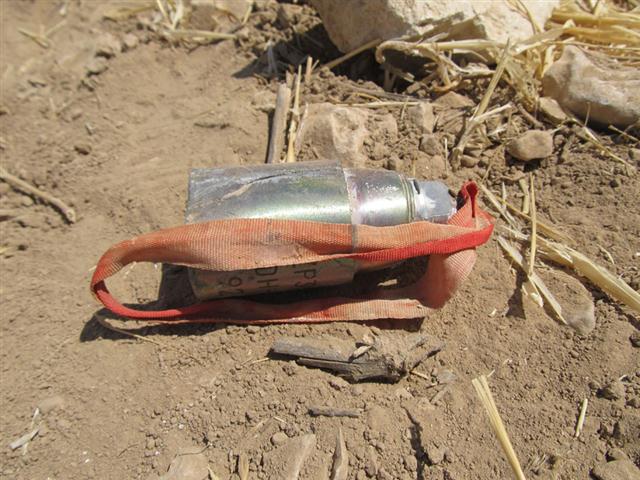 ZP-39 submunitionDual-purpose improved conventional munition submunitionSide: Yemeni government and coalition forcesBuilt: Unknown / UnknownThe ZP-39 is an unidentified dual-purpose improved conventional munition submunition associated with ground-fired cluster munitions. In Yemen, Human Rights Watch identified ZP-39 remnants after an April 2015 Baqim incident in Saada governorate, while noting that the producer, country of origin, and delivery system were not publicly known.
 Sea mineNaval mineSide: Houthi-aligned forcesBuilt: Various manufacturers / MultipleSea mines are explosive naval weapons laid in water to damage ships and submarines. In the Yemen Civil War, Houthi-aligned forces used sea mines in the Red Sea and around Bab el-Mandeb to threaten fishing boats and commercial shipping lanes.