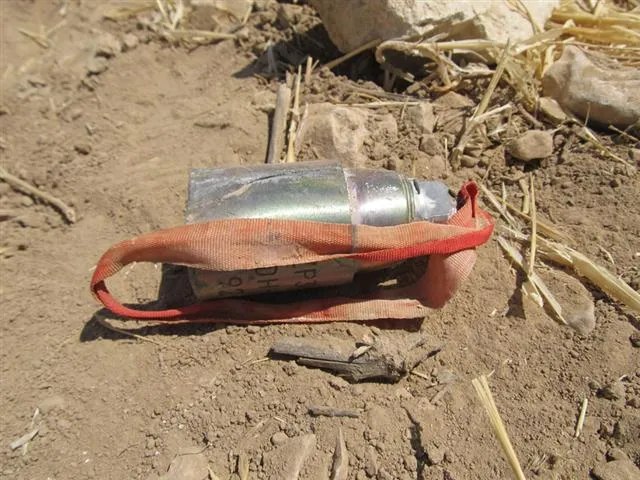

Human Rights Watch said photographs and local Kurdish information strongly indicated Islamic State forces used ZP-39 submunitions in attacks near Ayn al-Arab/Kobani in July and August 2014; HRW identified red-ribbon ZP-39 remnants at Cevi while noting the producer, acquisition route, and delivery system were unknown.
Role detailsMunitions
ZP-39 submunition
Also known as
- ZP 39
- ZP39
- ZP-39 DPICM
- ZP-39 DPICM submunition
- ZP39A
- ZP39A submunition
The ZP-39 is an unidentified dual-purpose improved conventional munition submunition associated with ground-fired cluster munitions and a red ribbon arming or stabilizing component. Human Rights Watch connected ZP-39 remnants to Islamic State attacks near Kobani in Syria and to an April 2015 Baqim incident in Yemen, while repeatedly noting that the producer, country of origin, and exact delivery system were not publicly known.
Role in Conflicts

Human Rights Watch identified ZP-39 DPICM submunitions after an April 29, 2015 incident near Baqim in Saada governorate; the attack occurred in Houthi-controlled territory, and HRW said the evidence suggested Saudi forces fired them but did not conclusively determine responsibility.
Role detailsProfile / Specs
Profile
- Origin
- Unknown
- Built by
- Unknown
- Type
- Dual-purpose improved conventional munition submunition
- Service note
- Documented in recent conflicts by 2014-2015
- Designer
- Unknown
- Designed
- Unknown
- Produced
- Unknown
- Number built
- Unknown
Specifications
- Munition class
- Dual-purpose improved conventional munition (DPICM) submunition
- Delivery method
- Ground-fired artillery projectile or rocket; exact carrier not publicly identified
- Arming method
- Spin-armed submunition using a stabilizing ribbon; CAT-UXO describes a ribbon-driven firing-pin and detonator-slider mechanism
- Effects
- Dual-purpose anti-armor, anti-personnel, and anti-materiel effects reported by METIS for the ZP39A designation
- Visible identifier
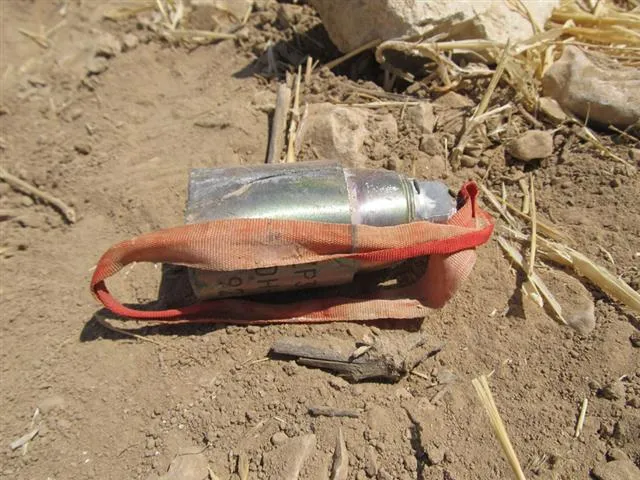
- Small cylindrical submunition associated with a distinctive red ribbon
- Reported markings
- HRW reported photographed ZP-39 markings from Syria showing 1992 and 1993 manufacture dates
- Known Yemen location
- Baqim, Saada governorate, 29 April 2015
Identification Notes
The ZP-39 record is unusually narrow: public sources identify the submunition and its red-ribbon arming feature more clearly than they identify the parent munition, manufacturer, or transfer route.
Designation
HRW and the Monitor use ZP-39 for the DPICM-like red-ribbon submunition; CAT-UXO also lists the designation ZP39A.
Carrier
HRW says a ground-fired artillery projectile or rocket would provide the spin needed to arm this DPICM type, but the exact carrier remains unidentified.
Visible cue
The red nylon ribbon is a useful visual clue because public reporting links it to the arming or stabilizing mechanism seen on photographed ZP-39 remnants.
Variants
Open sources use ZP-39 for the HRW and Monitor designation, while CAT-UXO and METIS use ZP39A for what appears to be the same or a closely related red-ribbon DPICM/HEDP submunition. No public manufacturer document confirming a formal variant split was found.
| Variant | Configuration | Designation notes |
|---|---|---|
| ZP39A | Reported alternate designation | CAT-UXO and METIS list the item as ZP39A, while HRW and Cluster Munition Monitor use ZP-39; the catalog keeps origin and manufacturer unknown because the strongest conflict-use sources do not identify them. Sources: CAT-UXO ZP39A Submunition, METIS ZP39A Submunition, Syria: Evidence of Islamic State Cluster Munition Use, Syria Cluster Munition Ban Policy |
Timeline
ZP-39 submunition Key Events
Manufacture-date markings reported
Human Rights Watch reported ZP-39 markings in Syrian imagery showing 1992 manufacture dates, and noted other reported Syria videos of the same type with 1993 markings.
Sources: Syria: Evidence of Islamic State Cluster Munition Use
Kobani cluster-munition allegation reviewed
Bellingcat reviewed Kurdish reporting and images from the Ayn al-Arab/Kobani area and identified the red-ribbon submunition as the type then known as ZP-39.
Sources: Accusations of Cluster Munition Use by the Islamic State in Kurdish Syria
HRW identifies ZP-39 in Syria
Human Rights Watch said photographs and local information strongly indicated Islamic State use of ZP-39 submunitions near Kobani, including remnants photographed outside Cevi.
Sources: Syria: Evidence of Islamic State Cluster Munition Use
Baqim incident in Yemen
Human Rights Watch later listed a Baqim, Saada attack on April 29, 2015 as an unknown cluster-munition delivery event involving ZP-39 DPICM submunitions.
Sources: Technical Briefing Note: Cluster Munition Use in Yemen
Yemen technical briefing published
HRW's Yemen briefing separated ZP-39 from other air-dropped and ground-launched cluster munitions because both the country of origin and delivery system remained unidentified.
Sources: Technical Briefing Note: Cluster Munition Use in Yemen
Related Weapon Systems




Sources
Yemen: Cluster Munitions Harm CiviliansPublisher: Human Rights Watch | Note: Supports 2014 Yemen Civil War direct-use context: ZP-39 submunitions were used by the assessed coalition side near Baqim, while HRW stated responsibility was suggested but not conclusive; also supports unknown producer and delivery-system limits. | Accessed: 2026-06-20Technical Briefing Note: Cluster Munition Use in YemenPublisher: Human Rights Watch | Note: Supports 2014 Yemen Civil War direct-use context: ZP-39 DPICM submunitions were used by the assessed coalition side at Baqim on 29 April 2015, with the delivery system and country of origin listed as unknown. | Accessed: 2026-06-20Yemen Cluster Munition Ban PolicyPublisher: Cluster Munition Monitor | Note: Supports 2014 Yemen Civil War direct-use context: the Saudi Arabia-led coalition used cluster munitions in Yemen, including an unknown-delivery-system ZP-39 DPICM attack at Baqim on 29 April 2015. | Accessed: 2026-06-20Syria Cluster Munition Ban PolicyPublisher: Cluster Munition Monitor | Note: Supports 2011 Syrian Civil War direct-use context: the Monitor says Islamic State forces used an unknown rocket-fired cluster munition in 2014 that dispersed red-ribbon ZP-39 submunitions. | Accessed: 2026-07-01Syria: Evidence of Islamic State Cluster Munition UsePublisher: Human Rights Watch | Note: Supports 2011 Syrian Civil War direct-use context: HRW said Islamic State forces used ZP-39 submunitions near Ayn al-Arab/Kobani and identified red-ribbon ZP-39 remnants at Cevi; also supports unknown producer, unknown delivery system, markings, and spin-armed DPICM behavior. | Accessed: 2026-07-01Accusations of Cluster Munition Use by the Islamic State in Kurdish SyriaPublisher: Bellingcat | Note: Supports 2011 Syrian Civil War background context for Kurdish reports near Ayn al-Arab/Kobani and ZP-39 identification from red-ribbon submunition imagery; images are used as limited reference imagery because rights-clear ZP-39 media was not found. | Accessed: 2026-07-01CAT-UXO ZP39A SubmunitionPublisher: CAT-UXO | Note: Supports alternate ZP39A designation and secondary technical background on the red-ribbon firing-pin and detonator-slider arming mechanism; source is used for component context, not for origin attribution. | Accessed: 2026-07-01METIS ZP39A SubmunitionPublisher: Fenix Insight | Note: Supports the ZP39A alternate designation and dual-purpose HE-fragmentation and shaped-charge effects; the catalog keeps origin unknown because NGO and Monitor conflict-use sources do not identify a manufacturer or country of origin. | Accessed: 2026-07-01Air Strikes and Cluster Munitions AttacksPublisher: Amnesty International | Note: Supports 2014 Yemen Civil War direct-use context: Amnesty documented Saada civilian encounters with cylindrical red-ribbon submunitions that it assessed as ZP-39 DPICM used in Yemen. | Accessed: 2026-06-20