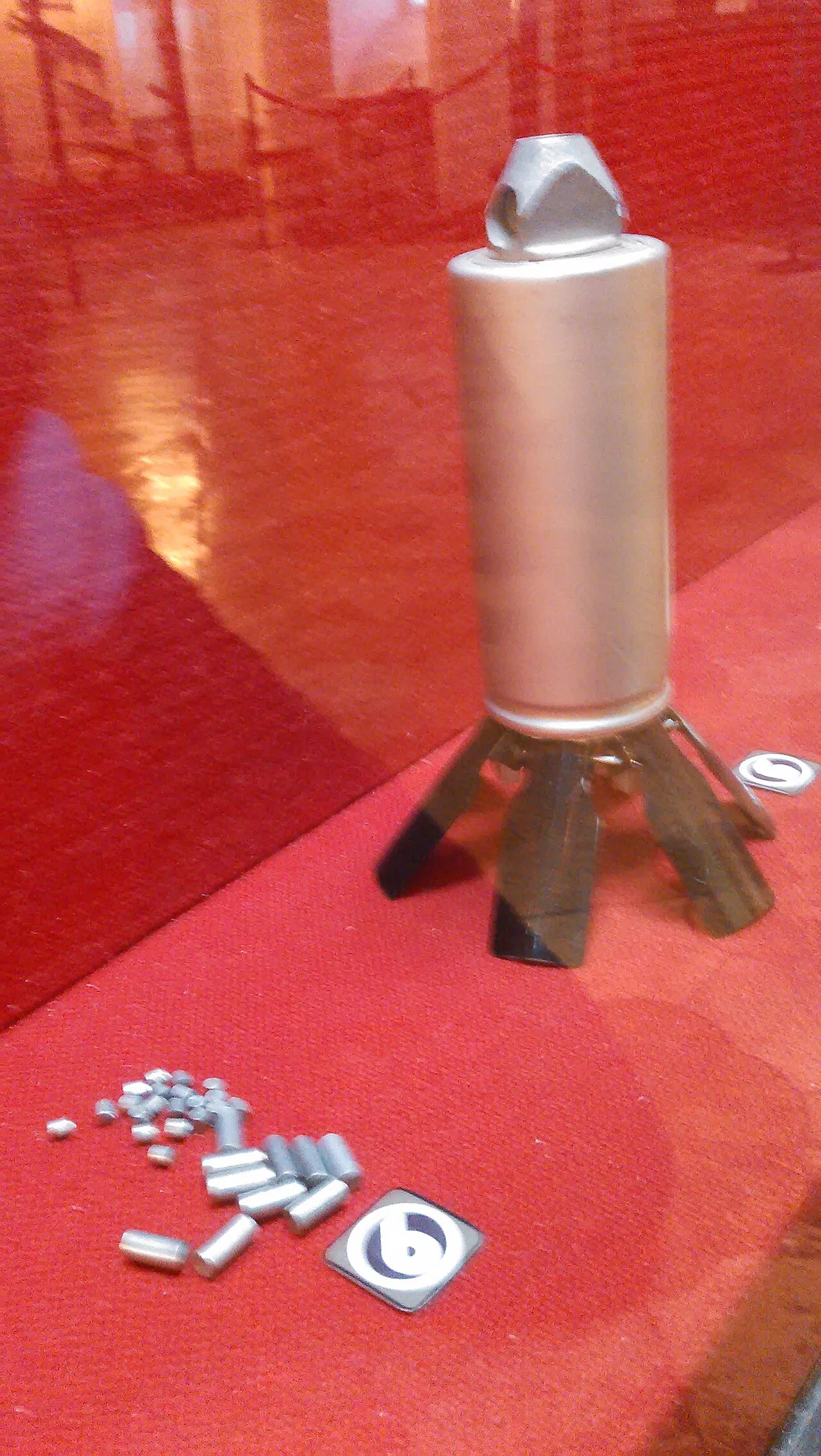

ARES documented 9M55K cargo-rocket remnants and an unexploded 9N235 submunition near Kafr Zita in February 2014, while noting uncertainty over how the rockets and launchers reached Syria.
Role detailsMunitions
9N235 cluster submunition
Also known as
- 9N235
- 9H235
- 9N235 fragmentation submunition
- 9N235 bomblet
- 9N235 Smerch submunition
- 9N235 Uragan submunition
The 9N235 is a Soviet/Russian fin-stabilized high-explosive fragmentation submunition dispersed by Smerch and Uragan cargo rockets. Open-source ordnance investigations and humanitarian monitors document it in Syria, Ukraine, and the 2020 Nagorno-Karabakh war, where it appears as an area-effect rocket-artillery payload rather than a standalone fired weapon.
Role in Conflicts


ARES, Human Rights Watch, and Bellingcat reporting document 9N235 or 9N210/9N235 submunitions from Smerch and Uragan cargo rockets in Ukraine, including 2014-2015 use and Russian attacks after the February 2022 escalation.
Role details
Human Rights Watch identified 9N235 fragmentation submunitions in 9M55K Smerch cluster rockets and found evidence that Armenian and/or Nagorno-Karabakh forces used those rockets in attacks on Azerbaijani locations during the 2020 war.
Profile / Specs
Profile
- Origin
- Soviet Union / Russia
- Built by
- NPO Splav
- Type
- High-explosive fragmentation cluster submunition
- Service note
- Late Cold War to present rocket-artillery service
- Designer
- Soviet defense industry
- Designed
- Late Soviet period
- Produced
- Soviet and Russian production
Specifications
- Munition class
- Fin-stabilized high-explosive fragmentation submunition
- Length
- 263 mm
- Diameter
- 65 mm
- Weight
- About 1.75 kg
- Explosive filler
- About 312 g A-IX-10 explosive composition
- Fragments
- About 96 fragments of 4.5 g and 360 fragments of 0.75 g
- Fuze
- 9E272 impact fuze with self-destruct mechanism
- Stabilization
- Six folding fins after ejection from the cargo rocket
- Carrier rockets
- 72 carried by a 300 mm 9M55K Smerch rocket; 30 carried by a 220 mm 9M27K1 Uragan rocket
Identification Notes
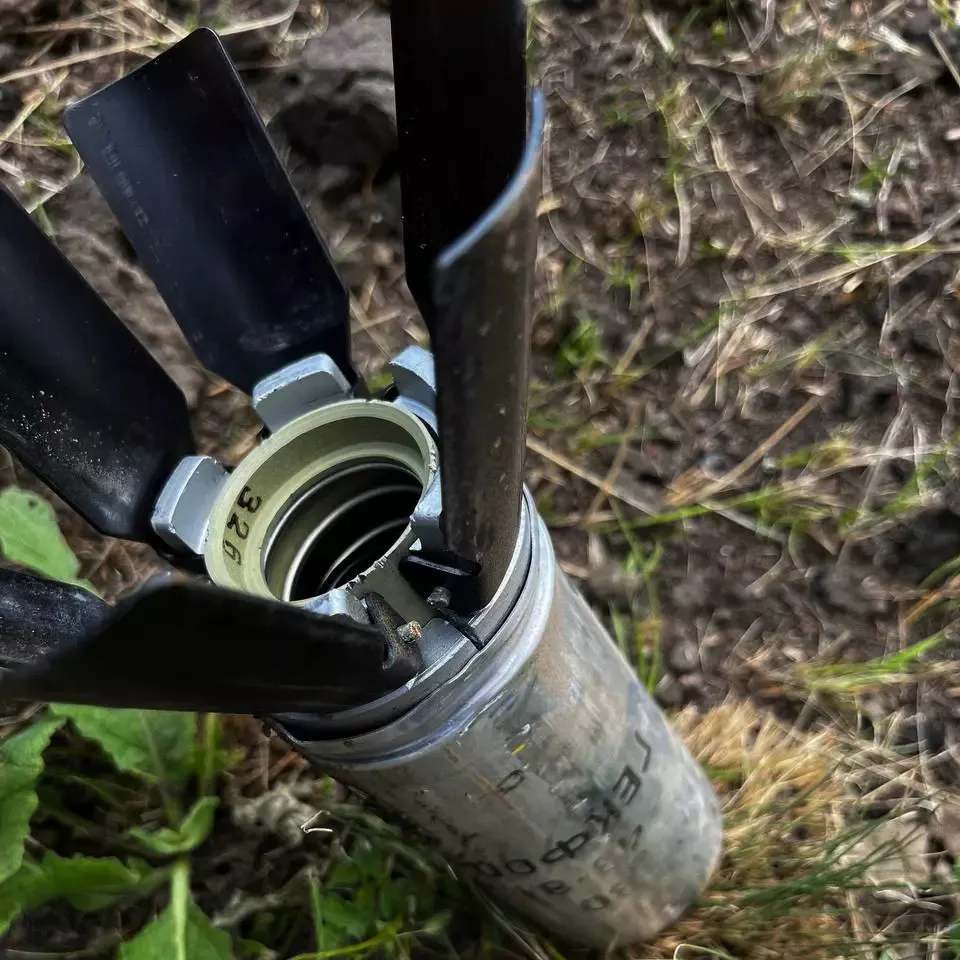
The 9N235 is usually identified from submunition markings, cargo-rocket remnants, or the rocket type documented at the scene. Because the 9N210 and 9N235 are visually similar, several Ukraine sources report the pair together unless markings allow a narrower identification.
Field identification
ARES documents markings and carrier-rocket context as key evidence for distinguishing 9N235 from the similar 9N210.
Payload role
The submunition disperses fragmentation over an area after release from cargo rockets rather than being aimed or fired independently.
Unexploded hazard
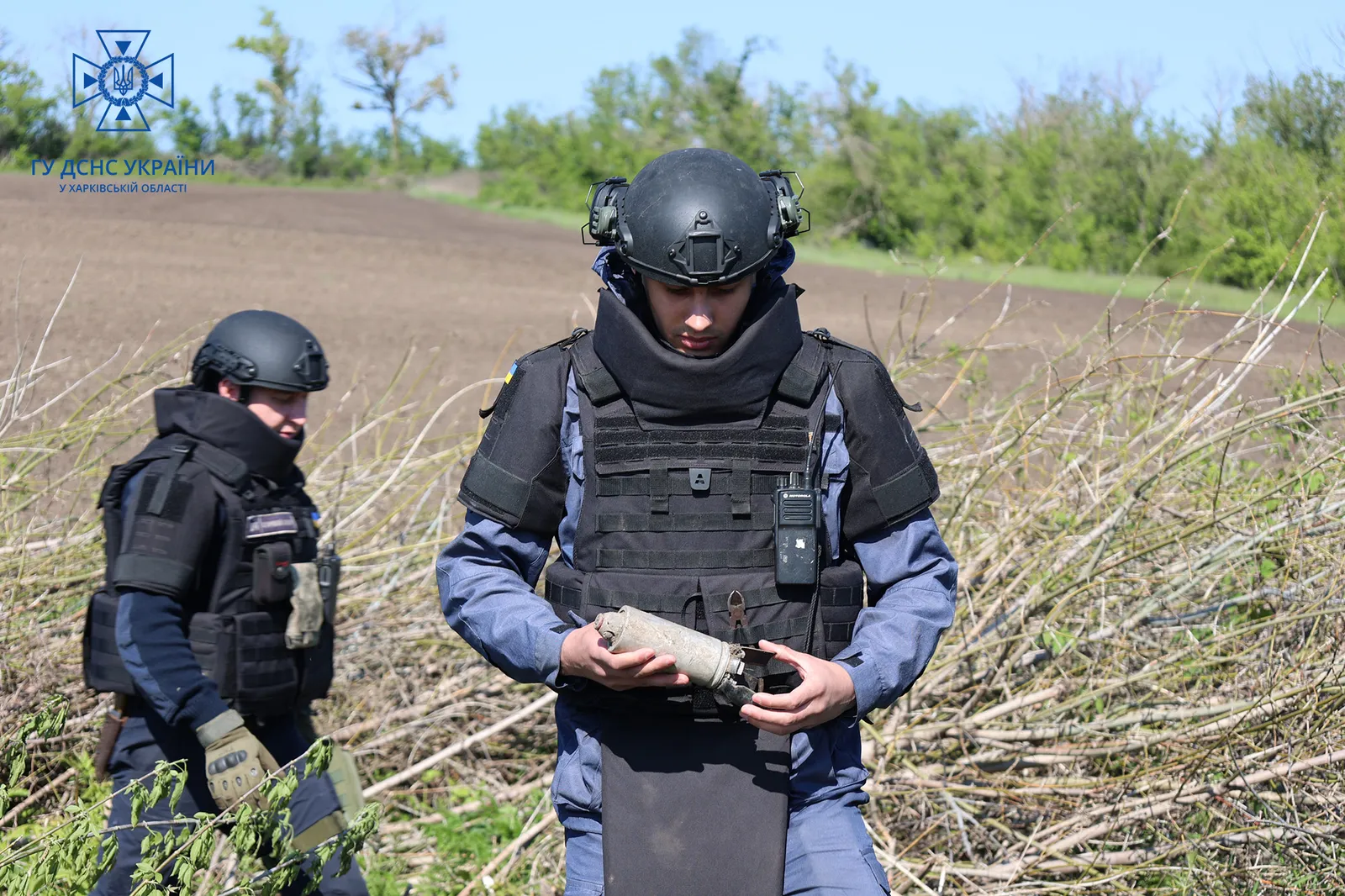
Human Rights Watch and demining image sources document unexploded 9N210/9N235-category bomblets in Ukraine-war cleanup contexts.
Sources: ARES Russian 9N235 in Ukraine 2022; CAT-UXO 9N235 submunition; HRW Ukraine cluster munition technical note.
Variants
Open-source ordnance references often discuss 9N235 together with the externally similar 9N210; visible markings and carrier-rocket context are important for precise field identification.
| Variant | Configuration | Designation notes |
|---|---|---|
| 9N210 fragmentation submunition | Externally similar companion submunition | CAT-UXO and ARES distinguish 9N235 from the similar 9N210, and Ukraine-war reporting often groups them unless markings or other identifying features are visible. Sources: CAT-UXO 9N235 submunition, ARES Russian 9N235 in Ukraine 2022 |
Carrier Rockets
The 9N235 is documented as a submunition carried by 300 mm Smerch-family and 220 mm Uragan cargo rockets.
| Carrier | Carrier type | Carriage evidence |
|---|---|---|
 | 300 mm cargo rocket | ARES, Human Rights Watch, and Rosoboronexport-derived technical data identify the 9M55K as a Smerch cargo rocket carrying 72 9N235 fragmentation submunitions. Sources: ARES 9M55K and 9N235 in Syria, ARES 9M55K and 9N235 in Ukraine, HRW Karabakh cluster munition technical note |
 | 220 mm cargo rocket | ARES and Human Rights Watch identify the 9M27K1 as a 220 mm Uragan cargo rocket that carries 30 9N235 or 9N210/9N235 submunitions. Sources: ARES 9M27K series in Ukraine, HRW Ukraine cluster munition technical note |
Timeline
9N235 cluster submunition Key Events
9N235 evidence documented in Syria
ARES documented 9M55K cargo-rocket remnants and a nearby unexploded 9N235 submunition around Kafr Zita.
Sources: ARES 9M55K and 9N235 in Syria
Ukraine 9M55K evidence reported
ARES reported likely 9M55K cargo-rocket use near Kramatorsk and described the rocket's 9N235 payload.
Sources: ARES 9M55K and 9N235 in Ukraine
Karabakh technical note identifies 9N235
Human Rights Watch published a technical note identifying 9N235 submunitions from 9M55K Smerch rockets in the 2020 Nagorno-Karabakh conflict.
Sources: HRW Karabakh cluster munition technical note
Civilian documentation in Ukraine assessed
Bellingcat identified 9M55K and 9M27K cluster rockets with 9N210 or 9N235 submunitions among cluster munitions documented by Ukrainian civilians after the full-scale invasion.
Sources: Bellingcat Ukraine cluster munitions
Media
9N235 cluster submunition Videos
9N235 cluster submunition Images
Related Weapon Systems


Sources
ARES 9M55K and 9N235 in SyriaPublisher: Armament Research Services | Note: Directly supports 2011 Syrian Civil War use by documenting 9M55K cargo-rocket remnants and an unexploded 9N235 submunition around Kafr Zita; also supports 9M55K carrier context and the selected Armament Research video. | Accessed: 2026-07-04ARES 9M55K and 9N235 in UkrainePublisher: Armament Research Services | Note: Directly supports 2014 Russia-Ukraine War use by reporting likely 9M55K cargo rockets with 9N235 fragmentation submunitions near Kramatorsk in 2014, while noting attribution limits. | Accessed: 2026-07-04ARES Russian 9N235 in Ukraine 2022Publisher: Armament Research Services | Note: Directly supports 2014 Russia-Ukraine War use by documenting 9N235-marked submunitions employed by Russian forces in Ukraine in 2022; also supports technical background, carrier-rocket context, dimensions, filler, fragments, fuze details, and the 9N210/9N235 identification distinction. | Accessed: 2026-07-04ARES 9M27K series in UkrainePublisher: Armament Research Services | Note: Supports the 9N235's relationship to 9M27K1 Uragan cargo rockets and the 30-submunition carrier-rocket context. | Accessed: 2026-07-04HRW Ukraine cluster munition technical notePublisher: Human Rights Watch | Note: Supports the 9N235's carriage by 9M27K1 Uragan cargo rockets and the 30-submunition cargo-rocket context. | Accessed: 2026-07-04HRW Kharkiv cluster munition attacksPublisher: Human Rights Watch | Note: Directly supports 2014 Russia-Ukraine War use by reporting 9M55K-series Smerch cluster rocket use in Kharkiv after the February 2022 escalation and describing the 9N235-payload rocket family. | Accessed: 2026-07-04Bellingcat Ukraine cluster munitionsPublisher: Bellingcat | Note: Directly supports 2014 Russia-Ukraine War use by identifying 9M55K and 9M27K cluster rockets with 9N210 or 9N235 submunitions among cluster munitions documented in Ukraine after February 2022. | Accessed: 2026-07-04HRW Karabakh cluster munition technical notePublisher: Human Rights Watch | Note: Directly supports 2020 Nagorno-Karabakh Conflict use: 9N235 submunitions were used by Armenian and/or Nagorno-Karabakh forces in 9M55K Smerch cluster rockets during the 2020 conflict; also identifies Splav as the state-owned manufacturer for the Smerch rocket. | Accessed: 2026-07-04CAT-UXO 9N235 submunitionPublisher: CAT-UXO | Note: Supports ordnance identification background and the distinction between 9N235 and externally similar 9N210 submunitions. | Accessed: 2026-07-04Commons 9N235 cassette imagePublisher: Wikimedia Commons | Note: Supports image provenance for the primary 9N235 gallery image; file page lists own work by Andrey Khokhlushin under CC BY-SA 4.0. | Accessed: 2026-07-04Commons Mykolaiv cluster bomblet imagePublisher: Wikimedia Commons | Note: Supports image provenance for a 9N210/9N235-category cluster bomblet image from the State Emergency Service of Ukraine under CC BY 4.0. | Accessed: 2026-07-04Commons Kharkiv demining imagePublisher: Wikimedia Commons | Note: Supports image provenance for a 9N210/9N235-category cluster munition image from the State Emergency Service of Ukraine under CC BY 4.0. | Accessed: 2026-07-04