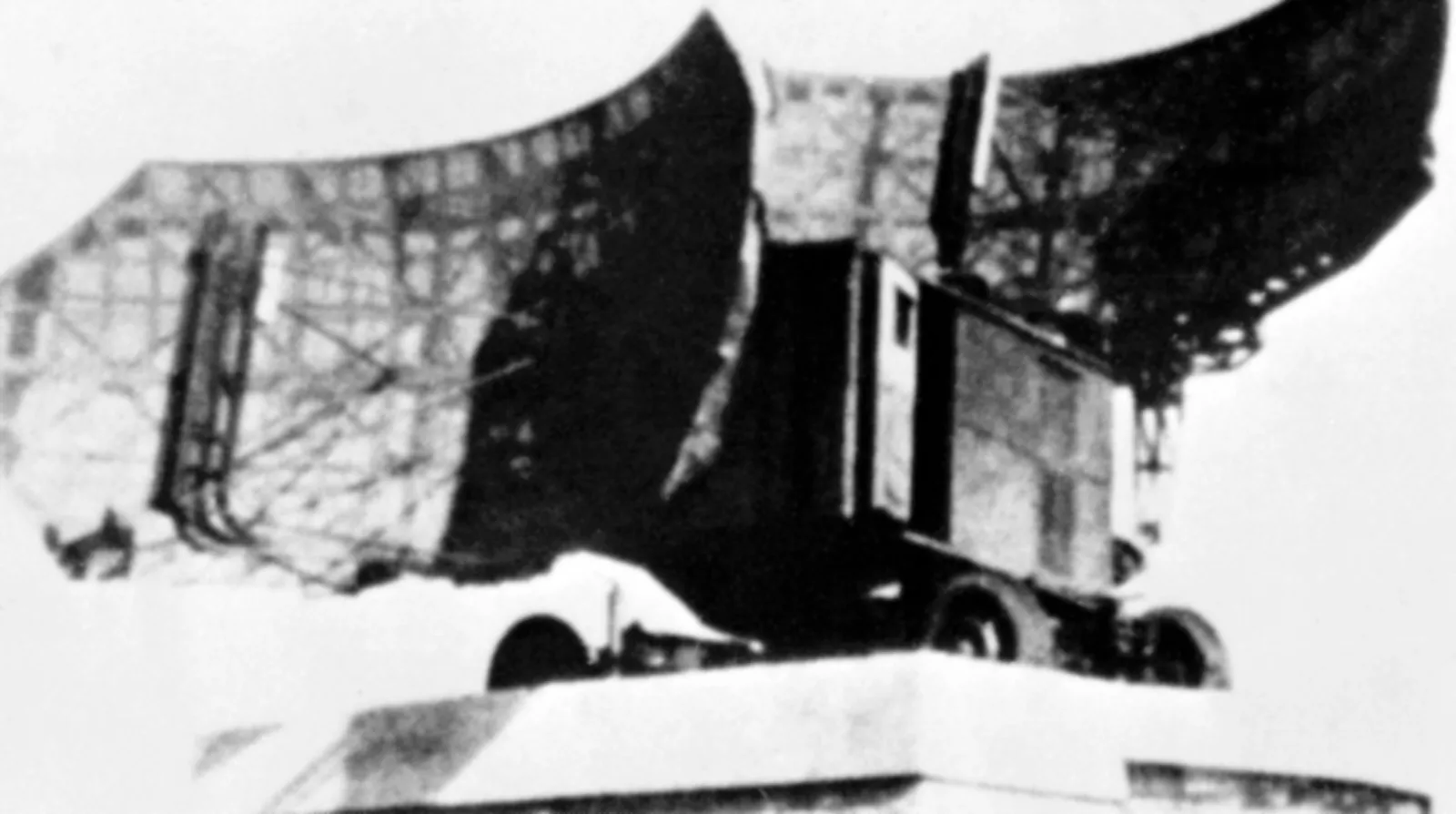


Both sides are documented with the family: Oryx lists a Ukrainian P-35/37 Bar Lock radar targeted but missed by a Russian Lancet-3, while Ukrainian reporting and WarSpotting identify a Russian P-37 Mech or 1RL110 P-35/1RL139 P-37-family radar destroyed at Kirovske airbase in occupied Crimea on 2 April 2026.
Role detailsAir Defense
P-35/P-37 Bar Lock radar
Also known as
- 1RL110 P-35 Saturn
- P-35 Saturn
- P-35 radar
- 1RL139 P-37 Mech
- P-37 Mech
- P-37 Metch
- P-37 radar
- Bar Lock
- Bar Lock radar
- 1RL139
- 1RL110
The P-35/P-37 Bar Lock family is a Soviet transportable two-coordinate radar line used for air surveillance, fighter guidance, and target assignment to air-defense missile systems. The family links the 1RL110 P-35 Saturn and later 1RL139 P-37 Mech designations, with documented use from North Vietnam's air-defense network, Syria's T4 airbase, and Iraq's 1991 IADS to Russian and Ukrainian radar losses or targeting in the 2014 Russia-Ukraine War; open air-defense references also place P-35M/Bar Lock search radar in S-200/SA-5 site architecture.
Role in Conflicts

Syrian government air-defense forces are documented using two P-35/37 Bar Lock radars at T4 airbase during the Syrian Civil War, where they supported active S-75 and S-125 SAM sites and provided aircraft detection over central Syria.
Role details- Side
- Iraq

Iraq used Soviet P-35M/P-37 Bar Lock radars in its integrated air-defense system for wide-area surveillance, early warning, fighter GCI support, and warning handoff to SAM and AAA batteries during the Gulf War.
Role details- Side
- North Vietnam and Viet Cong

North Vietnamese air-defense forces used Bar Lock/P-35 radar in the SAM-regiment and GCI early-warning network supporting SA-2 operations against U.S. aircraft.
Profile / Specs
Profile
- Origin
- Soviet Union
- Built by
- Soviet
- Type
- Transportable 2D air-surveillance and GCI radar
- Service note
- Introduced in the late 1950s and 1960s; later P-37 variants and modernized sets remained in post-Cold-War service.
- Designer
- All-Union Scientific Research Institute of Radio Engineering (VNIIRT) design lineage; Soviet production attribution retained where open sources differ on exact plant responsibility
- Designed
- 1950s P-35 development; P-37 entered service in the early 1960s
- Produced
- Late 1950s onward
Specifications
- Radar class
- Transportable 2D air-surveillance and ground-controlled-intercept radar
- NATO reporting name
- Bar Lock
- P-35 designation
- 1RL110 P-35 Saturn
- P-37 designation
- 1RL139 P-37 Mech / Metch
- Operating band
- Centimeter/S-band family; GlobalSecurity lists P-35/37 carrier frequencies at 2700-3100 MHz, while Radartutorial lists P-37 fixed frequencies in the 2695-3115 MHz sub-band and Air Power Australia summarizes P-37 as 2.9-3.3 GHz
- Instrumented range
- About 450 km displayed range for P-37 in Radartutorial/Air Power Australia tables; other P-37 characteristic tables list 350 km maximum range
- PRF
- 375 / 750 pulses per second for P-37
- Pulse duration
- 1.2 microseconds for P-37
- Peak power
- Five transmitters at about 700 kW each for P-37
- Antenna layout
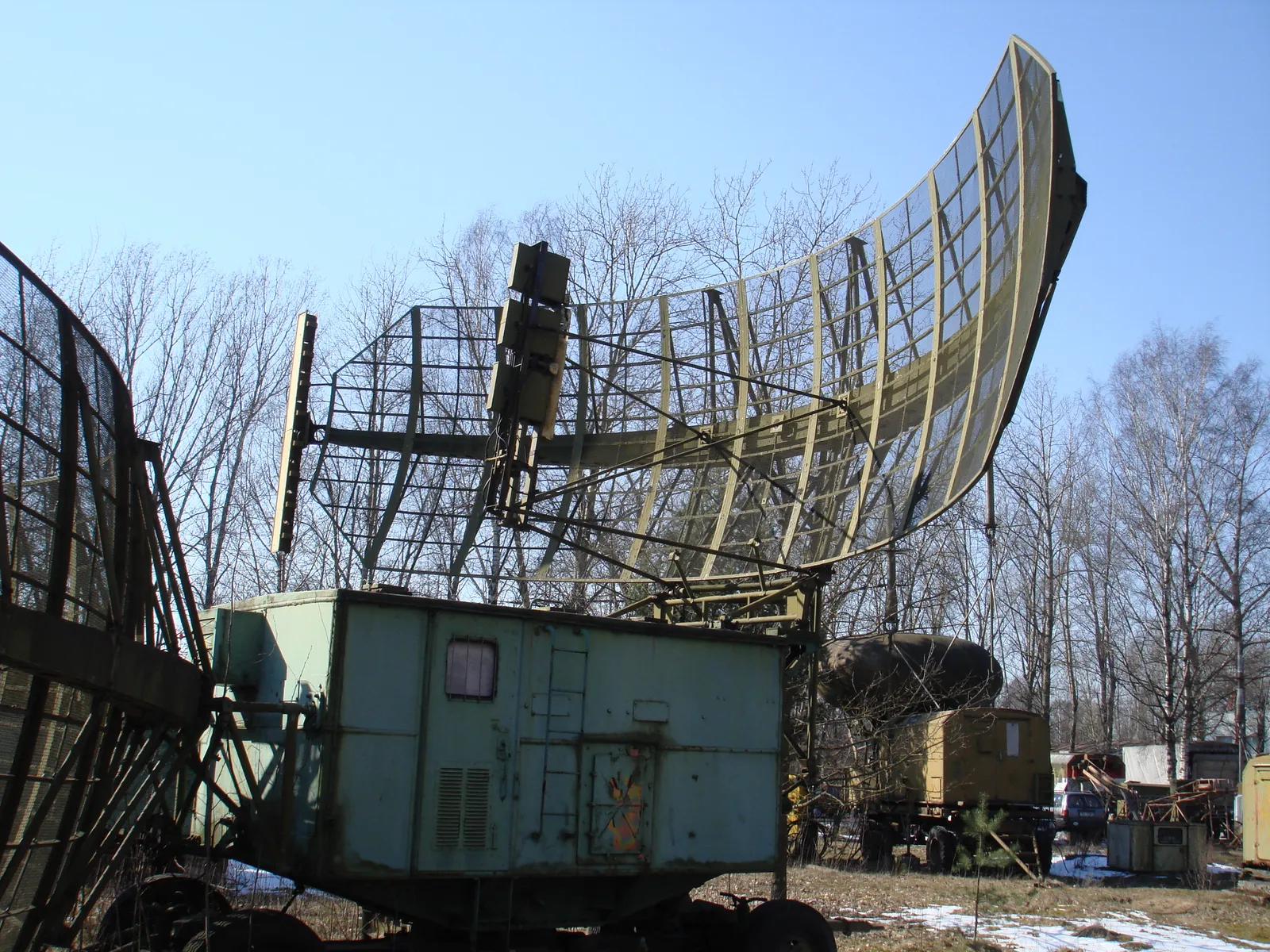
- Two horizontal truncated parabolic mesh reflectors; GlobalSecurity describes four beams from the lower reflector and two from the upper reflector
- Antenna rotation
- 3 or 6 rpm for P-37
- Range resolution
- 180 m in Radartutorial/Air Power Australia P-37 table
- Height data
- P-37 is a two-coordinate radar; Radartutorial states it could be coupled with PRV/PRW-11 or PRV/PRW-13 height-finder radars to measure the third spatial coordinate
- Associated SAM site role
- CSIS and FAS describe P-35M/P-35/37 Bar Lock as a target-search or acquisition radar associated with S-200/SA-5 sites
- Crew
- Eight-person crew listed in GlobalSecurity P-35/37 table
- Deployment and stowage
- Air Power Australia lists about 60 minutes for P-37 deploy/stow, while GlobalSecurity lists about 12 hours for trained deployment in its broader P-35/37 table
Radar Family Notes
The Bar Lock family sits between early-warning radar and air-defense command support. P-37 was a two-coordinate circular-search radar, so a full three-coordinate air picture normally depended on a height-finder. Radartutorial identifies PRV/PRW-11 and PRV/PRW-13 as compatible height-finder radars for third-coordinate measurement, while GlobalSecurity describes Bar Lock as especially useful when collocated with Side Net-type height finders in GCI site use.
Primary role
Wide-area air surveillance, fighter guidance, and target assignment for air-defense missile systems.
Radar coordinate class
Two-coordinate search radar; height-finder coupling provided the third spatial coordinate for GCI and air-defense site use.
Site integration
Open references describe Bar Lock as especially useful when collocated with Side Net-type height finders and list P-35M/P-35/37 as a search or acquisition radar associated with S-200/SA-5 sites.
Modernization pattern
Later service-life programs focused on digital signal processing, reliability, diagnostics, secondary-radar integration, and operator-workstation improvements.
Variants
Open references usually treat P-35 Saturn and P-37 Mech as successive members of the Soviet Bar Lock 2D radar family rather than unrelated systems.
| Variant | Configuration | Designation notes |
|---|---|---|
| P-35 Saturn | 1RL110 early Bar Lock model | P-35 was the earlier Soviet 2D radar in the family, accepted after state trials in 1958 and associated with the Saturn name. Sources: P-35 radar |
| P-35M | Improved P-35 model | The P-35M retained the recognizable stacked-feed antenna arrangement and appears in open imagery from Latvia. Sources: Air Power Australia Bar Lock report, Commons P-35M radar in Latvia |
| P-37 Mech | 1RL139 later Bar Lock model | Radartutorial identifies P-37 Mech as a transportable 2D radar for air surveillance, fighter guidance, and target assignment, with optional height-finder coupling for third-coordinate measurement. Sources: Radartutorial P-37 Bar Lock |
| Modernized Hungarian P-37 | Post-Cold-War upgrade | Hungarian museum and HM Arzenal material describe Hungary's P-37 service and a modernization program begun in 1997 that added digital signal processing, diagnostics, secondary-radar integration, operator-workstation improvements, and limited height-finding capability from five receiver channels. |
Air-Defense Network Links
The Bar Lock family was normally useful as part of a wider air-defense command network rather than as a standalone weapon effect.
| Compatible item | Item type | Compatibility evidence |
|---|---|---|
 | High-altitude surface-to-air missile system | North Vietnamese SAM-regiment headquarters used Bar Lock/P-35 radar for early warning and handoff to SA-2 missile battalions, linking the surveillance radar to S-75/SA-2 engagements against U.S. aircraft. Sources: Wild Weasels SA-2 and SR-71, USAF Air War North Vietnam 1965-1968, CIA North Vietnamese Antiaircraft Defense System |
 | Long-range surface-to-air missile system | S-200 battery command-post documentation describes integration of track data from acquisition radars such as P-35/37 Bar Lock; CSIS and FAS also place P-35M/P-35/37 Bar Lock search or acquisition radar in S-200/SA-5 site architecture. Sources: Air Power Australia Engagement and Fire Control Radars, CSIS S-200 Missile Threat, FAS S-200 SA-5 Gammon |
 | Short- to medium-range surface-to-air missile system | Bellingcat's T4 airbase analysis identified two P-35/37 Bar Lock radars directing active S-75 and S-125 SAM sites during the Syrian Civil War. Sources: Bellingcat Fortress T4 |
Timeline
P-35/P-37 Bar Lock radar Key Events
P-35 Saturn accepted into service
Open references place the P-35 Saturn's state-trial completion and Soviet service acceptance in 1958.
Sources: P-35 radar
P-37 Mech enters service
Radartutorial identifies P-37 Mech as entering service in 1961 as a transportable Bar Lock 2D radar.
Sources: Radartutorial P-37 Bar Lock
Bar Lock radars documented in North Vietnam
U.S. Air Force historical reporting described North Vietnamese Bar Lock radars near Haiphong and in western Route Package 5, contributing to early-warning and GCI coverage.
Sources: USAF Air War North Vietnam 1965-1968, Wild Weasels SA-2 and SR-71
Iraq employs Bar Lock radars in its IADS
Air Power Australia describes Iraqi P-35M and P-37 Bar Lock radars as top-tier GCI and early-warning sensors in Iraq's integrated air-defense system during Operation Desert Storm.
Sources: Air Power Australia Desert Storm EW
Hungarian P-37 modernization begins
HM Arzenal and Reptar museum material state that Hungary's P-37 modernization program started in 1997, with the first modernized radar handed over in 1999.
Sources: Reptar P-37 radar, HM Arzenal P-37 modernization
P-37 Mech reported destroyed in occupied Crimea
Ukrainian reporting attributed a strike at Kirovske airfield to Ukraine's Unmanned Systems Forces and Defence Intelligence, described the use of FP-2 attack drones, and identified a Russian P-37 Mech radar among the destroyed targets.
Sources: Ukrainska Pravda Kirovske strike, UNN Kirovske P-37 report, NV Kirovske P-37 report, Defense Express Kirovske P-37 report
Media
P-35/P-37 Bar Lock radar Videos
P-35/P-37 Bar Lock radar Images
Related Weapon Systems


Sources
P-35 radarPublisher: Wikipedia | Note: Starting reference for P-35 Saturn identity, 1RL110 designation, 1958 service acceptance, Bar Lock naming, and broad family relationship to P-37. | Accessed: 2026-07-03Radartutorial P-37 Bar LockPublisher: Radartutorial | Note: Supports P-37 Mech identity, 1RL139 designation, transportable 2D radar role, height-finder coupling, service-entry context, and P-37 technical characteristics. | Accessed: 2026-07-03Air Power Australia Bar Lock reportPublisher: Air Power Australia | Note: Supports the Bar Lock family grouping and P-37 specification table, including operating band, PRF, pulse duration, displayed range, range resolution, sweep rate, and LEMZ characteristic table values. | Accessed: 2026-07-03GlobalSecurity P-35/37 Bar LockPublisher: GlobalSecurity.org | Note: Supports P-35/37 Bar Lock background, circular-search role, wide GCI use, height-finder collocation context, crew count, deployment-time table value, and selected technical characteristics. | Accessed: 2026-07-03HM Arzenal P-37 modernizationPublisher: HM Arzenal | Note: Supports Hungarian P-37 modernization history and upgrade details for transmitter, receiver, signal-processing, diagnostics, secondary-radar integration, and operator-workstation changes. | Accessed: 2026-07-03Reptar P-37 radarPublisher: Reptar Szolnok Aviation Museum | Note: Supports P-37 Hungarian service context, modernization dates, five-frequency operation, range, pulse power, rotation rate, crew, and NATO air-surveillance service after modernization. | Accessed: 2026-07-03Radartutorial PRV-11 Side NetPublisher: Radartutorial | Note: Supports PRV/PRW-11 height-finder context, including its radio-altimeter role and use after target assignment by a panoramic surveillance radar or automated guidance system. | Accessed: 2026-07-03Radartutorial PRV-13 Odd PairPublisher: Radartutorial | Note: Supports PRV/PRW-13 height-finder context for the Bar Lock family section, including its Warsaw Pact height-finder role and remote-control description. | Accessed: 2026-07-03CSIS S-200 Missile ThreatPublisher: Center for Strategic and International Studies Missile Threat | Note: Supports the relationship between S-200/SA-5 batteries and P-35M target-search and acquisition radar in typical S-200 site architecture. | Accessed: 2026-07-03Air Power Australia Engagement and Fire Control RadarsPublisher: Air Power Australia | Note: Supports S-200/Square Pair command-post context, including integration of track data from acquisition radars such as P-35/37 Bar Lock and supporting height-finders. | Accessed: 2026-07-03FAS S-200 SA-5 GammonPublisher: Federation of American Scientists | Note: Supports the P-35/37 Bar Lock association with SA-5 sites and lists P-35M Bar Lock-B as target-search and acquisition radar in an S-200 battalion. | Accessed: 2026-07-03Commons P-35M radar in LatviaPublisher: Wikimedia Commons | Note: Supports image provenance for the P-35M radar photograph retained in the gallery; the file page identifies the subject and CC BY 3.0 licensing metadata. | Accessed: 2026-07-03Commons Soviet P-37 radar systemPublisher: Wikimedia Commons | Note: Supports image provenance for the P-37 Bar Lock photograph used as the primary image; the file page identifies U.S. Defense Imagery provenance and public-domain U.S. military licensing metadata. | Accessed: 2026-07-03Bellingcat Fortress T4Publisher: Bellingcat | Note: Supports direct 2011 Syrian Civil War use context by documenting two P-35/37 Bar Lock radars at Syrian government T4 airbase directing active S-75 and S-125 SAM sites and detecting aircraft over central Syria. | Accessed: 2026-07-03Ukrainska Pravda Kirovske strikePublisher: Ukrainska Pravda | Note: Supports direct 2014 Russia-Ukraine War use context by reporting that Ukrainian Unmanned Systems Forces and Defence Intelligence destroyed a Russian-occupied Crimea target set including a P-37 Mech radar at Kirovske airfield. | Accessed: 2026-07-03Crimea Platform Kirovske weekly updatePublisher: Crimea Platform | Note: Supports direct 2014 Russia-Ukraine War use context by noting the destruction of a P-37 Mech radar station at Kirovske airfield in occupied Crimea during the April 2026 strike. | Accessed: 2026-07-03Oryx Russian equipment lossesPublisher: Oryx | Note: Supports direct 2014 Russia-Ukraine War use context by listing a visually documented Russian 1RL110 P-35 Saturn or 1RL139 P-37 Mech radar destroyed during the Russian invasion of Ukraine. | Accessed: 2026-07-03Oryx Lancet miss listPublisher: Oryx | Note: Supports direct 2014 Russia-Ukraine War use context by listing a Ukrainian P-35/37 Bar Lock radar among Ukrainian equipment missed by a Russian Lancet-3 loitering munition. | Accessed: 2026-07-03WarSpotting Kirovske P-35 P-37 lossPublisher: WarSpotting | Note: Supports direct 2014 Russia-Ukraine War use context by recording a Russian 1RL110 P-35 Saturn or 1RL139 P-37 Mech loss at Kirovske airbase on 2 April 2026. | Accessed: 2026-07-03UNN Kirovske P-37 reportPublisher: Ukrainian National News | Note: Supports direct 2014 Russia-Ukraine War use context by reporting the 2 April 2026 Kirovske airfield strike and identifying a P-37 Mech circular-surveillance radar station on the Russian side among the hit targets. | Accessed: 2026-07-03NV Kirovske P-37 reportPublisher: The New Voice of Ukraine | Note: Supports direct 2014 Russia-Ukraine War use context by reporting that Ukrainian forces destroyed a Russian P-37 Mech radar at Kirovske airfield in occupied Crimea with FP-2 drones. | Accessed: 2026-07-03Defense Express Kirovske P-37 reportPublisher: Defense Express | Note: Supports direct 2014 Russia-Ukraine War use context by reporting that Ukraine's Unmanned Systems Forces and Defence Intelligence destroyed a Russian P-37 Mech radar during the Kirovske airfield strike. | Accessed: 2026-07-03Air Power Australia Desert Storm EWPublisher: Air Power Australia | Note: Supports direct 1990 Gulf War use context by describing Iraqi P-35M and P-37 Bar Lock radars in Iraq's integrated air-defense system for wide-area surveillance, early warning, fighter GCI support, and warning handoff to SAM and AAA batteries. | Accessed: 2026-07-03War on the Rocks Iraqi Bar LockPublisher: War on the Rocks | Note: Supports direct 1990 Gulf War use context by identifying Soviet-supplied P-35/37 Bar Lock radars as part of Iraq's early-warning network during Desert Storm. | Accessed: 2026-07-03Wild Weasels SA-2 and SR-71Publisher: Wild Weasels | Note: Supports direct 1955 Vietnam War use context by describing North Vietnamese SAM regiment headquarters using Bar Lock/P-35 radar for aircraft early warning and handoff to SA-2 missile battalions. | Accessed: 2026-07-03CIA North Vietnamese Antiaircraft Defense SystemPublisher: Central Intelligence Agency Reading Room | Note: Supports direct 1955 Vietnam War use context by identifying P-35 Bar Lock radar in North Vietnamese antiaircraft-defense equipment and deployment reporting. | Accessed: 2026-07-03USAF Air War North Vietnam 1965-1968Publisher: Office of Air Force History | Note: Supports direct 1955 Vietnam War use context by documenting North Vietnamese Bar Lock radars in the GCI and early-warning network and U.S. efforts to jam or attack that radar capability. | Accessed: 2026-07-03