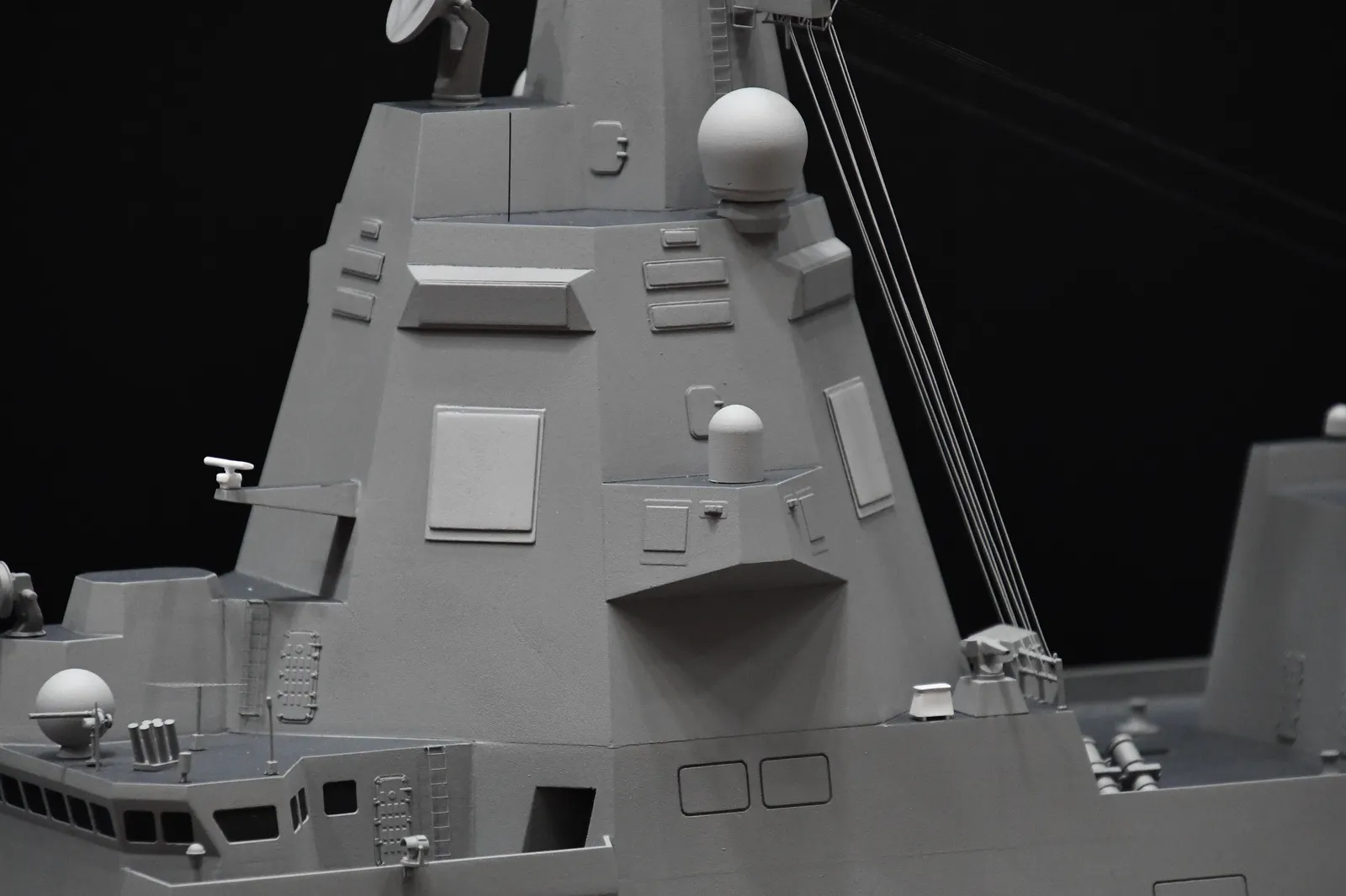
Profile
- Origin
- United States
- Built by
- Lockheed Martin
- Type
- Solid-state S-band AESA radar family
- Service note
- 2019-present
- Produced
- 2019-present
AN/SPY-7 is Lockheed Martin's modular, scalable solid-state S-band AESA radar family for Aegis-equipped missile-defense missions. Designated AN/SPY-7(V)1 in 2019, it is documented in Japan's ASEV program, Spain's F-110 frigate, and Canada's River-class destroyer, while related land systems such as LRDR and AN/TPY-6 use the same solid-state radar technology lineage.
Public sources identify three naval AN/SPY-7 designations tied to Japan, Spain, and Canada; LRDR and AN/TPY-6 are related land systems using the same solid-state radar technology lineage rather than naval SPY-7 variants.
SPY-7 is documented as an Aegis-integrated radar family for shipboard air and missile-defense programs.
| Compatible item | Item type | Compatibility evidence |
|---|---|---|
 | Shipboard combat system | Lockheed Martin's 2019 designation release says AN/SPY-7(V)1 will be fully integrated with the Aegis Combat System. Sources: AN/SPY-7(V)1 designation |
Published program sources identify SPY-7 variants selected for allied ship classes.
| Carrier | Carrier type | Carriage evidence |
|---|---|---|
 | Destroyer class | Lockheed Martin and the Royal Canadian Navy identify SPY-7 as the solid-state AESA radar for Canada's River-class destroyer program. Sources: AN/SPY-7(V)3 designation, River-Class Destroyer Fact Sheet (2026) |
LRDR is a cataloged land-based radar connected to the same Lockheed Martin solid-state radar technology line.
| Compatible item | Item type | Compatibility evidence |
|---|---|---|
 | Land-based missile-defense radar | Lockheed Martin describes LRDR and TPY-6 as using the same solid-state radar technology family as SPY-7, while U.S. Space Force reporting places LRDR at Clear Space Force Station. Sources: Japan first shipset delivery, CFC LRDR operational acceptance |
Public sources place the naval AN/SPY-7 designations in three allied ship programs, while LRDR and AN/TPY-6 are related land systems sharing the same solid-state radar technology lineage.
| Designation | Program | Reader note |
|---|---|---|
| AN/SPY-7(V)1 | | Designated in 2019; Japan received the first and second ASEV radar shipsets in 2025 and 2026, with both ships planned for Japan FY2027 and FY2028 commissioning. |
| AN/SPY-7(V)2 | Spain F-110 frigate | First live-track testing was reported in January 2025, followed by SCOMBA combat-system integration work later that year. |
| AN/SPY-7(V)3 | | Canada's Canadian Surface Combatant program was designated V3 in 2022, and the Royal Canadian Navy lists LM SPY-7 as the class's solid-state 3D AESA radar. |
| Related land systems | | Lockheed Martin links LRDR and TPY-6 to the same radar technology family; GAO reported in 2025 that AN/TPY-6 further development had been directed to cease while its fielded panel was retained experimentally. |
Lockheed Martin announced that its solid-state radar had been designated AN/SPY-7(V)1 and described it as modular and scalable for Aegis integration.
Sources: AN/SPY-7(V)1 designation
Lockheed Martin said Canada's government had given the Canadian Surface Combatant radar the AN/SPY-7(V)3 nomenclature.
Sources: AN/SPY-7(V)3 designation
Lockheed Martin said the AN/SPY-7(V)1 radar on Japan's Aegis System Equipped Vessel achieved its first live track of objects in space.
Sources: Japan ASEV first track
Lockheed Martin reported a successful live-track test of the AN/SPY-7(V)2 radar for Spain's F-110 frigate program.
Sources: AN/SPY-7(V)2 first live track
Lockheed Martin delivered the first AN/SPY-7(V)1 radar antenna for Japan's Aegis System Equipped Vessel program.
Sources: Japan first antenna delivery
Lockheed Martin delivered the first four-antenna AN/SPY-7(V)1 shipset to Japan and said the same radar technology was also being produced for Canada, Spain, LRDR, and TPY-6.
Sources: Japan first shipset delivery
Japan's Ministry of Defense reported that land-based integration testing of SPY-7 radar arrays for the first Aegis System Equipped Vessel started in September 2025.
Sources: Japan FY2026 defense progress
Navantia said SPY-7 engineering-development radar tracks were displayed on SCOMBA consoles for the first time during F-110 combat-system integration work.
Sources: F-110 SCOMBA integration
U.S. Space Force Combat Forces Command took operational acceptance of LRDR's missile-warning, tracking, and targeting mission function at Clear Space Force Station.
Sources: CFC LRDR operational acceptance
Lockheed Martin delivered the second ASEV shipset of AN/SPY-7(V)1 radar equipment to Japan's Ministry of Defense and said both ASEVs remained on track for Japan FY2027 and FY2028 commissioning.
Sources: Japan second ASEV shipment
Lockheed Martin, the Missile Defense Agency, and Japan's Ministry of Defense completed the first live target tracking exercise using the SPY-7 radar intended for Japan's first ASEV.
Sources: ASEV live target tracking


