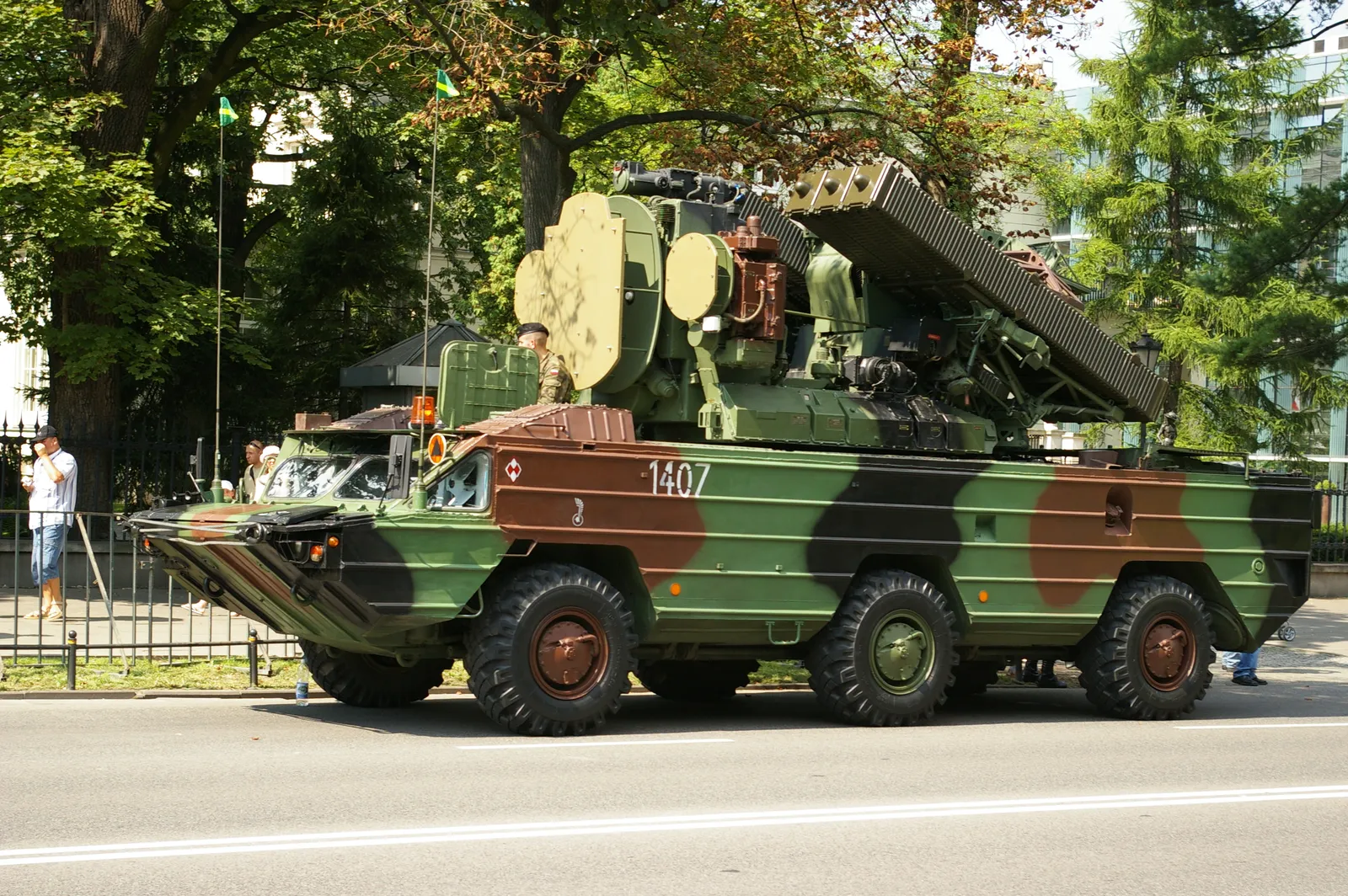


Both Russian and Ukrainian forces have fielded Osa-family short-range air defense systems; Poland supplied Osa examples to Ukraine, and visually documented losses include Russian and Ukrainian 9K33 Osa systems during the full-scale invasion.
Role detailsAir Defense
9K33 Osa
Also known as
- SA-8 Gecko
- SA-8
- Gecko
- Osa-AK
- Osa-AKM
- 9K33M2
- 9K33M3
- 9A33BM
- Romb
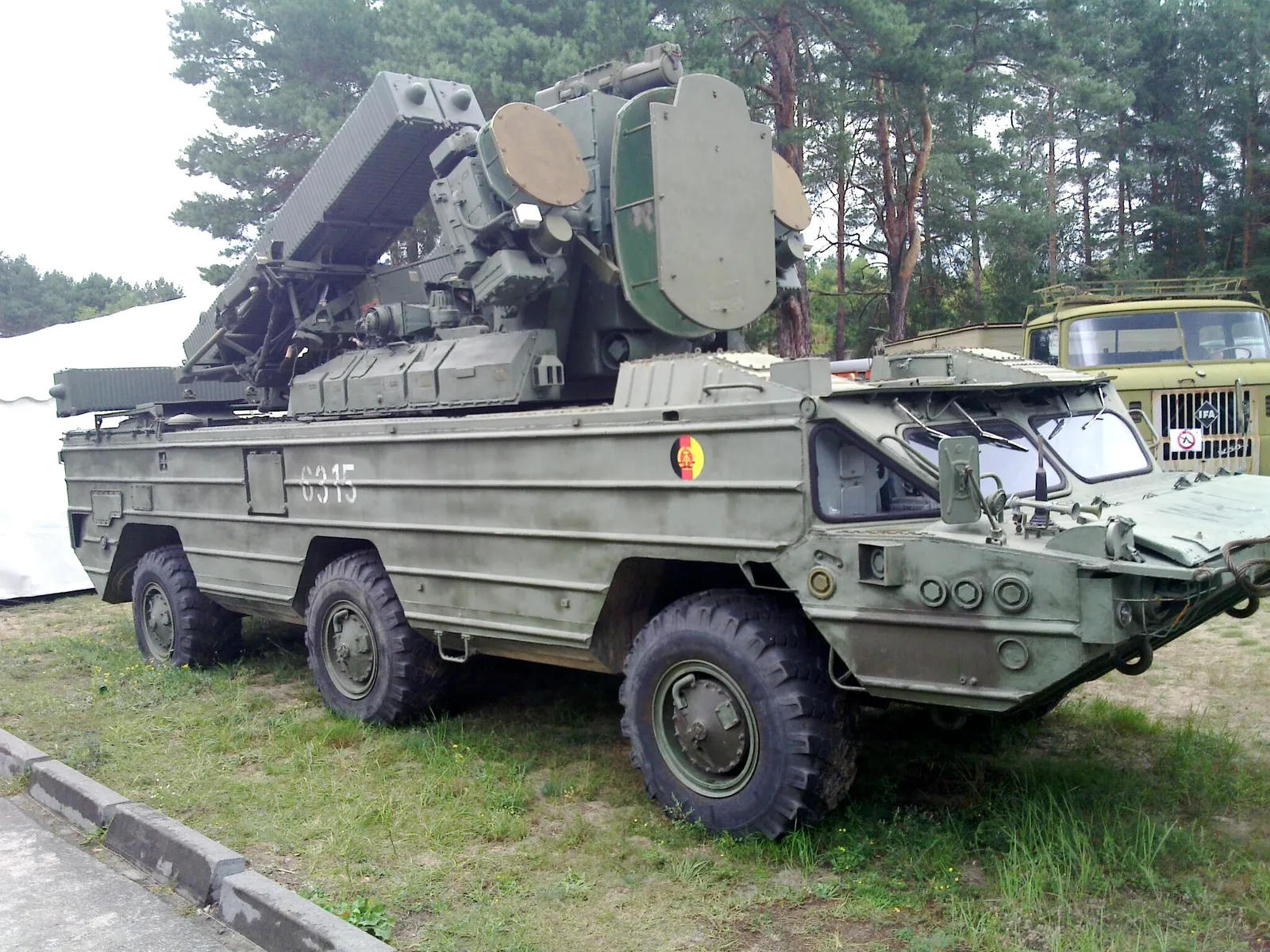
The 9K33 Osa, NATO reporting name SA-8 Gecko, is a Soviet short-range self-propelled surface-to-air missile system that combines search radar, tracking radar, command guidance, and ready-to-fire missiles on a single amphibious 6x6 TELAR. Cataloged conflict records show the system across several generations of air-defense use: Syrian Osa-AK vehicles in Lebanon in 1982, Iraqi SA-8s in the Gulf War air-defense network, captured Georgian systems in 2008, rebel-held examples in Syria, Armenian and Ukrainian battlefield use, and Indian OSA-AK service during Operation Sindoor.
Role in Conflicts


Jaish al-Islam captured operational 9K33 Osa systems at Marj al-Sultan air base and later attempted to operate them during the Syrian Civil War; Bellingcat treated the systems as rare rebel-held SAMs rather than confirmed successful interceptors. In the April 2018 U.S., UK, and French strike phase of the same war, Russian Defense Ministry statements identified Osa among Syrian Soviet/Russian-made air-defense systems used by Syrian government forces; U.S. officials reported more than 40 Syrian surface-to-air missiles fired but assessed that they did not successfully engage coalition aircraft or missiles.
Role details
Armenian and Artsakh-aligned forces fielded 9K33 Osa-family short-range air-defense systems during the 2020 Nagorno-Karabakh war; reporting by CSIS identified the Osa among Armenia's Soviet-era air defenses, and Azerbaijan's Defense Ministry reported destroying an Armenian Osa system in the Aghdam direction.
- Side
- India

India's Press Information Bureau listed OSA-AK among battle-proven air-defense systems used as part of Operation Sindoor, within a layered Indian defense against Pakistani drone and missile attacks during the May 2025 crisis.

Bellingcat noted that operational Libyan Osa systems around Benghazi were destroyed during the 2011 war before they were documented launching missiles, placing the system in Gaddafi-government air-defense service during the conflict.
- Side
- MPLA government

FAPLA forces fielded SA-8 air-defense systems in southeast Angola during the 1987-1988 Operation Hooper phase; a military-history study notes the destruction of 21 Brigade's SA-8 system during attacks around Cuito Cuanavale.
- Side
- Iraq

Marine Corps University describes Iraq's Operation Desert Storm surface-to-air missile arsenal as including the Soviet SA-8 Gecko, tied into the Kari command-and-control network that coalition air operations attacked and suppressed.
Role details- Side
- Georgia

Oryx's Russo-Georgian War equipment-loss list documents Georgian 9K33 Osa/Osa-AK air-defense systems captured by Russian forces during the 2008 war.
Bellingcat describes Syrian Osa-AK systems as deployed in Lebanon's Bekaa Valley during the 1982 Lebanon War, where the type entered combat service as part of Syrian air defenses.
Profile / Specs
Profile
- Origin
- Soviet Union
- Type
- Short-range self-propelled surface-to-air missile system
- Service note
- Entered service in the early 1970s; still used in upgraded Osa-AK and Osa-AKM forms
- Designed
- 1960-1971 development period
- Produced
- 1970-1988 for launch vehicles
- Number built
- Over 1,150 launch vehicles reported
- Developed into
- 9K330 Tor and later Tor-family short-range air-defense systems
Specifications
- Crew
- 5 on Osa-AKM launch vehicle
- Armament
- Six ready-to-fire 9M33M2 or 9M33M3 surface-to-air missiles on later Osa-AK/Osa-AKM vehicles
- Engagement range
- About 1.5-10 km for Osa-AK; Osa-AKM missile envelope listed up to 15 km in some references
- Engagement altitude
- About 25 m to 5 km for Osa-AK; Osa-AKM missile envelope listed up to 12 km
- Guidance
- Radio command guidance using onboard search, tracking, and missile guidance radars
- Mobility
- BAZ-5937 6x6 amphibious chassis; about 500 km road range and up to 8 km/h afloat
- Reaction time
- About 26-34 seconds in comparative Osa/Osa-AK/Osa-AKM technical data
- Deployment and reload
- GlobalSecurity lists four-minute combat deployment, 26-second system reaction, and five-minute reload time for SA-8b / Osa-AKM
- Radar
- LAND ROLL acquisition and tracking radar set integrated on the TELAR
System Layout
The Osa was designed as an all-in-one short-range air-defense vehicle rather than a launcher that depends on a separate radar vehicle at the firing point.
| Subsystem | Cataloged detail | Why it matters |
|---|---|---|
| Launch vehicle | BAZ-5937 amphibious 6x6 TELAR | The chassis lets the battery reposition with maneuver forces and cross water obstacles without a bridge. |
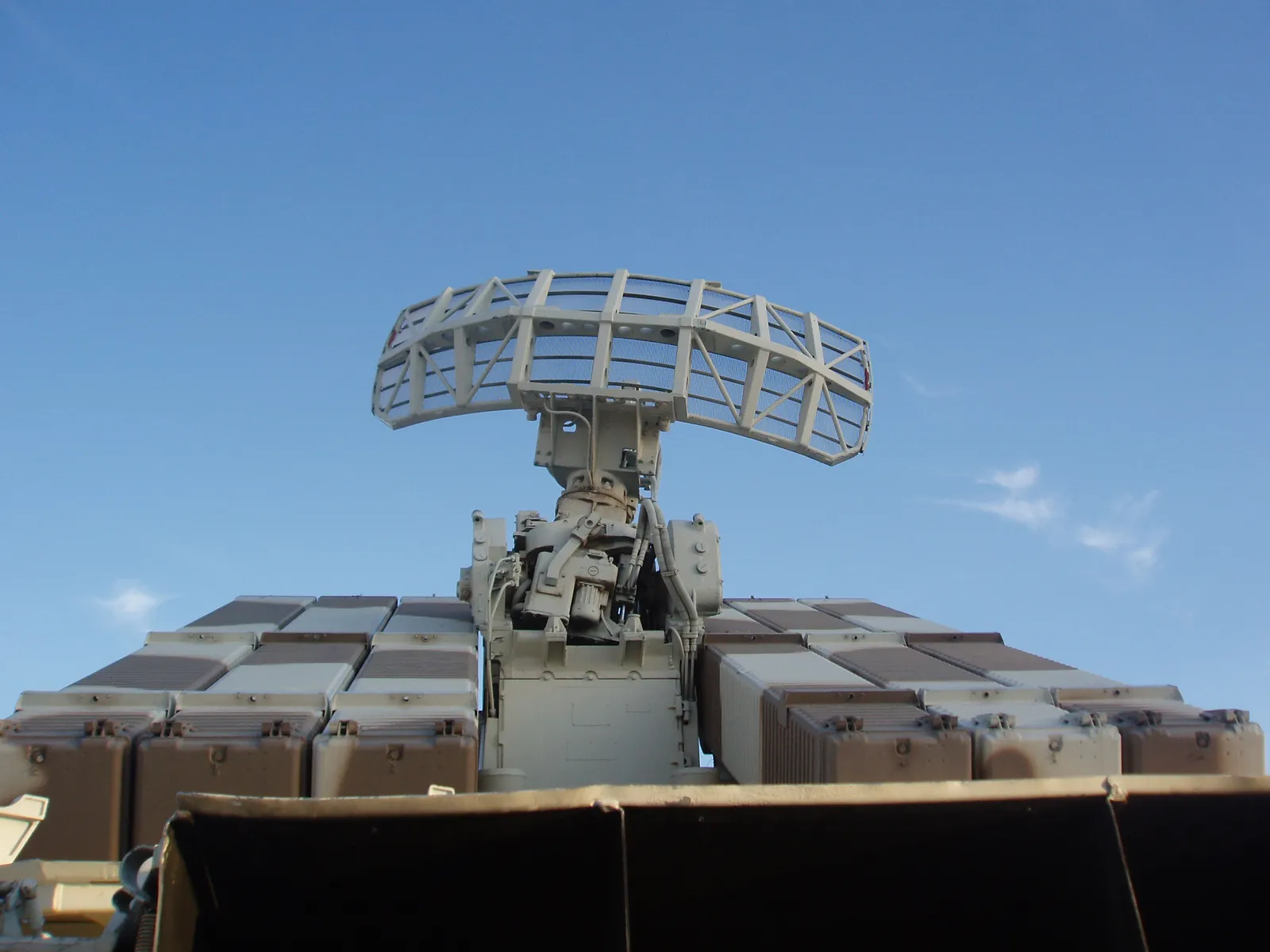
| Sensor package | Search, tracking, and missile-guidance radars on the same vehicle | The vehicle can search, track, and guide command-guided missiles from a single launcher. |
| Ready missiles | Six 9M33M2 or 9M33M3 missiles on Osa-AK/Osa-AKM | The later canister layout gives each vehicle a compact ready-to-fire interceptor load. |
Variants
Osa family designations separate the original four-missile 9K33 launcher from the Osa-AK and Osa-AKM upgrades, which changed ready missile stowage and the missile/control package.
| Variant | Configuration | Designation notes |
|---|---|---|
| 9K33 Osa / SA-8A Gecko | Original four-missile launcher | WeaponSystems.net describes the original 1972 9A33 launch vehicle with four exposed 9M33 missiles before the later six-canister Osa-AK and Osa-AKM launch vehicles. Sources: 9K33 Osa |
| 9K33M2 Osa-AK | Six-canister launcher upgrade | WeaponSystems.net lists Osa-AK as the 1975 9K33M2 variant, while Bellingcat distinguishes Osa-AK vehicles by their six launch containers and older identification equipment. Sources: 9K33 Osa, Jaish al-Islam's 9K33 Osa SAMs |
| 9K33M3 Osa-AKM | Improved missile and control variant | WeaponSystems.net identifies Osa-AKM as the 1980 9K33M3 variant associated with the improved 9M33M3 missile, and GlobalSecurity lists the Osa-AKM engagement envelope separately from earlier Osa-AK figures. Sources: 9K33 Osa, SA-8 GECKO / 9K33M3 Osa-AKM |
Launched Munitions
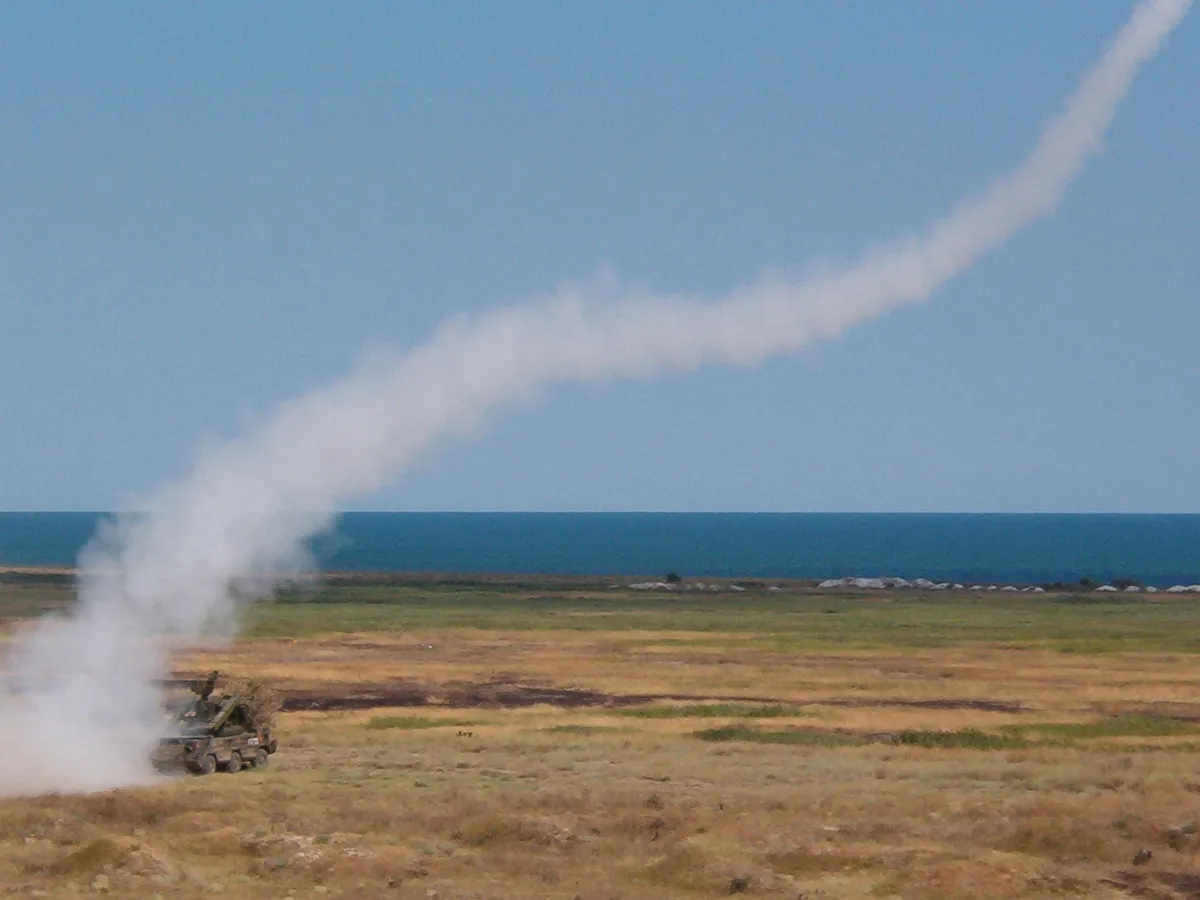
The 9K33 Osa is documented as launching the 9M33 missile family, including later Osa-AK and Osa-AKM variants.

Battery Components
Although each Osa TELAR carries its own search, tracking, and missile-guidance radars, battery-level operation used support vehicles for command, reloading, maintenance, and wider-area acquisition.
Firing element
Air Power Australia lists four 9A33BM six-round amphibious TELARs as the core firing vehicles in a 9K33M3 battery.
Source: 9K33 Osa/Romb Self Propelled Air Defence System / SA-8 Gecko.
Reload support
The same battery table lists 9T217BM amphibious transporter/transloader/tanker vehicles plus a towed missile transporter, mobile crane, and missile-preparation support equipment.
Source: 9K33 Osa/Romb Self Propelled Air Defence System / SA-8 Gecko.
Battery control
The battery context includes PU-12M or 9S738-3 command-post vehicles and optional acquisition-radar support such as P-40/1S12 or P-15/P-19-family radars.
Source: 9K33 Osa/Romb Self Propelled Air Defence System / SA-8 Gecko.
Timeline
9K33 Osa Key Events
Osa development begins
WeaponSystems.net traces Osa development to 1960-1971 and describes the system as a mobile replacement for the towed 57 mm S-60 anti-aircraft gun.
Osa enters Soviet service
WeaponSystems.net places the 9K33 Osa's service entry in 1971 after a development period that began in the 1960s.
Osa-AK upgrade appears
The 9K33M2 Osa-AK variant introduced the six-canister launcher configuration documented in later export and conflict examples.
Osa-AKM follows
The 9K33M3 Osa-AKM brought the improved later missile/control configuration that many current references use for Osa-family performance data.
Syrian Osa-AK systems in Lebanon
Bellingcat describes Syrian Osa-AK vehicles as deployed in the Bekaa Valley during the 1982 Lebanon War.
SA-8 in Iraqi air defenses
Marine Corps University identifies SA-8 Gecko as part of Iraq's surface-to-air missile arsenal during Operation Desert Storm.
Jaish al-Islam captures Osa systems
Bellingcat traced Jaish al-Islam's capture and attempted use of 9K33 Osa systems during the Syrian Civil War.
Osa losses in Nagorno-Karabakh
CSIS and Azerbaijan's defense ministry documented Osa-family systems in Armenian service during the 2020 Nagorno-Karabakh war.
Osa remains active in Ukraine
The Russia-Ukraine War includes Osa-family use and losses, with Ukraine receiving Polish Osa systems and Oryx documenting Russian 9K33 losses.
Related Weapon Systems


Sources
9K33 OsaPublisher: WeaponSystems.net | Note: Supports system background, production/manufacturer context, variants, Osa-AKM specifications, system-layout details, S-60 replacement and Tor successor context, and the page's identification of the 9M33 series as the missile family fired by 9K33 Osa. | Accessed: 2026-07-02SA-8 GECKO / 9K33M3 Osa-AKMPublisher: GlobalSecurity.org | Note: Supports Osa-family engagement envelope, reaction time, reload time, combat deployment time, radar, guidance, mobility, and missile specifications. | Accessed: 2026-07-029K33 Osa/Romb Self Propelled Air Defence System / SA-8 GeckoPublisher: Air Power Australia | Note: Supports Osa development context, variant distinctions, battery components, support vehicles, reaction-time data, export Romb alias, and the later Tor replacement context. | Accessed: 2026-07-02What Could Happen If Ukraine's Stock Of Soviet SAMs Runs DryPublisher: The War Zone | Note: Supports 2014 Russia-Ukraine War context that Poland provided 9K33 Osa systems to Ukraine as part of Soviet-era air-defense support. | Accessed: 2026-06-20Attack On Europe: Documenting Russian Equipment Losses During The Russian Invasion Of UkrainePublisher: Oryx | Note: Supports 2014 Russia-Ukraine War context with visually documented Russian 9K33 Osa losses. | Accessed: 2026-06-20Attack On Europe: Documenting Ukrainian Equipment Losses During The Russian Invasion Of UkrainePublisher: Oryx | Note: Supports 2014 Russia-Ukraine War context with visually documented Ukrainian 9K33 Osa losses. | Accessed: 2026-07-02Russian General's Claim of 71 Missiles Downed Countered by Satellite DataPublisher: Voice of America | Note: Supports April 2018 U.S., UK, and French strikes in the 2011 Syrian Civil War direct-use context: Russian Defense Ministry statements said Osa was used by Syrian government air-defense forces during the April 14 strike, while VOA assessed the 71-intercepts claim as likely false. | Accessed: 2026-06-20Syria - Air Defense CommandPublisher: GlobalSecurity.org | Note: Supports April 2018 U.S., UK, and French strikes in the 2011 Syrian Civil War direct-use context by stating Osa was used by the Syrian military in the April 2018 air-defense response; interception effectiveness remains disputed. | Accessed: 2026-06-20DoD Syria Strike BriefingPublisher: U.S. Central Command | Note: Supports official April 2018 U.S., UK, and French strikes in the 2011 Syrian Civil War context that Syrian forces fired more than 40 surface-to-air missiles and that U.S. officials assessed no successful engagement of coalition aircraft or missiles. | Accessed: 2026-06-20The Air and Missile War in Nagorno-KarabakhPublisher: Center for Strategic and International Studies | Note: Supports 2020 Nagorno-Karabakh Conflict direct-use context: 9K33 Osa systems were fielded by Armenian forces as part of Armenia's Soviet-era air defenses during the 2020 war. | Accessed: 2026-06-20Another Osa Anti-Aircraft Missile System Was DestroyedPublisher: Ministry of Defense of the Republic of Azerbaijan | Note: Supports 2020 Nagorno-Karabakh Conflict direct-use context: an Osa anti-aircraft missile system was used by Armenian armed forces and reported destroyed by Azerbaijani units in the Aghdam direction. | Accessed: 2026-06-20Operation SINDOOR: The Rise of Aatmanirbhar Innovation in National SecurityPublisher: Press Information Bureau, Government of India | Note: Supports 2025 India-Pakistan Conflict direct-use context: OSA-AK was used by Indian air-defense forces as part of Operation Sindoor's layered air-defense response. | Accessed: 2026-06-21Jaish al-Islam's 9K33 Osa SAMsPublisher: Bellingcat | Note: Supports Osa family variant background and direct conflict-use context for 2011 Syrian Civil War rebel-held Osa systems, 2011 First Libyan Civil War Osa systems around Benghazi, and 1982 Lebanon War Syrian Osa-AK deployment in the Bekaa Valley. | Accessed: 2026-06-30The Desert WarPublisher: Marine Corps University Press | Note: Supports 1990 Gulf War direct-use context by identifying SA-8 Gecko as part of Iraq's surface-to-air missile arsenal during Operation Desert Storm and describing the Iraqi air-defense network targeted by coalition forces. | Accessed: 2026-06-30The South African Defence Force and Operation Hooper, Southeast Angola, December 1987 to March 1988Publisher: Scientia Militaria: South African Journal of Military Studies | Note: Supports 1975 Angolan Civil War direct-use context by documenting FAPLA's SA-8 system during Operation Hooper in southeast Angola. | Accessed: 2026-07-02Russia's Wars: Listing Equipment Losses During The 2008 Russo-Georgian WarPublisher: Oryx | Note: Supports 2008 Russo-Georgian War direct-use context by listing Georgian 9K33 Osa/Osa-AK systems captured during the war. | Accessed: 2026-06-30File:POL 9K33 Osa.JPGPublisher: Wikimedia Commons | Note: Supports image identity and reuse status; the Commons page identifies the subject as a 9K33 Osa and records VRT-confirmed permission with attribution to Konflikty.pl. | Accessed: 2026-06-20File:Romanian 9K33 Osa (SA-8).jpgPublisher: Wikimedia Commons | Note: Supports image identity and reuse status for a Romanian 9K33 Osa firing a missile at Capu Midia firing range. | Accessed: 2026-06-20File:9K33 Osa radar.jpgPublisher: Wikimedia Commons | Note: Supports image identity and Creative Commons licensing for a close view of 9K33 Osa radar equipment displayed at Nellis Air Show. | Accessed: 2026-06-20File:East-German 9K33 Osa.jpgPublisher: Wikimedia Commons | Note: Supports image identity and Creative Commons licensing for an East German 9K33 Osa view. | Accessed: 2026-06-20