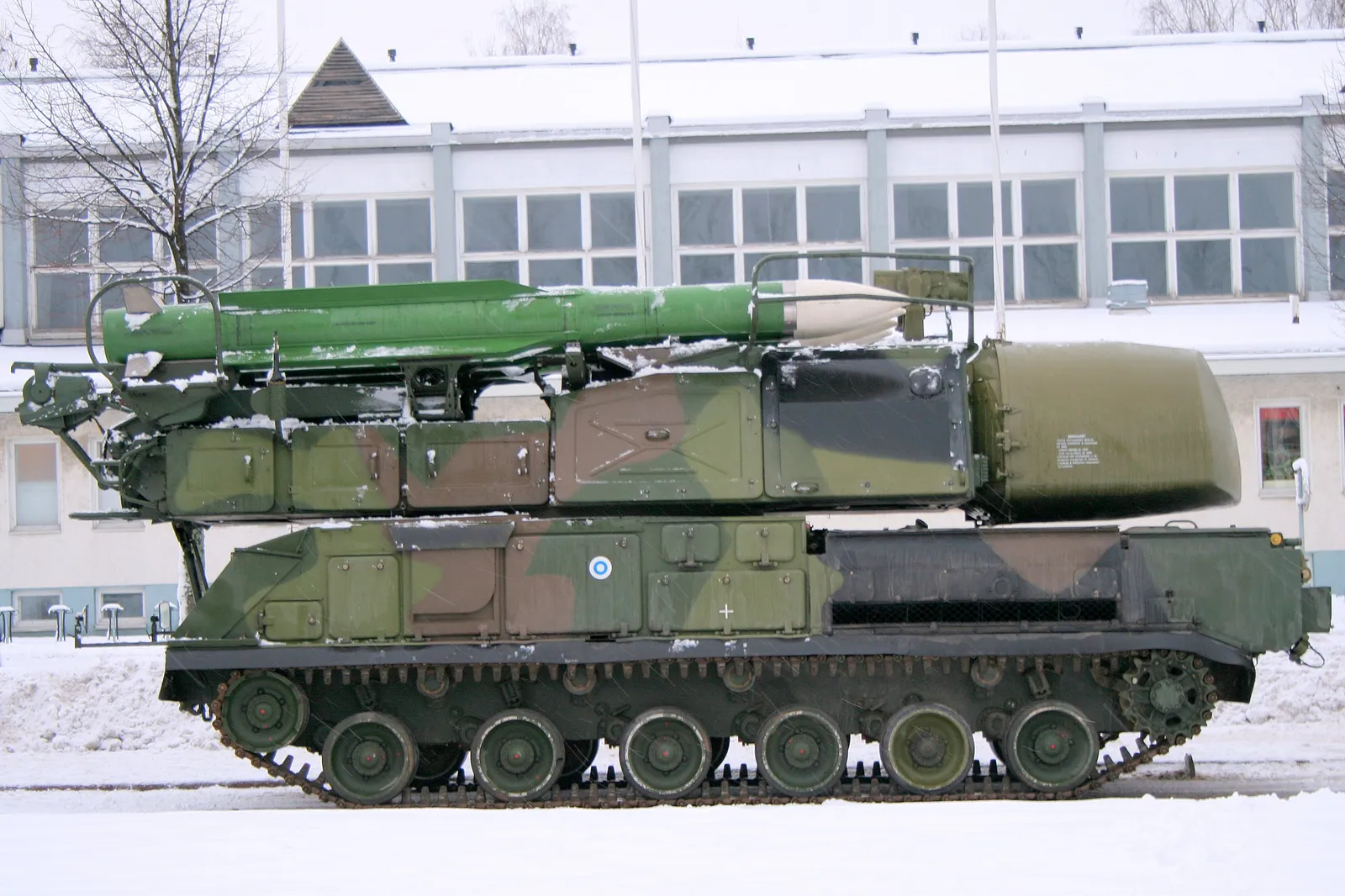


Russia-linked forces and Ukraine both fielded Buk/Buk-M1-family air-defense systems in the 2014 Russia-Ukraine War: the Dutch-led JIT says MH17 was shot down by a 9M38-series Buk missile launched from a Buk TELAR transported from Russia to separatist-controlled Pervomaiskyi, while CSIS and Oryx document Ukrainian 9K37M Buk-M1 systems and 9A310M1/9A39M1 Buk-M1 vehicles during the full-scale invasion phase.
Role detailsAir Defense
9K37 Buk
Also known as
- Buk
- Buk-M1
- 9K37M1 Buk-M1
- SA-11 Gadfly
- 9A310 TELAR
- 9A310M1 TELAR
- 9M38
- 9M38M1
The 9K37 Buk is the original Soviet tracked medium-range surface-to-air missile system behind the SA-11 Gadfly family, built around mobile command, target-acquisition, TELAR, reload, and 9M38/9M38M1 missile elements. It remains relevant in conflict records because Buk-M1 systems appeared in Georgia's 2008 air-defense campaign and in the 2014 Russia-Ukraine War, including Ukraine's surviving Buk-M1 network and the evidence chain around the Russian Buk TELAR that launched the MH17 missile.
Role in Conflicts
- Side
- Georgia

Georgia fielded Buk-M1 systems in the 2008 war; DefenceWeb reported that Georgian attack groups included a Buk-M1 battalion and that Russian officials considered Buk-M1 systems responsible for major Russian aircraft losses, while Oryx records Georgian Buk-M1 systems among air-defense systems used and lost in the five-day war.
Profile / Specs
Profile
- Origin
- Soviet Union
- Built by
- NIIPUlyanovsk Mechanical Plant
- Type
- Tracked medium-range surface-to-air missile system
- Service note
- Entered Soviet service around 1980, with Buk-M1 accepted in 1983 and later retained by post-Soviet operators.
- Designer
- V. V. Tikhomirov Scientific Research Institute of Instrument Design (NIIP)
- Designed
- Development authorized in 1972; full 9K37 system tested from 1977 to 1979
- Produced
- Late 1970s onward for 9K37/Buk-M1 family systems
Specifications
- System role
- Self-propelled medium-range surface-to-air missile system for battlefield air defense
- Primary missiles
- 9M38 and 9M38M1 surface-to-air missiles in original Buk/Buk-M1 references
- Firing vehicle
- 9A310/9A310M1 TELAR with four ready missiles and Fire Dome engagement radar in Buk-M1 descriptions
- Battery structure
- Two TELAR vehicles and one TEL/reload vehicle in Army Recognition's Buk battery description
- Battalion structure
- Command vehicle, target-acquisition radar, six TELAR vehicles, and three TEL reload vehicles in Army Recognition's standard battalion description
- Engagement range
- About 3.5-25/30 km in Missilery.info original 9K37 data; Army Recognition lists 32-35 km maximum for Buk-M1 missile engagement
- Engagement altitude
- About 0.025-18/20 km in Missilery.info original 9K37 data; Army Recognition lists 20-22,000 m for Buk-M1 missile altitude
- Missile speed
- About 850 m/s in Missilery.info and Army Recognition data
- Missile warhead
- About 70 kg high-explosive fragmentation warhead
- Missile mass
- About 685-690 kg depending on source and missile variant
- Road speed
- Up to 65 km/h for the tracked Buk-M1 vehicle family in Army Recognition and Air Power Australia data
- Road range
- About 500 km for the GM-569 tracked chassis family in Army Recognition and Air Power Australia data
- Deployment time
- No more than 5 minutes for original 9K37 closure/deployment data in Missilery.info
Variants
This page covers the original 9K37/Buk-M1 family. Later Buk-M1-2 and Buk-M2 pages or component pages handle the 9M317 generation and newer TELARs separately.
| Variant | Configuration | Designation notes |
|---|---|---|
| 9K37-1 Buk-1 | Early mixed Kub/Buk configuration | Open Buk-family references describe Buk-1 as the first service step, incorporating a 9A38 firing vehicle into a Kub-M3 battery before the complete 9K37 system. Sources: Buk Missile System - Wikipedia |
| 9K37M1 Buk-M1 | Improved SA-11 Gadfly family system | Army Recognition identifies Buk-M1/SA-11 as firing 9M38 and 9M38M1 missiles and gives the system's tracked mobility, battery structure, and radar set. Sources: SA-11 Gadfly Buk-M1 9K37 |
| 9K37M1-2 Buk-M1-2 | 1990s modernization branch | Buk-M1-2 belongs to the later branch that added 9A310M1-2/9S470M1-2 components and 9M317 missile context, so this page treats it as adjacent family context rather than the original 9K37 baseline. Sources: 9K37 Buk M1/M2 - Air Power Australia |
 | Later Buk-M1-2 firing vehicle | The linked TELAR record covers the Buk-M1-2 firing vehicle and 9M317 compatibility rather than the original 9K37/Buk-M1 baseline. Sources: 9K37 Buk M1/M2 - Air Power Australia |
| 9K37MB Buk-MB | Belarusian digital retrofit | Air Power Australia describes Buk-MB as a digital retrofit of 9K37-1/9K37M1 equipment with upgraded command-post, TELAR, and launcher-loader components. Sources: 9K37 Buk M1/M2 - Air Power Australia |
 | Later 9K317 system family | The linked Buk-M2 record covers the later 9K317 system and 9M317-family missile architecture, keeping newer Buk-M2/Buk-M2E conflict evidence separate from this original-family entry. Sources: 9K37 Buk M1/M2 - Air Power Australia |
Buk Battery Components
Original Buk and Buk-M1 batteries combine command, surveillance, firing, reload, and missile elements rather than a single vehicle type.
| Compatible item | Item type | Compatibility evidence |
|---|---|---|
 | Target-acquisition radar | Army Recognition identifies the 9S18 or 9S18M1 target-acquisition radar as the surveillance element used with the 9K37 SA-11 Gadfly system. Sources: SA-11 Gadfly Buk-M1 9K37 |
 | Command post vehicle | Buk-family references place the 9S470 command post between target-acquisition radars and TELARs, coordinating target information and firing assignments in the battery. Sources: 9K37 Buk - Missilery.info, SA-11 Gadfly Buk-M1 9K37 |
 | Buk-M1 surface-to-air missile | Army Recognition says the SA-11/Buk-M1 can fire 9M38 and 9M38M1 missiles; the linked missile page handles munition-level specifications and MH17 missile evidence. Sources: SA-11 Gadfly Buk-M1 9K37 |
System Boundary
Buk records can become confusing because open sources may name the system, TELAR, radar, missile, or later modernization as though each were the whole weapon. This page keeps the original 9K37/Buk-M1 family separate from later Buk-M1-2 and Buk-M2 records while linking the main cataloged components.
System family
9K37 and 9K37M1 refer to the original Buk and Buk-M1 system family, normally read as a battery or battalion with command, search radar, firing, reload, and missile vehicles.
Firing vehicle
Reports may identify a Buk TELAR when the direct evidence is the launcher-radar vehicle rather than a complete deployed battery.
Missile evidence
The 9M38M1 record carries missile-level details; this system record uses those links only where sources connect the missile to Buk/Buk-M1 operation.
Sources: 9K37 Buk - Missilery.info; SA-11 Gadfly Buk-M1 9K37; JIT MH17 Criminal Investigation.
Timeline
9K37 Buk Key Events
Buk development authorized
Open Buk references trace the program to a January 1972 Soviet development decision for a self-propelled medium-range air-defense system.
Sources: Buk Missile System - Wikipedia, 9K37 Buk - Missilery.info
Full 9K37 system tested
Missilery.info places joint testing of the complete 9K37 Buk complex from November 1977 to March 1979 at the Emba test range.
Sources: 9K37 Buk - Missilery.info
Buk-M1 accepted into service context
Buk-family references describe the 9K37M1 Buk-M1 as the improved early-1980s generation of the original system.
Sources: Buk Missile System - Wikipedia, SA-11 Gadfly Buk-M1 9K37
Georgian Buk-M1 systems used in the August war
DefenceWeb reported Georgian Buk-M1 deployment during the 2008 Russo-Georgian War, including Buk-M1 systems in the air-defense echelon and Russian attribution of major aircraft losses to Buk-M1 fire.
Sources: Georgia's Air Defence in the August War
MH17 shot down by a Buk missile system
The JIT and Dutch Safety Board tied the MH17 shootdown in eastern Ukraine to a Buk TELAR and a Buk surface-to-air missile system, respectively.
Sources: JIT MH17 Criminal Investigation, Dutch Safety Board MH17 Buk Finding
Ukrainian Buk-M1 network survives the opening strike campaign
CSIS analysis of Russia's 2022 air campaign says Ukraine operated 72 9K37M Buk-M1 systems before the full-scale invasion and used dispersed, mobile ground-based air defenses to deny Russia lasting air superiority.
Sources: CSIS Air Superiority Lessons from Iran and Ukraine, Ukrainian Equipment Losses - Oryx
Media
9K37 Buk Videos
Related Weapon Systems


Sources
Buk Missile System - WikipediaPublisher: Wikipedia | Note: Baseline terminology source for Buk-family designations, original design tree, and 9K37/Buk-M1 naming; not used as the sole support for technical or conflict-use claims. | Accessed: 2026-07-059K37 Buk - Missilery.infoPublisher: Missilery.info | Note: Supports original 9K37 Buk development, testing chronology, system composition, 9A310/9A39 vehicle context, deployment time, missile speed, missile mass, warhead, and engagement-zone figures. | Accessed: 2026-07-059K37 Buk-M1 - Missilery.infoPublisher: Missilery.info | Note: Supports Buk-M1 modernization chronology, 1983 service entry, 9M38M1, 9S470M1, 9S18M1, 9A310M1, 9A39 composition, engagement range and altitude, missile mass, warhead, missile speed, and deployment-time figures. | Accessed: 2026-07-05SA-11 History - GlobalSecurity.orgPublisher: GlobalSecurity.org | Note: Supports Buk development authorization, NIIP developer attribution, 9S470, 9A38, 9A39, 9S18, 9M38 design responsibilities, and the early Buk-1/Kub-M4 service path. | Accessed: 2026-07-059K37 Buk M1/M2 - Air Power AustraliaPublisher: Air Power Australia | Note: Specialist Buk-family reference used for 9K37/9K37M1/9K317 designation boundaries, vehicle and missile context, road speed, road range, chassis data, and later-system comparison. | Accessed: 2026-07-05SA-11 Gadfly Buk-M1 9K37Publisher: Army Recognition | Note: Supports Buk-M1/SA-11 system role, 9M38/9M38M1 missile compatibility, battery and battalion structure, radar elements, tracked mobility, and missile performance data. | Accessed: 2026-07-05JIT MH17 Criminal InvestigationPublisher: Public Prosecution Service of the Netherlands | Note: Direct conflict-use source for the 2014 Russia-Ukraine War: says MH17 was shot down by a 9M38-series Buk missile launched by a Buk TELAR transported from Russia to separatist-controlled Pervomaiskyi and returned to Russia with a missing missile. | Accessed: 2026-07-05Dutch Safety Board MH17 Buk FindingPublisher: Dutch Safety Board | Note: Direct conflict-use source for the 2014 Russia-Ukraine War: identifies a 9N314M warhead launched by a Buk surface-to-air missile system from eastern Ukraine as the cause of the MH17 crash. | Accessed: 2026-07-05CSIS Air Superiority Lessons from Iran and UkrainePublisher: Center for Strategic and International Studies | Note: Direct conflict-use source for the 2014 Russia-Ukraine War: describes Ukraine operating 72 9K37M Buk-M1 systems before the 2022 invasion and using mobile ground-based air defenses to deny Russia lasting air superiority. | Accessed: 2026-07-05Ukrainian Equipment Losses - OryxPublisher: Oryx | Note: Direct conflict-use source for the 2014 Russia-Ukraine War: visually documented Ukrainian 9A310M1 TELARs and 9A39M1 TELs for Buk-M1 destroyed, damaged, or captured during the full-scale invasion phase. | Accessed: 2026-07-05Georgia's Air Defence in the August WarPublisher: DefenceWeb | Note: Direct conflict-use source for the 2008 Russo-Georgian War: reports Georgian Buk-M1 systems in the air-defense echelon, Buk-M1 ambush tactics, Russian attribution of major aircraft losses to Buk-M1 fire, and captured or destroyed Georgian Buk-M1 equipment. | Accessed: 2026-07-05Russia's Wars: 2008 Russo-Georgian War Equipment LossesPublisher: Oryx | Note: Direct conflict-use source for the 2008 Russo-Georgian War: states Georgian Spyder and Buk-M1 SAM systems were responsible for Russian aircraft losses and records Georgian Buk SAM systems lost in the war. | Accessed: 2026-07-05File:9K37 Buk M1 SA-11 GadflyPublisher: Wikimedia Commons | Note: Image provenance source for the primary 9K37 Buk-M1 image; the Commons page identifies the photograph as public domain. | Accessed: 2026-07-05How does a BUK missile system work? - BBC NewsPublisher: BBC News | Note: Selected video embed from a reputable news channel showing a Ukrainian Buk system and explaining system operation; not used as a factual source for conflict-use rows. | Accessed: 2026-07-05