Munitions

BLG 66 Belouga

Also known as
  • BLG-66
  • BLG66
  • Belouga
  • GR-66

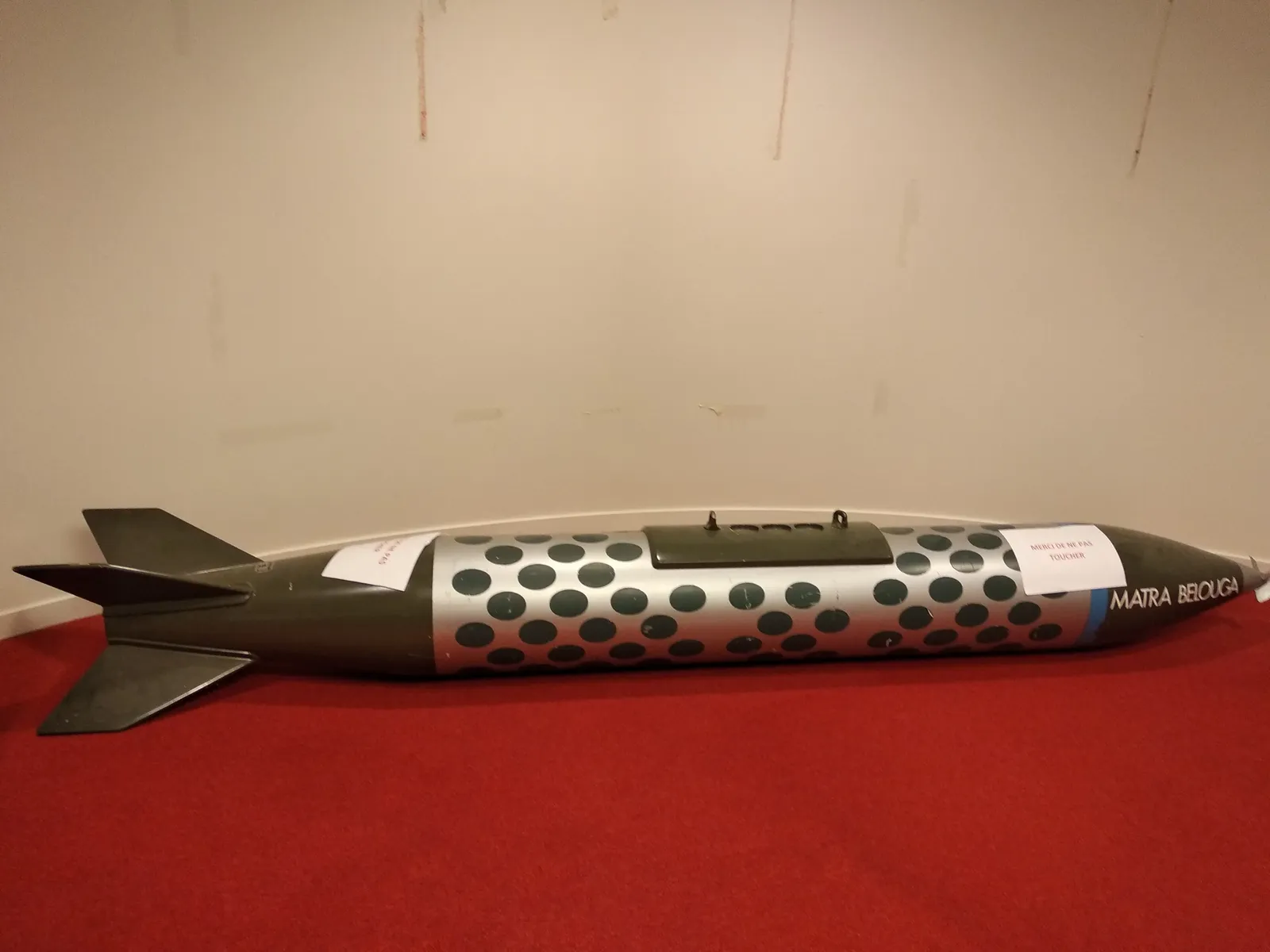
The BLG 66 Belouga is a French low-drag air-dropped cluster bomb that dispenses 151 EG, IZ, or AC 66 mm submunitions from a standard NATO 14-inch attachment. The record covers French Jaguar carriage in the 1990 Gulf War, a disputed Nigerian ECOWAS use allegation from Sierra Leone, and later Boko Haram evidence limited to recovered submunitions reused in improvised explosives.

Role in Conflicts

Side
Sierra Leone government, UN, ECOWAS, and British forces

The Monitor records Sierra Leone allegations that Nigerian ECOWAS peacekeepers used French-produced BLG-66 Belouga cluster bombs at Kenema in December 1997; Nigerian commanders denied the allegation, so this row treats the use as reported rather than uncontested.

Submunition Types

Forecast International breaks the Belouga load into three 66 mm submunition types with different effects. The same dispenser body could carry either the fragmentation, delay, or shaped-charge variant.

TypePrimary effectDocumented detail
EGGeneral-purpose fragmentationFour-millimeter steel penetration at 10 m; described as the main area-effect option.
IZDelayed interdictionDelay-action submunition intended to function later and complicate clearance.
ACAnti-armor shaped chargeForecast International describes it as the shaped-charge option with about 25 cm armor penetration.
Profile / Specs

Profile

Origin
France
Type
Air-dropped cluster bomb and submunition dispenser
Service note
Developed in the 1970s; serial production began in 1979.
Designer
French Ministry of Defense-sponsored Belouga program; Forecast International attributes joint design and coproduction to Giat Industries and Thomson-DASA Armements, while The Monitor and Military Periscope identify Matra as the BLG-66 producer/developer before Matra's absorption into GIAT.
Designed
Development began in 1975
Unit cost
About US$50,670 per complete system in equivalent 1998 dollars; EG, IZ, and AC submunitions were about US$21 each in quantity purchases, according to Forecast International
Produced
Serial production from 1979; production dormant by late 2002
Number built
About 4,905 dispensers and 770,655 submunitions produced by January 2003, according to Forecast International

Specifications

Payload
151 EG, IZ, or AC submunitions per dispenser
Length
3.30 m
Diameter
36 cm
Tail span
58 cm
Loaded weight
245 kg in Forecast International's archived data
Submunition dimensions
6.6 cm diameter by 22.5 cm length
Submunition weight
1.3 kg each
Release envelope
Dropped from as low as 60 m and up to about 550 knots
Footprint
Pattern about 40 m or 60 m wide by 120 m or 240 m long
Attachment
Standard NATO 14-inch attachment
Production, Export, And Retention Context

The Belouga sits in France's former cluster-munition export history rather than a current French production line. The Monitor identifies Matra as the producer of BLG-66 Belouga air-dropped cluster bombs, says France last produced or exported cluster munitions in 2002, and lists Argentina, Cameroon, Greece, and India among past Belouga export recipients.

French production status

France is described as a former user, producer, and exporter of cluster munitions, with BLG-66 production tied to Matra and later French industry changes.

Cameroon retention

Cameroon reported retaining five BLG-66 Belouga bombs and 755 submunitions in 2024 for permitted research and training.

Nigeria caveat

Nigeria's convention reporting says it has no current cluster-munition stocks, while Monitor reporting preserves both older Sierra Leone allegations and later Boko Haram submunition evidence.
Variants

Belouga variant language usually refers to the three 66 mm submunition loads fitted inside the dispenser rather than separate dispenser models.

VariantConfigurationDesignation notes
EG general-purpose fragmentation submunitionFragmentation load

Forecast International describes EG as a percussion-fuzed fragmentation munition with steel-penetration effects at short distance.

Sources: Belouga BLG 66 and EG/IZ/AC Submunitions

IZ delayed-action interdiction submunitionDelayed interdiction load

Forecast International describes IZ as using the EG warhead with a delay fuze that can function hours after delivery.

Sources: Belouga BLG 66 and EG/IZ/AC Submunitions

AC shaped-charge anti-tank submunitionAnti-armor load

Forecast International describes AC as a shaped-charge HEAT submunition with manufacturer-claimed armor perforation of about 25 cm.

Sources: Belouga BLG 66 and EG/IZ/AC Submunitions

Carrier Aircraft

Forecast International lists the Belouga for several tactical aircraft and says it uses a standard NATO 14-inch attachment.

CarrierCarrier typeCarriage evidence
Alpha Jet attack aircraft, Twin-engine advanced trainer and light attack aircraft, Aircraft & UAVsAlpha Jet attack aircraftAttack aircraft

Forecast International lists the Alpha Jet among the aircraft that could carry the Belouga dispenser.

Sources: Belouga BLG 66 and EG/IZ/AC Submunitions

Dassault Mirage III/5, Single-engine delta-wing multirole fighter family, Aircraft & UAVsDassault Mirage III/5Strike fighter

Forecast International lists Mirage III/V/50 aircraft among the Belouga carrier aircraft; this catalog page covers the Mirage III/5 family.

Sources: Belouga BLG 66 and EG/IZ/AC Submunitions

Mirage 2000, Single-engine multirole fighter aircraft, Aircraft & UAVsMirage 2000Multirole fighter

Forecast International lists the Mirage 2000 among the Belouga carrier aircraft.

Sources: Belouga BLG 66 and EG/IZ/AC Submunitions

Dassault Rafale, Twin-engine multirole fighter aircraft, Aircraft & UAVsDassault RafaleMultirole fighter

Forecast International names the Rafale as a compatible carrier for the Belouga dispenser.

Sources: Belouga BLG 66 and EG/IZ/AC Submunitions

Panavia Tornado, Twin-engine variable-sweep wing multirole strike aircraft, Aircraft & UAVsPanavia TornadoStrike aircraft

Forecast International names the Panavia Tornado among the Belouga's carrier aircraft.

Sources: Belouga BLG 66 and EG/IZ/AC Submunitions

SEPECAT Jaguar, Supersonic jet attack aircraft, Aircraft & UAVsSEPECAT JaguarStrike aircraft

Aviation Geek Club reporting on the January 17, 1991 Ahmad Al Jaber attack says some French Jaguar A strike fighters carried four Matra-Thomson BLG 66 Belouga cluster bombs.

Sources: Ahmad al-Jaber airfield attack

Timeline

BLG 66 Belouga Key Events

  1. Development begins, 1975

    Forecast International places the start of Belouga development in 1975 under the French program that led to the BLG 66 family.

    Sources: Belouga BLG 66 and EG/IZ/AC Submunitions

  2. Serial production starts, 1979

    Serial production began in 1979, making the Belouga a late-Cold-War French cluster-bomb dispenser rather than a one-off prototype.

    Sources: Belouga BLG 66 and EG/IZ/AC Submunitions

  3. French Jaguars carry Belouga bombs, 1991

    Specialist aviation reporting, citing Richard P. Hallion's Osprey study, says some French Jaguars carried Matra-Thomson BLG 66 Belouga bombs during the day-one Ahmad Al Jaber airfield attack.

    Sources: Ahmad al-Jaber airfield attack

  4. Reported Kenema strike, 1997

    The Monitor and Handicap International record reported BLG 66 or Beluga cluster-munition use by Nigerian ECOWAS forces in Sierra Leone, with The Monitor also preserving Nigeria's denial.

    Sources: Nigeria: Cluster Munition Ban Policy, Circle of Impact: Sierra Leone

  5. Production is described as dormant, 2002

    Forecast International described production as dormant by late 2002, with any later output tied to specific French Air Force or export demand.

    Sources: Belouga BLG 66 and EG/IZ/AC Submunitions

  6. Boko Haram submunition evidence, 2015

    Monitor reporting tied photographs and Nigerian statements about Boko Haram IED materials to BLG-66 submunitions, while noting uncertainty over whether they came from military stocks or regional smuggling.

    Sources: Nigeria: Cluster Munition Ban Policy, Info RFI: des bombes francaises refont surface aux mains de Boko Haram

Related Weapon Systems
RBG-6, 40x46 mm six-shot revolving grenade launcher, Infantry WeaponsInfantry WeaponsRBG-640x46 mm six-shot revolving grenade launcherThe RBG-6 is a Croatian 40x46 mm shoulder-fired revolving grenade launcher from M Adler D, built around a semi-automatic gas-operated action, a six-round cylinder, and low-velocity grenade ammunition for infantry fire support. Direct Syria reporting documented RBG-6 launchers among opposition weapons flows, while official Croatian export and manufacturer pages describe the weapon's squad-firepower role, sighting arrangement, barrel versions, and ammunition family.
Mk 118 Rockeye submunition, HEAT cluster submunition, MunitionsMunitionsMk 118 Rockeye submunitionHEAT cluster submunitionThe Mk 118 Rockeye is a U.S. high-explosive anti-tank submunition carried in Rockeye-family cluster bombs, including Mk 20, CBU-99, and CBU-100 configurations that release 247 bomblets over an area target. Its shaped-charge warhead and folding fins made it an anti-armor bomblet, while failed functioning creates unexploded-ordnance hazards after a strike. The submunition is documented through Rockeye use in Vietnam, the Gulf War, Kosovo, the 2003 Iraq War, and North Sinai, where Amnesty International linked an unexploded Mk 118 to Egyptian Air Force cluster-munition use during Operation Sinai 2018.
Mortar bombs, 60mm, 60 mm mortar ammunition, MunitionsMunitionsMortar bombs, 60mm60 mm mortar ammunition60 mm mortar bombs are fin-stabilized light mortar rounds made in high-explosive, smoke, illumination, infrared-illumination, and training variants for portable 60 mm mortar tubes. This entry treats the caliber as a family rather than a single national model: Boko Haram/ISWAP evidence is based on recovered rounds and IED adaptation, Myanmar evidence includes both fired and air-dropped mortar rounds, and Ukrainian evidence covers 60 mm mortar shells integrated into FPV strike drones.

Sources