- Side
- South Africa

South African Air Force history describes Mirage III operations during the border war, including attacks that helped stop armoured vehicles before Buccaneer strikes.
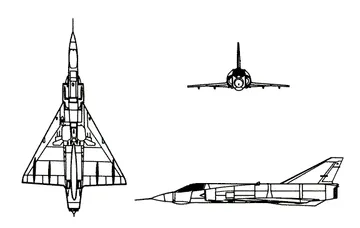
The Dassault Mirage III/5 is a French single-engine, delta-wing fighter family that evolved from the Mirage III interceptor into the Mirage 5 strike derivative. Exported widely and adapted by multiple air arms, it saw combat from the 1967 Six-Day War and 1969 War of Attrition through the Falklands, Paquisha, 1966 South African Border War, and Pakistan's 2019 air crisis.
South African Air Force history describes Mirage III operations during the border war, including attacks that helped stop armoured vehicles before Buccaneer strikes.
Israeli Air Force history says Mirage aircraft were among the service's interceptor squadrons in the 1967 Six-Day War.
Israeli Air Force history says Mirage III models continued to bear the brunt during the 1969 War of Attrition.
Pakistan Air Force history says the Mirages spearheaded retaliation from the west during the 1971 war.
Israeli Air Force history says Mirage pilots flew combat sorties in the 1973 Yom Kippur War and scored air-to-air victories.
Peruvian reporting says Mirage 5P aircraft flew 68 missions during the Falso Paquisha fighting.
Argentine armed-forces history describes Mirage IIIEA combat missions during the Malvinas / Falklands fighting.
Pakistan Air Force history says Mirages supported the army against tribesmen in North and South Waziristan.
Pakistan Air Force reporting described dual-seat Mirage IIIDAs guiding H-4 SOW glide bombs by data link during Operation Swift Retort.
Dassault used the Mirage III/5/50 family name for a broad set of delta-wing fighters, trainers, reconnaissance aircraft, strike derivatives, and national subvariants built from the same design line.
| Variant | Configuration | Designation notes |
|---|---|---|
| Mirage IIIA | pre-production Mach 2 development aircraft | Dassault says the French state ordered ten pre-production Mirage IIIA aircraft in 1957 and that Mirage IIIA 01 first flew on May 12, 1958. Sources: Mirage III origins, characteristics and performance data |
| Mirage IIIB | dual-control two-seat trainer | The IIIB lengthened the fuselage for a second crew member and moved equipment into a non-radar nose. Sources: Mirage III origins, characteristics and performance data |
| Mirage IIIC | interceptor | Dassault identifies the IIIC as the interceptor version and places French operational service in December 1961. Sources: Mirage III origins, characteristics and performance data |
| Mirage IIIE | low-altitude strike version | The IIIE was lengthened for navigation and attack electronics, used the Atar 9C engine, and first flew on April 5, 1961. Sources: Mirage III origins, characteristics and performance data |
| Mirage IIID | export designation connected to the IIIE line | Dassault describes the IIID as the export version of the Mirage IIIE, while the RAAF used Mirage IIID for its two-seat operational trainers. Sources: Mirage III origins, characteristics and performance data, RAAF A3 Dassault Mirage III history |
| Mirage IIIR/RD | tactical reconnaissance versions | The IIIR was specialized for day or night tactical reconnaissance at low and medium altitude; Dassault also lists the RD with the same navigation system as the IIIE. Sources: Mirage III origins, characteristics and performance data |
| Mirage IIIO | Australian IIIE-based fighter-bomber | The RAAF history says Australia ordered 100 Mirage IIIO fighter-bombers and 16 Mirage IIID two-seat trainers; IIIO(F) interceptors and IIIO(A) ground-attack variants were later distinguished by radar and low-level attack equipment. Sources: RAAF A3 Dassault Mirage III history |
| Mirage 5 | simplified low-altitude tactical support and patrol derivative | Dassault says the Mirage 5 was defined in 1965 as a simplified Mirage IIIE derivative with attack/navigation equipment in place of radar, more fuel capacity, and more attachment points for external loads. Sources: Mirage 5 origins, characteristics and performance data |
| Mirage III NG | new-generation prototype | Dassault says the Mirage III NG effort used a Mirage 50 airframe, canards, electronic controls, and the Snecma Atar 9K50, but was not exported. Sources: Mirage III origins, characteristics and performance data |
Pakistan Air Force Mirage III/5 aircraft are documented as carriers for the H-2/H-4 stand-off glide-bomb family.
| Carried item | Item type | Carriage evidence |
|---|---|---|
 | Rocket-boosted glide bomb | Dawn reported that H-4 bombs could be carried by Mirage fighter jets, and Quwa described H-4 as the 120 km member of the H-2/H-4 family deployed from PAF Mirage III/5 fighter-bombers. Sources: Dawn: PAF adds new bombs to its arsenal, Quwa: Pakistan's Force Multipliers (Part 2): Precision-guided bombs |
| Shorter-range glide bomb | Dawn identified H-2 as the lighter 60 km member of the family that could be carried by Mirage fighter jets, while Quwa described H-2 and H-4 as Mirage III/5-deployed stand-off weapons. Sources: Dawn: PAF adds new bombs to its arsenal, Quwa: Pakistan's Force Multipliers (Part 2): Precision-guided bombs |
Pakistan's Mirage 5PA3 anti-shipping role is documented separately from the H-2/H-4 strike-bomb fit.
| Carried item | Item type | Carriage evidence |
|---|---|---|
 | Air-launched anti-ship missile | Quwa described the Mirage 5PA3 as able to carry the MBDA AM39 Exocet anti-ship missile and noted its role as a Pakistan Air Force anti-surface-warfare asset before the C-802-equipped JF-17. Sources: Quwa: Pakistan's Mirages, Specialists Enduring out of Necessity |
Dawn and Quwa connect Pakistan's Mirage fleet to named stand-off and anti-ship weapons, with the strongest source-backed internal links pointing to the H-2, H-4, and AM39 Exocet records.
| Munition | Class | Documented relationship |
|---|---|---|
| 60 km-class glide bomb | Dawn described H-2 as the lighter family member and said H-2/H-4 bombs could be carried by Mirage fighters before JF-17 induction; Quwa lists H-2 among PAF Mirage III/5-deployed stand-off weapons. |
| 120 km-class rocket-boosted glide bomb | Dawn reported H-4 integration into PAF fighter aircraft and Mirage carriage; Quwa describes H-4 as the longer-range member currently deployed from Mirage III/5 fighter-bombers. |
| Air-launched anti-ship missile | Quwa identifies the Mirage 5PA3 as an AM39 Exocet carrier in Pakistan's anti-surface-warfare role. |
Dassault traces the Mirage III to a late-1955 design derived from the Mirage I delta formula and shaped around an area-ruled fuselage.
Sources: Mirage III origins, characteristics and performance data
Dassault places the Mirage III 001 first flight at Melun-Villaroche on November 17, 1956.
Sources: Mirage III origins, characteristics and performance data
Dassault says Mirage IIIA 01 first flew on May 12, 1958, after the French state ordered ten pre-production Mirage IIIA aircraft.
Sources: Mirage III origins, characteristics and performance data
Dassault says the Mirage IIIC entered operational service with the French Air Force on December 19, 1961.
Sources: Mirage III origins, characteristics and performance data
Dassault says its technical management defined the Mirage 5 as a simplified Mirage IIIE for low-altitude tactical support and patrol work on July 9, 1965.
Sources: Mirage 5 origins, characteristics and performance data
Dassault places the Mirage 5 first flight at Melun-Villaroche on May 19, 1967.
Sources: Mirage 5 origins, characteristics and performance data
Israeli Air Force history says Mirage aircraft served in interceptor squadrons during the 1967 Six-Day War.
Sources: Mirage III origins, characteristics and performance data, IAF Mirage and the 1967 Six-Day War
Pakistan Air Force history says the Mirages spearheaded retaliation from the west during the 1971 war.
Sources: Pakistan Air Force History
Peruvian reporting says Mirage 5P aircraft flew 68 missions during the Falso Paquisha fighting.
Sources: El Peruano: Mirage 5P and Paquisha
Dassault says the Mirage III NG first flew on December 21, 1982, after a canard-equipped Mirage 50 testbed validated the new-generation work.
Sources: Mirage III origins, characteristics and performance data
Quwa reported that Pakistan Air Force Mirage IIIDAs guided H-4 SOW glide bombs by data link during Operation Swift Retort.
Sources: Pakistan's Mirages: Today's Success and Tomorrow's Roadmap