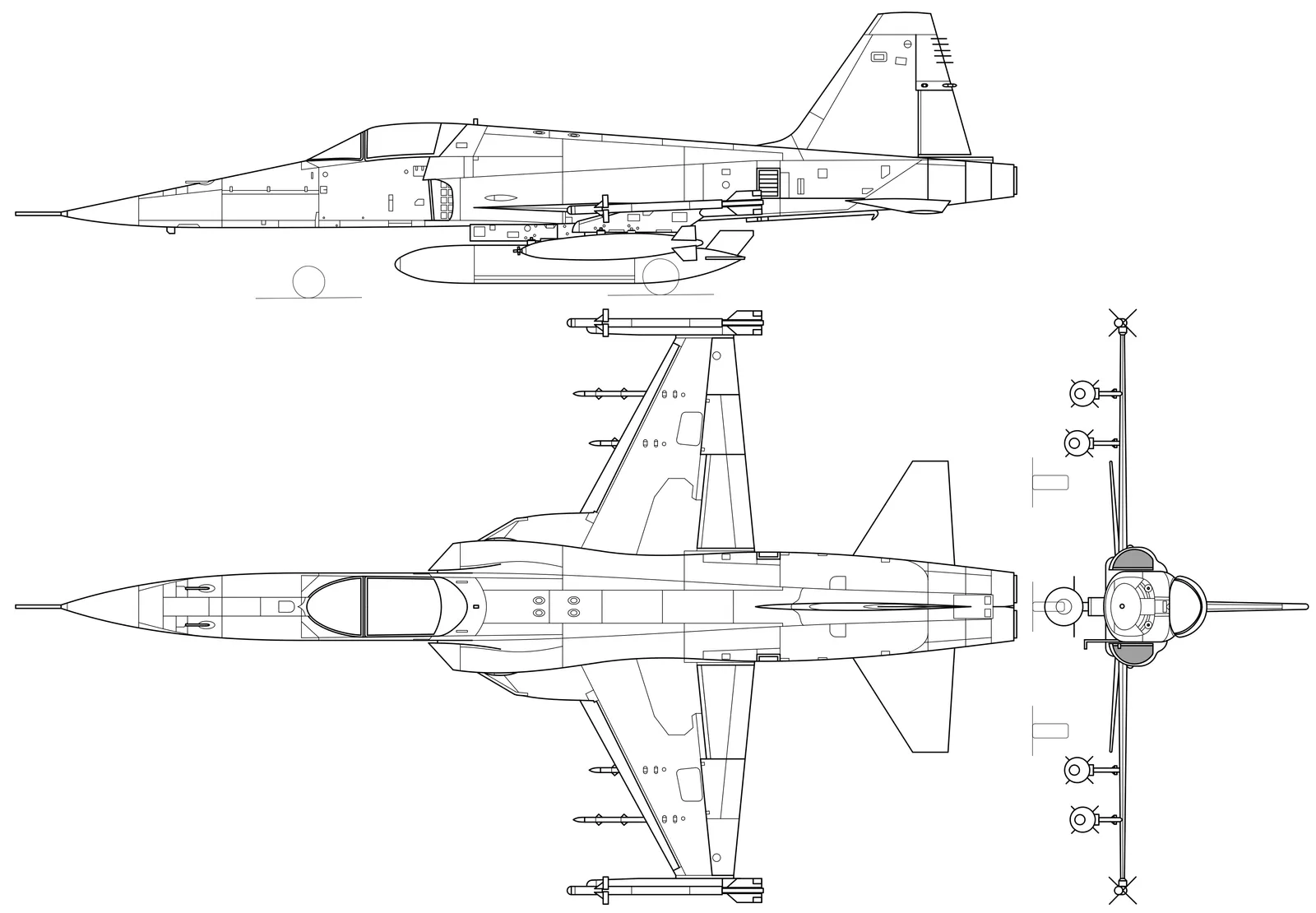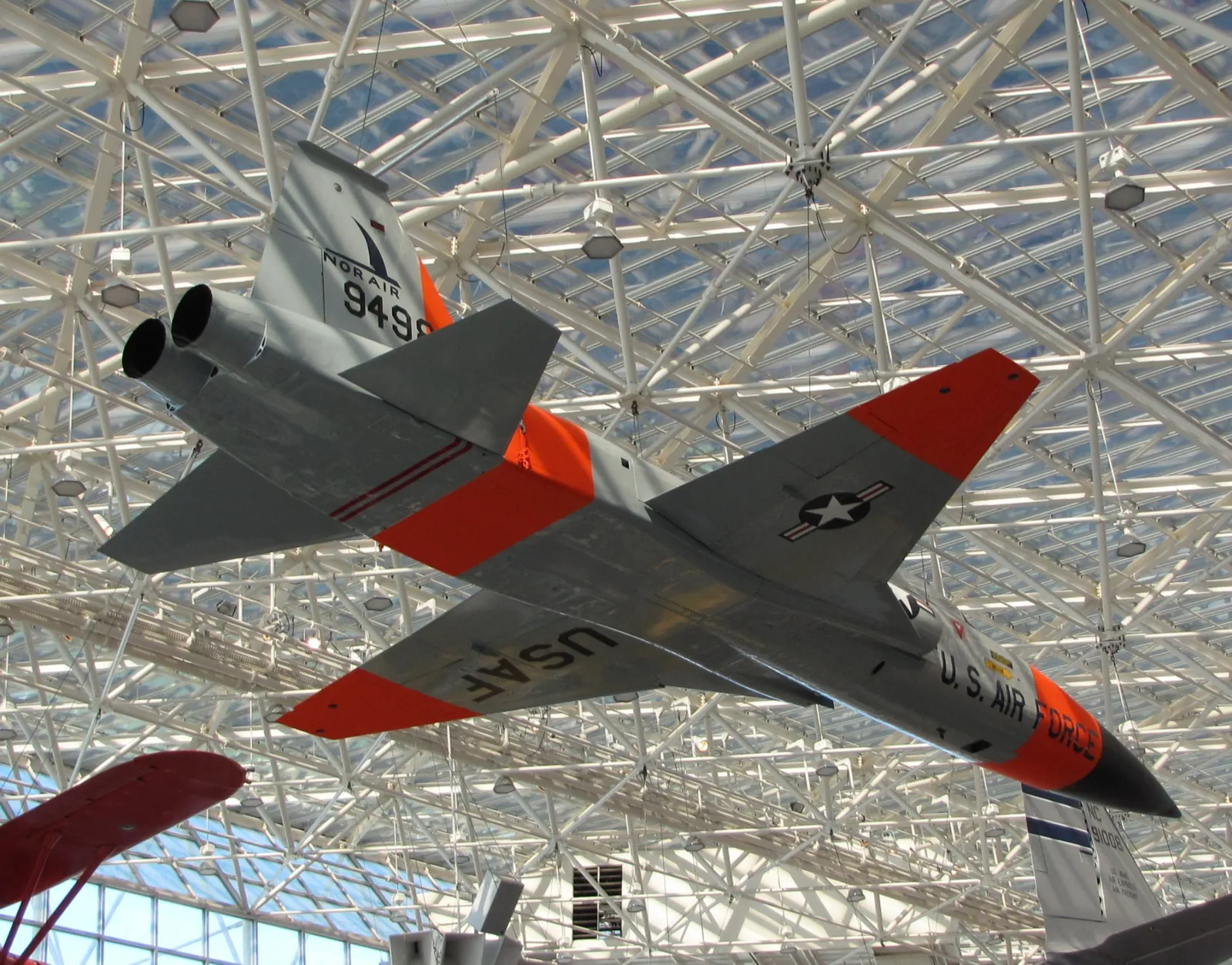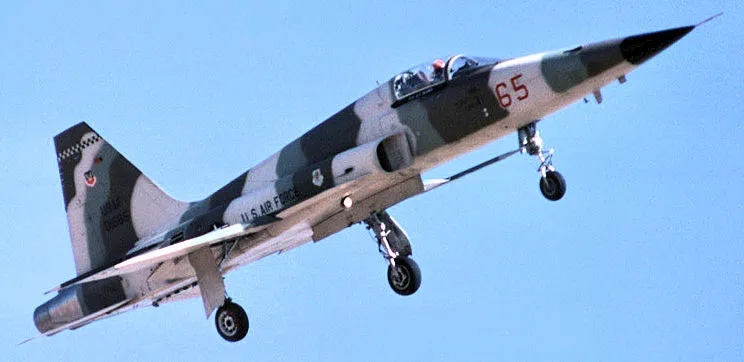
- Side
- United States and South Vietnam


USAF F-5C Skoshi Tiger aircraft were combat-tested in Vietnam from 1965 to 1967, then surviving aircraft were transferred to the South Vietnamese air force for continued F-5 operations.
The Northrop F-5 Freedom Fighter / Tiger II is a lightweight supersonic fighter family developed by Northrop for export customers, low operating cost, and easy support. The later F-5E/F Tiger II and F-5N/F adversary aircraft kept the design relevant through radar, structural, avionics, and training-role upgrades, while combat use spans Vietnam, Iran, Yemen, North Africa, and other source-limited air-war records.
USAF F-5C Skoshi Tiger aircraft were combat-tested in Vietnam from 1965 to 1967, then surviving aircraft were transferred to the South Vietnamese air force for continued F-5 operations.
Vietnam operated captured F-5s after 1975, and open reference material describes the type being used in ground-attack sorties against Khmer Rouge forces.
Ethiopian F-5 fighters saw combat against Somali forces during the 1977 Ogaden War, with F-5A and F-5E aircraft forming a central part of Ethiopia's fighter force.
Iranian F-5s remained in service after the 1979 revolution and were heavily involved in 1980 Iran-Iraq War sorties, including air combat and air-to-ground missions.
U.S. diplomatic reporting during the Sahara conflict discussed Moroccan F-5 aircraft stationed for Sahara operations, with later open references tying Moroccan F-5s to reconnaissance and bombing missions.
North Yemeni F-5E Tiger IIs saw combat during the 1994 civil war, including reported air-to-air engagements with South Yemeni aircraft and helicopters.
Yemeni F-5Es were used by government forces against Houthi rebels during the 2004 Houthi Insurgency before the broader 2015 intervention phase.
Royal Saudi Air Force F-5Es flew 1990 Gulf War close-air-support and aerial-interdiction missions against Iraqi forces in Kuwait; one Saudi F-5E was lost to ground fire in February 1991.
Role detailsSomalia operated a small F-5 fleet that is tied to the country's air arm and broader civil-war-era combat aviation record.
Tunisian F-5s were used from 2013 in strike missions supporting operations around Mount Chaambi against Ansar al-Sharia and al-Qaeda-linked militants.
During the 2026 Iran War, Janes reported Iranian F-5 pilot claims tied to bomb releases over Camp Buehring in Kuwait.
The F-5 family is best read as a set of export fighter, combat-test, reconnaissance, and adversary-training branches rather than a single fixed configuration.
| Branch | Configuration | Source-backed distinction |
|---|---|---|
| F-5A/B Freedom Fighter | Original fighter and trainer | The museum record ties the F-5A/B to allied training, ground-support and interception use, with the F-5B first flying in February 1964. |
| F-5C Skoshi Tiger | Vietnam combat-test aircraft | USAF F-5s were combat-tested in Vietnam during 1965-1967 and then handed over to the South Vietnamese air force. |
| F-5E/F Tiger II | Improved Tiger II family | The later Tiger II branch underpins many export combat fleets and the two-seat F-5F first flew at Edwards on September 25, 1974. |
| RF-5 Tigereye | Reconnaissance derivative | Northrop support material treats RF-5 reconnaissance aircraft as part of the F-5 structural-upgrade and support population. |
| F-5N/F | Adversary conversion | U.S. Navy fact data describes F-5N/F aircraft as Swiss-origin conversions with modernized systems for Navy and Marine Corps adversary training. |
This page covers the original F-5A/B Freedom Fighter, the Vietnam F-5C Skoshi Tiger combat-test configuration, the later F-5E/F Tiger II, reconnaissance RF-5 derivatives, and U.S. Navy/Marine Corps F-5N/F adversary conversions.
| Variant | Configuration | Designation notes |
|---|---|---|
| F-5A Freedom Fighter | Single-seat export fighter | Original Freedom Fighter model used for allied pilot training and ground-support or interception missions. Sources: Northrop YF-5A Freedom Fighter |
| F-5B Freedom Fighter | Two-seat combat trainer | Two-place trainer version that first flew in February 1964. Sources: Northrop YF-5A Freedom Fighter |
| F-5C Skoshi Tiger | Vietnam combat-test aircraft | USAF F-5A aircraft modified for the Skoshi Tiger combat evaluation and later transferred to the South Vietnamese air force. Sources: Northrop YF-5A Freedom Fighter |
| F-5E Tiger II | Improved single-seat Tiger II | Second-generation F-5 family member with greater capability and long-running export, training, and adversary use. |
| F-5F Tiger II | Two-seat Tiger II | Two-seat F-5E-family trainer with a new fuselage; Edwards AFB records its first flight on September 25, 1974. Sources: This week in Edwards history, F-5 Tiger II |
| RF-5 Tigereye | Reconnaissance derivative | Reconnaissance F-5 derivative identified by Northrop support material and RF-5 structural-upgrade coverage. Sources: F-5 Tiger Fighter Jet |
| F-5N/F adversary aircraft | U.S. Navy and Marine Corps adversary conversion | Low-hour Swiss F-5E/F aircraft updated to U.S. Navy and Marine Corps F-5N/F adversary standards, with later ARTEMIS F-5N+/F+ modernization. Sources: F-5N/F Adversary Aircraft, Navy F-5 modernization program |
Museum and manufacturer records document F-5E/F carriage or provisions for short-range air-to-air and air-to-surface missiles.
| Carried item | Item type | Carriage evidence |
|---|---|---|
 | Short-range air-to-air missile | The National Museum of the U.S. Air Force identifies F-5E and F-5F aircraft carrying AIM-9 Sidewinder-family missiles. Sources: Northrop F-5E AIM-9 photo, Northrop F-5F AIM-9J and AGM-65 photo |
 | Air-to-surface missile | Northrop Grumman describes F-5 wing upgrade provisions for Maverick missiles, and the Air Force museum identifies an F-5F carrying AGM-65 Maverick missiles. Sources: F-5 Tiger Fighter Jet, Northrop F-5F AIM-9J and AGM-65 photo |
The National Museum of the U.S. Air Force places the F-5's first flight in July 1959.
Sources: Northrop YF-5A Freedom Fighter
The two-place F-5B combat trainer first flew in February 1964.
Sources: Northrop YF-5A Freedom Fighter
Deliveries to Tactical Air Command for training foreign F-5 pilots began in April 1964.
Sources: Northrop YF-5A Freedom Fighter
USAF Skoshi Tiger F-5s were combat-tested in Vietnam from 1965 to 1967 before handover to the South Vietnamese air force.
Sources: Northrop YF-5A Freedom Fighter
Northrop's F-5F made its first flight at Edwards as the two-seat trainer version of the F-5E Tiger II.
Sources: This week in Edwards history
The War Zone's history of Yemen's F-5Es places the type in North Yemeni service by 1979, before the later civil-war era.
Sources: The Intriguing Story Of How Yemen Got F-5E Tiger II Fighters
The War Zone reports Yemeni F-5Es flying in the 1994 civil war, including air combat against South Yemeni aircraft and helicopters.
Sources: The Intriguing Story Of How Yemen Got F-5E Tiger II Fighters
Northrop's F-5 page identifies 1989 as the final delivery year for the production line.
Sources: F-5 Tiger Fighter Jet
Navy fact data lists 2003 for F-5N deployment in the U.S. adversary aircraft role.
Sources: F-5 Tiger II
NAVAIR's F-5N+/F+ ARTEMIS program reached Milestone C, moving the upgrade program toward production and deployment.
Sources: Navy F-5 modernization program
Janes reported Iranian F-5 activity in the 2026 Iran War, including claims tied to the Kuwait attack reporting and subsequent airbase strikes.
Sources: Iran conflict 2026: Iranian F-5 pilots claim credit for Kuwaiti friendly fire shootdowns