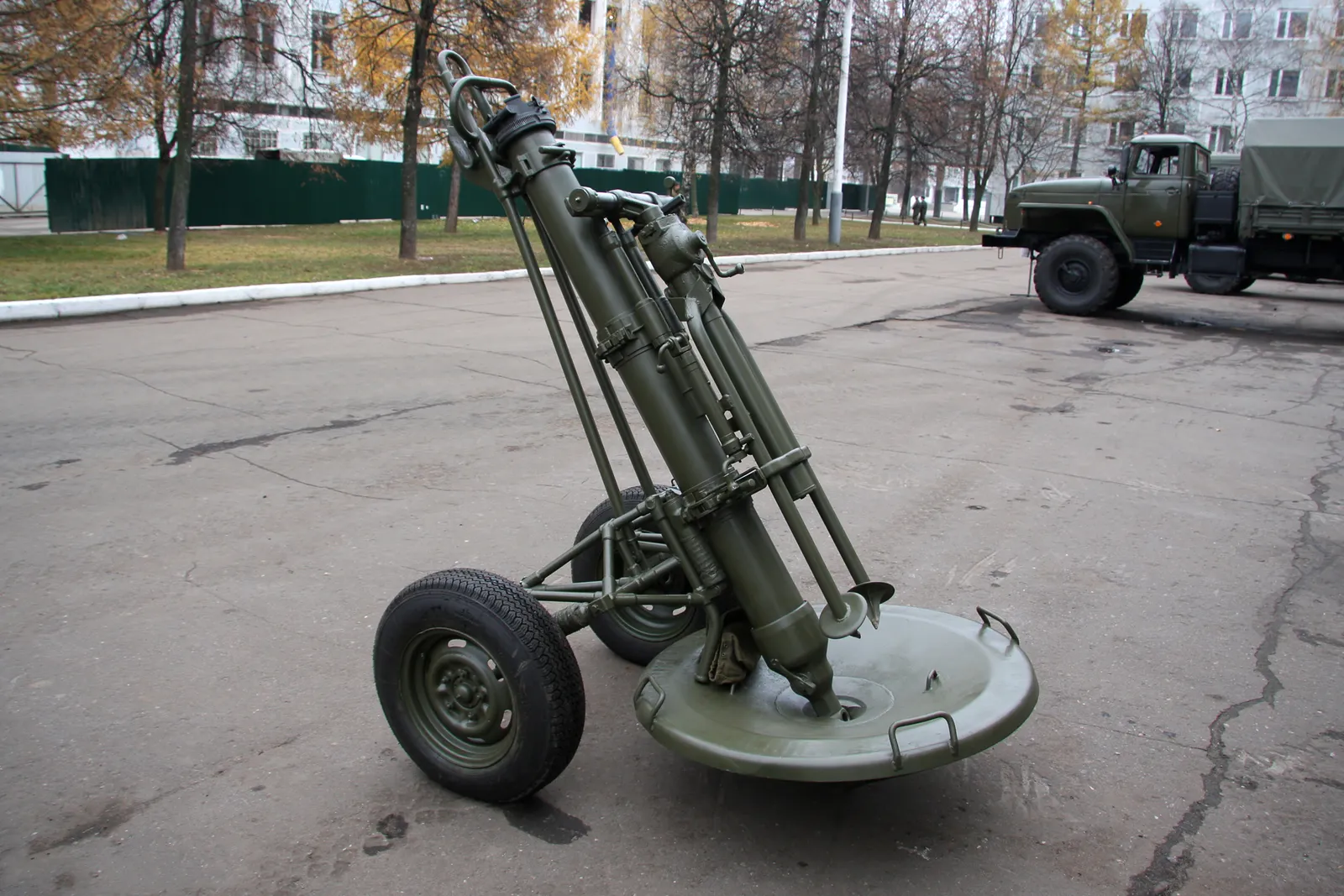


OSCE SMM reports observed 2B11 or probable 2B11/2S12 Sani mortars in non-government-controlled Luhansk-region firing positions, 2S12 Sani mortars near government-controlled Orikhuvatka, and a 2B11 Sani in government-controlled Hnutove; full-scale-invasion reporting also documents Ukrainian capture of a Russian 2S12A/2B11 mortar and Russian 2F510 Sani transport-vehicle losses.
Role detailsArtillery
2S12 Sani
Also known as
- 120mm 2B11 Sani
- 120 mm 2B11 Sani
- 120-mm 2B11 Sani
- 2B11 / 2S12 Sani
- 2S12A Sani
- 2B11 Sani
- 2B11
- 2Б11
- 2Б11 Сани
- Sani mortar
- 2C12A
- 2C12A Mortar System
- 2С12 Сани
- 2С12А Сани
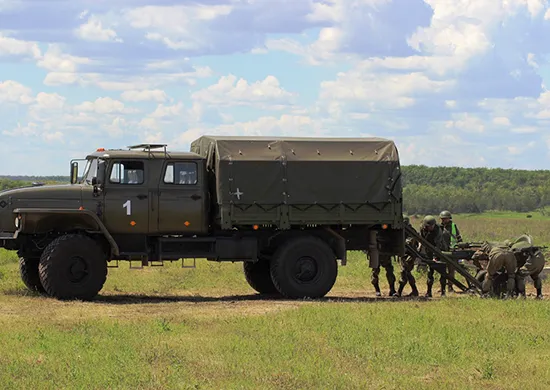
The 2S12 Sani is a Soviet/Russian 120 mm mortar system built around the 2B11 mortar, a wheeled carriage, and a dedicated transport vehicle. The system gives battalion-level units mobile indirect fire out to about 7 km, while the modernized 2S12A uses an Ural-based vehicle and has been documented in Russian deliveries, monitored firing-position reports, captures, and equipment losses during the 2014 Russia-Ukraine War.
Role in Conflicts
Profile / Specs
Profile
- Origin
- Soviet Union / Russia
- Type
- 120 mm heavy mortar system
- Service note
- Introduced in 1981; upgraded 2S12A batches remain in Russian service
- Designer
- TsNII Burevestnik is identified in official 2S12A/2C12A documentation
- Designed
- 1981
- Unit cost
- Not publicly reported
- Produced
- 1980s-present for original and modernized production batches
- Number built
- More than 1,500 reported in open references
Specifications
- Caliber
- 120 mm
- Primary weapon
- 2B11 smoothbore mortar
- Maximum range
- More than 7 km; Rostec cites an effective range above 7 km
- Rate of fire
- Up to 15 rounds per minute for the 2B11 mortar
- Crew
- Five-person crew in Rosoboronexport's 2C12A vehicle data; Rosgvardia lists a six-person combat crew including driver
- Mobility
- Original 2S12 uses a 2L81 wheeled carriage and 2F510 GAZ-66-based transport; 2S12A uses an Ural-based transport vehicle with an electric winch
- Ammunition
- 120 mm high-explosive fragmentation, smoke, illumination, incendiary, and compatible guided mortar bombs
- Modernized transport
- 2S12A/2C12A uses an Ural-based transport vehicle; Rosoboronexport lists the 2F510A vehicle with 56 rounds carried, 85 km/h maximum road speed, and 1,080 km cruising range
- 2B11 weight
- 230 kg in combat position and 360 kg in travel position in Rosoboronexport's 2C12A data
System Layout
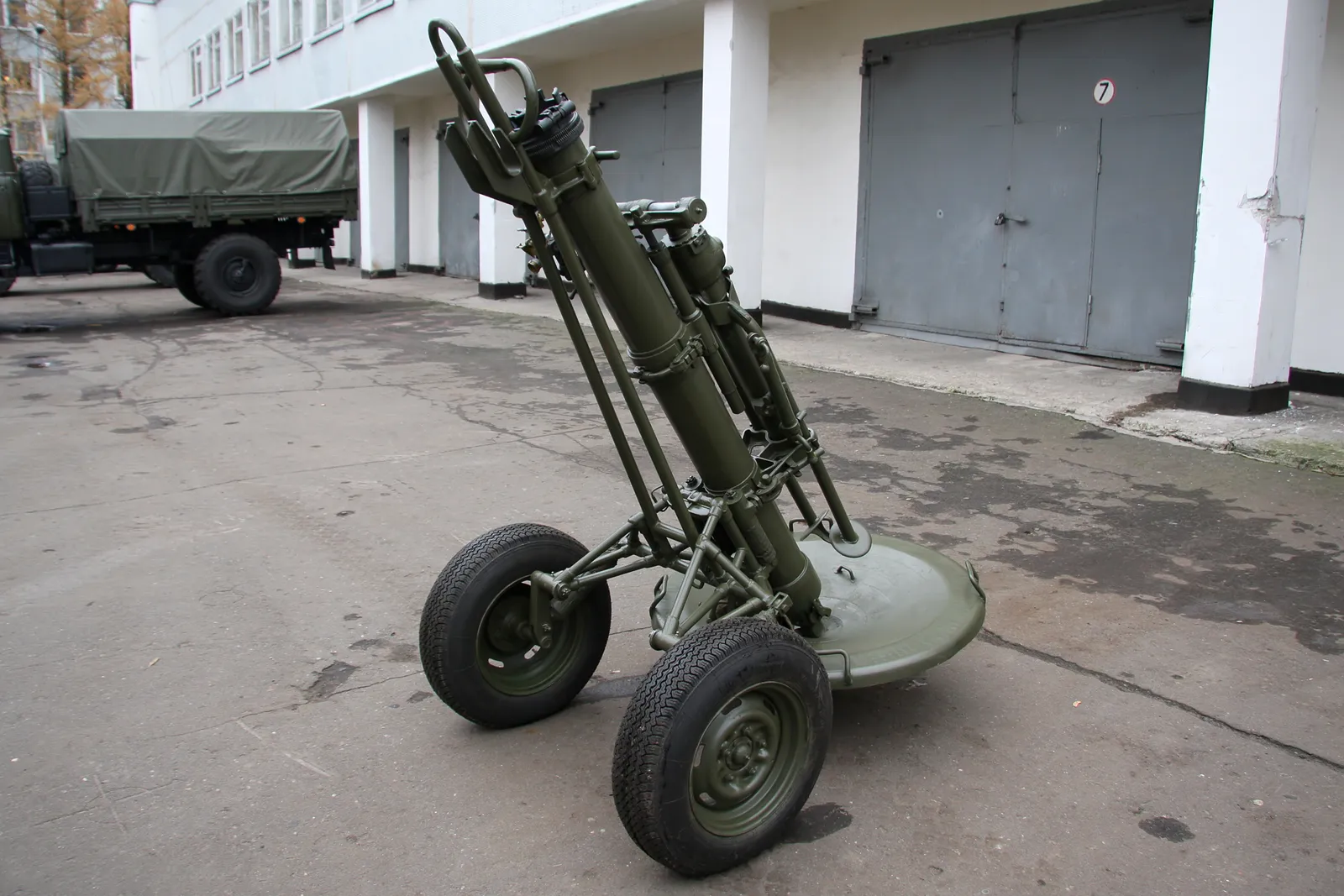
The 2S12 designation describes a mortar-and-transport system rather than a single tube. The fielded package combines the 2B11 mortar, 2L81 carriage, transport vehicle, crew, and ammunition handling arrangements that let the mortar move between firing positions.
| Element | Documented role | Notes |
|---|---|---|
| 2B11 mortar | 120 mm smoothbore mortar | Core weapon; Rostec describes separate 2B11 towed-mortar deliveries alongside upgraded Sani systems. |
| 2L81 carriage | Two-wheel mortar carriage | Rosgvardia and Rosoboronexport list the 2L81 as the wheeled carriage in the modernized package. |
| 2F510 transport vehicle | Original 2S12 transport | WeaponSystems.net identifies the original 2S12 transport vehicle as the 2F510 based on the GAZ-66 4x4 truck. |
| 2F510A transport vehicle | Modernized 2S12A/2C12A transport | Rosoboronexport lists the modernized package with a 2F510A transport vehicle, 56-round vehicle load, five-person crew, and electric-winch loading. |
Sources: Rostec has Delivered a Next Batch of Mobile Mortars to the Army; Rosgvardia 2S12A Sani Mortar System; Rosoboronexport 120mm 2C12A Mortar System; 120mm 2B11 Sani.
Variants
The Sani family is a designation stack: 2B11 is the 120 mm mortar, 2S12 is the complete mortar-and-transport system, and 2S12A, also rendered 2C12A in some export and Russian-language material, denotes the modernized Ural-based package.
| Variant | Configuration | Designation notes |
|---|---|---|
| 2B11 | 120 mm mortar component | The 2B11 is the smoothbore mortar carried within the 2S12/2S12A system and is also delivered as a separate towed mortar. Sources: 2B11 Sani Russian 120mm Towed Mortar, Rostec has Delivered a Next Batch of Mobile Mortars to the Army |
| 2S12A / 2C12A Sani | Modernized mobile system | The 2S12A/2C12A modernization keeps the 2B11 mortar and 2L81 carriage but uses an Ural-based transport vehicle with winch-assisted loading; Rosgvardia identifies an Ural-43206 chassis and Rosoboronexport names the 2F510A transport vehicle. Sources: Rostec has Delivered a Next Batch of Mobile Mortars to the Army, Rosgvardia 2S12A Sani Mortar System, Rosoboronexport 120mm 2C12A Mortar System |
Compatible Ammunition
The 2B11 ammunition table names HE/FRAG rounds for the mortar family used by the 2S12 Sani, and Rosoboronexport catalogs KM-8 Gran as a compatible 120 mm guided round.
| Ammunition | Ammunition type | Firing evidence |
|---|---|---|
 | 120 mm high-explosive fragmentation mortar bomb | The 2B11 ammunition table lists 3OF34 as a HE/FRAG round with a 16.1 kg mass, 3.43 kg explosive fill, and about 7.1 km maximum range. Sources: 2B11 Ammunition Table |
 | 120 mm HE/FRAG mortar bomb | The 2B11 ammunition table lists 3OF36 as a HE/FRAG round for the mortar family used within the 2S12 Sani. Sources: 2B11 3OF36 Ammunition Table |
 | 120 mm HE/FRAG mortar bomb | Arcus lists the VOF-843B family as designed for 120 mm smooth-bore mortars including the 2B11 and 2S12 Sani. Sources: 2B11 Ammunition Table, 120mm HE Mortar Bomb VOF-843B |
 | 120 mm guided mortar round | Rosoboronexport says KM-8 Gran is intended for smooth-bore and rifled 120 mm mortars, which includes the 2S12 Sani system. Sources: Rosoboronexport Land Forces Weapons Export Catalogue |
Timeline
2S12 Sani Key Events
2B11/2S12 family enters service
Defense Express describes the Soviet-designed 2B11 as entering service in 1981, while WeaponSystems.net ties the original 2S12 Sani transport system to the 2B11 mortar and 2F510 GAZ-66-based vehicle.
Sources: Defense Express Rostec 2S12A Sani Deliveries, 120mm 2B11 Sani
OSCE observes probable Sani mortars in Donbas firing positions
An OSCE SMM mini-UAV spotted probable 2B11/2S12 Sani mortars in firing positions in a non-government-controlled area near Donetskyi.
Sources: OSCE SMM Daily Report 28 July 2018
ArmyInform reports captured 2S12A Sani complex
ArmyInform reported that Ukrainian troops captured a Russian 2S12A Sani mortar complex during a counteroffensive.
Sources: ArmyInform Ukrainian Troops Capture 2S12A Sani
Rostec announces new Sani and 2B11 deliveries
Rostec announced delivery of upgraded 2S12A Sani systems, 2B11 towed mortars, and 2B24 light mortars to the Russian Ministry of Defence.
Sources: Rostec has Delivered a Next Batch of Mobile Mortars to the Army
Related Weapon Systems


Sources
2B11 Ammunition TablePublisher: Wikipedia | Note: Supports the 2B11 ammunition table listing HE/FRAG rounds such as 3OF34 and 53-OF-843B for the mortar family used by the 2S12 Sani. | Accessed: 2026-07-082B11 3OF36 Ammunition TablePublisher: Wikipedia | Note: Supports the 2B11 ammunition table listing 3OF36 as a HE/FRAG round for the mortar family used by the 2S12 Sani. | Accessed: 2026-07-082B11 Sani Russian 120mm Towed MortarPublisher: U.S. Army ODIN Worldwide Equipment Guide | Note: Supports background for the 2B11 mortar as the 120 mm Soviet-developed mortar used within the Sani system. | Accessed: 2026-07-08120mm 2B11 SaniPublisher: WeaponSystems.net | Note: Supports system composition, including the 2B11 mortar, 2L81 carriage, 2F510 vehicle, and 2S12A Ural-based modernization. | Accessed: 2026-07-08Rostec has Delivered a Next Batch of Mobile Mortars to the ArmyPublisher: Rostec | Note: Supports the 22 July 2024 delivery announcement for upgraded 2S12A Sani systems and 2B11 mortars, plus Ural-based mobility, electric-winch unloading, range, ammunition capacity, and current Russian production/supply context. | Accessed: 2026-07-08Rosgvardia 2S12A Sani Mortar SystemPublisher: Federal Service of the National Guard Troops of the Russian Federation | Note: Supports 2S12A composition as a 2B11 mortar, 2L81 wheeled carriage, and Ural-43206-based transport vehicle, plus Motovilikha Plants as manufacturer and TsNII Burevestnik as developer. | Accessed: 2026-07-08Rosoboronexport 120mm 2C12A Mortar SystemPublisher: Rosoboronexport | Note: Supports official 2C12A composition, 2B11 mortar and 2L81 carriage relationship, 2F510A transport vehicle, crew, ammunition load, road speed, cruising range, mortar weights, and mission profile. | Accessed: 2026-07-08Defense Express Rostec 2S12A Sani DeliveriesPublisher: Defense Express | Note: Supports Russian 2S12A Sani and 2B11 mortar delivery context, with background on the 2B11 entering service in 1981 and the Ural-based Sani transport arrangement. | Accessed: 2026-07-08OSCE SMM Daily Report 28 July 2018Publisher: Organization for Security and Co-operation in Europe | Note: Directly documents probable 2B11/2S12 Sani mortars in firing positions in a non-government-controlled area during the 2014 Russia-Ukraine War. | Accessed: 2026-07-08OSCE SMM Daily Report 22 December 2016Publisher: Organization for Security and Co-operation in Europe | Note: Directly documents ten 2S12 Sani 120 mm mortars loaded on a trailer truck near government-controlled Orikhuvatka during the 2014 Russia-Ukraine War. | Accessed: 2026-07-08OSCE SMM Daily Report 5 March 2018Publisher: Organization for Security and Co-operation in Europe | Note: Directly supports 2014 Russia-Ukraine War use by documenting four 2B11 Sani 120 mm mortars in firing positions near Vesela Hora in a non-government-controlled area, with nearby trucks assessed as carrying mortar ammunition crates. | Accessed: 2026-07-08OSCE SMM Daily Report 13 August 2019Publisher: Organization for Security and Co-operation in Europe | Note: Directly documents a 2B11 Sani 120 mm mortar in government-controlled Hnutove during the 2014 Russia-Ukraine War. | Accessed: 2026-07-08ArmyInform Ukrainian Troops Capture 2S12A SaniPublisher: ArmyInform | Note: Direct 2014 Russia-Ukraine War source for Ukrainian troops capturing a Russian 2S12A Sani mortar complex; also supports 2S12A modernization, 2B11 component, range, rate of fire, and Ural-based transport details. | Accessed: 2026-07-08Oryx Russian Equipment Losses in UkrainePublisher: Oryx | Note: Direct 2014 Russia-Ukraine War loss source documenting Russian 2F510 transport vehicles for the 2S12 Sani mortar on the Ural-43206 chassis. | Accessed: 2026-07-08Army Recognition 2S12A Sani Ukraine Delivery ContextPublisher: Army Recognition | Note: Directly supports 2014 Russia-Ukraine War Russian supply context by reporting the 2024 Rostec 2S12A Sani and 2B11 delivery as a delivery to Russian forces in Ukraine and by placing the system in the Ukrainian-conflict context. | Accessed: 2026-07-08120mm HE Mortar Bomb VOF-843BPublisher: Arcus JSC | Note: Supports the VOF-843B mortar-bomb family's 120 mm smooth-bore mortar compatibility, including 2B11 and 2S12 SANI. | Accessed: 2026-07-08File:2S12 Sani (heavy mortar system).jpgPublisher: Wikimedia Commons | Note: Supports image provenance and licensing for the primary 2S12 Sani photograph by Vitaly V. Kuzmin under CC BY-SA 4.0. | Accessed: 2026-07-08File:2S12 Sani (heavy mortar system) 2.jpgPublisher: Wikimedia Commons | Note: Supports image provenance and licensing for an additional 2S12 Sani photograph by Vitaly V. Kuzmin under CC BY-SA 4.0. | Accessed: 2026-07-08File:2S12A - Masters of artillery fire - 2017.jpgPublisher: Wikimedia Commons | Note: Supports image provenance and licensing for a 2S12A mortar training photograph from Mil.ru under CC BY 4.0. | Accessed: 2026-07-08Rosoboronexport Land Forces Weapons Export CataloguePublisher: Rosoboronexport | Note: Supports the KM-8 Gran compatibility claim for smooth-bore and rifled 120 mm mortars, plus the round's catalogued specs. | Accessed: 2026-07-08