- Side
- Iran

Iran used ballistic missiles, drones, and artillery against Iranian Kurdish opposition groups in northern Iraq during the September-November 2022 strike campaign.
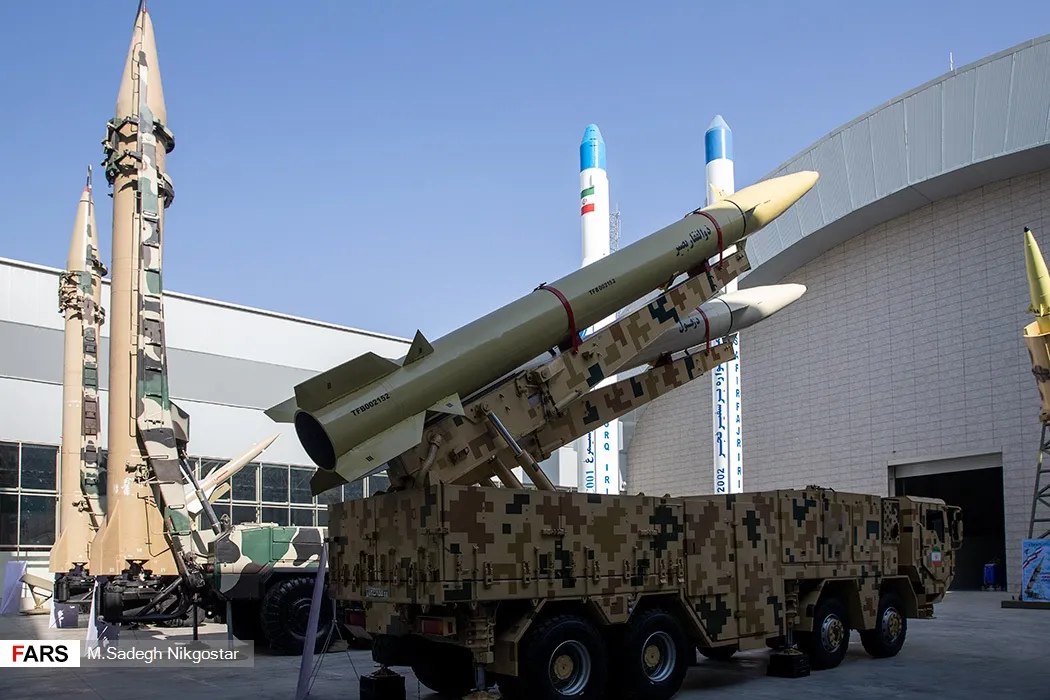
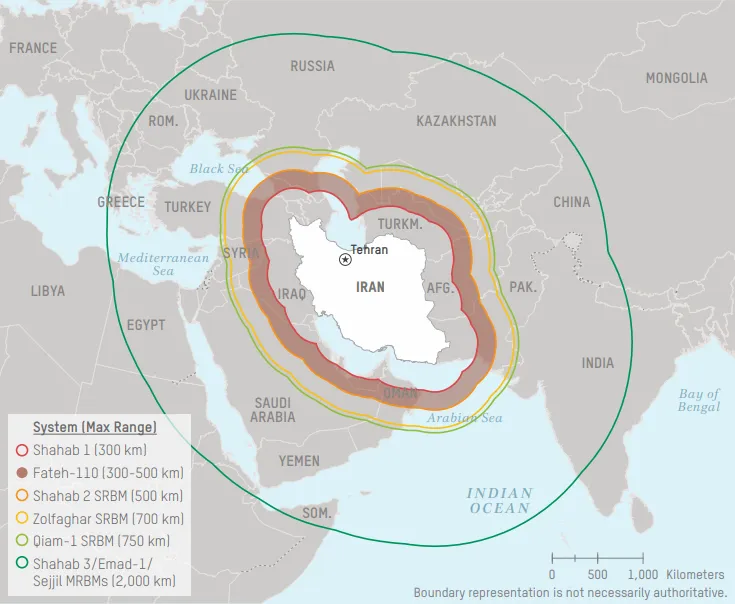
Iranian ballistic missiles comprise Iran's short- and medium-range strike families, from Scud-derived Shahab and Qiam liquid-fuel systems to solid-fuel Fateh, Zolfaghar, Kheibar Shekan, Fattah, and Sejjil lines. Public references describe a mostly road-mobile force with ranges from a few hundred kilometers to about 2,000 km or more, improved precision and reentry-vehicle work, and repeated direct use in regional conflicts.
Iran used ballistic missiles, drones, and artillery against Iranian Kurdish opposition groups in northern Iraq during the September-November 2022 strike campaign.
Iran used ballistic missiles in direct U.S.-Iran exchanges, including attacks on U.S.-used bases in Iraq in January 2020, Al-Udeid Air Base in Qatar on June 23, 2025, and missiles fired toward Kuwait and Bahrain on June 5, 2026; public releases did not identify the exact 2025 or 2026 missile models.
Iran launched medium-range ballistic missiles as part of the April 13-14, 2024 attack on Israel; U.S. defense reporting counted more than 110 medium-range ballistic missiles among the airborne weapons.
Iran launched waves of ballistic missiles against Israel during the June 2025 Israel-Iran conflict; public summaries usually identify the weapon class rather than every missile model.
Iran fired ballistic missiles during the 2026 Iran War, including seven missiles toward Kuwait and Bahrain on June 5, 2026; CENTCOM reported six interceptions and one missile failing to reach its target, without naming exact missile models.
Iran's ballistic-missile inventory is better read as overlapping families rather than one linear model series: Scud-derived Shahab and Qiam systems, solid-fuel Fateh and Zolfaghar descendants, Shahab-3/Ghadr/Emad medium-range systems, and larger Sejjil and Khorramshahr designs.
| Variant | Configuration | Designation notes |
|---|---|---|
 | Solid-fuel SRBM family base | CSIS lists Fateh-110 as a road-mobile Iranian SRBM and Iran Watch treats later solid-fuel systems as part of Iran's move toward faster-launching, more survivable missiles. Sources: Fateh-110 | Missile Threat - CSIS, Iran Watch Table of Iran's Missile Arsenal |
 | Extended-range Fateh derivative | CSIS lists Fateh-313 among Iran's operational ballistic missiles and the catalog treats it as an extended Fateh-family derivative. Sources: Missiles of Iran |
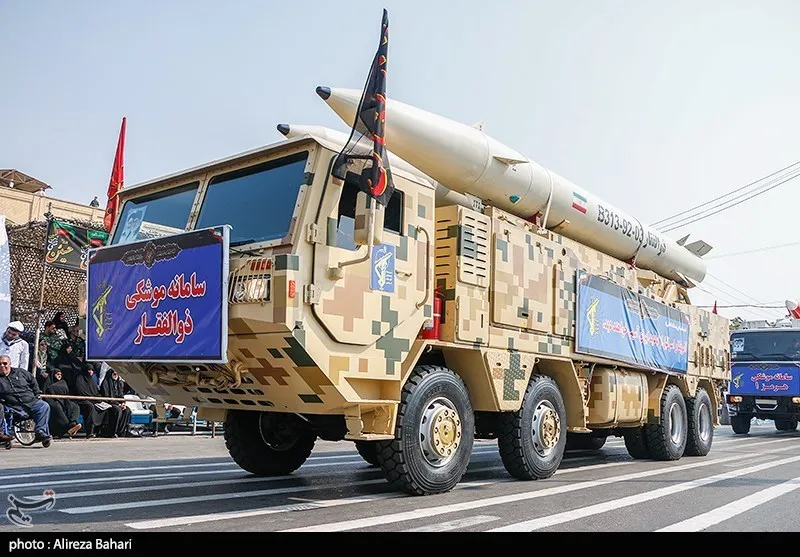
 | Longer-range Fateh-family SRBM | CSIS groups Dezful and Qasem under the Zolfaghar family and lists the line as solid-fueled and road-mobile. |
 | Qasem/Haj Qasem longer-range Fateh-family derivative | Cataloged Haj Qasem sources place it in the extended Fateh/Zolfaghar design line with a reported 1,400 km class range. |
 | Liquid-fuel SRBM | CSIS describes Qiam-1 as a Shahab-2-derived Iranian SRBM with a separating warhead and road-mobile basing. Sources: Qiam-1 | Missile Threat - CSIS |
 | Modified Qiam with reentry-vehicle changes | Iran Watch notes that independent analysts call the modified Qiam-1 Qiam-2 and link it to improved reentry-vehicle performance. |
 | Scud-C/Shahab-2 lineage | The Shahab and Qiam branch represents Iran's older liquid-fuel Scud-derived missile line. Sources: Qiam-1 | Missile Threat - CSIS |
 | Shahab-3 variant family | CSIS lists Ghadr-1 and Emad as Shahab-3 variants in Iran's MRBM inventory. Sources: Missiles of Iran |
 | Two-stage solid-propellant MRBM | CSIS lists Sejjil as an Iranian medium-range ballistic missile with a 2,000 km class range. Sources: Missiles of Iran |
 | Solid-fuel MRBM | Iran Watch includes Kheibar Shekan among Iran's solid-propellant ballistic-missile systems. |
 | Maneuvering reentry-vehicle ballistic missile | Iran Watch describes Fattah-1 as a ballistic missile with a solid booster and a maneuvering reentry-vehicle motor rather than a conventional hypersonic-glide system. |
| Khorramshahr | Liquid-fuel MRBM | CSIS describes Khorramshahr as a road-mobile Iranian MRBM likely derived from the North Korean Musudan/BM-25, with a heavy payload and reported 2,000-3,000 km range. Sources: Khorramshahr | Missile Threat - CSIS |
Some Iranian ballistic-missile families are described in public references as able to carry submunition or cluster-style warheads.
| Carried item | Item type | Carriage evidence |
|---|---|---|
 | Cluster-munition warhead | CSIS describes Khorramshahr as an Iranian medium-range ballistic missile whose claimed multiple-warhead capability most likely refers to a submunitions warhead. Sources: Khorramshahr | Missile Threat - CSIS |
Open references group Iran's ballistic missiles by overlapping technology lineages rather than by one official family tree. The catalog links below separate the broad family page from named missile records where public sourcing is strong enough.
Older liquid-fuel missiles include Shahab and Qiam systems, with Qiam described as a Shahab-2 derivative and modified Qiam versions assessed with improved reentry-vehicle behavior.
Solid-fuel road-mobile designs include Fateh-110, Fateh-313, Zolfaghar, and longer-range descendants such as Haj Qasem.
The medium-range branch includes Ghadr/Qadr, Sejjil, Kheibar Shekan, Fattah-1, and Khorramshahr, with public sources mixing official claims and outside estimates.
CSIS says Iran sought greater standoff strike capability during the Iran-Iraq War and acquired Scud-B missiles and related launcher technology in the mid-1980s.
Sources: Shahab-1 (Scud B-Variant) | Missile Threat - CSIS
CSIS records Iranian missile combat use in June 2017 against Islamic State targets near Deir ez-Zor, one of several regional missile operations before the U.S.-Iran and Israel-Iran exchanges cataloged here.
Sources: Missiles of Iran
The Defense Department said Iran launched more than a dozen ballistic missiles against U.S. military and coalition forces at Al-Asad and Irbil after the U.S. killing of Qassem Soleimani.
Sources: DOD Iranian Ballistic Missile Attacks in Iraq
U.S. defense reporting counted more than 110 medium-range ballistic missiles among the weapons launched from Iran, Syria, and Yemen at Israel during the April 2024 exchange.
Sources: DOD Iran Airborne Attacks Against Israel
CRS reported that Iran retaliated against Israel's June 2025 operation by launching waves of ballistic missiles against Israel.
Sources: CRS 2025 Israel-Iran Conflict
CENTCOM said U.S. and Qatari forces defeated an Iranian ballistic-missile attack on Qatar's Al-Udeid Air Base with Patriot batteries.
Sources: CENTCOM Al-Udeid Defense
CENTCOM said Iran fired seven ballistic missiles toward Kuwait and Bahrain, with six intercepted and one failing to reach its target.
Sources: CENTCOM Forces Defeat Missiles, Drones Launched by Iran