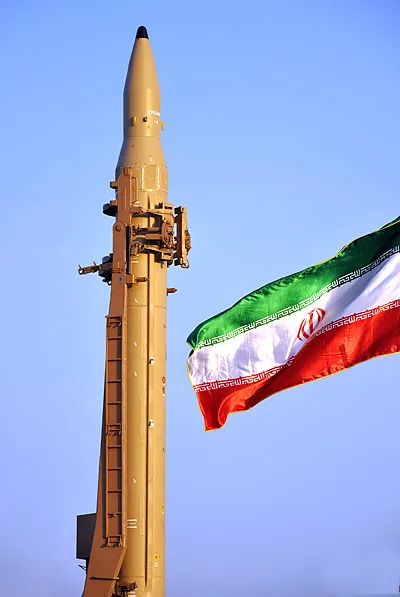

Used by Iran during the 2011 Syrian Civil War in the October 1, 2018 missile strike toward Islamic State targets near Al Bukamal; CSIS describes up to two of the six missiles as Qiam-2, while IISS lists the system as an upgraded Qiam.
Role detailsArtillery
Qiam-2 ballistic missile
Also known as
- Qiam-1 mod.
- Qiam-1 modified
- Modified Qiam
- Upgraded Qiam
- Qiam-2?
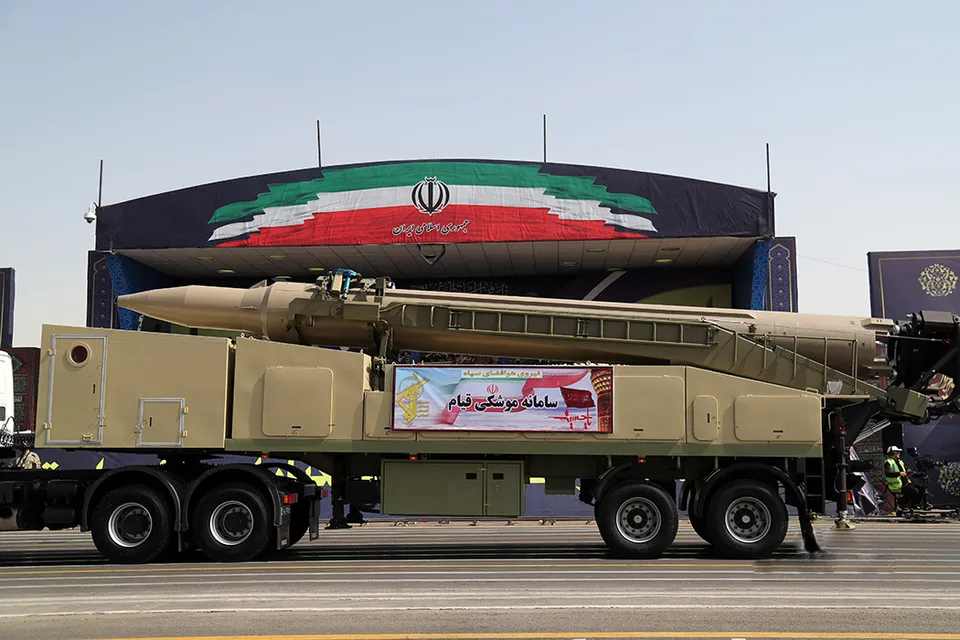
Qiam-2 is an analyst designation for an upgraded Iranian Qiam short-range ballistic missile with a revised reentry section, road-mobile launch configuration, and improved accuracy. Open-source references tie the modified missile to Iran's October 2018 Al Bukamal strike in Syria and the January 2020 Ain al-Asad strike in Iraq, while noting that Qiam-2 is not an official Iranian designation.
Role in Conflicts
- Side
- Iran
- Role in conflict
- Retaliatory ballistic-missile strike

Used by Iran in the 2020 United States-Iran Conflict during the January 2020 Ain al-Asad strike; open-source reporting describes the missiles as modified Qiams and treats the exact Qiam-2 attribution as analyst-assigned.
Profile / Specs
Profile
- Origin
- Iran
- Type
- Short-range ballistic missile
- Service note
- 2018-present
- Designer
- Aerospace Industries Organization
- Designed
- Late 2010s
- Unit cost
- Not publicly disclosed
- Produced
- Late 2010s-present
- Number built
- Not publicly disclosed
Specifications
- Range
- About 800 km in open-source references for the Qiam family and modified variant.
- Payload
- About 500 kg conventional warhead class.
- Propulsion
- Single-stage liquid propellant.
- Basing
- Road-mobile transporter-erector-launcher.
- Guidance
- Separating warhead with small movable fins on the reentry section and improved accuracy over earlier Qiam versions.
- Accuracy
- IISS lists about 100 m CEP for the Qiam-1 mod. / Qiam-2 configuration.
Variants
Qiam-2 is best treated as a Qiam-family analyst label rather than a clearly published Iranian model name.
| Variant | Configuration | Designation notes |
|---|---|---|
 | Baseline and modified Qiam family record | CSIS describes Qiam-1 as the finless Iranian SRBM family; Iran Watch and IISS treat the modified Qiam-1, sometimes called Qiam-2 by analysts, as a later upgraded configuration. Sources: CSIS Qiam-1 Missile Threat, Iran Watch Missile Arsenal Table, IISS Open-Source Missile Analysis |
 | Qiam-derived Houthi designation | CSIS and IISS describe Burkan-2H as a Qiam-1-derived missile line used by Houthi forces, making it a related Qiam-family branch rather than an Iranian Qiam-2 designation. Sources: CSIS Qiam-1 Missile Threat, IISS Open-Source Missile Analysis |
Timeline
Qiam-2 ballistic missile Key Events
Upgraded Qiam configuration reported
CSIS says Iran displayed a Qiam-2 variant with four fins at the base and four smaller moving fins on the reentry vehicle.
Sources: CSIS Qiam-1 Missile Threat
Strike toward Al Bukamal
CSIS says Iran launched up to two Qiam-2 missiles, along with Zolfaghar missiles, toward Islamic State targets near Al Bukamal in Syria; IISS describes the strike package as including upgraded Qiams.
Sources: CSIS Qiam-1 Missile Threat, IISS Open-Source Missile Analysis
Ain al-Asad strike
IISS and FRS identify modified Qiam/Qiam-2 missiles in Iran's retaliatory strike on Ain al-Asad Air Base in Iraq, with IISS listing an estimated 800 km range and about 100 m CEP for the modified Qiam.
Sources: IISS Open-Source Missile Analysis, FRS El-Asad Imagery Analysis
Designation And Documented Strikes
The public record for Qiam-2 is mostly built from external analysis, so the page treats the name as an analyst designation for an upgraded Qiam rather than as a confirmed Iranian service name.
| Topic | Source-backed detail |
|---|---|
| Designation | Iran Watch says some independent analysts call the modified Qiam-1 Qiam-2, but it has not been publicly confirmed by official Iranian sources. |
| Visible changes | CSIS describes the displayed Qiam-2 configuration with four fins at the base and four smaller moving fins on the reentry vehicle. |
| 2018 Syria strike | CSIS reports up to two Qiam-2 missiles in Iran's six-missile strike toward Islamic State targets near Al Bukamal; IISS describes the missiles as upgraded Qiams. |
| 2020 Iraq strike | IISS and FRS identify modified Qiam or Qiam-2 missiles among the weapons used against Ain al-Asad Air Base after the killing of Qassem Soleimani. |
Media
Related Weapon Systems


Sources
CSIS Qiam-1 Missile ThreatPublisher: CSIS Missile Threat | Note: 2011 Syrian Civil War: used by Iran in the October 1, 2018 strike toward Islamic State targets near Al Bukamal, with CSIS describing up to two of the six missiles as Qiam-2; also supports baseline Qiam design, range class, liquid propulsion, visible Qiam-2 fin changes, and Qiam-family background. | Accessed: 2026-06-29Iran Watch Missile Arsenal TablePublisher: Wisconsin Project on Nuclear Arms Control | Note: Supports the Qiam-family background and the note that the modified Qiam-1 has been called Qiam-2 by some independent analysts, but not by official Iranian sources. | Accessed: 2026-06-29IISS Open-Source Missile AnalysisPublisher: International Institute for Strategic Studies | Note: 2011 Syrian Civil War: used by Iran in the October 1, 2018 Al Bukamal strike package as upgraded Qiams; 2020 United States-Iran Conflict: modified Qiam used by Iran in the January 2020 Ain al-Asad attack; the paper's table lists the system as Qiam-1 mod. (Qiam-2?) with an 800 km range and about 100 m CEP. | Accessed: 2026-06-29FRS El-Asad Imagery AnalysisPublisher: Fondation pour la Recherche Strategique | Note: 2020 United States-Iran Conflict: identifies Qiam-2 missiles in Iran's January 2020 strike against Ain al-Asad Air Base and supports the site-level impact context used in the timeline. | Accessed: 2026-06-29MDAA Iran Missile OverviewPublisher: Missile Defense Advocacy Alliance | Note: 2020 United States-Iran Conflict: modified Qiams used by Iran in the January 2020 Ain al-Asad strike during the conflict. | Accessed: 2026-06-29Qiam-1 (09) - Wikimedia CommonsPublisher: Wikimedia Commons | Note: Wikimedia Commons file page for the primary Qiam launch image and its licensing context. | Accessed: 2026-06-292019 Sacred Defence Week parade (343) - Wikimedia CommonsPublisher: Wikimedia Commons | Note: Wikimedia Commons file page for a parade image showing the missile in display context and its licensing context. | Accessed: 2026-06-29Sejil 2 and qiam at tehran exhibition 2012 - Wikimedia CommonsPublisher: Wikimedia Commons | Note: Wikimedia Commons file page for the exhibition image and its licensing context. | Accessed: 2026-06-29